Silicon Valley Technology Commentary & Archives · Est. 2006 3,032 Posts · 2006–2026

March 30, 2009

March 30, 2009 · 4 MIN READ · BY LOUIS GRAY

10 People To Follow On FriendFeed For The Month Of March

10 People To Follow On FriendFeed For The Month Of March

My tag team partner in crime, Mike Fruchter, who I hope will be returning to top speed once again soon, is still letting real life trump his online activities, so I'm pinch hitting in a vital role, with his permission, highlighting ten well-deserving FriendFeed users who bring consistently interesting items to the fore. This month's batch, as with others, highlights people you may already know, and some lesser-known but equally as deserving folks who have so far hidden from the limelight.

Previous FriendFeed members to follow lists, largely driven by Mike, can be found for the 2008 months of, July, September, November and December. The 2009 lists can be found for January and February.

Apologies for the lateness in the month... on with the list for March!

1) RAPatton

Short Bio: Robert Patton, an Ohio native, is a software architect and senior consultant at Optimum Technology, who can claim search engine design and e-commerce application development to his credit. He has a degree in computer science from Ohio State University, and is a father of two. A frequent sharer of items from UK-based publications, including the BBC, The Independent, the Daily Mail and The Telegraph, Robert, uncovers stories of interest to the community, well outside of the technology space, including updates on astronomy, health and Hollywood.

What they find interesting: Entertainment, News, Science

FriendFeed: Subscribe

2) Thomas Hawk

Short Bio: Thomas Hawk is the CEO of Zooomr, Inc., and is among the tech Web's most visible photographers. An East Bay resident, he is a popular blogger in his own right, and recently covered Oakland residents' violent response to a policeman's slaying of a youth at a BART station earlier this year - an incident predating this weekend's slayings of four police officers in the city. Thomas is widely considered an expert in photography in Silicon Valley and counts Robert Scoble as one of his proteges. (The two are pictured here with Chris Pirillo)

What they find interesting: Photography, Business

FriendFeed: Subscribe | Blog: Subscribe

3) Akiva Moskovitz

Short Bio: A recent father to a two and a half month old daughter, Akiva is the male half of the popular FriendFeed couple, including his wife, Rochelle. In addition to the updates on Audrey, who just so happens to share many of the same characteristics we like about our daughter, Sarah, you can see Akiva's comments on religion, technology and entertainment.

What they find interesting: Family, Photography

FriendFeed: Subscribe | Blog: Subscribe

4) Daniel Brusilovsky

Short Bio: Daniel Brusilovsky is the founder and CEO of Teens In Tech, a social media platform and community for teens, and a contributor to multiple Apple Macintosh projects, including the Apple Universe Podcast and MacMegasite. Daniel's young age shouldn't mask a deep interest and involvement in technology development and the startup culture - as he clearly displays excitement about meetings with entrepreneurs and seeing startups gain new rounds of capital.

What they find interesting: Technology, Social Media, Startups

FriendFeed: Subscribe | Blog: Subscribe

5) Bindu Reddy

Short Bio: Bindu is the founder of Likaholix, which shares many aspects of content discovery as FriendFeed does. Previous to Likaholix, Bindu was the head of product management for Google Docs and Sites, and was the first product manager at JotSpot. A graduate of the Indian Institute of Technology in Bombay, Bindu also collected a Masters degree in Engineering from Dartmouth College.

What they find interesting: Music, Food, Technology

FriendFeed: Subscribe | Blog: Subscribe

6) Kevin Fox

Short Bio: Kevin Fox runs the design at FriendFeed, and previously worked at Google, bringing to life many of the applications you frequently use, including Google Reader and GMail. He also spent some time at Yahoo!, and long ago, wrote for the since passed on MacWeek magazine.

What they find interesting: Google, Technology, Travel, Politics, Photography

FriendFeed: Subscribe | Blog: Subscribe

7) Steve Rubel

Short Bio: Steve Rubel is a director at Edelman Digital, a worldwide public relations company. His Micro Persuasion blog, launched in 2004, is among the most cited in Marketing and PR departments when looking at social media trends. Prior to Edelman, Rubel worked at CooperKatz and company.

What they find interesting: Marketing, PR, Technology, Social Media

FriendFeed: Subscribe | Blog: Subscribe

8) Josh Haley

Short Bio: Josh Haley describes himself as a computer geek and music freak. He and his wife, Trish, design branded items, including clothing, in Houston, Texas. Josh is a University of Hawaii graduate, and one of the three leaders of a popular podcast called "FFundercats".

What they find interesting: Humor, Food, Family

FriendFeed: Subscribe

9) Stephen Foskett

Short Bio: Stephen Foskett is a technolgy analyst and IT consultant based in Ohio, who focuses primarily on storage and networking. He is a Microsoft MVP and contributes to multiple technology blogs and magazines.

What they find interesting: Cloud computing, storage, Apple, Sports

FriendFeed: Subscribe | Blog: Subscribe

10) Erin Kotecki Vest

Short Bio: Erin is the Producer of Special Projects for BlogHer.com, and is a contributor to the Huffington Post. She previously spent ten years as a broadcast journalist in Los Angeles, Orlando and Detroit, and was a staunch Obama supporter during his campaign. She has two children.

What they find interesting: Politics, Technology, Women's Issues, Humor

FriendFeed: Subscribe | Blog: Subscribe

March 29, 2009

March 29, 2009 · 2 MIN READ · BY LOUIS GRAY

iPhones Can Protect Your Warcraft Account, and Someday Much More

iPhones Can Protect Your Warcraft Account, and Someday Much More

By Daniel J. Pritchett of Sharing at Work (FriendFeed/Twitter)

Two recent iPhone stories highlight some interesting potential for Apple's iPhone and iPod family.  First up is WoW Insider's announcement of a free iPhone Authenticator available in the app store for securing World of Warcraft accounts.  A Battle.net user is typically a World of Warcraft player but the accounts can be tied to any Blizzard game you might own, including their future releases.

As shown in the screen shot on the left, the Authenticator program generates a new string of numbers once every minute or so.  Once a player links the authenticator to an account, these numbers must be supplied along with a user name and password at each login — a two-factor authentication challenge.  This iPhone app is an alternative to the existing solution where gamers can pay Blizzard $7 for a key fob that generates a similar passkey every time its button is pushed.

World of Warcraft characters and items are regularly hijacked via targeted trojans and keyloggers.  They can be stripped bare in a matter of minutes, their contents flipped quickly for tens or even hundreds of dollars on WoW's thriving grey market.  Given the time and effort involved in securing an account rollback from Blizzard customer service, many players will opt for the peace of mind granted them by this new application.

The next iPhone may read fingerprints and retinas

The second tidbit comes from Apple Insider (via Engadget): An Apple patent filling hints at fingerprint and retina scanning potential in future iPhones. Apple is researching the potential for embedding biometric scanning devices (cameras, etc.) behind the touch screen of an iPhone.  Such enhanced iPhones would allow for secure identification in order to unlock the phone itself.  These enhancements would also allow the iPhone to serve as an easily obtainable high-powered authenticator for other systems such as Blizzard's Battle.net.  While we might only imagine such tools as being necessary for sensitive operations like banking or remote logins to corporate intranets, the Blizzard app demonstrates that it can be cost effective to secure our less critical digital holdings.

The Blizzard authenticator is a great example of high-powered security applications that the iPhone family can provide right now, and the recent patent filing by Apple gives us insight into other uses for tomorrow's iPhone.  We'll certainly have the mobile available as an ever-more-secure authentication tool, but we'll also be able to use it as a remote sensor for home and office medical purposes such as the recently promised glucose monitor or a biometrically secured retail barcode scanner.  There are undoubtedly more possibilities than I can come up with on my own, and I look forward to seeing some of them becoming reality in the near future.  If you've got a great example of alternate uses for mobile phones, please share it in a comment!

Read more by Daniel J. Pritchett at Sharing at Work

March 28, 2009

March 28, 2009 · 3 MIN READ · BY LOUIS GRAY

Britney Spears Passes Obama for Most Followed Human on Twitter

Britney Spears Passes Obama for Most Followed Human on Twitter

This evening, around 8:25 p.m. Pacific Time, pop star Britney Spears passed President Barack Obama for the most popular Twitter account representing an individual (Both trail CNN Breaking News). While Spears joined Twitter relatively recently, only 6 months ago, to Obama's more than two years ago, the diva and those who help manage her online presence have shot to the top of the rankings, as Twitter has moved out of the geek sphere and into the mainstream. Not surprisingly, she and Obama are trailed by other "real world" celebrities like Ashton Kutcher (#4 overall), Jimmy Fallon (#6) and Shaquille O'Neal (#7).
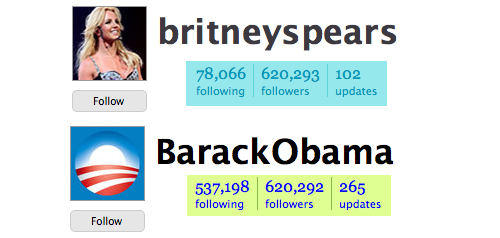

As of 8:25 p.m. Pacific time on Saturday, @britneyspears topped @barackobama.

Both Spears and Obama have more than 620,000 followers as of tonight, following Britney's passing of Barack.

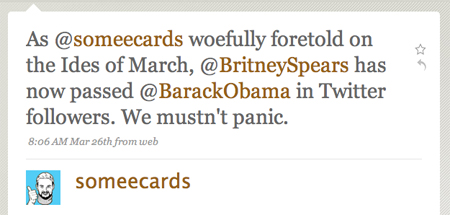
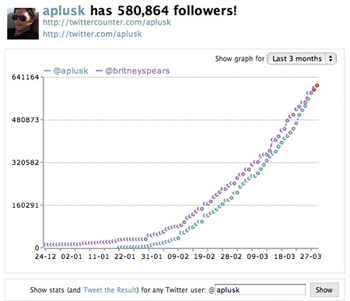
Note: Previous reports from sites like WeFollow, TwitterHolic and TwitterCounter were incorrect, as Obama's following statistics were undercounted by almost 50,000, stuck at 571,885 for some reason. (See some premature notes of Spears passing Obama on Twitter Search and a tweet by someecards to that effect.)


@someecards was premature, but on target.

Earlier this week, sparked by a New York Times story, Spears' account, as well as others, were highlighted as being operated by "ghost writers" - sparking outrage from some corners of the Web who thought they were authentic. Guy Kawasaki, who admitted to letting others tweet on his behalf, said he managed all direct messages and replies, while others were able to post links. But Spears' account was never really a secret - offering some transparency to the process. In December, you can recall an interview by Jesse Stay with Lauren Kozak, her social media director, that discussed how the account operated.

As she said then:
"Yes, we do get Twitters directly from Britney. We also get Twitters directly from Britney's Entourage. We provide announcement and tour information. We also have messages which are designed to drive traffic around Britney Spears' properties when we have something cool go on."
Ghost writers or not, the account has gained significant visibility and popularity - despite only adding a tweet about once a day. Of course, in contrast, Obama has only posted an update once since his swearing in on January 20th.

As Twitter grows, you can see the growth in the pair's audiences. Refreshing either's page will show a few dozen followers joining each minute, though Britney is increasing hers at a more dramatic rate.

The Spears and Obama teams operate differently when it comes to Twitter, not just in terms of frequency of their updates, but in how they follow back. Obama's account follows more than half a million, with 60,000 or so not being followed, for whatever reason. Spears' account, in comparison, follows fewer than 80,000. Of course, it doesn't exactly seem possible that either user, or their handlers, is really paying attention to the updates from fans - as the numbers are astronomical, and they probably have other priorities.

It's not clear if Britney can maintain the top spot for long. Kutcher joined Twitter in January, and his account is rapidly gaining, showing more than 583,000 followers as of 7:30 Pacific time this evening. At the current pace, it may be he, and not Britney, who tops the followers chart.


Ashton is Looking to Pass Britney Soon

Oh... and for the record, I don't follow any of these accounts, so my own data did not contribute.
March 28, 2009 · 5 MIN READ · BY LOUIS GRAY

10 Business Models to Monetize Web Applications

10 Business Models to Monetize Web Applications

By Rob Diana of Regular Geek (Twitter/FriendFeed)

During my morning reading, The Long Tail had a link to a survey of Web app business models. If you take a look at the charts listing the revenue models, you will see there are twenty models listed. However, that is not an exhaustive list of ways to make money. Some of the models, such as Fixed and Variable Subscriptions, have several "implementations" that you can attempt.

Having said this, why is it that monetization is so hard for many Web 2.0 applications? Let's look at what needs to be done to support the various business models.

Subscriptions

1. Fixed subscriptions are a simple concept where people pay monthly fee for a product or service. Typically, you can charge for removing advertisements or some level of premium features. The problems with fixed subscriptions are that you need to create a subscription payment system and you need something to charge for. The first issue can be rectified by integrating with something like PayPal. The second issue is what most sites have difficulty with, what do you charge for? Premium content or features are much harder to find as you want to ensure you can build as large an audience as possible. Premium features need to be really interesting, and generally not available for free elsewhere.

2. Variable subscriptions are much more interesting. These are things like charging for use of an API or data feed. These are difficult as it requires a large amount of tracking application usage, and the pricing plans are more difficult to administer. Again, there are the questions of whether your services are generally available for free or even that useful.

Third Party Support

3. Advertising is the most common form of third party support. However, most Web applications are not launching with advertisements, which I think is a mistake. Google AdSense may not help you make millions, but maybe it offsets the costs a little bit and it opens up opportunities for real advertisements in the future.

4. Sponsor is a glorified word for really nice advertiser. A sponsor typically has a permanent advertisement on the site. These are nice, but it typically requires a decent amount of traffic in order to attract one.

5. Paid content is the black sheep of third party support and generally vilified by bloggers. The amount of negative publicity that you could receive from paid content may not be worth the money, especially if your site is still young. I would definitely recommend against this unless you are an established blogger and can easily defend your position.

Products And Pay-Per-Use

6. Products and Pay-Per-Use are probably the hardest monetization models to use. Do you have a physical product or virtual product that you can sell? Are people even willing to buy your product? Products typically require a significant amount of capital to develop or purchase, so your costs are generally high as well. Pay-per-use models are also difficult to develop. PayPal is an excellent example, where they charge transaction fees for each transaction. Just like the variable subscriptions, tracking of application usage can be difficult and for transaction fees, there is a large amount of financial work involved. Most technical people do not have significant financial background, so there is a large knowledge obstacle to overcome.

Services

7. Branding tends to be a side effect of what you have tried to do with your application. However, there is good money to be made from consulting and speaking engagements. This is an interesting option, but it tends to be more of a personal option as opposed to monetizing your application directly.

8. Create a platform. This is part of the model for the iPhone. You can charge developers for the development kit. This is immensely difficult to do because your platform must be hugely popular. Twitter is becoming a platform, but has been so open with their API that they would have difficulty charging people at this point. With this option, you should start charging immediately when it is released.

9. Affiliate sales are also an interesting option and do not require a huge amount of initial work. The difficulty with affiliate sales is that you still have to create something that is worth buying. I would also think that the amount of revenue possible from affiliate sales is smaller than most people creating Web applications would want. Granted, I do not have experience with this model, but you are sharing revenue with the people who are your affiliates. You could create a larger sales network in this way, but people would have to want to sell your product.

10. White label services do not appear very often for some reason. This is similar to the platform model, but the difference is that your software is not obviously at the forefront of the product. Ning is the most widely known option in the social network space, but there is a significant amount of competition. This model also requires some portion of other models as well. Ning has fixed monthly subscriptions as well as variable usage subscriptions. You could avoid mixing models by charging a larger fee for the initial creation of the white label service, but a larger initial payment will also scare potential buyers away.

Obviously, this list is not complete, but these basic models can be implemented or even integrated into most applications. I have avoided the "holy grail" of internet applications, selling the entire startup, as there is no direct way to implement this. It is also ridiculously difficult to survive without any monetization and be purchased for a decent amount of money. Most potential acquirers would like to see some semblance of revenue and potential revenue before buying something. It does help to be the hot application in the hot industry, i.e. YouTube or Twitter, but there are very few opportunities to do that and there will be tons of competition.

Read more by Rob Diana at RegularGeek.com.