Silicon Valley Technology Commentary & Archives · Est. 2006 3,045 Posts · 2006–2026

November 29, 2010

November 29, 2010 · 6 MIN READ · BY LOUIS GRAY

Unfriending, Unfollowing, Unsubscribing... Less Is More

Unfriending, Unfollowing, Unsubscribing... Less Is More

The world of social media and networking is much too consumed with numbers, and it seems at times, we are making sacrifices of our time and energy wading through piles of noise and indirect relationships in an effort to obtain the rare connections of serendipity that bring us value.

In the past year, my position on connections in all these networks and with all these people vying for a piece of attention has changed - from an open networking approach, to one much more tidy, and it is constantly being refined. I've had it with seeing the streams where I spend a lot of time overwhelmed by strangers and off-topic behavior, and continue to take steps to improve the experience. Lately, I've resorted to seeing my numbers go in the reverse direction - fewer connections, fewer subscriptions and fewer services.

It's often said "he with the most names wins", but while that may be true for a social network, it's not always true for an individual. You are not a social network. You are just one point in that network.

A year ago, I said to jump on the massive unfollowing trend would be a mistake. At the time, I was following more than 12,000 people on Twitter, and that number eventually climbed to more than 14,000. Similarly, as I accepted connections on Facebook to all who wanted in, that pile of flesh grew to more than 2,000 - not near the network's famous 5,000 limit, but enough that if I ever looked at the "Recent News" feed, I was unlikely to know most of the folks.

What's changed in the last year for me is that I have had to adjust and spend more time on those two networks in particular, making them central points for engagement and discovery. With that post being written on August 6 of 2009, FriendFeed's acquisition by Facebook happened 4 days later, putting the once-vibrant community into practical mummification, making its centricity for my own activity dramatically less useful.

Additionally, more and more services are launching that enable the portability of one's social graph from site to site. For every new service I try, I can automatically discover who else I am already linked to, and get the chance to add them to my network. As others do the same, this increases the volume of service notifications by e-mail, and consequently, the number of updates on each site is proportional to your social graph at the source hubs - usually Facebook, Twitter and Google. Therefore, a reduction of people on any or all of those three services reduces the noise in all other places.

When Facebook launched their new messaging platform two weeks ago, putting an emphasis on the friends in the site having access to your in box, I started to have second thoughts about all these random people I'd blindly said yes to in the last couple years. For every great person who I would meet in the future and learn from, there were others trying to invite me to events and groups that were a waste of time, or whose updates were never catching my eye. So I took the opportunity to get out of the mess I had created.

Thankfully, Facebook has made the process of disconnecting much easier of late. Under the friends tab of the site, you can click "Edit". Sort by All Friends, and you can start to remove folks 1 by 1 with the little x to the right until your feeds are clean again.

In a bloody swoop, I cut more than 1,200 people on the site this way on the 15th, going from 2200+ to less than 1,000. Does this mean fewer people will see my blog posts, my photos or my status updates? Sure. But the benefits are that I know who I am engaging with and the quality of the site has improved a great deal. Before this move, I could only get a good Facebook experience through my6sense.

Unfollowing by Source in SocialToo Cleaned Up My Twitter Stream

For Twitter, the work was a little harder, but doable. A few months ago, as discovered by Twittercism, I leveraged SocialToo, where I am an advisor. The first thing I did was whitelist hundreds of my favorite contacts in Twitter, to be sure I wouldn't drop them. Then, I set up content filters on the site to automatically unfollow all people who used any of the major Twitter platforms, like TwitterFeed, Ping.fm, TweetDeck, or even "Web". I left this brutal killer on for about 5 days, and saw the people I was following melt away from 14,000 to about 2,000. Then I stopped the bleeding and took out the noise one by one, to the point I follow just over 1,000 now. Of course, I had to refollow some innocents who were caught in the purge, but most have been fixed. While Twitter still is rough to read in real time (again, my6sense wins here), I am connected to real people I know - and their reshares of other folks' content get the best of the rest.

Twittercism Captured My Unfollowing Earlier This Year

That leaves two major repositories of content that I also have moved to thin, to reduce content overwhelming my available time. The first was to unsubscribe from services that I don't use. Despite my practical abandonment of some services, that didn't stop people from following me constantly. It's obvious the social graph synchronization with Twitter and Facebook means people aren't even looking at your content, even if you think they are. So for the most egregious notification in box fillers, I just deleted my account. I started with GetGlue and Plaxo and may hit some more if things aren't dramatically improved. The other is in Google Reader. I'm notorious for reading a lot of RSS feeds, and still do, but Reader helpfully shows me just how many updates come from each source to clutter my daily reading. Contrasting the updates to shares I make shows me what I find valuable. For those where the noise ratio was too high, I have been cutting them one by one, and it's saving me hundreds of items a day. Bliss.

After some cuts, these are the top publishers (30 days of data) I read.

Twitter and Facebook hold more value for me in 2010 than they did in 2008. With their improved abilities to hide content by source, and to use lists, friend management has improved a great deal. Plus, they, in addition to Google Buzz and LinkedIn, are practically the only games in town for centralized discussions now. So rather than fight against the grain, it's made sense to make the sites a better experience for me.

There's no harm in letting people go. It's your right to unfollow and unsubscribe. It's their right to bring you value and deliver you a good experience so you don't disconnect. But if you're finding your streams a mess, take a deep breath and do something about it. I am glad I did.

Disclosure: I am VP of Marketing for my6sense, which has an app that supports Google Reader, Twitter, Facebook and Google Buzz, and sorts by personal relevancy. I am also an advisor to SocialToo.

November 29, 2010 · 1 MIN READ · BY LOUIS GRAY

Sparkbuy Launches Personalized Gadget Recommendations

Sparkbuy Launches Personalized Gadget Recommendations

With the 2010 Holiday shopping season officially kicking off today in what's commonly referred to as Cyber Monday, Sparkbuy is hoping to give consumers a boost in finding personalized consumer electronics gear, based on a deep database that started with thousands of laptops and plans to expand to TVs, mobile devices and more soon. The goal? Leveraging the big trend of personalization and recommendations per individual and applying it to shopping, beyond that found from popular sites like Amazon.com.

Sparkbuy promises customizable results based on users' specific needs, a large database of independent research, and unbiased product information, unswayed by vendor interests or store margins.

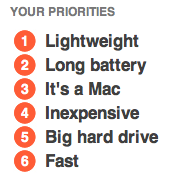
My Top Laptop Priorities on Sparkbuy

Users looking to find the best laptop for them can specific their top priorities, ordered by individual preference, including items such as "long battery", "inexpensive", "big hard drive", "high resolution", etc. For those of us Macolytes, selecting "It's a Mac" and making it a top priority gives us the best from Cupertino, hiding Asus, Dell and the rest from our view, less we end up on Windows.

Sparkbuy Recommended I go for a 13" MacBook Pro

If I Got Out of Mac Land, Sparkbuy Recommends ASUS

CEO Dan Shapiro compares Sparkbuy to popular travel search engine Kayak, and relayed his experience of buying an airplane ticket as giving him "the 'aha' moment" that pushed him to start building the site.

The talk is big, assuming the site fulfills its promise, with a deep product database and curtailing the offerings to what users are searching for. At launch, limited to only laptops, the current offering is an intriguing tease - especially for those of us just fine with our current laptop and not looking to upgrade.

If you want a boost in finding the best laptop for you, and think the database will come in handy for future products, you can get in with the code LOUIS-VIP at www.sparkbuy.com to register.

November 26, 2010

November 26, 2010 · 4 MIN READ · BY LOUIS GRAY

Apple's War On Android Escalates, But No Total War Yet

Apple's War On Android Escalates, But No Total War Yet


Apple's lock on the iTunes application store is legendary. In contrast to more "open" marketplaces that don't rely on centralized editorial control, iTunes applications are hand-reviewed by Apple employees, and the company controls what gets in and what gets out, what applications are featured, and can take weeks or even months to give your application the thumbs up. As the company's competition with Google and Android has escalated in the last year plus, we've heard stories of developers not being able to mention the alternative mobile OS in their products, and have seen those which are iPad-only getting significantly more play with Apple's marketing muscle. Today, headlines were made after one publisher's Android-centric magazine was blocked, not because of any rules infringement or legalities, but due to its content. The idea that Apple would start to police the subject matter of content in its store beyond its also-famous war on pornography, is eye opening and has many people wondering how much power the company intends to wield on the store. As of now, the ruling looks overreaching - and to be honest, it's also wildly inconsistent with existing content already available.

One major weakness for the iTunes review process is that it actually involves humans on both sides. That sounds silly, but it also gives Apple leeway if one rep overstepped his bounds, assuming that an Android-centric magazine would have no place on iTunes. It's easy to see a menacing Steve Jobs in the darkness pronouncing there is "one true phone" and that no others shall be mentioned, but it's just as likely it's a mistake. I hope it is, for the alternative is far more dramatic - one that spells an extremely unfriendly environment from a company that for the most part has its users fawning over its every move.

Curious to see how hard it was to find Android related content on iTunes, I looked around this evening, and while it's not easy to find, it's also not impossible, especially if you branch over to the iBooks section of the store.

Hey Look! A Magazine that Mentions Android on iTunes!

I even found a smartphone-centric magazine in the App Store that looks like it regularly features Android content and reviews. Smartphone Essentials Magazine uses Android as one of its keywords, and the application displays Android phones on some of its covers. If centering on Android is verboten, it looks like featuring it is just fine.

The iBooks section of the iTunes Store is overflowing with Android titles, highlighting Android apps marketing, Android application development and top apps on the Android platform for business, games and entertainment. There are books on free Android apps and wireless apps, reference apps and geeky guides. The simplest of these float for $2.99 apiece, while the developer tomes check in as high as $35.99.


Android Books Galore in the iBooks Section of iTunes


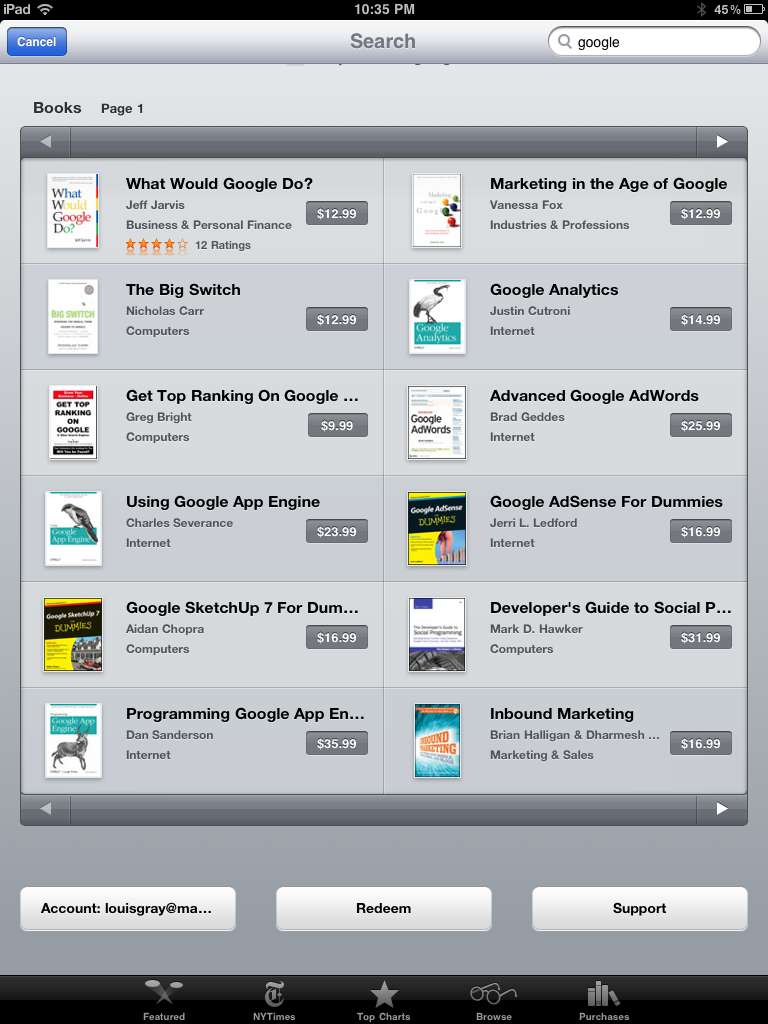
Staying in the iBooks section, and flipping the search from Android to Google also doesn't show the impact of mass censorship and whiting out of competition one could expect if Apple had escalated the war of words to an unprecedented level. The bookshelf shows "What Would Google Do?", "Marketing in the age of Google", and many more titles on analytics, ads and SEO.


What Would Google Do? Not Censor, Probably.


In the Android market, which doesn't have the notorious human filters to it iTunes does, searching for iPhone doesn't come up empty either. There's O'Reilly Media's Missing Manual, iPhone themes to skin Android, and more. Don't let the fact that less than 50 people have downloaded the missing manual fool you, it's there, even if it isn't very popular.


The Android Market Isn't Afraid of iPhone


Brutish bullheadedness on the part of Apple to try and force consumers, publishers and developers into a predefined world of what's acceptable and what's not fatigues my good will toward the company and the platform. The beauty of its apps, core OS and devices may be unmatched, but I fear they are on the brink of misusing their market position in a way that would raise fierce scrutiny if it was somebody else performing the evil deeds. The company should not expect its exclusionary behavior, if it is indeed true, to go unchecked, for even if it is not in a monopoly position, it is playing an unacceptable role with considerable market power. I cannot adhere to the belief that this company knows what is best for me and for all its customers every single time.

Apple and Google have an uncomfortable relationship now. Google's apps play a core role on the iPhone. Google search is the default engine on the iPhone and in Safari. But Apple is clearly threatened by Android and is squirming under the heat coming with the platform's market growth and feature creep that arguably brings it to near-parity in quality. That the iBooks section does not shy away from showing Android titles gives me hope that this ban is an exception to the rule and that we're not on a slippery slope that damages consumers and developers. Google would never remove Apple and Mac or iPhone results from their search engine, and the company helpfully offers Mac hardware to employees, and will keep doing so until some theoretical future where Chrome OS notebooks usurp that role.

As a businessperson, I get Apple doesn't want to help the enemy. I understand they are not a government entity, required to offer constitutionally-protected free speech. But I do not like the role they are playing as arbiters of morality and markets. The company has proven it can compete and do extremely well in offering high quality software and hardware in desktop and mobile, and should focus on marketing its own brand without its power to pretend alternatives exist.

Want to make customers forget about competition? Make something dramatically better and execute. None of this censorship garbage.

November 25, 2010

November 25, 2010 · 3 MIN READ · BY LOUIS GRAY

iPad Tablet Competition Reacting Fast, Expanding Market

iPad Tablet Competition Reacting Fast, Expanding Market


When Apple introduced the iPod, there were already a number of hard disk MP3 players out there. It wasn't clear to everyone that the move into this market was a good one for the company, and its initial sales didn't hint at the juggernaut it would later become. This was due in part to its Mac-only start, as well as its need for Firewire, but also due to needing to publicly define a market, improving upon the established competition and convincing the public that this product was a must have. Over time, the public got it in a big way, and the iPod became a cultural icon, selling nearly 300 million units. Later competition to the iPod from Dell, Microsoft and others was clunky, and sales were comparatively pathetic.

iPod Sales Growth by Year (Wikipedia)

When Apple introduced the iPad earlier this year, they were not the first tablet PC provider, but they set the standard again - helping to transition the market from a geeky niche to a consumer product millions are lusting over, just as they had done with the iPod. This time, however, it seems the competition is faster to respond, and with better quality peers - backed by able competitors, starting with the expanding variety of Android tablets including the Samsung Galaxy Tab and MotoPad, to BlackBerry's PlayBook, which are taking the iPad's queues in terms of appearance and functionality, and getting out there not years after the iPad, but only a few quarters.
The BlackBerry PlayBook

Regardless of your personal preference for Android or the iOS, it seems apparent that Apple will have a battle on its hands that is better coordinated, and on more fronts, than it did with the iPod. They don't have two years to slowly define the market and get the product right.

On Monday, it was announced that Samsung's Galaxy Tab had sold 600,000 units globally in the first month it was available. This contrasted with the iPad selling more than a million units in the same time period. Knee-jerk horse race focused reactions, like this one from VentureBeat said things like "So just a month in, the first model in a new series of Android-based tablet computers is already losing to Apple’s market-defining iPad."

It's a good thing markets aren't made in thirty days and that brands know better to ignore bloggers when it makes sense. If markets were made in thirty days, Apple should have walked away from the first generation iPod. And it's also a good thing this isn't a zero-sum game. There are going to be a lot of people who have room for Android tablets who didn't have room for iPads, and there are going to be others, like my house, no doubt, that will have both.

Apple CEO Steve Jobs roundly mocked the first Android tablet entrants to the market, saying their 7 inch screens would do them in, contrasted with the iPad's nearly 10 inches. But his comments smack more of preemptive market protection, as Apple no doubt plans to offer a family of iPads, as they have laptops and iPods for the last decade. As someone who has the Barnes and Noble NOOKColor, which has an Android foundation and one of those smaller screens, it's clear to me there is room for both. The NOOKColor review is for a later time, but there is absolutely a space for a tablet that can be held one-handed, and with the variety of Android manufacturers that are out there, there will no doubt be a variety of designs consumers can choose from - not a one size fits all strategy.

Apple is on quite a roll. There is no debate, really, with the stock at all-time highs and the company expanding its corporate offices in Cupertino, purchasing land from HP, and their product line is fantastic. But they cannot rest easy. The market is being defined, and a single month's sales are just that - a single month's worth of data.