Silicon Valley Technology Commentary & Archives · Est. 2006 3,045 Posts · 2006–2026

November 25, 2010

November 25, 2010 · 2 MIN READ · BY LOUIS GRAY

Less Informed Analysts Don't Serve the Public Good

Less Informed Analysts Don't Serve the Public Good

In the wake of the first dot com boom and subsequent crash, regulation swept through the financial industry, pushing a wedge between those who rated stocks and those who backed them, buckling down on insider information and weeding out a visible few who had not exactly acted with their clients' best interests in mind. With public trust in corporations further declining in the following few years with high-profile scams led by Enron, Worldcom and others, the federal government has played an increased role in watching what businesses can say at which times, both publicly and privately. What is released from companies now comes with lengthy SEC disclosures, authors routinely disclose their stock positions, and Sarbanes-Oxley compliance puts fear into the hearts of public and would-be public companies, to follow the rules - or else.

With this background came news earlier in the week that the SEC was looking into Apple stock analysts who had relied on connections with suppliers and manufacturers in the channel to help predict the company's sales projections. This broader definition of insider trading, if it becomes commonplace, nullifies some advantage and insight the analysts had, and reduces their value to customers.

While most of the SECs' moves in the last decade can be easily tracked to protecting investors from scams, conflicts of interest and pyramid schemes, I have to wonder what this type of move signals. Is the eventual goal to eliminate any real research and intelligence used in the community to level the playing field and make the professional analyst game one that more heavily relies on a gut feel and chart reading? Neither is an exact science.

Assuming the new guide to insider trading is to be adopted, the suggestion essentially means that financial analysts should not be briefed by company employees during the quarter, should not survey those selling the products, their partners or maybe even the customers themselves. The rarified times an analyst can talk with the execs would be limited to the short conference call Q&A periods that occur after each briefing. This would make the already imperfect industry one further removed from real data. Anybody can count numbers after they have been released, but few have proven true abilities to accurately guess a company's direction - and provide real data to customers who don't exactly do this for a living.

What I worry about is not that Apple investors (or others like them) are suddenly going to be in the dark because 1 or 2 guys get slapped on the wrist for chatting up resellers. What this leads to is a company running unchecked with no communication to the outside world, except for every 90 days when they emerge from their corporate offices and tell you how they actually did.

What we need as investors and market watchers is not less access to real data, but more access to information, which we can then use to make good decisions, or bad, based on what we know. There are already enough people out there guessing and writing and throwing stuff on the wall to see what sticks. This just will make it worse.

November 22, 2010

November 22, 2010 · 3 MIN READ · BY LOUIS GRAY

my6sense Adds Posting, Smart Widgets to Android App

my6sense Adds Posting, Smart Widgets to Android App

Following a humble start as a consumption-focused RSS reader on iTunes, my6sense has grown to become a versatile intersection of news and social, consumption and sharing. The app, available for both iOS and Android, pulls in streams from Facebook, Twitter and Google Buzz, and lets you share out to each of these networks. Today, the company, where I am VP of Marketing, issued the latest update for the fast-growing Android platform - bringing native posting to the aforementioned networks within the app, and a helpful widget that brings your top news to you on your Android device.
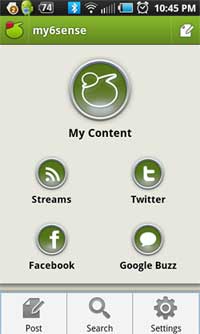
As you can imagine, creating an application that impacts social streams like Facebook, Twitter and Google Buzz presents its own challenges, as users start to expect the most advanced capabilities of native clients, such as TweetDeck and Seesmic. No sooner did we support these networks than did calls come for native replies, retweets, direct messages, likes and comments for each network. After knocking those off, the similar refrain continued as people wanted to update their status on the go directly from our app, instead of reading an update in our app and opening a second one to jump into the streams themselves.

So we listened.

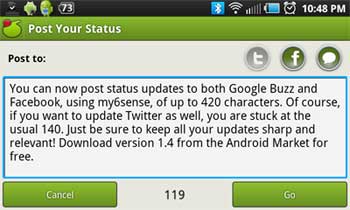
You can now Post to Your Networks in my6sense for Android.

Version 1.4 of the application, available free on the Android Market, has a "Post" button in the top right of all streams. And it's not limited to just one stream at a time, either. If you have connected your Facebook, Twitter and Buzz, you can post to any or each of the networks, much like the Seesmic-owned Ping.fm does. Of course, if you post to Twitter, the standard 140 character limit applies, and Facebook updates are similarly limited to 420 characters. That said, if you have a keyboard on your phone and you want to bang out War and Peace, point it at Google Buzz, and you can go as long as you like.

Posting to Facebook and Buzz Using my6sense

One of the benefits of building out a sharp app for the Android platform is customization of a widget for the app - unavailable on iOS. Familiar with widgets from other platforms, which tend to show the most recent update, chronologically, we wanted to leverage the strength of our service, bringing personalized top news to you - and more than one update. The widget, a stylish black, scrolls through your top messages and you can click the up or down arrows to find them yourself, without opening the app. Find the article you like and click through to read.

The my6sense Widget With Top Stories

my6sense's core focus is, and will be, on making sure the best content gets to you as an individual, and that you don't miss important updates. We're working on making this digital intuition available in more places, and with more partners. But we want to make this a versatile Swiss Army knife that lets you jump into the streams with both feet.

Brad of TheNextWeb, a great user and clear fan of the service, wrote about the updates, saying "my6sense for Android gets updates to take over as your social client of choice". Choice is a good thing. I will choose the smart apps that make me the most efficient. He also posted a great demo video you might like. If you are on Android and haven't already picked up the app, find it at http://bit.ly/m6sandroid.

Disclosure: I am VP of Marketing at my6sense.
November 22, 2010 · 2 MIN READ · BY LOUIS GRAY

Founders Moving On from Social Aggregator Cliqset

Founders Moving On from Social Aggregator Cliqset

Taking on Facebook, Twitter and Google in the fiercely competitive world of social networking and community building is a tremendous challenge that can be practically impossible to overcome, even with superior technology leadership and adherence to federated open standards. Cliqset, the wildly innovative social networking aggregator that was among the first pioneers to adopt Pubsubhubbub for real-time updates, and Salmon for cross-network comment posting, faces a murky future with news today that the company's founders, Darren Bounds and Charlie Cauthen, are going to be leaving the company, following an unsuccessful round of funding.

Despite a number of smart moves to make the site increasingly useful, such as the launch of social search in September, and the addition of Groups and Activity Streams in January, the site struggled to grow a consistent and growing community of users, with a short-lived Turkish invasion drawing a traffic bump and some amusement.

Speaking with Darren today, he said that he and Charlie are not moving on to a new project, nor have they sold the company, saying as founders of the company, it didn't seem appropriate to seek out other opportunities while simultaneously growing the site. But there are no regrets about the adherence to cutting-edge open standards with the site, which were ahead of practically any other service on the Web.

"A federated social Web agenda at Cliqset is something we chose to promote," he said. "The open standards aspect is something I believe is still the future. The roadmap to getting there is going to be a little longer than we would have liked. But where these standards can be implemented and improve efficiencies, they deliver real value."


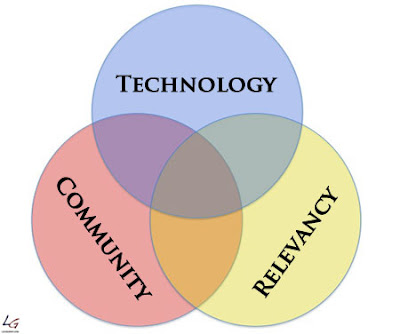
As I wrote a year ago in a post on the 3 social pillars needed for any successful network, one needs to find leading technology, community and relevancy to make a site a must-visit each day. For Cliqset, their technology was never in question, but scrapping for users was a challenge that didn't find a great deal of traction. Darren agreed.

"In order to build a community, you need massive differentiation today," he said. "It's fairly obvious in hindsight. Projects I would be working on in the future would be leveraging the existing social graph, and the need for success wouldn't be contingent on relationships and community within itself. In no means do I think Facebook is impenetrable and somebody can't build something to compete with it, but it's not an easy task."

There are no plans to shut down Cliqset.com immediately, as the company's investors have opted to keep it up and running, despite a lack of engineering and operational support. In the event the service were to be acquired, Charlie and Darren could theoretically be pulled back in, but that scenario is unlikely. As I have been saying for a year aggregation is great in theory, but sites like FriendFeed, Cliqset and Arktan haven't been able to find a unique voice that makes people go their way instead of the original sources of content - Twitter and Facebook. I am eager to learn about the team's next move - they're very sharp and were focused on pushing open standards forward. In an ideal world, their work will not have been in vain.

November 19, 2010

November 19, 2010 · 3 MIN READ · BY LOUIS GRAY

Closed to Open: Downloading Your Data from Facebook

Closed to Open: Downloading Your Data from Facebook

Six weeks ago, Facebook announced they would enable users to download the entirety of personal profile on the network - a big move for the company often seen as being "closed" when other sites have attached themselves to phrases like "open" and "portable". The promise was that content you put into the system could be easily retrieved, from your own personal profile (or Wall) to your photos, videos and even the friend list - while that famously does not contain e-mails, and has been at the heart of a data tug of war between the company and its occasional nemesis, Google.

The data comes as a ZIP file which expands into simple HTML pages, with each major section of one's Facebook experience hosted as browsable directories. In fact, the data is easily expandable and movable that you could choose to replicate the Facebook profile experience on your own site, simply by uploading the content to a server under your control.

My Facebook Data Weighed In at 31 Megabytes

Eager to try this, earlier this week, I set out to get a local copy of the data I put into Facebook. Not a tremendously active Facebook user, I didn't imagine it would be a huge mass of data, but it did weigh in at a compressed 31 megabytes, complete with a pair of short videos, and 13 photo albums, including "Wall Photos", "Mobile Uploads" and "Profile Pictures".

The first thing to note upon downloading and expanding is that when Facebook says they let you download all your info, they aren't messing around. The index.html file shows the data you list on your wall, from your real birthday and spouse info to religion, political party, employer, and interests (such as all those Likes you have racked up). This you probably anticipated. But it also backs up all your messages, so you now run the risk of downloading entire e-mail message threads from friends and posting them live for all to see, making the private public.

Facebook Said It Would Take A While

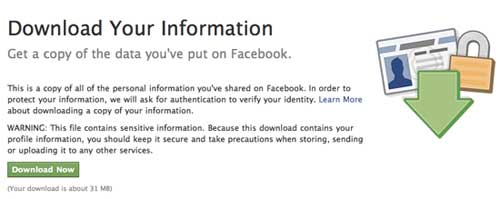
I Had to Confirm It Was Me Before Downloading

If you do choose to upload this content somewhere outside of Facebook, the major heft of the content is on the "Wall", which is not paginated by length at all - so you can expect it to weigh in at several megabytes.

My Downloaded Facebook Profile

Mine hits more than 7, but you can embarrassingly scroll down to the bottom of my Facebook history, when I joined late July 20th, 2007, updating my first status to read "wondering why he's looking at this facebook stuff and considering getting out before it's too late...", following on the next day, adding, "Any activity I have here will be met with serious resistance on my part. I see Facebook more like the MySpace and Geocities of the future than a serious Web platform, especially as it's password-protected and outside the range of Google."

Looks like I was wrong on that one. Point Zuckerberg.

As one's Wall can be impressively long, it actually can be fun to search for keywords posted over the lifetime of one's Facebook use. You can also scan quickly and see what applications you may have used and abandoned.

In addition to Profile, Wall and Messages, there are top level directories for Photos, Videos, Friends, Notes and Events. Photos and Videos are self-explanatory, providing the option to back up your rich media, while friends just lists your friends in alphabetical order by first name. Your Notes are included and Events shows those Events you said you participated in.

In the interest of sharing, I downloaded my Facebook details and posted them on my own site. You can find my full experience at http://www.louisgray.com/facebook if you are curious. I removed Messages for obvious reasons, but the rest is there.

Of note, according to an interview with the LA Times, the project was the last one worked on by FriendFeed cofounder Paul Buchheit before he left the company to join Y! Combinator - and not the revamp of Messaging many people thought would be under his umbrella.

Getting one's data out of Facebook is a good thing. It doesn't mean they don't still have it, unless you were to close your account, but the idea that one's posted content and personal data is available to the author is the right concept.