Silicon Valley Technology Commentary & Archives · Est. 2006 3,045 Posts · 2006–2026

November 18, 2010

November 18, 2010 · 1 MIN READ · BY LOUIS GRAY

Facebook Recruiting Video Promises Bold Vision, Potential

Facebook Recruiting Video Promises Bold Vision, Potential

With a much reported "War for Talent" under way in the Valley's largest tech companies, the companies making their case for the best and brightest minds are tapping into their culture and the employees themselves to make a solid case why you should join their team. Twitter launched a recruiting video in early August, and Google has more than 2,000 job listings for interested prospects. Not to be left out, social networking giant Facebook posted a video earlier this week helping to show they think their efforts are far from complete - even after growth beyond 500 million members.

The video's main points from CEO Mark Zuckerberg and others?
  1. You don't need a lot of experience to make a big difference.
  2. Be bold, because what's being attempted has never been done.
  3. You can touch the lives of hundreds of millions every day.
  4. The company maintains a "David vs. Goliath" feeling.
  5. Passionate individuals can champion ideas, regardless of org chart.
  6. Facebook is about empowering human connections.
  7. The devices you use should feel like there are people there, and they are conduits to people you know.
The video is embedded below.


In the video, Zuckerberg says, "It's really early. If you look at the type of information that people share, it's all very simple. The amount of context that people can have about the world around them, the type of sharing that people want to be able to do, the type of things that you want to be able to learn about the people around you, it's really just getting started."

I was personally pleased to see FriendFeed alumni Bret Taylor and Sanjeev Singh, both previous Googlers, featured.

Like Twitter's fun, this too is a convincing video that just might make you jealous you don't have an FB.com address, and it just might encourage some folks on the fence about sending their resume to Palo Alto to do just that.

November 16, 2010

November 16, 2010 · 2 MIN READ · BY LOUIS GRAY

Google Hotpot Launches Social Place Reviews, Ratings

Google Hotpot Launches Social Place Reviews, Ratings

The transition of location based services from simple game-oriented exercises to valuable review repositories is well under way. From the promise six months ago by product manager Siobhan Quinn that Foursquare's value would be from friends' tips to Yelp and Facebook Places, people are sharing their thoughts and experiences about places they shop, eat and visit. Monday night, Google jumped into this fray with both feet with the simplest, most lightweight platform I have seen yet, called Hotpot. The extension to Google Places, embedded in an update to the Maps application for Android, can be accessed through the Web or mobile.

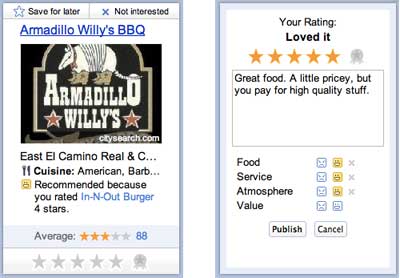
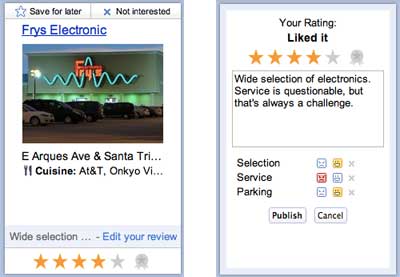
On the Web, Google hotpot starts with your home city, or places from your Web history, if that is enabled, and displays local businesses. You can rate each place with up to 5 stars, or can even present a medal if you absolutely think the place is the "best ever". When you provide a rating, the flashcard-like places flip front to back and offer a place for you to write a simple review. Then it's on to the next card. Don't want to review an establishment? Just click "not interested" and move on. I found it only took a couple minutes to rack up about a dozen reviews, probably as many as I've ever logged in Foursquare.

Rating Fry's On Hotpot via the Web

Rating Restaurants on Hotpot via the Web

While some folks are projecting a massive social service from Google to take on Facebook, Google has instead referred to adding social layers to its many products. Hotpot itself presents a social layer as well, letting you connect with friends to see places they have reviewed, and cutely, posting a leaderboard, with the most active individuals at the top. The option to add friends, instead of being a "everybody in the pool" synchronization with Gmail contacts or any other database, feels more like Google Buzz - with a screen offering you the option to connect to the people you e-mail most often.

The Google Hotpot Leaderboard Early On


Rating Sunnyvale Restaurants Via the Mobile Widget

When on an Android device, assuming you have loaded version 4.7 of the Google Maps app, you can add a widget to rate places for Hotpot on the fly. Dependent on your location, you can rate businesses, or do a quick search (for example, restaurants near Sunnyvale). Find what you like, and as with the Web site, you can post 1-5 stars, and add a comment.

For the most part, although I am sure it is not universal, it seems the majority of Foursquare users choose the app primarily to check in quickly, not to leave detailed reviews and guide to friends. This will probably remain the truth until game mechanics are introduced that push reviews. But for Hotpot, it's not about checking in that you were somewhere, but all about the reviews and providing recommendations to friends. It may have been a quiet little release pushed out from the Mountain View giant after 7:30 pm Monday night, but it could be a big deal. I have added the Rate Places widget to my Android home screen, and expect to be using it a lot.

Want to find my recommendations, just get connected through my e-mail address: [email protected].

November 15, 2010

November 15, 2010 · 2 MIN READ · BY LOUIS GRAY

MyLikes Passes 100k Influencers, Hires 3 More Ex-Googlers

MyLikes Passes 100k Influencers, Hires 3 More Ex-Googlers

MyLikes, the personal endorsement-based advertising platform best known for the ability to create sponsored tweets and YouTube videos, has seen significant growth since the company announced an initial funding round last April, opening up to the public and unveiling its advisory board, of which I am a member. The company's CEO, Bindu Reddy, reports more than 100,000 "influencers" are registered on the platform, reaching more than 160 million people. The company, who was founded by a pair of ex-Googlers, and who raised the angel round solely from former Google employees, has now added another three Xooglers to the mix, with the hiring of a new senior director of sales and engineering talent from the Mountain View search giant.

Like with Twitter, much of MyLikes' initial traction has come thanks to early engagement with notable Hollywood celebrities, and their loyal followers. Early users of the platform have included Snoop Dogg, Lindsay Lohan, Khloe and Kourtney Kardashian. Also like Twitter, many of the company's initial employees are former Googlers. Of the company's first 7 employees, 6 came via Google.

MyLikes Finds a Home With Celeb Tweeters

Of the new hires, the most visible is that of the company's new sales director John DiCola, who spent 7 years in Sales at Google, from 2000 to 2007, and is credited with opening and growing the Google offices in Chicago, Detroit and Dallas as the regional sales manager in the midwest.

John is joined by Tracy Scott, a new engineering hire at MyLikes, who was a senior ads infrastructure and system engineer at Google, receiving the prestigious founders award, before becoming the CTO of Pixelpipe, and Nick White, a senior software engineer at Google who most recently worked at YouTube on social features and personalization.

Also joining the company, the only non-Xoogler, Grzegorz Miaskiewicz, who recently blogged on updates to the MyLikes home page.

Growth on the company in terms of users, employees and clicks has also spawned new features and product improvements. As users "Like" items and share items through MyLikes, they get a unique MyLikes page, which can be shared on multiple sites throughout the Web, including Blogger, Posterous, Twitter and Facebook.

Also, an interesting twist, the company has created a patent-pending influence score that is based on user's social engagement, taking into account multiple factors like the numbers of friends and followers, clickthrough rates on shared links, mentions and retweets on Twitter, and more. The Influence score is continuously updated.

Disclosure: I am an unpaid advisor to MyLikes and hold a small equity position. Content of this post, and others, did not pass their way in advance.
November 15, 2010 · 2 MIN READ · BY LOUIS GRAY

Does an Invisible Path Draw Intrigue or Fatigue?

Does an Invisible Path Draw Intrigue or Fatigue?

As most tech insiders know, one of the more anticipated stealth startups, Path, unveiled itself to the world last night. Founded by respected Valley names with pedigrees from Facebook and Napster, and funded by a long, yet elite, list of active angel investors, the service launched on iPhones, presenting the concept of sharing photos with a smaller network of one's closest friends. This concept, a more intimate social circle, runs contrary to the "bigger, better, more" mentality of today's leading Web services, and has some appeal to those inundated by off-topic connections from friends on the periphery.

While the knee-jerk reaction to something like Path is to ask "why?", as in "why do we need yet another simple photo sharing service?", it's often the trivial and mundane concepts which get traction. The initial response of "why?" led to Twitter and Foursquare and so on, as the more intellectual pursuits that were noteworthy challenges had less success getting steam. I may want to find more places to learn and be challenged, but there's obviously a huge market for the casual and simple.

Path Photos from Drew and Robert

Path is notable for its limits. 50 people. If you hit 51, you drop somebody in the list, and from what I've read, they know about it. The concept of exclusivity drives intrigue - as people want to know if you really are BFF with those people you thought you were. But also limited, at least on day one? The platform. Path is an iPhone only service, and you can't even run the application on the very latest iPod Touch, let alone Android.
"The problem this app is trying to solve: we have too many friends (on Facebook) and as a result we miss key moments we should share with some of the people who are closest to us."
-- Om Malik
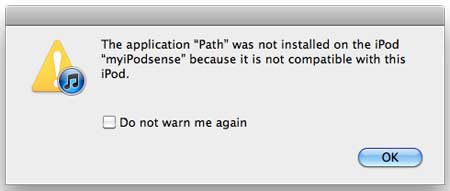
I made a personal decision to switch to Android away from iPhone, and bought an iPod Touch to test apps, like Path, that were made for the iOS platform. 9 times out of 10, that's not an issue. But Path, for whatever reason, detects if the device is an iPhone, and won't sync otherwise. So if you thought the service was limited in terms of scope or in terms of numbers, the limited platform ensures scarcity. The question becomes, as scarcity continues, will it drive demand, or annoyance?

Path Won't Go on My iPod, So I'm Out of the Game for Now

I like the guys behind Path. I think they've made great products together. I like the guys who I have seen already sharing their photos with me, as I teasingly have a read-only version of the service from the Web. But so far, I will have to be shown even more before I am a full believer. This looks like a test once and check in on occasionally type of app. There is definitely a hole out there for an intimate network of your closest friends. I just don't know if photo sharing is that start, and don't know if it will have value for me once it hits a platform I use.

For smart folks who get Path, see:
   Drew Olanoff: The “Intimate Social” Revolution
   Om Malik: On A Path To Nowhere