Silicon Valley Technology Commentary & Archives · Est. 2006 3,045 Posts · 2006–2026

March 9, 2011

March 9, 2011 · 4 MIN READ · BY LOUIS GRAY

Is The Web's Focus on "Now" Losing How to Find "When"?

Is The Web's Focus on "Now" Losing How to Find "When"?


Our attention spans are getting shorter. While being constantly interrupted or distracted by new toys, new sites, new things, new messages, new people, and new ideas, we're delivering a stream of consciousness into a void which quickly gobbles it up and waits for more. Scads of sites are helping us find out what is trending in real time, and deliver us the "now". What's hot now. What's peaking now. What's being said now. But the focus on the cutting edge of time, combined with reduced capability to search our history is making finding what happened "when" a lot harder.

Consider for a moment some simple questions that pertain to the social Web, blogging and lifestreaming - and our lack of great tools to discover the answers. I'll start with some real examples.
1. What was the first blog to cover the service backtype.com? 
2. When was the first time Denton Gentry left a comment on my blog?
3. When was the first time Robert Scoble mentioned the word Twitter in his blog?
4. Who mentioned FriendFeed on Twitter first? MG Siegler or me?
I use these specific questions with real people to help consider questions that may pop up from time to time. Substitute your own curiosities.

There are a few places we've trained ourselves to look for such answers, namely Google Web Search (and its competitors like Bing), Google Blog Search (and IceRocket, my favorite), and Twitter Search. For individual blogs, we have to hope they have integrated blog search tools, such as that from Lijit, or Google's Custom Search Engine (CSE), a subset of results from one domain. But each of these has some weaknesses.

First, Twitter Search. Two years ago, when I was a more grumpy person, I targeted the search engine for being quite broken, only going a few days deep and failing in more specific searches. The archive hasn't been built to go deep in the last two years, and the accelerated volume of posts isn't helping the issue.

Second, Google Blog Search. You can search by date, and even set custom ranges, but the archive of blogs is both incomplete, but overly full of low-quality content. So finding out a question like the first blog to mention BackType requires you to visit their own blog and hope they mentioned it, or to just know they were funded through Y! Combinator, and thus, got started with TechCrunch, back in August of 2008. Peeking at Crunchbase helps too in this regard. Icerocket offers search by date, but I didn't find any results in August of 2008, so that's a miss.

The Web has collectively accepted these sites inability to accurately deliver on archive search, with an expectation that questions such as this are only done by a small few.

For the second question, one I posed to Denton last night out of curiosity, I would have to hope one of two things - that Denton had used Disqus.com with my blog and that I could somehow see all of his comments on my domain through Disqus. But looking at his profile there only shows how many comments he's made on my blog, and that's not clickable. If Disqus has the data, it's not easy to find. In fact, the only way we arrived at the answer is that I'm enough of an information hoarder to have every comment he's ever made tucked away in my email and was able to search locally on my laptop to find his July 2008 comment on a guest post by Jesse Stay. He finally posted on an entry from me in August of that same year.

So what about Mr. Scoble mentioning Twitter? I tapped Google Blog Search, went to Advanced search, entered scobleizer.com as the domain and the keyword of Twitter and chose 2007 as the year. The results nicely omitted his URL as part of the query - so that had no value. I searched his own site, using Lijit, but there is no sort by date. One of the first results included mention of an earthquake on Twitter in 2007, but knowing Robert, there's no way that's the first mention. Just can't find it.

As for who mentioned FriendFeed on Twitter.com first, MG or me? That's something of a trick question. We already know Twitter search won't find it - nor will its realtime search partners Google or Bing. But I can guarantee that MG mentioned it first because I didn't even join Twitter until early 2008, several months after I had been using FriendFeed. By that point, MG was very active on Twitter and had no doubt mentioned FriendFeed several times. But this all requires knowledge outside of the search engines.

Wikipedia and Quora and Crunchbase are all human-powered knowledge bases that are being built to answer questions such as these that capture more than the "right now". That we have access to things like Google and Bing and Icerocket that find answers to so many things is fantastic. There are even archival sites like MemoLane (which is beautifully done) to capture your history, but the when is becoming a footnote in history. Will the big engines let the flow of social media and blogs outrun the ability to capture it?

March 7, 2011

March 7, 2011 · 1 MIN READ · BY LOUIS GRAY

Rent Movies on Facebook With Credits, Starting With WB

Rent Movies on Facebook With Credits, Starting With WB


Facebook is quite possibly readying the transition from a place for idle time to a place where real commerce transactions take place in the world's largest social network. Warner Brothers announced late tonight that the company is beginning testing of select movies for purchase or rental through the company's Facebook pages, payable with Facebook credits. The first movie title to be available? "The Dark Knight", available for rent for 30 Facebook Credits, or $3, to US customers.

While the movie distribution business has gradually moved from warehouse retailers like Blockbuster and Hollywood Video to iTunes, Netflix and Amazon, Facebook hasn't yet been seen as a player. But with hundreds of millions of people using the site as a daily destination (often multiple times daily), it may make sense to put this content in front of the screen where people are spending significant time.

Rent The Dark Knight for 30 Facebook Credits

Tonight's release says film viewers will have full control over the film for up to 48 hours after purchase, including the ability to watch the show in full screen, or to pause and resume the film upon login. Of course, being on Facebook enables users to comment on the film and update their status, so expect a lot of "I'm Watching the Dark Knight!" to be in your feed stream coming up.
March 7, 2011 · 3 MIN READ · BY LOUIS GRAY

LiquidSpace Connects Mobile Employees With Fluid Offices

LiquidSpace Connects Mobile Employees With Fluid Offices

Just in time for SXSW 2011, LiquidSpace is opening its doors to mobile workers looking for flexible meeting and office space on demand through an innovative application for iOS that lets you track down and book available meeting spaces, based on location, availability and features. But which doors exactly? Well, any of them - for LiquidSpace is leveraging advances in technology, such as location awareness and the ubiquity of mobile applications, with trends in real estate that see employees working "all over the place" in a world where many buildings are significantly underutilized. The combination has delivered an opportunity for someone to step in with a solution for both - putting people to work in buildings that could spare it. LiquidSpace smoothly offers a real solution.

The founders, Mark Gilbreath and Doug Marinaro, over the last decade became familiar with how traditional real estate models with fixed leases were "completely at odds" with dynamic and growing companies. With commercial real estate responsible for 60% of our carbon footprint and money being inefficiently spent on holding space for people who might not be using it enough or would demand it too much, the pair determined there had to be a better way to get things done.

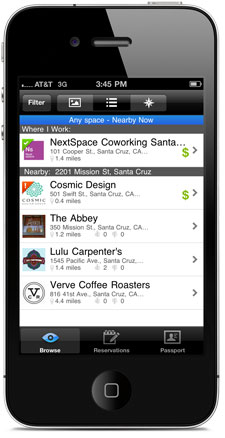
LiquidSpace Shows Available Venues In Your Area

Enter LiquidSpace. The concept is two-way, like Foursquare, for users to check into a location that offers a space, and for owners to claim a venue to set up description, hours of availability, and pricing. Venues can be slugged in one of three ways, namely:
  • Public Venues (such as a cafe)
  • Paid Venues (such as a shared work space)
  • Private Venues (such as a incubator or VC office)
In the Bay Area alone, we've seen incubators rise with notable hotspots such as the Founders' Den and Dogpatch Labs, which have helped to move the market in LiquidSpace's favor, delivering private venues withs hared work spaces, often including conference rooms and kitchens. LiquidSpace essentially tries to deliver a location-aware search with a unique piece of real estate that matches the scenario you are working to.

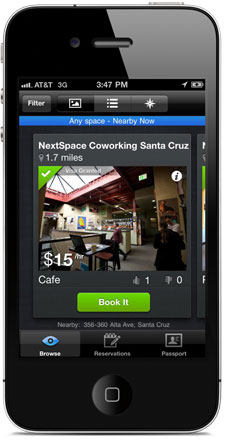
Booking a Workspace on LiquidSpace

The application is quite robust for not having yet officially hit the App Store. You can find meeting places by location, sorted by private workspaces, public venues or meeting rooms, see their free/busy schedules, and can book well in advance if you like. Venues can set criteria for you to book the spot, and you can even use your confirmation from LiquidSpace as your identification at the front desk when you show up unannounced.

For the home office worker, an app like LiquidSpace comes none too soon. Are partners from out of town looking to meet face to face over PowerPoint? Forget about Starbucks or your living room. Fire up LiquidSpace, find a private meeting room in your area and book it. Get a call from your boss when on the freeway that you need to be on a Webcast in 20 minutes? Pull over, open up your iPhone and book the nearest LiquidSpace location. The more you think about the possibilities, the more an application like this makes sense.

I won't hold it against LiquidSpace that they're iOS only right now. In my discussions with them last week, it was clear they were thinking big on how to crack the Blackberry-carrying mobile worker, and the growing Android population. We even talked about whether their next step should be to make a Web app available in HTML5, which I'd strongly recommend. But before all that, if you happen to have an iOS-capable device, and you want a meeting place on demand, and are in a supported area, LiquidSpace sounds like a great idea. If you're attending SXSW this upcoming weekend, you can even book a space in Austin now. So do it before all the meeting rooms fill up.
March 7, 2011 · 1 MIN READ · BY LOUIS GRAY

Spotify Reaches 1M Paid Subscribers, Features Exclusives

Spotify Reaches 1M Paid Subscribers, Features Exclusives

With Apple's iTunes subscription service remaining a mere rumor, and Google Music still not released, Spotify is marching forward, racking up paying subscribers and significant revenue, even if almost none of the revenue is stateside. The service, which I joined as a paying subscriber a bit over a month ago, following the completion of a free trial, not only offers the deepest on-demand music library on the Web, but also extended Facebook integration for social connections, and lately, big name bands like R.E.M. have chosen to debut on Spotify, hallowed ground previously held for iTunes or big box retailers. Today the company announced the achievement of one million paid accounts (per MediaMemo).

While there remains some skepticism from cynical industry pundits about Spotify and its delayed entry to the US, feedback from all its users I know has been unhesitatingly enthusiastic, and paying for the service has been a no-brainer. I'm currently signed up to pay $9.99 a month automatically from PayPal to Spotify, and have considered closing other paid music accounts, including Sirius XM and the competitive Rdio, who coincidentally introduced its Mac OS X application earlier today.

Daniel Ek, founder of Spotify, commemorated the milestone today in a quick blog post, saying "It’s a testament to our fantastic users who continue to support us and spread the Spotify word." Early access to albums like R.E.M.'s "Collapse Into Now" doesn't hurt either.

Recent news has discussed Spotify's ongoing discussions with US record labels about entering the states, negotiations which don't sound fun, fast, or cheap, but are clearly happening. It's also probable that Apple's controversial subscription battle was designed with Spotify in mind, though they have opted to stay out of that particular PR thicket.