Silicon Valley Technology Commentary & Archives · Est. 2006 3,034 Posts · 2006–2026

October 18, 2007

October 18, 2007 · 2 MIN READ · BY LOUIS GRAY

Will RSS Readers Ever Report Detailed Referrals?

Will RSS Readers Ever Report Detailed Referrals?

It wasn't all that long ago that much of the blogosphere was abuzz around the power, or supposed lack thereof, from A-list sites and TechMeme. How come they were only counting a few hundred visitors? It could be, in my opinion, due to the growing use of RSS readers, like Google Reader, NewsGator and Bloglines, which mask the URL of the referring feed if a visitor clicks through.

Instead of telling site owners what feed, and what post, a visitor originated from, RSS feed readers trumpet their own URL as the source for the link. As a result, instead of giving TechMeme, Scoble or TechCrunch the credit, it's Google Reader who snakes the statistic. And God forbid a small site link your way that only has a few RSS feed readers, but one who liked your content. In that case, you'd see a visitor from the feed reader to a specific subpage, but not know who was linking.
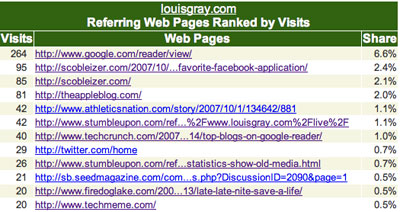
Yesterday evening, after my flight from Dallas, I clicked through on my Blackberry to obsessively check my blog stats, and I saw an uncommon spike in traffic, sent my way from a post on Scobleizer linking to my Feedheads article. While I know that more than 500 unique visitors came my way in the last 24 hours from his note, scobleizer.com only is given credit for 40 to 50% of that amount in my site statistics, as you can see in the side graphic, which shows the share of referrals among my last 4,000 visitors. Instead, Google Reader, BlogLines, Twitter and other RSS feed engines snaked the rest.

Ideally, an RSS feed reader would pass to the site owner enough information as to ascertain which feed was being viewed, and even better, which post fed the link. It could be that this data today doesn't rest with the feed reader, but instead with today's browsers, and the URL passed to Web server logs is dictated, not by the feed reader, but instead by Firefox, Internet Explorer or Safari, but I'm sure somebody smart (like Dave Winer) could figure this out and help us get more detail.

October 17, 2007

October 17, 2007 · 1 MIN READ · BY LOUIS GRAY

Leaving Dallas for the Bay Area

Leaving Dallas for the Bay Area

After a quick two-day stop in Dallas, we're headed back home. Right now, I'm awaiting boarding for the flight to San Jose, and power surfing/e-mailing on the T-Mobile powered WiFi at the airport. If it didn't already cost $9.99, I'd be lauding its speed, but as I've paid, I expect the world.

In case you missed it, the big news of the day was that Steve Jobs announced Apple is going to open up the iPhone for third party applications, issuing an SDK in February. You can say a lot about the Apple icon, but he sure does appear more willing to listen to users and developers than Apple's reputation has shown previously. (Coverage: The Apple Blog | The Last Podcast | Apple Hot News)

I still love how Apple's using their Hot News site as a blog.

While in Dallas, it was also noted that Apple's Mac OS X 10.5 (Leopard) is to hit stores by October 26th. I'll have to check and see if my new MacBook Pro qualifies to get it for super-low pricing of $10, but the truth is, we'll be getting it as soon as possible, regardless. (Coverage: Paris Lemon | Webomatica | Chris Pirillo)

You can read through 300 new features expected from Leopard on the Apple site.

Of course, despite the above, the world doesn't revolve around Apple. Even I get that. So as I took in about 500 RSS posts here in the airport, I shared those I found most interesting in the last 12 hours on my Shared Google Reader link blog. We'll soon be back on the West coast, in the "correct" time zone, and back at full speed. Of course, I didn't ever adjust to Central time, finding the clock reading well past 3 a.m. before I called it a night. Silly me.
October 17, 2007 · 1 MIN READ · BY LOUIS GRAY

Facebook Google Reader App Rebrands As Feedheads

Facebook Google Reader App Rebrands As Feedheads

One of the more useful Facebook applications out there, enabling you to integrate your Google Reader shared items with your Facebook profile, and view most frequently shared items, has recently, quietly, undergone a rebranding, to "Feedheads".

While the application's author, Mario Romero, hasn't said anything about the change, it's possible that he made the change to avoid confusing people into thinking the application was produced, or endorsed, by Google. Another possible reason for the change? It now appears that Mario has added the option to include shared items from NewsGator, in addition to Google Reader.

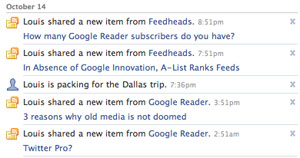
Previously labeled as a "Google Reader" application, the application changed names sometime in the afternoon on Sunday, October 14th, to "Feedheads". You can see the change transparently occur on the right in a screenshot from my Facebook mini-feed.
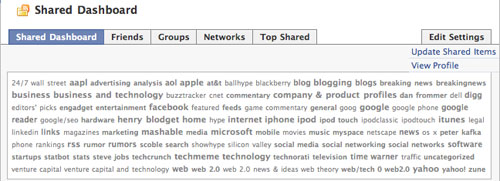

The application, one of the few useful applications on Facebook, as has been well documented, says it has 348 daily users (myself included). Should Robert Scoble's hopes ever come true, and enough people use the program, its aggregate power could be very strong, in effect becoming a democratized Digg of sorts, where you could opt in to view your own friends' shared items, rather than that of the mob.


A Tag Cloud of My Shared Items in Feedheads


If you're on Facebook, and you're an avid Google Reader Shared Links user, sign up for Feedheads. To see my shared links in Google Reader without getting into Facebok, click here. To view my Facebook profile instead, click here.

October 16, 2007

October 16, 2007 · 1 MIN READ · BY LOUIS GRAY

Technorati Fights Off Irrelevance With Return of Charts

Technorati Fights Off Irrelevance With Return of Charts

Given the discussions of the last few days, it's obvious there's little better the blogosphere likes to do than find new ways to rank one another, show charts and count links. That's why the on-again, off-again discussion of Technorati's potential demise is so odd, as if there's anyone positioned to own the stats sphere, it's them, if only they can execute and stay focused. But in a mix of feature missteps and general lack of reliability, they've lost face amid challenges from Google, TechMeme and others.
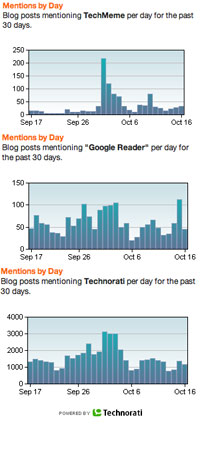
Today, they charged back in a good way with the return of keyword charts and filtering by blog "Authority" in search results.

Previously, I had wondered where the charts went, but hadn't given it too much thought. Now, like Google's Trends feature, I can see how frequently a keyword has been mentioned each day in the blogosphere over the last 30, or choose not to see results from blogs that haven't gained enough popularity yet to be deemed relevant.

While the additions were noted on Technorati's official Weblog, I was alerted via RSS from David Sifry, the company's former CEO. Additionally, it looks like he was so excited about the move, he blasted his Twitter audience as well. How did I know? Not from using Twitter, but instead, from Technorati.

You can see some quick examples of the charts provided by Technorati by way of searches for the aforementioned TechMeme, Google Reader and Technorati itself.