Silicon Valley Technology Commentary & Archives · Est. 2006 3,034 Posts · 2006–2026

January 24, 2008

January 24, 2008 · 2 MIN READ · BY LOUIS GRAY

The Downside to Raised Blog Expectations

The Downside to Raised Blog Expectations

Heading into the last week of January, this has been more than a record-breaking month for louisgray.com. Instead, it's been a tidal wave. Without giving away all the fun statistics, planned for a February 1 post, suffice it to say that we've already had traffic more than 1,500% greater than January 2007, also more than double that of December, which was the previous record.

Rather than resulting from a few Digg spikes or runs at StumbleUpon, this increased level of activity has been through increased presence on Google, significantly higher linkage from other blogs, and a number of highly-discussed posts, both here and elsewhere.

And with the higher page views, site visits, RSS feed subscribers and Technorati Authority, I'm feeling as if I'm going to fall victim to my own raised expectations. While I used to be content to make comments on the latest updates in Bay Area sports, or my favorite TV shows, the threshold has been heightened, and more is expected.

After all, take a look at what Marshall Kirkpatrick of Read/Write Web (and formerly of TechCrunch) was saying on Twitter last night...
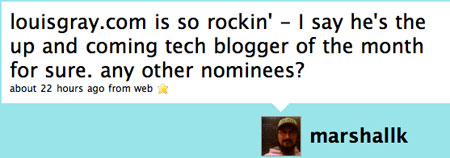

Via http://twitter.com/marshallk

Whether he was being too kind or just trying to send me a few new visitors from Twitterland isn't 100% clear, but now that we're getting noticed by some high-profile folks, and achieving previously uncharted levels of traffic, as well as reaching the rarified air of the TechMeme leaderboard, I'm feeling the pressure if I'm staying too many hours at work, or if I'm putting the laptop down a few hours to catch up on TV. My new subscribers are going to expect big things from this blog, and they won't want to be let down.

While I can't expect to find new services like ReadBurner and Shared Reader every day, and I don't anticipate starting a verbal war with one of the most widely read blogs on the planet all that often, I do expect we'll try to find new insight into the world of technology, and hope to earn the kind of accolades I've seen from people like Marshall, or VentureBeat's Eric Eldon that we've received over the last few weeks.

I do expect there will be days when I don't post at all. There will be days when my posts just might not be interesting to people, and there might be days when my RSS feed count goes down as people unsubscribe. And just as we've seen our traffic jump in January, it may fall in February, making me feel we're not measuring up. Even if there were an official "Up and coming tech blogger of the month", and even if I won for January, somebody else would win the next month, and I'd be yesterday's news, potentially fighting to stay relevant.

January 24, 2008 · 2 MIN READ · BY LOUIS GRAY

Taking Technologies for Granted, and the Resulting Quiet

Taking Technologies for Granted, and the Resulting Quiet

Yesterday, while browsing updates on Twitter, Frederic Lardinois of The Last Podcast asked an interesting question saying, "I noticed that the Facebook hype seems to have died down quickly. What's going to be the next big 'it' thing online?"

While I can't speak for everyone, I see the lowered discussion around Facebook as part of the cycle which occurs when a technology transitions from being new, and therefore exciting, to instead, being accepted and absorbed into daily use. Oddly enough, in this phase, you're more likely to see news about these accepted technologies when they surprisingly stop working, or go down (in the case of Web applications).

That's why it's not too uncommon to see bloggers, from A-Listers like Robert Scoble and Steve Rubel, all the way to B-Listers and below, like me, seemingly change their tune - gravitating like moths to one technology, and then buzzing on to the next and the next and the next. One day it will be Twitter. The next day it will be Facebook. Then TechMeme. Or Google Reader. Then Joost. Then Seesmic, Pownce and so on.

For me, I was doing some thinking about how you've seen that here - and there's no doubt it's happened. I used to talk a lot about how I use iTunes. During my off-work hours, there is very little time when on the laptop and iTunes isn't running. I also don't talk much about my TiVo, where I used to. I don't mention FriendFeed as much as I once did, nor LinkedIn, Facebook, or standard Mac apps. Why? Simply because they work, and they are part of my every day technology intake.

Does this mean these services are less valuable than today's flavor of the month?

No, of course not. But they are not as shiny as they once were. They don't have the newness factor and intrigue they did when they were first discovered, and by the time you've been using a product for months or even years, it can seem that everything that needs to be said has been said. Is Facebook still inhabited by zombies and are people SuperPoking too much? Yes. That didn't change. Do my iTunes updates still automatically populate Last.fm? Yes, of course. Am I still using Google Reader at a rapid pace? Yes. But I won't mention it unless I set some new record, they add a new feature, go down or lose all my feeds.

So while Scoble and others are occasionally lambasted for having something approaching attention deficit disorder, it's not necessarily a medical issue. And that doesn't mean those developers working hard on the next generation of iTunes, Google, and Facebook have the option to slow down. It just means they're entering a new, more mature, quieter phase. As bloggers, we're not necessarily always looking for the "next big 'it' thing" online, but if we find it, there's no doubt we'll tell you.

January 23, 2008

January 23, 2008 · 3 MIN READ · BY LOUIS GRAY

A Big Upgrade Day for Five Social Services

A Big Upgrade Day for Five Social Services

Sometimes, you can go weeks without news, and then seemingly, there's this spike of activity, when the industry snaps out of its temporary slumber and gets coding.
Today, in the space of a few hours, some of my favorite Web services all went into the shop for a tune-up and came out with some intriguing features. Of note, FriendFeed, ReadBurner, Spokeo, Shared Reader and LinkedIn have all made improvements worth highlighting.

LinkedIn

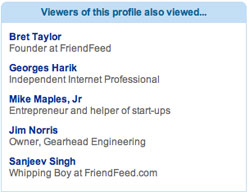
LinkedIn continues to add new features related to who is viewing your profile. I asked LinkedIn back in February to show how often your profile was visited, who did it, and who has similar profiles to yours, and the company is definitely moving in this direction, knocking off the first two in May, and today, interestingly letting you know what other profiles viewers of a specific individual also looked at. (The example on the right came when I viewed FriendFeed's Paul Buchheit.)

The company's official blog tonight hints at even more features of this sort coming, saying, "At LinkedIn, we believe in collective intelligence, and the team that brought you this feature ... is busy working on some even cooler stuff. Stay tuned."

We will, and we're looking forward to it. (My profile is here...)

FriendFeed

FriendFeed, also a good listener, added some great features that let you reduce some of the noise generated from verbose friends, through hiding specific services (like Twitter), muting comments on a specific entry, and, in a new twist, adding the ability to link to a specific item. While this feature was hinted at in a quick note from Paul Buchheit a few weeks ago, it's now been rolled out in style. (See: FriendFeed Options)

FriendFeed is doing a great job of upgrading through what's today still a spartan Google-like interface, managing to get a lot of data without a lot of clutter. The new features come up when you click the "Options" tag next to any item.

I had mentioned that one of my highest recommendations for FriendFeed in "10 Suggestions for FriendFeed" was to add the ability to block updates from specific services. As the blog post says, "does one of your friends Twitter way too often?" Well, the answer is yes. And rather than unsubscribe from that friend, I can just "untweet" them if I so choose.


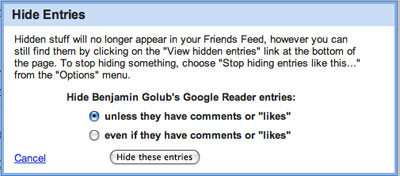
The level of specificity in the "hiding options" is fantastic, determining that you can block specific services from specific users, and further delineate whether you want to block all such items, or just those without "Comments" or "Likes", which typically split the popular from the unpopular. (See above image)

Spokeo

Spokeo, the friend-focused feeds aggregator, well known for letting you find all the Web services your friends subscribe to and giving you a single point of access for their social network data, got some old media publicity, through Newsweek (See: Friends Under the Microscope), and in a blog post this evening, titled "What's Next?", Harrison hints and improved search features, and expanded privacy settings, which will honor private blog posts and photo albums.

ReadBurner

The day wouldn't be complete without a ReadBurner update. After my post this morning on how to share items to your Google Reader link blog without requiring subscriptions, Alexander Marktl was on the case immediately. As he posted in Share items directly through ReadBurner!, he saw the work-around as a great way to keep populating his fast-growing service.

Shared Reader

Meanwhile, in ReadBurner's wake, Shared Reader is back online and adding new features as well. Shared Reader is duplicating many of ReadBurner's efforts, aggregating the most-shared Google Reader items, but it's also added new pages for "Tags" (See the tag for "ReadBurner" or Twitter), and has added both Digg counts and Del.icio.us counts for every single shared feed item.

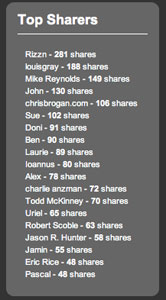
Of course, the most popular shared items are also from the same sources you commonly see dominating TechMeme or Digg, so what rises to the top... still rises to the top. Also, Shared Reader has been highlighting the most-active linkblogs, and sources for articles, on the site's front page. So far, Mark "Rizzn" Hopkins of Mashable is #1, and I'm trailing in the #2 position for active link blogging...
January 23, 2008 · 2 MIN READ · BY LOUIS GRAY

Add Items to Your Google Reader Link Blog Without Subscribing

Add Items to Your Google Reader Link Blog Without Subscribing

Unlike newer services including FriendFeed and AssetBar, Google Reader doesn't enable you to share items to your shared items link blog without first having an RSS feed subscription to the said site. But there is a work-around for this limitation, which lets you share an item without committing to any kind of long-term, or even short-term, relationship with the blog it came from.

(See also: #4 in 10 Suggestions to Improve Google Reader from March '07)

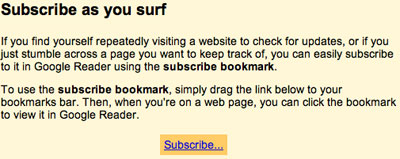
To do so, you need to be using a feature in Google Reader's "Goodies" page, under your Settings, which they call "Subscribe as you surf". Essentially, you are adding a bookmark that with one click, prompts you to add an RSS-enabled site to your Google Reader.


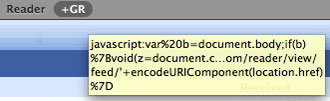
I've personally added this bookmark to my Safari toolbar as "+GR", standing for "add to Google Reader", and click it whenever I find a must-subscribe site. But if you're in a gray area, and find a site that has a great article, but is one you don't think you'll be subscribing to, there's still a way to get it on your link blog.

1. Click your new "Subscribe as you surf" bookmark.

Google Reader will show you what the feed will look like if you choose to subscribe, with the note "You are not subscribed to this feed yet" along with a "Subscribe" button.


2. Scroll to the item or items you want to share on your link blog.

3. Hit the share option.

Then you can exit out of the feed subscription window by clicking All Items, getting back to your feed reading, or get on with your life. Sure enough, even though you never did subscribe to that site, their item made its way to your link blog, to be shared with your Google friends, and services like ReadBurner.

Until Google finds a more direct way to share items from the Web directly to your link blog, this is a fairly simple work-around, one I've been using on occasion and will be trying to make more-frequent use of in the future.