Silicon Valley Technology Commentary & Archives · Est. 2006 3,034 Posts · 2006–2026

March 9, 2008

March 9, 2008 · 6 MIN READ · BY LOUIS GRAY

10 Suggestions for Google Reader, One Year Later

10 Suggestions for Google Reader, One Year Later

On March 3rd of last year, I posted one of the more active and popular posts in louisgray.com's history, offering my thoughts on where I hoped Google Reader would take the service. In a simple "10 suggestions" format, I listed some ideas that were small enhancements, and others, more broad. Now that we've had just over a year go by, I thought it'd be interesting to check back in with Google Reader and see what's changed. How many of the 10 did they hit, and if they didn't get it, who did?

In my opinion, you'll see that due to Google Reader's not filling all the gaps I laid out a year ago, a cottage industry of RSS readers and link aggregators has emerged - great for the Web, not always so great for Google.

1. "More Like This" Suggestions

I asked Google to recommend feeds based on those I subscribed to.

Google added a broad "Suggestions" feature, based on all my feeds in aggregate. They haven't implemented this feature on a feed by feed basis, as in my example: "Others who subscribed to Jeremy Zawodny also subscribed to Don Dodge or Robert Scoble.", but they do get partial credit here.

Who did implement something like this the way I asked? Nobody, really. AssetBar claimed to have solved this in their initial product description, but I haven't yet seen it. NewsGator, Shyftr, Fav.or.it, also don't do it, as far as I can tell. Neither does RSSMeme, although the service does try to find similar posts, and FriendFeed offers recommended user subscriptions.

(Of interest, I'm beta testing one solution that does exactly this. More on that soon.)

2. Eliminate Duplicate Feed Items

Nobody likes getting the same feed item over and over. Over the year, Google has done a lot of work here to have this fixed. There are still issues with seeing duplicate items if you have subscribed to a friend's shared items feed, or if you've subscribed to keywords via Google News, but largely, this is not as big an issue in 2008 as it was in 2007.

Who else fixed the duplicate items issue? Shyftr's implementation here is flawless. AssetBar also does a fantastic job showing just one item, though if I look at an item I've already viewed, through a friend's shared link list, it doesn't always know I've already seen it. The issue of duplicate items continues to be a major point of discussion on FriendFeed and elsewhere.

3. Add Negative Keywords

For some folks, I'd like the option to get almost all their posts, except when they talk about politics (Dave Winer), fatblogging (Jason Calacanis), or if they just post a series of del.icio.us links (Steve Rubel and Chris Brogan come to mind).

Google hasn't done anything here. But Ionut at Google Operating System highlighted a new Greasemonkey script that works in FireFox to approach this by highlighting posts with keywords you select and grays out those you would like to exclude (See the post: Filters for Google Reader).

Who does do this right? AssetBar again claimed to when introducing their product, but if it's integrated, I haven't seen it.

4. Share Items Without Subscriptions

I'd like to add items to my shared link items feed without subscribing.

While Google didn't do anything about this, I discussed a work-around back in January.

Who does this right? Just about all the link aggregators, including LinkRiver, AssetBar and FriendFeed let you share items without subscriptions. ReadBurner had implemented this as well before Alexander Marktl had to take the site down.

5. Aggregate Reader Statistics

I wanted to know the most frequently read blogs, and what were the most shared items that day.

Google Reader recently added a "Details" item, showing how many Google Reader users were subscribed to a specific blog, but they're nowhere on showing rankings or seeing the most popular shared items in a single day.

Who does this now? As discussed a ton here in 2008, the shared items space took off like a rocket. FeedHeads had done a fantastic job and pioneered this space, on FaceBook, while ReadBurner, RSSMeme, Shared Reader, and LinkRiver all offer details on most popular shared items. Amusingly, in an attempt to discover the most popular items by Google Reader, everybody from Scoble to TechCrunch was fighting to add the data they did have by hand.

6. Addition of Search

At the time, Google Reader was missing core Google functionality - search!

The Google Reader team solved this one in a big way back in September. Nice job.

Who else offers search through feeds? LinkRiver, AssetBar, RSSMeme, and Shyftr all do this very well. So far, Fav.or.it does not, and FriendFeed I'm sure will, but hasn't gotten there yet.

7. Create a Link Blogs Directory

I wanted to see a directory of Google Reader link blogs both ranked by name and by interest.

Google Reader, so far, has largely neglected the power and discovery of link blogs, so this is nowhere.

Who does do this? RSSMeme offers a directory of the most active link bloggers, based on total number of shared items, as did ReadBurner. AssetBar integrates shared link blogs and shows which ones are most read by individuals, but doesn't yet have aggregate data. Nobody has mastered a directory by name, by topic, or by subscriber count yet.

8. Further Integrate "Trends"

I wanted my trends data to be easily accessible from Google Reader.

Google Reader integrated Trends relatively quickly. It was an easy fix.

Who else does this? LinkRiver, as noted last night, features a page called "Attention" on who I share more often and what are the top keywords. FriendFeed offers a "Stats" page showing who I interact with the most, and who interacts with me. RSSMeme integrated global statistics, but not by user. And AssetBar shows all my stats on my profile, in aggregate.

9. Expand Individual Feed Statistics

I'd love to see stats by feed as to their schedule, and if things have changed.

Google Reader has shown basic statistics on how often a feed publishes. (i.e. loisgray.com publishes 10.7 stories per week) But beyond this, more data is missing.

Who else does this? RSSMeme offers the ability to see what the most popular shared items were, by source, which is very interesting, considering individual post popularity, but nobody that I'm aware of has tackled the expanded feed statistics set.

10. Customization Everywhere

Google Reader, unlike iGoogle or other portals, comes in one flavor. So does their link blog.

In the year since my initial post, Google added the ability to customize a small profile to include in my link blog, with links out to other sites, but with that exception, there remains no customization for my application interface or the shared items blog.

Who does do this? Not really anybody comes to mind. iGoogle, My Yahoo! and portal sites that have integrated RSS feeds enable a great deal of customization, but as far as the main application's interface is concerned, it's usually a take it or leave it strategy.

It can be seen that Google has made some strides toward my 10 suggestions. They integrated trends. They nailed Search. They added suggestions. They improved by reducing duplicates. But they dramatically fell short when it came to harnessing the power of link blogs, and this gap enabled more focused services to emerge to fill the hole - services which are now growing and becoming very interesting. The Reader team has also largely stayed quiet, making it uncertain as to whether we should look to them for innovation, or elsewhere. There's no question Google Reader is a fantastic application, one I use multiple times a day, and one I haven't yet seen eclipsed, even by the next generation readers, enough so to get me to switch. But if they get out-innovated, that time may eventually pass.

March 9, 2008 · 2 MIN READ · BY LOUIS GRAY

LinkRiver Embeds Shared Feed Stats, Attention Data

LinkRiver Embeds Shared Feed Stats, Attention Data

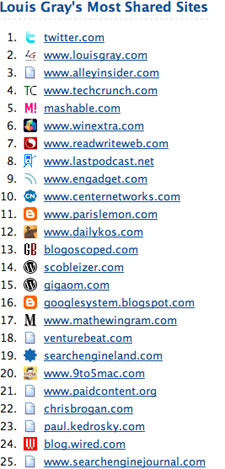
For more than a year, Google Reader has let users know which blogs and RSS feeds are those they read and share most frequently. About a month into LinkRiver's being in the public sphere, the shared item aggregator launched a similar functionality, letting us see not only the topmost 25 shared sites, but also the top 25 most shared keywords. The development comes as developer Adam Stiles continues to quietly expand the site and make it a serious challenger in a growing field.

(See: Adam Stiles: LinkRiver Adds Attention Data)

As discussed in February, LinkRiver is primarily focused on gathering your RSS streams from Google Reader shared items, del.icio.us and other services, letting you act as a human filter for the best of the Web. Through LinkRiver, you can subscribe or "follow" others, and let their streams mix with yours to make a river.

And now, looking at my own statistics, by adding both my Twitter feed and the RSS feed for louisgray.com to my LinkRiver, I've artificially overweighted both services, making me look like a serious egomaniac.

Via LinkRiver/Louis: Attention, we find the sites I share most often includes the A-listers like Silicon Alley Insider, TechCrunch and Read Write Web, but also B-listers including Steven Hodson and Frederic Lardinois. My top keywords included big companies like Google, Yahoo! and Microsoft, but also FriendFeed (at #7), FeedBurner (at #14), ReadBurner (at #24) and LinkRiver (at #25).

Unique to LinkRiver, so far as I'm aware, is the ability to see the same data for other users of the service. I can see that Frederic shares ValleyWag a lot more than I do, and enjoys both BlogHerald and LifeHacker. I can also see that Paul Buchheit shares items from VentureBeat, Marc Andreesen, and Andrew Sullivan.

The shared attention sites are available not just for the active users of LinkRiver, but the seed accounts as well. You can look in on such folks' activity as Jeremy Zawodny, Nick Bradbury, Daryl Tay, and Chris Brogan, for instance.

Unsurprisingly, LinkRiver's data on me is fairly in line with what Google Reader reports, given the high overlap. But it's more comprehensive than Google Reader, thanks to LinkRiver's incorporation of other services. The data is good to see, and something I think other aggregators, such as FriendFeed, would be wise to follow.

March 7, 2008

March 7, 2008 · 1 MIN READ · BY LOUIS GRAY

Yes, I'll Send a Member of My Team Immediately

Yes, I'll Send a Member of My Team Immediately

It's SXSW week, and some PR folks are under the mistaken impression that I'm both going and/or a big deal. :-)

After I got an e-mail from one PR rep earlier in the week about a company looking to capitalize on social media, and I had no interest, this afternoon I got a follow-up. (With edits, naturally)

"Any interest in the (client name) social media story? They’re in Austin all weekend meeting with bloggers and media if you have anyone down there who’d like to talk with them."

Yes, of course. I'll send one of my staffers to go get this story immediately. All expenses paid. What... you're saying I don't have staff? Or I did, and they just quit? Dang. I'll have to get back to you then.
March 7, 2008 · 5 MIN READ · BY LOUIS GRAY

louisgray.com: A Brief History of the Site

louisgray.com: A Brief History of the Site

Editor's note: I've been thinking a lot about how I first found Web services or made them part of online life. Some, I have perfect answers for, and others, not so much. I hope to talk more about some of these experiences in the coming weeks. But I thought it'd be interesting to play show and tell with just how louisgray.com got started, with all the missteps along the way.
And soon... we can talk about all the other cool services and how we got there.

1999 - 2001


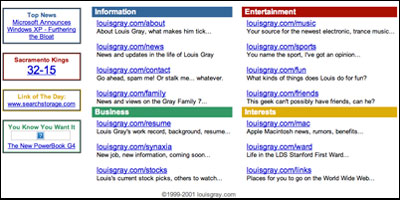
I first bought the louisgray.com domain on December 30 of 1999. I didn't do much with it in the first round, building out a set of static pages that essentially acted as an "About Us" site, featuring comments on sports, tech and stocks. Amusingly, I'd patterned the look and feel of the site off one of Google's "About Us" pages, hence the coloring and clean look. I didn't expect Google to get as big as they are now, but I liked their design even back then. Of course, if I used that look/feel now, it'd have been obvious.

But I didn't give the site much attention. At one point, I even let it expire!

(See the Archive.org Backup from February 2001)

2004 - 2005

I bought louisgray.com back again in 2004, from a new registrar, but again, didn't do much. In fact, given I'd largely deleted the old files, I had to crawl through archive.org to find the old content and graphics, and rebuilt.

(See the Archive.org Backup from August 2004)

In 2005, I messed around with launching a blog with Six Apart's TypePad software, but I didn't get all that far. Eventually, I'm sure I broke it, and I abandoned the plan, but didn't give up on the idea. In fact, most of what I did with louisgray.com at this time was serve as a repository for my ANtics Oakland A's comics, featured on AthleticsNation.com.

2006


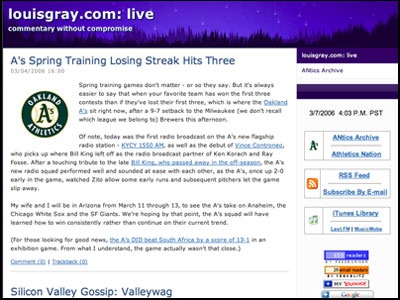
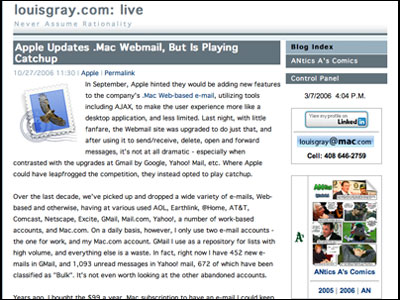
In 2006, I finally found a solution that let me blog to louisgray.com. A little fatigued by the non-tech content on my family's shared blog, in existence from 2004, I forged out on my own, very slowly, mostly offering an echo chamber that consisted of talking to myself about the A's and Silicon Valley news. I certainly wasn't breaking news, but instead, treating it as one person's commentary on the day's news.


(See Archive.org for Mach 2006 and October of 2006.)

First Half 2007 - The Scoble Effect

Writing for my seeming one-person audience was at times frustrating. But somewhere between mid-2006 and early 2007 I had this epiphany around Web 2.0 and leading bloggers. I started leaving comments on some sites, and engaging. At times, I felt like I was catching up in terms of the quality of the content, talking about the news of the day, but I wasn't getting any traction.

In January of 2007, I let my frustration spill over a bit. Robert Scoble wrote a memorable post called "Pissing off the blogosphere…, where he recapped complaining that large blogs like Engadget weren't linking his way. The first to comment on his story, I wrote, "... for what it’s worth, you are one of the A-listers who everybody who does link links to. As you know, all us Z-listers are pumping out content every day and it could be nobody notices…"

Robert, only minutes later, wrote, "Louis, just subscribed to you. I appreciate it is tough for a new blogger to get noticed. I wonder how we can solve that?"

Clearly, I got Robert thinking... as for a later post that day, he asked, "Do A-list bloggers have a responsibility to link to others?, where he offered to visit and subscribe to good tech blogs, mine included.

This made me excited, but nervous too. For if I didn't start writing about stuff that Scoble wanted, he would unsubscribe. He wouldn't share my items in his link reader, and that'd be the end of that little experiment. Luckily, I started to arc my coverage even more toward tech, and more toward those things he liked, including Google Reader and RSS.

January of 2007 was also a big move behind the scenes, as I moved off RapidWeaver, a Mac OS X software application, and onto Google's Blogger, where we remain today. It's not WordPress, but it does exactly what I need it to.

Second Half 2007

18 months into the new blogging experiment, I continued to fly under the radar for the most part, with the exception of the occasional surprise on TechMeme and rare Scoble link. But I also started to find friends with similar interests who covered similar things, people like Steven Hodson of WinExtra, Jason Kaneshiro of Webomatica, MG Siegler of ParisLemon, Kent Newsome of Newsome.org and Frederic Lardinois of The Last Podcast. This little sub-community served, in my opinion, to help push each of us further to do better and keep up the pace. Even if just a few dozen of us were trading ideas and sharing comments, it was something. In this time, I was also buoyed by seeing my subscriber base grow from less than 100 to about 200 by end of year.

Early 2008

Not much use recapping this. It's early yet. But I've talked openly about some of the momentum we've had, now that we have a better idea of what we want to talk about, and now that we have new services coming to market, wanting to be part of the discussion and engaged. I've been delighted to see services I talk about go from 5 users to 500 seemingly overnight, or to see others excited about finding new sites with my help. And while I once felt stress to remain relevant, I feel a lot more comfortable now, that we're engaged and actively part of a larger conversation. And now that we're here... you know, as Paul Harvey says... the rest of the story.