In mainstream print journalism, a good headline can be remembered for decades, whether for its unintentional incorrectness ("Dewey Defeats Truman" --
Chicago Daily Tribune, November 3, 1948), its unconventional approach ("BASTARDS!" --
San Francisco Examiner, Sept. 12, 2001), its editorial wit ("Headless Body In Topless Bar" --
New York Post, April 15, 1983), or its emotional angst. ("Ford to City: Drop Dead" --
New York Daily News, October 30, 1975)
With social aspects of blog consumption becoming increasingly important, as well as the meteoric rise of RSS feed readers to take in information, a good blog headline can mean your story will be read instead of others on the same topic.
A good headline can mean the difference between getting ignored and getting
Dugg, and as seemingly everyone is adding new feeds by the day, the sheer overload of information virtually guarantees a high number of your readers may never get to the full body of your story, if the headline doesn't grab their interest, or even turns them away.
Today, it is well accepted that
Google Reader is the most widely-utilized RSS feed reader out there. While some have said it's not capable of handling the most avid feed consumers, I've yet to see one built more robustly. Helpfully, the service also offers a full set of historical statistics.
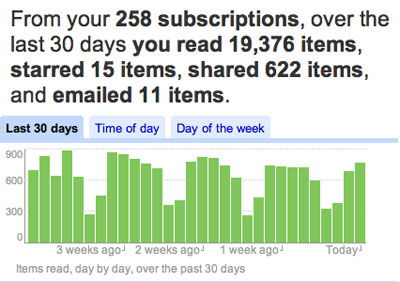
My Google Reader data as of this evening.On a typical weekday, my stats show I'm seeing 700 to 900 items in my Google Reader, and need to make a quick judgment call on whether I'll read the full story, click through if it's a partial feed, hit share, or move on.
Just how little time do I have to make that decision? Assume that I read every post for 1 minute apiece. This would mean I spend 12-15 hours a day just in Google Reader. Take that number down to only 10 seconds, and you're still looking at 2 hours a day. What about three measly seconds? Taking a mere three seconds per headline means I've carved out 45 minutes a day just for feed reading, assuming 900 items. On the low end, that would be 30 minutes a day for 600 items, including those you actually read, and don't just scan the headlines.
RSS feed reading at that volume only truly becomes trivial if you think you can read and determine an action for the average post in one second. One second per post could take you all the way down to a stressful speed reading demonstration of 15 minutes a day. (Don't even try and get me started on
how folks like Robert Scoble, who read more than I do, manage to cope.)
Contributing factors to whether I
share a post on my link blog include the newness and uniqueness of the information, the quality or brand of the source and conversely if it's a new and emerging blogger, the amount of interest I have in the topic, that I perceive my readers to have in that topic, and the quality or content of the post itself.
But also a factor? The headline. If I happen upon two stories on the same topic, of interest to me and my readers, where the source is equal, it can be the headline and first paragraph that make one item shared over another. And as it is only the headline that is displayed in my Google Reader shared items on my blog or on
FriendFeed, that's sometimes all the consumers see as well.
The issue of headlines becomes especially important for sites like Digg,
Reddit and the like. Reddit, in fact, shows only headlines, begging for an up or down arrow. Digg shows a headline, and a submitter's authored one paragraph description. When you see stories that have hundreds or thousands of Diggs, do you really think all of those folks clicked out to the story, read it, and returned to Digg it? I doubt it.
Outside of social news submission sites, you can also see the importance of the headline on places like
TechMeme. Items in the TechMeme discussion links show only a headline, and the story's source. Often, there can be 5-20 different stories from different sources on the same topic, making the headline, or the brand of the source, be the deciding factor for which post to click.
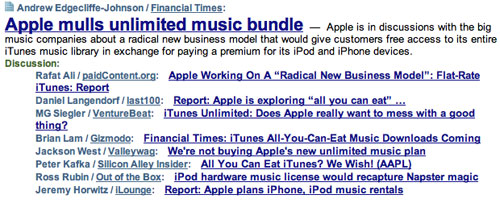
An example TechMeme discussion from tonight.In 1998-1999, while wrapping up my senior year at Berkeley, I worked at
a Web site focused on Internet and Silicon Valley history, called Internet Valley. My boss was certain that Web site consumption would change, and that the era of long textual pieces without styling was dying, in favor of pieces highlighted by bold, italics and colors. His theory was that Web users would "skim" and no longer "read" articles.
While his design tendencies were abysmal, he was right about people changing the way they consume news in this firehose of information. Now, it's obvious that you can lose them from your headlines alone, so for as much work as you may put into your writing, and getting the data or sources right, give your headlines their due.
 At the end of February, MyBlogLog debuted their entry into the lifestreaming market, aggregating your services from around the Web, and should you choose, showing you those activities from your MyBlogLog contacts. While I wasn't blown away with their first attempt, the Yahoo! subsidiary has come back with a new MyBlogLog-only wrinkle, dividing the lifestreaming activity by Topics, aggregated around specific tags. Now, instead of seeing the lifestream from just your contacts, you can see who the top members are by topic, and see a specific topic stream as a whole.
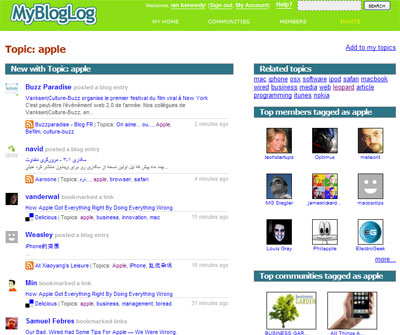 Early pre-launch screenshots from the new MyBlogLog Topics showing streams for "Web 2.0" and "Apple", for example, show how blog posts or del.icio.us bookmarks tagged with those terms fill the topic feed, with mugshots of "top members" and top community thumbnails also tagged on the right side. You can even subscribe to the Topics feed by RSS if you want to take the stream with you. (See: MyBlogLog: Topics: Apple)
 This morning, TechCrunch's Michael Arrington, amid news and rumors that some blog networks are raising millions of dollars in funding, said that with more to lose in the blogging business, these funded networks are going to get more aggressive, not just in focusing on content, but also on politics, picking fights when necessary. But most interestingly to me, he stated
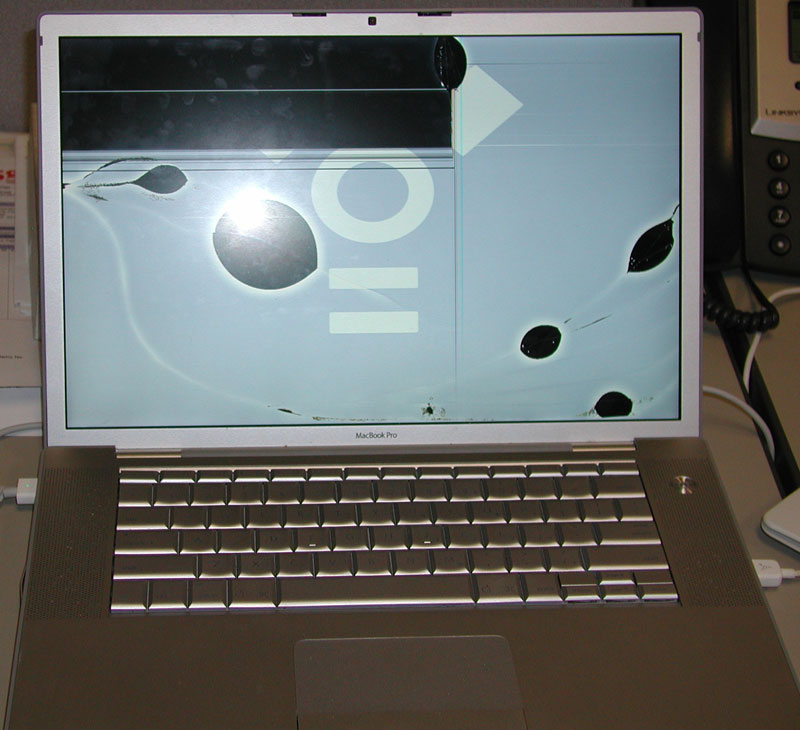
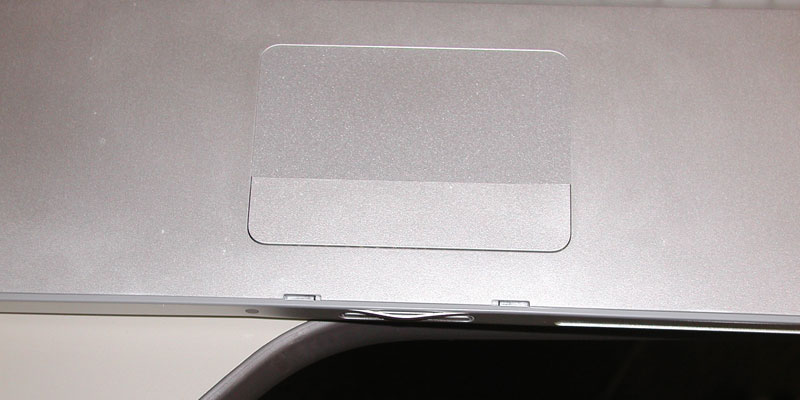
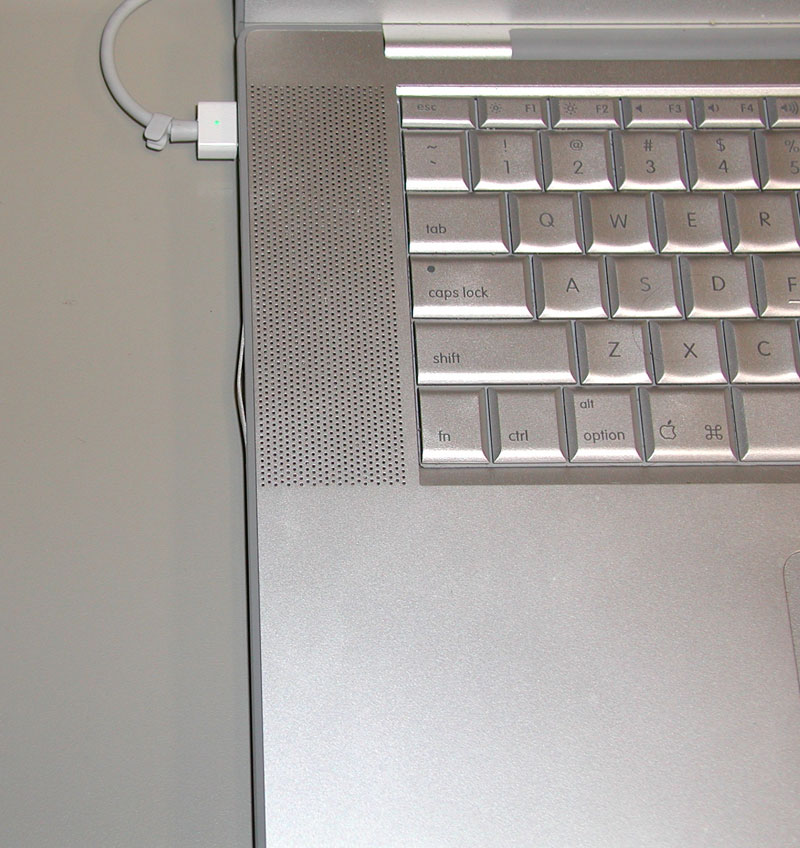
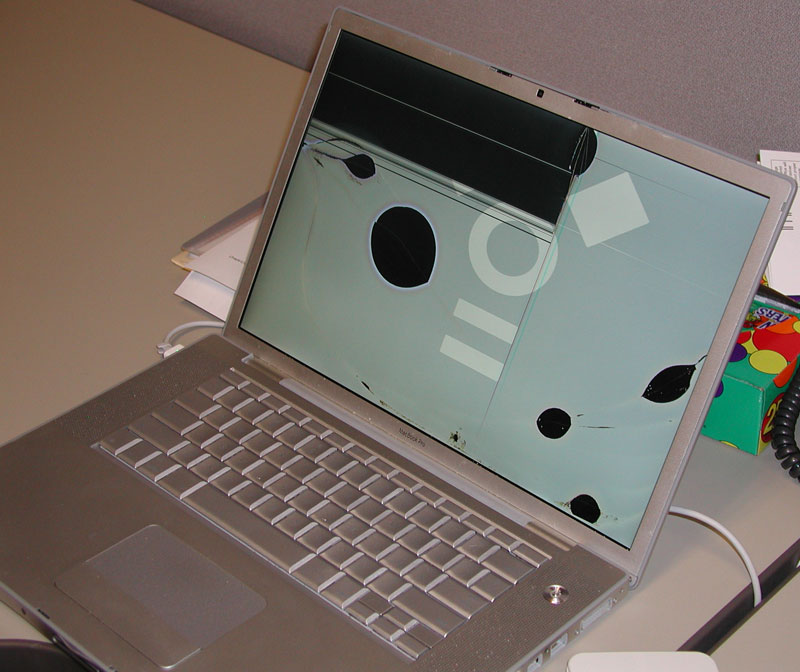
 Ever have 30 seconds of your life that you wish you could take back? A mere 30 seconds that can make a great experience instead be recalled with stains of regret? That's the quandary I find myself in, as after wrapping up a quick mini vacation that saw the Oakland A's win all four of the Spring Training games we saw from Thursday through yesterday, I made a stupid mistake that is already costing me sleep and productivity, and will no doubt lead to hitting my pocketbook. For yesterday, I crushed my MacBook Pro, like a moron, and I have pictures to prove it.