Silicon Valley Technology Commentary & Archives · Est. 2006 3,034 Posts · 2006–2026

March 31, 2008

March 31, 2008 · 2 MIN READ · BY LOUIS GRAY

Yokway's Social Sharing Site Launches In Beta

Yokway's Social Sharing Site Launches In Beta

At the beginning of the month, I profiled an early edition of Yokway!, an interesting Digg-like derivative for small social circles of friends interested in similar topics. Now, nearly a month later, the site is ready to open up for beta users, having upgraded their user interface, adding search functionality, and reorganizing the site to better help users find friends interested in similar topics. And while Yokway! doesn't yet have the kind of buzz behind it that FriendFeed has developed, it debuts with a number of handy items that the popular social aggregation site doesn't yet have nailed.

Yokway's central offering is a site that lets you view items shared from your friends. Unlike some other lifestreaming services, which pull data from RSS feeds via services around the Web, Yokway requires users to post items one at a time, like Digg, select a topic, and provide a comment. This is called "Yoking", to be used as in the phrase, "What's Yoking?", also translated as "What's Happening?"
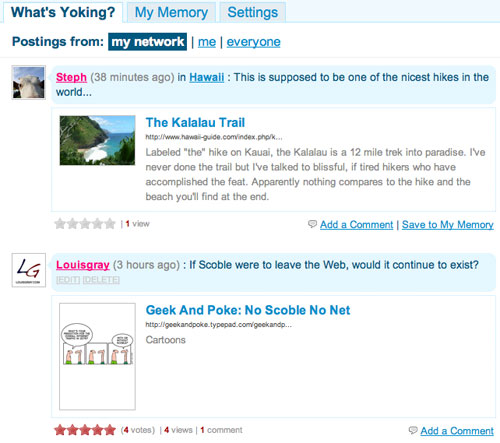

The Yokway! stream in action with two shared items.


The "What's Yoking?" stream has three modes, much like FriendFeed does, offering a "my network" stream with updates from myself and all friends, one just for my activity, and a third, for "everyone", encompassing all Yokway users.
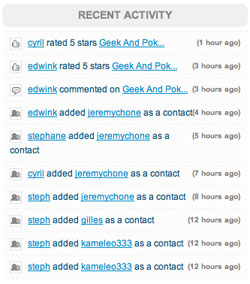
Running alongside the "What's Yoking?" stream is a "Recent Activity" board, which shows not just what's been posted recently, but who may have rated an item (from one to five stars), when they did it, and if they made comments or added new contacts.

In this early beta phase, the "Recent Activity" encompasses the last 12 hours, but undoubtedly, as users increase, it could provide a live, to the minute, feed.

Beyond the basics, what sets Yokway apart from FriendFeed is the use of topics, which Yokway calls "My Sharing Circles". Anybody can create a new "Sharing Circle", and I immediately joined a few that are likely no surprise to you, including "Web 2.0 Technologies", "Startups", "Faebook", and "Semantic Web". Clicking on any sharing circle shows all shares within the circle, as well as comments, the total number of views, and their rating.

Another pleasant feature from Yokway is the ability to state your relationship to a contact. While with many services, including Twitter and FriendFeed, you're either a "friend" or you're not, Yokway has an option to mark a contact as a friend, family or coworker. While I don't yet see how this is used at this stage, the groundwork is there to maybe share items with family or coworkers only, for example, or it could be to show other contacts how you know a contact they're not familiar with.

The service will have an uphill road to climb to take on sites like FriendFeed or Digg who have significant market traction, but its features are certainly interesting, and the team has done a lot of work in the last four weeks to upgrade the user interface. If you would like to start using Yokway, head to www.yokway.com and post your e-mail address to get a beta account. You can find me here: Yokway!: LouisGray.

March 31, 2008 · 1 MIN READ · BY LOUIS GRAY

Robert Scoble on Long-Form Blogging, New Voices

Robert Scoble on Long-Form Blogging, New Voices


Video Courtesy Mashable! and embedded from Stickam.

Starting around 6:20 into the video...

Pete Cashmore: "... the key question I wanted to ask you, which is, we're asking 'Blogs - what are they good for?' Is the long form of blogs kind of outdated now, and are you and other personal bloggers kind of moving on to Twitter, to FriendFeed and Facebook? It seems like you're building a personal brand, and blogging, really, that long form that takes more time - you seem to be on Twitter, developing more on Twitter..."

Robert Scoble: "Yeah, but new voices are taking our place, right? Louis Gray... who the hell is he? He came out of nowhere and is on the TechMeme leaderboard."

Cashmore: "There is something I seem to remember..." (Likely referring to this discussion from January)

Scoble: "Absolutely. And that's part of getting attention. But he's doing great, thoughtful, long posts, and he's adding something to the blogosphere that we're not able to add any more because we're too busy flying around the world."
I certainly didn't expect this kind of praise from Robert Scoble, who has forged one of the most well-recognized brands in blogging, but it's much appreciated. I just hope that over time, we move away from "Who is this guy?" to the name meaning something. Appreciate the mention, Robert. (Also: Hat tip to Matt Shaulis at Shyftr, who alerted me to it.)
-- Louis

March 30, 2008

March 30, 2008 · 3 MIN READ · BY LOUIS GRAY

RSSMeme Helps Bloggers Know What Their Readers Like

RSSMeme Helps Bloggers Know What Their Readers Like

RSSMeme, now two months old, has carved out an interesting niche in the shared links aggregation market, first forged by Mario Romero's FeedHeads application on Facebook, and later seeing ReadBurner and RSSMeme crowd in for availability on the Internet as a whole.

One of RSSMeme's so-far unique options is for a blog author to drill down and see how frequently each of their own blog posts have been shared on Google Reader link blogs. For those authors who have a variety of topics, RSSMeme can help gain yet another level of insight into what readers are finding most interesting, as well as saying what topics should be avoided in the future. As RSSMeme has the largest easily accessible library of Google Reader shared link blogs, it provides a good sounding board for the many popular tech blogs users are subscribed to.

To be counted among the most popular shared items on RSSMeme, an item would need at least 50 shares to achieve the weekly leaderboard, and nearly 100 shares for the all-time leaderboard. But for small fry like me, I can tell that one of my own items can be considered "popular" when it has as many as a dozen shares, and most popular items occasionally cross the 20 threshold. (See my RSSMeme page here)

Looking at my dedicated RSSMeme page, of the 20 items listed there, I had a total of 232 shares (as of 5 p.m. Sunday), for an average of 11.6 shares per item. Of these 20 items, five had as many as 18 shares or more apiece, including "Our Unborn Kids Will Wear Your Web 2.0 Schwag (18)", "LinkedIn Company Detail Shows Silicon Valley Carousel (20)", "In Blogging and RSS, Headlines Can be Make or Break (19)", "Duncan Riley Misses the Point of FriendFeed (19)" and "ReadBurner to Return With New Ownership (21)". Each of these items had a technology/Web feel to it, as did those items which fell just behind.

On the other side of things, three posts only had one measly share. Of those three, two were stories I wrote about baseball, and one was about having to use my old PowerBook. As Yuvi Panda, the once and future stat king, wrote me not too long ago, "One thing that you seem to like writing about but people don’t really pay too much attention to is sports." Looks like he was right.

This level of disparity becomes even more pronounced with the more popular subscribed blogs.

TechCrunch's last 20 items range from 3 and 4 shares for a pair of stories on Yahoo! to 72 and 81 shares for a pair of stories on FriendFeed. (See: RSSMeme: TechCrunch)

ReadWriteWeb's last 20 items show one item on Microsoft's SilverLight gained only 2 shares, while a review of Toluu racked up 45 and Sarah Perez's comments on good UI design got 70. (See: RSSMeme: Read/Write Web)

And Robert Scoble bottoms out at 2 shares for highlighting a recent video with Mashable, but peaks at 86 for revealing the secret to Twitter. Other hot topics gaining about 40 shares each was a post saying FriendFeed would trump TechMeme or Google Reader, and saying TechCrunch's Michael Arrington had the wrong goals for assembling a "Dream Team". ( See: RSSMeme: Scobleizer.com)

RSSMeme has done more than just tally the most popular shared items on Google Reader, and display publicly available link blogs. You can now visit any shared blog's dedicated page, and get a visual approximation for how frequently the site's readers are hitting share in Google Reader, and what topics those who read RSS feeds like.

If you have a blog with an RSS feed, I encourage you to go to www.rssmeme.com, do a search for your name, and see what your readers like. It'll even tell you who shared what, and isn't that the kind of direct feedback you're looking for?

March 28, 2008

March 28, 2008 · 3 MIN READ · BY LOUIS GRAY

The Largest Blogs Are Still Rapidly Growing Their Subscriber Base

The Largest Blogs Are Still Rapidly Growing Their Subscriber Base

There's no universally accepted way to track momentum in the blogosphere. Some point to Alexa and ComScore statistics, while others poke holes at this data. Others instead look to the TechMeme leaderboard to show who has the largest share of voice in tech. But we do have access to some quantitative tools that give us a clearer picture into just how fast the largest blogs are growing their most loyal readers via RSS, thanks to FeedBurner and tertiary services, including BlogPerfume and RatingBurner.
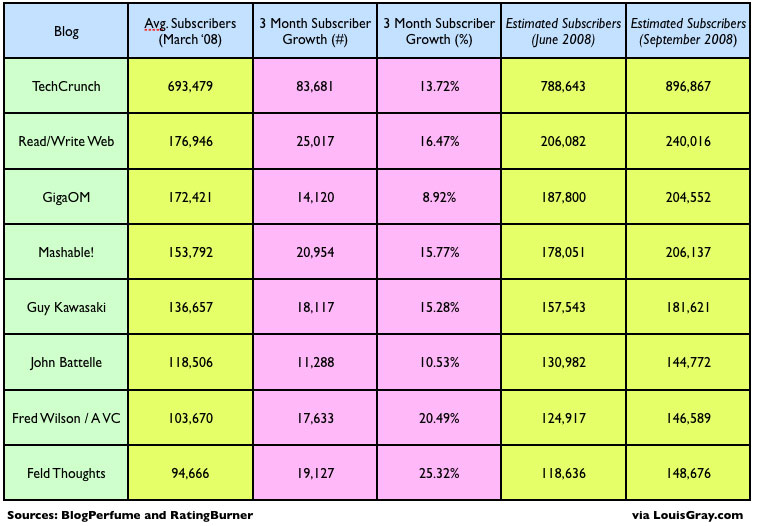
In December I first mentioned BlogPerfume and the site's ability to review your FeedBurner RSS growth, and project your statistics three, six and twelve months ahead. But more interesting than self navel-gazing, you can view any blog's statistics, so long as they use FeedBurner as their RSS engine and activate the Awareness API.

(This restriction made some popular feeds, including Engadget and Robert Scoble, unavailable for analysis.)

I clicked over to RatingBurner, which ranks public FeedBurner feeds from most popular to least popular, and fed BlogPerfume some of the most popular technology blogs.


(Click for larger image)

A quick look at some of the leaders in the so-called A-List, who hover in the 100,000 or so RSS subscriber range and above, shows 3-month growth of 10 to 25% per site. Looking much lower in the list, to those who are in the 500 to 5,000 or so RSS subscriber bracket, you can see a great deal wider range, including some who have nearly doubled their subscriber count over the last 90 days.

Unsurprisingly, TechCrunch is the king of the hill here, with an average of nearly 700,000 subscribers this month. Over the last three months alone, TechCrunch added nearly 84,000 new RSS subscribers, for a growth rate of 13.72%. BlogPerfume also showed single month growth of 4.2%, and projected TechCrunch would break 1 million subscribers before this time next year.

TechCrunch's enormous subscriber base means other sites can grow more quickly, despite getting fewer net new RSS readers. In the same period, Read/Write Web grew 16.47%, adding 25,017 subscribers, and Mashable! grew 15.77%, increasing their total by, 20,954. In fact, Mashable!'s high growth rate, coupled with GigaOM's lower 8.92% growth rate, would see them pass up Om Malik's team before six months are up, if you project that 90-day trajectory forward. Lower down the chart, you can also see Fred Wilson and Brad Feld posting growth rates of more than 20%, as they reach six digits. (Also Included: Guy Kawasaki, John Battelle)


(Click for larger image)

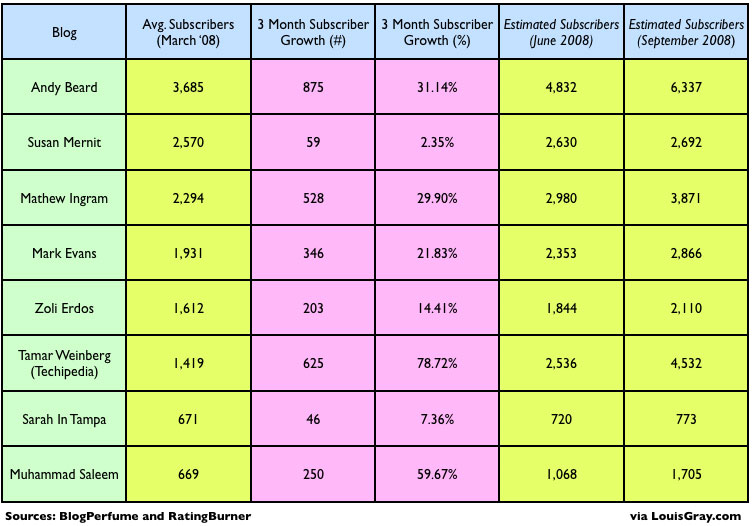
In fact, RSS subscribers are growing steadily at all levels. Looking down where I live and breathe, growth rates over the last three months at those off us under the 5k level show 30% increases for Andy Beard and Mathew Ingram, and dramatically higher levels for people like Tamar Weinberg (78.72%) and Muhammad Saleem (59.67%). (Also included: Mark Evans, Zoli Erdos, Susan Mernit and Sarah In Tampa)


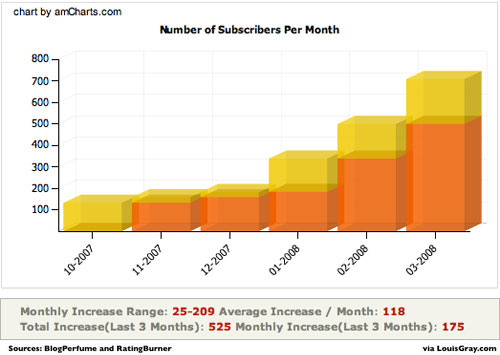
Our own stats reflected one-month growth of 41.88%, and three-month growth of 286.89%, with an average of 708 subscribers, up from just 183 back at the start of December. (See: BlogPerfume: LouisGray.com and above chart.)

Even as some are openly discussing dropping the RSS feed reader, or asking where they are going next, this rising tide is raising all boats. While there's no doubt this initial report is partial, it shows RSS adoption is strong at every level. With anticipated further growth in adoption and gravitation toward tech blogging, the momentum is sure to continue.


I know I didn't get every relevant site, so if you found one that is remarkable in growth rate or wasn't what you expected, head to http://www.blogperfume.com/feed-analysis/index.php, put their FeedBurner URL in, and note it in the comments. I'm eager to see what you find.