 In the 2008 presidential campaign, much has been made as to how the Obama camp and the Clinton camp have had differing approaches to using new Web 2.0 vehicles. Both Obama and Clinton have Twitter accounts, but Obama has gained many more followers, and the account follows people, while Clinton's does not. Obama's campaign even has a FriendFeed account, and both Obama and Clinton, as well as John McCain, have pages on LinkedIn with full resumes. But it's easy to see through this thin veneer of Web activity and realize it's not the actual individuals staffing the accounts. By and large, they are used as a vehicle for campaign's daily propaganda, promoting the issues of the day.
On this backdrop comes Maine resident Alex Hammer (See: Bio). Alex, 42 years old, with a background as the owner of HSC Media, an online media company based in New York, ran as an Independent candidate for governor in Maine during the 2006 campaign, is considering running again in 2010, and his name has even come up in some circles at the national level as a small number of supporters are urging him to take a run at the White House. (See: DC Political Report)
In the meantime, Alex is putting his efforts behind a vast network of 14 destination Web sites called Media 2.0 aimed to develop communities for engaging and discussing a wide array of topics, from Politics 2.0 and Financing 2.0, to a site dedicated to today's tech leaders at Tech Leaders 2.0. Alex's daily information consumption routine also extends well beyond the day's ink-stained papers and cable news networks, taking in Techmeme, Twitter, Facebook, FriendFeed, BlogLines and Toluu, aiming to use these next generation tools to enable knowledge and empowerment.
Late Monday night, we had a phone call where he expressed his excitement for both technology and politics.
He told me, "It's about empowerment. I see politics and technology as a natural overlap and bridge. People look to politics and technology for change and for prosperity. Politics are supposed to benefit our lives if they are done right."
Alex mentioned a number of people who have successfully managed to maintain high profiles in both the world of politics and the Web, including Arianna Huffington of the Huffington Post and Micah Sifry of the Personal Democracy Forum, as key influencers, as well as TechCrunch's Michael Arrington's interviews with various presidential candidates of both parties early in this election cycle.
Luckily for Alex, the state of Maine has a long history of supporting independent candidates. Maine had the first independent governor in the country, James Longley, who held the position from 1975 to 1979, and later, saw Angus King, another Independent, hold down the fort for two terms from 1995 to 2003. In 1996, during King's first term, Maine also passed the Maine Clean Election Act (MCEA), which established a program of full public financing of political campaigns for candidates running for Governor, State Senator or State Representative positions, making it easier for elections to be open to more participants. As with the McCain-Feingold campaign finance reform bill, the MCEA was intended to "take big money influence out of politics" and "level the playing field", Alex said. This led to 17 candidates in the 2006 gubernatorial campaign, which saw many raise in excess of $1 million apiece.
The pervasive integration of technology in a changing economy greatly impacted Alex's political platform. Issues surrounding Clean Technology have seen significant support from the Venture Capitalist community, gaining prominence at times even eclipsing that of Web companies. Alex believes that this trend plays right into the hands of the state of Maine.
"Maine has a lot of strengths," he said. "Maine is positioned to take advantage of these clean technology trends, including forestry, agricultural science, and being a leading state on renewable energy. We have a lot of these expertise for solving these environmental solutions. It's not well coordinated yet, but there are strengths that could be leveraged."
Making Maine a player on this stage could help stem some of the woes the state has seen in the job market over recent years, Alex argues.
"Maine is not a poor state, but it's not a rich state," he said. "It has lost a lot of jobs from manufacturing, and the services jobs don't pay as well comparatively. The state needs help transitioning to a 21st century economy, which is why I turned so much of my efforts to technology."
His efforts around Media 2.0 are aimed to create sticky destination sites that offer a customized knowledge base, as well as aggregated content from leading feeds. Alex claims that at this stage, a robust 18% of all visitors across the 14 active sites stay for an hour or more, and the network has a high volume of repeat traffic. But, so far, Alex is still the primary content generator, and hasn't gained a lot of outside help, which would come following a planned finance round, which currently has him engaged with VCs and angel investors.
The investment of time and community-building on the Web supports his overall belief that you need to be actively engaged, offering a win-win situation for you and your constituents, and to be flexible as change occurs.
"The reason I called it Media 2.0 is that this is about disruptive technology and processes," Alex said. "Now, with the debate of Blogging 1.0 and Blogging 2.0, we see the bloggers who themselves were once disruptive are themselves being disrupted by the way things are changing. We have to go where the action is, but I believe you always have to give more than you take. If you don't help anybody else, then nobody will help you."
By engaging in the blogosphere, and developing new relationships, Alex believes he is creating real value, and a competitive advantage.
"I focus on trying to tap into other people's knowledge," Alex says. "Before I got into politics, I read the biographies of all the recent presidents. Those who don't study the past are doomed to repeat it, and it's important to maximize the value of time and that's why I have tried to make processes more efficient. You don't have to go to 50 different sites with Media 2.0. I try to be a sponge, to pick people's brains as much as I can, to provide info and take info."
And for Alex, there's no telling where taking his traditional background in politics and getting seriously embedded in the world of Web 2.0 and the tech blogosphere could take him. But he says he's not running for president this year, and while he hasn't yet made a final decision, he's leaning toward Barack Obama in this year's campaign.
He believes the Independent voter hasn't been given its proper share of voice in this country, and that the two-party system isn't interested in making life easy for those with alternative messages, but the 2008 election has already proven that change is in the air, with Hillary Clinton getting further in the campaign process than any female candidate in American history, and with Barack Obama looking sure to take the Democratic nomination.
"In America, a lot more things are becoming possible," he said. "It's an exciting time in the world. There's a lot going on. Not only is there more change, but the rate of change is increasing. Even five years ago, on the Internet, you could take a day off and not miss anything. Now you take 20 minutes off, and you're #100 in the comments. Little differences become magnified. You might be 2% more efficient, but 100% more successful."
Alex will more than likely see a greater level of success in 2010 than he did in 2006, as his campaign was felled short after he was struck by a truck in a major traffic accident that put him in the hospital for a month, and forced him to wear crutches for a full year. He writes, "I am well known and highly regarded across Maine's political and additional leadership, for example, and well poised for a strong run in 2010, should I elect to do so," adding, "The Maine Clean Election Act gave some of my opponents $1 million+ to spend on their campaigns."
For an independent candidate who didn't garner 1% of the vote in a race for one of the smaller states in the country, Alex talks a strong game, anticipating that his focus and effort on the Web to enable conversations and give back to the new online constituency will help further his brand, showing him as engaged and ahead of the curve. He's already penned columns for America 2.0 and The Huffington Post, and is a regular contributor to the Magic City Morning Star, where you can see a February 2006 piece on why he believed himself to be the best gubernatorial candidate and later, discussing some of the struggles that can befall a challenging campaign.
When not taking calls from me, or working on his many sites under the Media 2.0 umbrella, Alex can be found on Twitter (AlexHammer) and on FriendFeed (alexhammer), as well as on Facebook.
 Yesterday was another Sunday evening, which meant another night spent filling the Web airwaves with geeky tech talk about blogging trends, where comments belong, and whether one service's success necessarily means that others will have to fail. But Sunday's agenda was aided by the addition of a blogger I've respected for a long time,
  Since its debut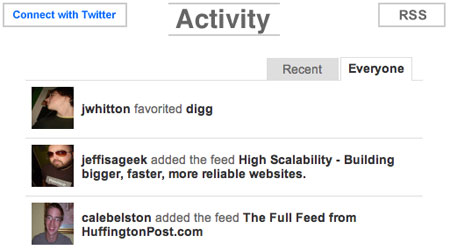
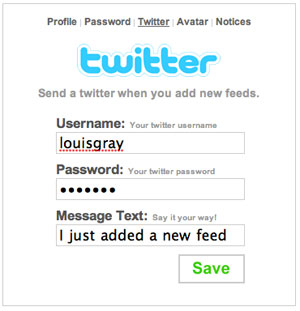 The addition of Twitter notifications offers Toluu users yet another way to share activity with friends, which in turn, offers another route for greater awareness of Toluu, already growing quite well so far on its own. By enabling Twitter integration, you can ask Toluu to send a note if you add a new feed by way of the site, through the bookmark (which I use heavily) or through the import page, which accepts OPML of all flavors.
 Duncan Riley is on a roll. After a multitude of posts from around the Web this weekend once again debating whether comments away from the blog were a good thing, or if new Web services like