Silicon Valley Technology Commentary & Archives · Est. 2006 3,034 Posts · 2006–2026

June 2, 2008

June 2, 2008 · 1 MIN READ · BY LOUIS GRAY

Has FriendFeed's Comment Activity Eclipsed Native Conversations?

Has FriendFeed's Comment Activity Eclipsed Native Conversations?

One of the biggest worries I've seen in blogging over the first half of this year is that with the conversation shifting to social aggregation sites in addition to the originating blog, FriendFeed being the most notable, with Plaxo Pulse, Shyftr and other sites being part of the discussion, that comments on the originating site will disappear, or erode, as activity at the secondary site increases.

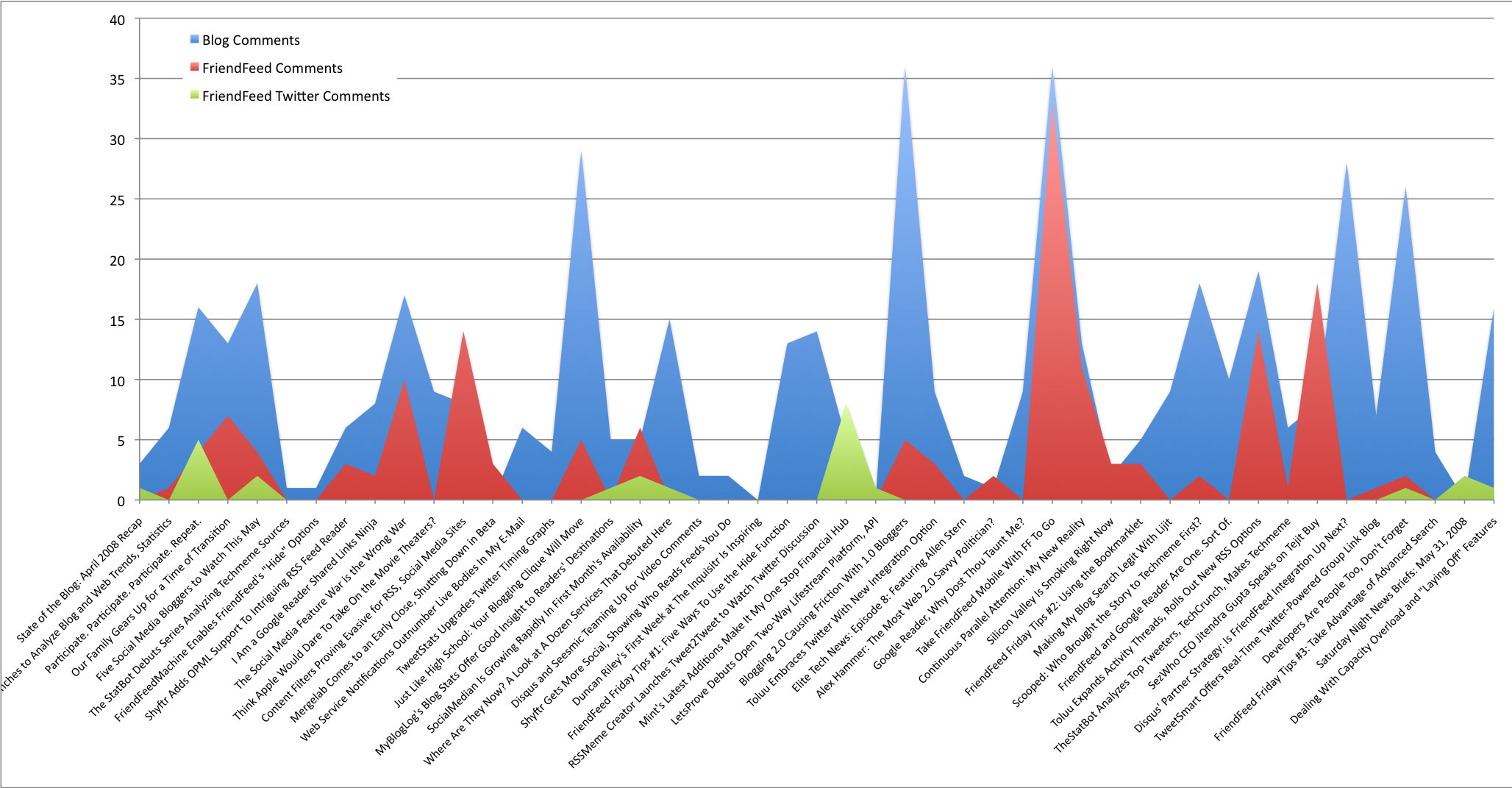
As one of the most visible and active participants on FriendFeed, I looked into my data over the month of May, and saw that on my 47 posts last month:

* There were 470 comments on the blog.
* There were 162 comments on the blog posts on FriendFeed.
* There were 25 comments on FriendFeed via Twitter "blog post" announcements.


May Comment Counts: Click for Much Larger View

On these 47 posts:

* On 3 occasions, no comments were on either site.
* On 1 occasion, both sites received the same number of comments.
* On 6 occasions, FriendFeed blog posts had more comments.
* On 37 occasions, more comments were on louisgray.com.

Source data:
* louisgray.com
* http://friendfeed.com/louisgray?service=blog
* http://friendfeed.com/louisgray?service=twitter

The data set of followers on FriendFeed and louisgray.com is actually quite close. As of tonight, there are 2,013 people following me on FriendFeed, and 1,969 RSS subscribers on louisgray.com, so in theory, with those two measurements being close, there is an equal opportunity for viewers to comment on either location, with there being some significant expected overlap.

I believe that as FriendFeed grows its user base I will see an increase in total comments on my FriendFeed activity, but it has also helped drive traffic and comments back here, in turn spurring the activity and discussion higher. So, has FriendFeed comment activity eclipsed conversations here? No. Not yet.

This serves as a good point in time capture for where we are today. I'll be watching this for sure.

June 1, 2008

June 1, 2008 · 2 MIN READ · BY LOUIS GRAY

Are Blog Comments Really Conversations, or Are They Just Replies?

Are Blog Comments Really Conversations, or Are They Just Replies?

The issue of comment fragmentation has been rearing up every other week or so since the initial discussion flared up in early April, but of late, I've been thinking about the purpose of comments in the first place. When you make a comment on a blog, is it to respond to the blog author and say they did a good job, especially if comments are currency, effectively making a longer version of a "thumbs up or thumbs down," are you looking to further the conversation with the blogger, or are you instead using it as a reply, without anticipating a response from the author?

This morning, I posted a question, using Google Talk, to FriendFeed, saying:

“Are blog comments a "conversation" with the author, or just answering and responding to the author? Do you expect the author to respond to your comment?"

For me personally, on those posts I do where there is a lot of conversation, I'm pulled in two opposing directions - the first, to reply to comments and engage with readers, and the second, to instead not reply and avoid dominating the comment thread. With Disqus tracking my every comment on the blog, I can make myself look like a fairly noisy egoist in no time. So, it is tempting to see the comments on posts as only replies, and fight the urge to respond. Typically, I end up replying to those comments that ask new questions, or spur the conversation forward, but of course, I read every single one.

When I post to other blogs, I don't usually expect a reply from the author. The bigger the blog, the less likely the response, and for small blogs, responses are almost a guarantee.

In response to my note on FriendFeed, the answers were strongly weighted toward conversations, rather than replies.

Brian Sullivan said, "The most successful bloggers it seems to me are conversational."

J.C. Hutchins said, "I always assume that author will read my comment, but rarely respond. Always feels validating when they do, though."

Susan Beebe said, "Blog Comments = Conversations with the world; AND yes, most importantly the author. I do not expect the author to respond to me; however, I am always really glad when they do!"

Of course, if every comment on every blog gained a reply from the original author, the most popular bloggers would spend just as much time responding to comments as they would creating new content. And if you take it one step further, if those replies also generated replies, in theory, the conversation would never end.

As Steven Hodson of WinExtra wrote in Comment Fragmentation isn’t the Blogger’s Fault earlier today, "In the end though we have absolutely no control over where the conversation; if there even is one, will take place." That works both in terms of the blog author not fully controlling where comments take place, and also from the commenter, who cannot force a conversation through leaving a reply. Now that comments are being bandied about like currency, both at the blog and through a myriad of RSS readers and social aggregators, maybe it's time to think about the whole structure of blogging and commenting in the first place.
June 1, 2008 · 3 MIN READ · BY LOUIS GRAY

State of the Blog: May 2008 Recap

State of the Blog: May 2008 Recap

May 2008 In Summary (Archive Page)

Total stories published to date: 1,351

Total stories published in May: 47
(About 1.5 per day, up from 1.3 in April)

Total stories in May with comments: 43
(91% of all stories, up from 34 and 89% in April)

Total comments on May posts: 456
(About 9.7 per post, 10.6 per commented post)


May statistics from SiteMeter, with that service's numbers.
(Why show real data? See blog post)

Technorati Authority Ranking: 659 (up 88)
Feedburner Peak in Month: 2,031 subscribers (up 394)
Feedblitz E-mail Subscribers: 47 subscribers (up 5)
MyBlogLog Members: 246 (up 43)

Twitter Followers: 1,109 (Up 308)
FriendFeed Followers: 1,998 (Up 1,008)

Monthly Traffic Rank in Last 12 (via SiteMeter):
3rd overall, behind the last two months.

Top Five Most Visited May Stories (According to Analog)

1. Blogging 2.0 Causing Friction With 1.0 Bloggers
2. The Social Media Feature War is the Wrong War
3. FriendFeed Friday Tips #1: Five Ways To Use the Hide Function
4. Participate. Participate. Participate. Repeat.
5. Take FriendFeed Mobile With FF To Go

Others receiving votes: Continuous Parallel Attention: My New Reality, FriendFeed Friday Tips #2: Using the Bookmarklet, Scooped: Who Brought the Story to Techmeme First?, Developers Are People Too, Don't Forget, Five Social Media Bloggers to Watch This May, and Where Are They Now? A Look at A Dozen Services That Debuted Here...

Top Five Visited Archive Stories (According to Analog)

1. FriendFeedMachine Debuts New Approach to FriendFeed
2. My Social Media Consumption Workflow
3. What's Your Twitter Noise Ratio?
4. Most Bloggers Don't Deserve Any Ad Revenue
5. Should Fractured Feed Reader Comments Raise Blog Owners' Ire?

After a continued "up and to the right" graph over the last few months, May's overall visits fell about 24% compared with April, at levels 4% lower than even March, according to SiteMeter, while in all other aspects, the surrounding elements of the blog have grown. Part of the reason for the decline? To be direct, the answer is a lowered presence on Techmeme. In April, a number of my more controversial posts, especially around the weekend, drove a significant portion of traffic. In May, I consciously made the decision to not only not launch these controversies, but also to not participate once they had started. It had a negative impact on my simple visitor traffic, but I believe a more positive impact with the blog overall. I didn't exactly want to get the reputation of being a controversy-stirrer, when not necessary.

Now, partly due to not engaging in the more-visible Techmeme headlines, my position on the Techmeme leaderboard is in doubt. At peak in April, louisgray.com had been above position #40, drawing amusement from fellow bloggers like Robert Scoble, who needled me about the positioning on video earlier this month. But now, I'm lingering in the precipitous #98 to #100 position, seeing folks like Yuvi Panda of TheStatBot blow by me.

As mentioned last month, lest it be believed I've started this series to highlight the higher awareness achieved in recent months, be assured that's not the case. I started doing monthly summaries after August of 2007, when I had 103 RSS subscribers, and 40 comments in the month. Hopefully you find these interesting or useful.

To keep on top of things, subscribe via RSS, via e-mail, follow me on Friendfeed or Twitter, or keep watch on the shared link blog!

May 31, 2008

May 31, 2008 · 3 MIN READ · BY LOUIS GRAY

Dealing With Capacity Overload and "Laying Off" Features

Dealing With Capacity Overload and "Laying Off" Features

If you take a step back and think about popular Web services, be they RSS feed readers, communications tools, social networks, link aggregators or lifestreams, their core deliverable is data. The way they are differentiating is through enabling that data to be accessed by more people, and manipulated in new ways. But as their popularity grows, with more users, more features, and richer media, be it photographs, music, or video, the data can spiral out of control, demanding larger databases, more servers, faster networks, better caching... you name it. And if they don't deal with it? Death. The services can slow down or crash, and users will move on.

Not every Web service has had the structure, the planning or the money of Google, so not every site can keep going with all features, saving all data, forever and ever.

Twitter's recent struggles keeping up with user growth and resulting issues have been extremely visible. To cope with the load, the microblogging service started whacking features one by one. At various points, Twitter turned off the @Replies tab, removed pagination, reduced the number of times that external services could access its API, and eliminated the use of instant messaging services. Limping along, Twitter has slowly returned to speed, as one by one, most of the pieces have been turned back on, but not everybody is happy about it.

But don't think Twitter's alone. Just yesterday, I logged into SocialThing, a lifestreaming service thought by many to have a better GUI for FriendFeed, and found that it had been forced to scale back its offering as users grew.

Rather than supporting many different services, SocialThing only lets me include Twitter, Flickr and Facebook, with LiveJournal, Pownce and Vimeo also being options. But the many other sites I use? Blocked. They write, "We have had to temporarily disable a few of our services, due to user growth. We hope to have them back up soon!"
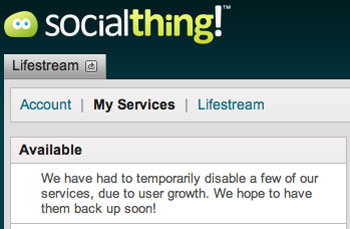

At a time when FriendFeed is gaining notoriety for supporting rapid access to the streaming of 35 different services without slowdown, that kind of scaling down can't be good.

For Shyftr, a new RSS reader I've covered quite a bit here, they too are seeing the challenge of user growth. As we saw with Mergelab's closure, the act of tracking thousands of feeds and storing their data for an infinite amount of time can be very challenging. I've already seen Toluu upgrade their server farm, and Shyftr has done the same recently. But more changes are coming to handle the rising user base.

As founder Dave Stanley wrote in a blog post, Notice: System Changes and New Implementations, Shyftr will be removing "a substantial portion of backdated data" which should reduce recent issues with database performance, and let them turn on services that had been disabled thanks to site slow-downs, including search. As he said, "It's time we trim some fat while making the system leaner, more efficient, and better prepared for future growth."

If you have a Shyftr login, see the full post:
Notice: System Changes and New Implementations

I expect that the rules for small companies are different than the rules for big companies. Twitter has gotten such a bad response for its issues in part due to its popularity, and in part due to its criticality for some communications. For smaller sites like Shyftr and SocialThing, users are more likely to be accepting of temporary scale-backs or data removal. But if the big guys like Yahoo!, Google, Apple or Microsoft, took the route of deleting data and reducing features, it'd be likely that we'd see an uproar.

So how should they handle it? Do you, as a user, have an absolute right to all your archives, ever? Do you have the right to demand that once features are added, they never be removed? And do services have an obligation to scale up their hardware and infrastructure to keep you happy? Would you help fund their upgrades? Handling growth is critical, in my opinion, and those best prepared for scaling will leapfrog those who are forced to "lay off" their data. We're wishing Twitter luck, but there are a lot of smaller services struggling with similar issues.