Silicon Valley Technology Commentary & Archives · Est. 2006 3,034 Posts · 2006–2026

June 13, 2008

June 13, 2008 · 4 MIN READ · BY LOUIS GRAY

FriendFeed Friday Tips #5: Bringing Comments Back to Your Blog

FriendFeed Friday Tips #5: Bringing Comments Back to Your Blog

By popular demand, I've been asked by other FriendFeed users to highlight how I use the popular social lifestreaming site. So far the series has covered the "Hide" function, the bookmarklet, advanced search, and how to integrate with Google Talk. Today, I'm going to talk about how you can bring comments from FriendFeed to your blog, capturing the conversation.

While FriendFeed has gained considerable praise from many corners of the tech blogosphere, one place where they have been maligned is in how conversations that take place on the site aren't immediately ported back to the original blog. These "fragmented conversations" have flared up as major issues every couple of weeks, and while I've personally never had a problem with it, and have actually seen comments on my own site grow, even as I've used FriendFeed, many are hoping to keep control over the conversation and keep it on their site.

While FriendFeed hasn't yet introduced an initiative to defragment these conversations, in their place, independent developers have designed tools that will bring comments from FriendFeed back to blogs, including Wordpress, and as of today, Blogger, both the "new" and the "old" versions of Blogger. You can even see the brand-new tool for Blogger live on my site already.

Bringing FriendFeed Comments to Your WordPress Blog

WordPress has gained a lot of traction in the blogosphere, in part due to its wide library of available third-party plug-ins. Only a day after FriendFeed released its API, the entrepreneurial Glenn Saven debuted announced a plug-in that pulls back comments and likes from FriendFeed and displays them on your site.

As he writes on the plug-in page:
"The plugin ads a template tag called , which you can drop onto your template somewhere inside "the loop" so it can access the post’s details to match it up with the FriendFeed data.
Unzip the plugin into your plugins folder & activate it. You’ll then need to go into the options (or settings if you’re running WP2.5) and click on FriendFeed. Put your FriendFeed nickname in & save and you’re done with the setup. All the other settings in there are optional. You then need to place on your template file(s)."
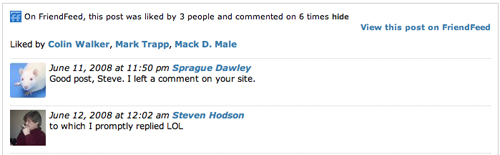
The result is a two-way box that shows how many comments and likes an item received, as well as the avatars of the poster, and has the option to add a comment yourself, back to FriendFeed, assuming you know your user name and API key. You can see it installed at my fellow B-List blogger, Steven Hodson's site, at WinExtra. The below screenshot is from his post Some thoughts on a Microsoft after Gates.


Not having installed WordPress myself and tested this, I'm no expert, but from what I've seen from Steven's site and Duncan Riley's work at The Inquisitr, it works very well.

Bringing FriendFeed Comments to Your Blogger Blog

The argument could be made that Blogger's not the most robust platform out there. It certainly hasn't been the most reliable. And its lacking plug-in architecture has made it a less-preferred choice among the with-it digerati. And for the last three months, as WordPress users have enjoyed Glenn Slaven's solution, we Blogger users have been in the dark. Until now.

Pat Hawks posted code using Yahoo! Pipes, which delivers a lightweight JavaScript based solution, bringing FriendFeed comments back to the originating blog. See: FriendFeed Comments in Blogger.

Rather than copy the full code from Pat, I recommend you visit his page if this is important to you. Still being on the "old" Blogger, I saved my Blogger template (just in case), added the new code, just by adding the JavaScript code after where Blogger concludes comments, and before my already customized Disqus code. Now, when people (including me) comment on my FriendFeed items, I can see the comments here as well, as well as those from Disqus. It's now one great big conversation.
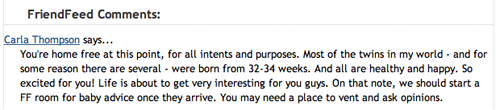


This, for me, is an exciting development. On May 25th, I offered a $250 bounty for the first solution good enough to integrate into my blog that shows both FriendFeed likes and comments. Now, Pat has delivered on comments. So... should I pay up now, or wait for likes to be supported as well? Either way, this is a great add.

On another solution? TypePad, for example?

I don't yet know of a way to get FriendFeed comments back to TypePad, the third leg of the blogging platform triumvirate. If somebody does have a solution, or is in the process, I'd love to hear about it.

So what comes next?

I expect this issue of comment fragmentation to fade away pretty quickly. It might not be long until there are solutions that support commenters, aggregators and publishers, all in one. But until then, these new ways to bring FriendFeed comments to your blog are a great solution. Leave a comment here (or on FriendFeed) if you've got one of these solutions running. I'd love to see it.

June 13, 2008 · 3 MIN READ · BY LOUIS GRAY

Giving a Service Wings By Pushing Them from the Nest

Giving a Service Wings By Pushing Them from the Nest

For those of us blogging who like to break the news by announcing new services, and using our site as their platform to debut, it can be tempting to pull an "old world" journalism mentality and claim that topic as "our turf", resenting anybody else who tries to step in and steal the thunder by posting the news first, or even feeling betrayed if the entrepreneur takes the news somewhere else. But I've seen that after what I consider an incubation period, the fastest-growing services do best when I can step back and let them take their first steps away from the nest, as they engage with other bloggers, gaining them a new audience and greater exposure.

In this analogy, it can be nerve-wracking to see the little ones as they leave the nest. I worry the new caregivers might not see them in the same way I do. The new influencer might be cruel or may not recognize their talents. But to try and protect them by keeping them in the nest could stunt their growth.

As mentioned in yesterday's popular post, the first stage of being an early adopter can at times be indistinguishable from the service's PR or Marketing firm, as you try to make a product you like extremely visible. You've no doubt seen me do this, as I'll not just help by introducing a product, but keeping you posted on its updates, from Assetbar to ReadBurner, FriendFeedMachine, RSSmeme and Toluu.

But there comes a time when the right thing to do is let go, when the service has gained such momentum that I instead suggest the developer reach out to other sites to get a broader perspective and more exposure, so that their service is less tied in with me, and seen, instead as more of the broader landscape.

Don't get me wrong. I love exclusives, and part of my journalism background makes the little hairs on the back of my neck stand up when I know that someone who might be considered competition is writing about the same topic at the same time with the same deadline. But lately, for services that have gotten some traction, I've opted out of story opportunities and encouraged the developer to get some new voices talking instead.

A prime example of this was with Toluu yesterday. On Wednesday, Caleb Elston reached out to me with some great new service updates, including details on subscriptions within Toluu by feed, and story popularity, in part helped by AideRSS. I told Caleb that instead of waiting for me, to take his outreach to the next level, and it worked, without question. Yesterday ended up being a record-setting day for Toluu, after what Hutch Carpenter called a great example of social media marketing, by participating and reaching out to bloggers and following Toluu references on both FriendFeed and Twitter.

Similarly, RSSmeme announced options to find similar sharers of data to you, and integrated widgets on each page that show top tags and sharers for that blog or topic. See: Using RSSmeme To Find Similar Sharers: Louis Gray’s Example. Having just given RSSmeme a ton of credit last Saturday on being the authority on Google Reader sharing notes, I again waved the white flag, and told Benjamin to spread the word. He did, leveraging a custom room on FriendFeed for RSSmeme, to update followers, also adding RSSmeme as a user of the service, and today, leveraging the FriendFeed API to speed up the site.

You can see how other services have taken steps to leave the nest, as other sites, often much bigger than mine, take up the rallying cry:

ReadBurner:
The Inquisitr: ReadBurner Gets Digg Like Features

Shyftr:
Mashable: Shyftr Beats Google Reader with OPML Imports

LinkRiver:
SheGeeks: LinkRiver is My Personal Techmeme

Part of being a good partner to new services is knowing when to let go, and to see if the service has wings. A few weeks ago, I wrote to one pair of entrepreneurs, "Let me know if there's anything else I can do, but I do believe it's going to come down to you guys being more visible." With everything else that's going on, I can't possibly do it all myself. That's why, even though it can be bittersweet on occasion, the right thing to do is let them take a risk and let go. It gives others, like Corvida, the opportunity to do a social media roundup on service updates, and it's best for the community at large.

June 12, 2008

June 12, 2008 · 6 MIN READ · BY LOUIS GRAY

The Five Stages Of Early Adopter Behavior

The Five Stages Of Early Adopter Behavior

Early adopters serve an important role in the world of Web services and technology gadgetry. helping to act in a multi-pronged position that can blur the line between journalist, customer and partner.

The best early adopters not only help spread the word about a new product, but they can help argue its features, they are eager to offer feedback to its developers, and at times can be indistinguishable from the service's PR or Marketing team. But with time, if not coddled, this crowd can often turn against the very service they helped champion, as they move on to the next new thing, sometimes taking an army of followers with them.

This relationship between service and early adopter is a healthy one, assuming the Web service has, in the interim, grown to the point they no longer need the initial proponent's efforts, having expanded to a more mainstream audience, or achieved sustainable organic growth. But if this doesn't happen, it's a very short trip from promotion to abandonment indeed.

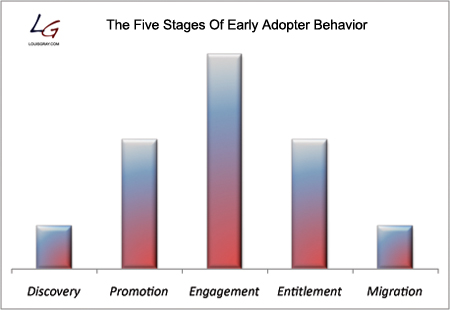
With not too much research, you can see evidence for five major stages of early adopter behavior, as I've summarized below.


1. Discovery, QA and Spreading the Word

The first weeks and months of a service can be very exciting. The early adopter often works with the developer behind the scenes to learn as much as they can about a product, often posting a new story that introduces the site. If there are any bugs with the product, they are easily glossed over as ones which will undoubtedly soon be fixed. If the site doesn't seem all that useful without a multitude of users, this too can be ignored, as the early adopter hopes everyone will see the service's full potential, and will use it the way they expect to.

In this phase, the early adopter has what can be construed as a personal interest in the success of the product, as he or she has gone out on a limb to associate the name with the third party brand. The adopter will not only be a frequent user of the service, but will track other posts or comments about it everywhere, and repeat the agreed upon talking points. Should they actually find a major issue with the product, they will e-mail or call the developers directly, rather than making the issues public.

At times, everything on the Web can be seen through the lenses of just how this new product will be affected, or how it could change everything else. All of a sudden, what may have been a hammer is proclaimed to be a Swiss Army Knife.

2. Promotion and Collaboration

As the service gains momentum, the early adopter befriends the first users of the product, who may have nothing in common except that they share interest in that product. At times, the product may be used only to discuss the product itself.

The early adopter, as new voices discover the service, will push follow-up posts, giving public suggestions to the company, in an extremely positive way, on how they believe the service should change and grow, showing themselves, in front of the world, to be an integral part of the product's development. Should the product incorporate any of these suggestions, whether due to the adopter's input or not, the early adopter will either take credit, or follow up and show how they were "right".

Now using the product a great deal, at the exclusion of others, the early adopter will openly mock those people who haven't jumped aboard yet, pointing them out as being stuck in the past, or married to clearly inferior products.

3. Mainstream Use and Engagement

Having grown tired of the part-time job of delivering free PR for the service, at this point the early adopter no longer feels the need to architect every story and every product through the lens of the service. Instead, having felt vindicated that the masses are now seeing the potential he always knew the product had, he or she remains engaged, trying to act as a "model citizen" for the product, engaging with newer users, but keeping in mind the higher visibility and trying to act as an example.

At this point, follow-on users have now picked up the ball in terms of promoting the product, announcing each of its aspects in the same breath-taking manner the early adopter once did for the service itself. At this point, the early adopter already knows his or her readers and peers know they like the product, and the need to constantly remind people they are using it is no longer necessary.

4. Sense of Entitlement, Nitpicking and Reduced Use

At this point, often in part due to favorable feedback from the service's authors, the early adopter feels a sense of entitlement, that the product absolutely must be architected in the way they say so, even if to move in that direction wouldn't serve the larger installed base. Now, instead of suggesting quick ways the service could update, the calls are more like ultimatums, and if not quickly seeing a response, the early adopter can get extremely frustrated, at times, seeing this annoyance bubble up to the same degree their first comments on the product reeked of praise.

Now disgruntled, the early adopter can be seen using the product less frequently, with less enthusiasm, and will even take consecutive days off, hoping the remaining audience notices the change.

5. Migration to Something New, Call to Move Followers

Having come full circle, from the exciting discovery stage, where the adopter considered themselves a team player, helping a threadbare company grow on the back of continuous praise and promotion, to a high-profile user role, the individual can come crashing down, lashing out at the product, the company's leadership or the product direction. The adopter often finds a tangential service that now draws their eye, and is seen as a replacement for the original product.

The adopter will, at this point, start heaping lavish praise upon the new product, in a quest to assert their dominance, and prove that they can, again, make a service successful, and to prove that all their belly-aching in the preceding months was valid. The adopter will use their blog and both the new and old service to call followers to migrate as a group, both helping the new shiny toy, and in turn, damaging the old one, out of spite and frustration.


On the Web, this process can be extremely fast. One month's golden boy can be next month's afterthought. One week's addiction can be next week's memory. For a service to succeed, it needs to attract those early adopters who can help propel a strong population, but it needs to do all it can to keep those adopters feeling like partners and mainstream users, before letting neglect fire up their egos so much that they leave you altogether. Making a successful Web service is more than writing the best code. It's also about relationships. And while the early adopter crowd is notoriously fickle, they're not going away all that soon.

Take a tally in your head of some of the services you use each day. If you're an early adopter, what stage are you in? If you're not an early adopter, but you know someone who is, what products do they make themselves part of? And do you see these stages progress? I know I do.
June 12, 2008 · 3 MIN READ · BY LOUIS GRAY

Our Twins' Countdown Enters 20 Day Window

Our Twins' Countdown Enters 20 Day Window

A month ago, I offered an update, saying our family was in a time of transition, as we prepared to go from a two-person household to four overnight, with the imminent arrival of our twin boy and girl. Last week, we saw another major change in our home as our 18-year-old beagle companion, Molly, passed on, much to our dismay. Today, following an array of doctor's visits, we're going full-speed ahead with more change, as the twins' debut date is no longer months away, but only weeks.

Here's an update.
(And if you're looking for tech or social media, you can skip this post)

This afternoon, Kristine went in for what's called a Fetal Non-Stress Test (NST), her third, where the babies' heart rates are measured, and she's monitored to check for contractions, be they Braxton Hicks, or the real thing. In both of the first two visits, contractions were definitely taking place, and as it's too early, even for twins, for these two to show up, she has been on medication in the last few weeks, popping pills every four hours, around the clock.

The NST test involved her laying still for about 30 minutes, hooked up to audible heart monitors, and a ticker tape showing their beats per minute, and any noted contractions. Both babies checked in around 135 BPM on average, spiking up to 150 or higher when disturbed. Despite the medicine, we still observed some contracting, but nothing major to be concerned about.

Following the NST test, we headed in for what might be our final ultrasound, in what's become an every two weeks visit at Lucile Packard Children's Hospital in Palo Alto.

The RN and doctor observed both kids are in good shape, both are well-positioned, and don't have any clear abnormalities. At just over 34 weeks, the boy is tracking at 5 pounds and one ounce, at 39th percentile (when measured against a singleton birth), and the girl is tracking a bit smaller, at 4 pounds, eight ounces, at the 25th percentile. The doctors told us that her smaller size was nothing to be concerned over, but it's clear that, as with most men, the boy is already taking his unfair share.

Our last visit was with the OB/GYN, who sounded pleased with the progress, and said all is tracking extremely well. When we first learned of the twin pregnancy, we were told to be pleased with anything over 32 weeks, and that 36 or 37 weeks is considered "full term" for twins. Now halfway through the 35th week, we were told we should not plan on going beyond the 37th week, which puts us anywhere from a dozen to twenty days away from having our lives permanently changed - no doubt for the better, and for the worse different.

While we haven't publicly posted names, as we honestly don't have that part completed, the twins have already gained a nickname from Profy's Cyndy Aleo-Carreira, who has taken to calling them "schwag magnets", after my repeated calls for Web 2.0 themed logoed baby gear. Our home has been inundated with baby gear, to be sure, thanks to an array of giving friends and relatives, not to mention three separate showers, but we're not drowning in logoed apparel yet. The ones we've gained so far have been fun, and I can't wait for the kids to model them, but it's not as if they have a brand for every day of the week.

While I know the change will definitely impact my behavior here, the goal is to keep going, with the blog, and all various activities online, from sharing to participating. There have been doubters, but I'll be watching this case study, as will some of you for sure. We'll try and keep you posted.