When I first learned of
Fav.or.it, I thought the site was going to try and take on the powerhouse
Google Reader, as a next-generation RSS reader with social features and integrated commenting back to the site. Not meeting those expectations, I didn't give
my beta experience a very favorable review.
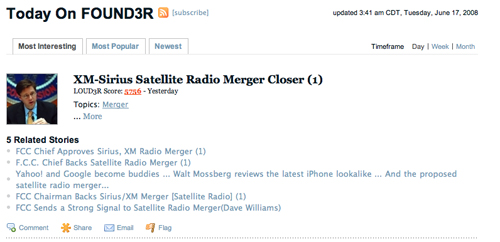
Now that Fav.or.it is finally here, the service has tried to make it more clear that it's about trying to reach "the masses" and not the odd early adopter (like me). The result, so far, is a portal-like service that looks a lot like
Google News in terms of prioritization of stories and categorization, but utilizing blog content instead of mainstream media.
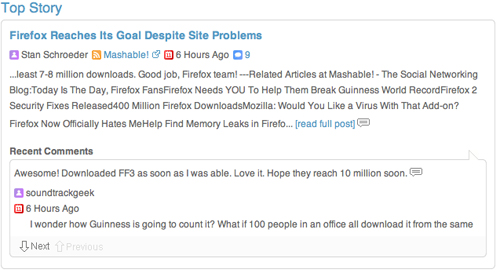
The top story on Fav.or.it on Wednesday morningThe change in strategy, or at least the change in my understanding the strategy, makes me both less interested in picking them apart, and less interested in making part of my daily consumption, so far. But I'm not exactly the target audience. For what it's worth, I don't read Google News either.
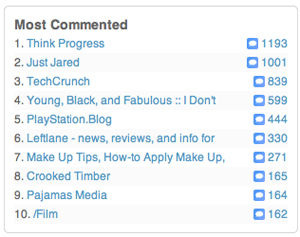
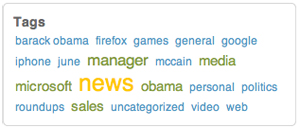
Fav.or.it's front page says it's "Bringing blogging to the masses." Note no mention of RSS or feeds. It has a top story, although it's unclear how that's determined, it features a section of recent posts, called "Brand Spanking New", and highlights many other facets of news and blog categorization you're used to, including "Tags", "Most Commented", and topics, such as Technology, News, Business, and Culture. Clicking through any of those topics leads you to the full copies of stories generated elsewhere, but integrated into Fav.or.it's look and feel.
Duncan Riley of the Inquisitr
calls Fav.or.it's new approach "splogging", essentially repurposing other people's content and aiming to make a profit, potentially in violation of copyright. Nick Halstead, the site's creator, responds in the comments there that by blog authors implementing Creative Commons, having the option to feed comments back to the original source, and being able to opt in or opt out of the site, this should reduce any concerns.
I don't share Duncan's concerns in this case. I've always erred on the side of letting RSS readers and sites innovate in new ways to present my feed content, and I expect that as RSS enables full feeds to be displayed, there will be some new and interesting ways they are shown from one site to another. For every reader who sees my full content elsewhere and chooses not to visit my site, there's another who does come in and becomes a regular, so those sites can serve as free advertising.

What Fav.or.it does do well is deliver a clean-looking site, with a strong amount of underlying data, easily findable. There's clearly a robust underlying database of stories and metadata around tags and comments powering the site, but it does a much better job than other sites, like
Technorati, who have tried to make blog posts a valid replacement for mainstream media. If, in fact, the common layperson chose to get their news from Fav.or.it instead of say, Google News, it would clearly expose them to a wealth of new sources for stories. It might also get them comfortable with the concepts of comments and tags, things we've long taken for granted.
In fact, Fav.or.it's efforts in the comment portability process should be lauded. At launch, the service claims to support many different commenting engines, meaning comments placed on Fav.or.it flow back to the original blog. They don't support threaded conversations, believing simple threads are preferred, but again, in theory, this might be less complicated for the blogging newbie. (See more in Nick's launch blog post:
Bringing Blogging to the Masses)
Talking about Fav.or.it now, as TechCrunch has with their piece,
Fav.or.it Finally Opens Beta To Take RSS And Commenting Mainstream, makes me feel wistful, like when you go to the graduation of a son or daughter leaving junior college when they once were offered a full-ride scholarship to an Ivy League school. Sure, you're proud of them, I guess, but it's tempting to wonder what might have been, and what they could have been if they'd just taken your advice or gone a different direction, they have so much talent.
Fav.or.it might have a hit on its hands with people who are nothing like me. There sure are a lot of them out there. But for now, it's a destination site displaying content I've either already seen in my RSS reader, or didn't care to see anyway. As a start page, it could work very well, and as a blogging ambassador it works well, and I'll probably just have to accept that maybe this is what they wanted to be when they grew up.
 Many Twitter users have a love/hate relationship with the service. They love what it does, helping people communicate in real time, from the Web or their mobile phones, but they hate that it hasn't scaled to meet demand. In its place, a new crop of services is rising to work around the downtime. The latest, debuting today, is called twitAbit, which leverages store and forward capabilities to ensure that Twitter fail doesn't ensure your own fail.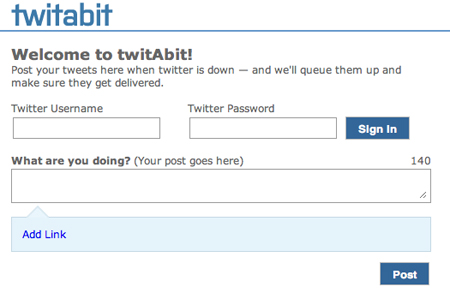
 But if those better times don't come right away, twitAbit is prepared. The service offers a simple form, asking for your user name and password, what you are doing, and a link. It appears to be a project of betaworks, and was announced on the switchAbit Web site, which RSS and blogging guru Dave Winer announced back in May.
 The
The 
 As I mentioned in yesterday's story on