Silicon Valley Technology Commentary & Archives · Est. 2006 3,033 Posts · 2006–2026

July 9, 2008

July 9, 2008 · 2 MIN READ · BY LOUIS GRAY

Seeing The Web's Racist Underbelly Is Saddening and Shocking

Seeing The Web's Racist Underbelly Is Saddening and Shocking

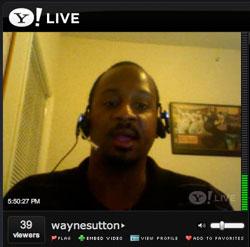
This afternoon, I caught a video broadcast with Wayne Sutton and Corvida Raven of SheGeeks.net, where Corvida had the opportunity to share her story of asking Verizon to drop their relationship with Loren Feldman of 1938 Media, in light of his controversial video parodying African American bloggers. While both carried on a strong conversation around the issues of race, bigotry and getting ahead through hard work, their efforts were dwarfed by some of the most hateful, shameful, racist speech I've been exposed to in a very long time.
It's common knowledge that anonymous commenters often fall to the lowest common denominator. The wider the audience, the less respectable the discussion, with YouTube being a perfect example.

Most of the time, the places I engage in social media (and real life) are civil. But as Corvida and Wayne talked about her family's efforts with Verizon, and how black tech bloggers are often stereotyped, with Feldman's video as an example, the Yahoo! Live chat screen filled with filth, with racist words, references to Kentucky Fried Chicken and watermelon, comments on Obama, and discussion of penis sizes.

Essentially, you name the negative stereotypes and hatred that could be spewed against the African American bloggers, and they were there.

I don't want to spread the filth that was said during the chat, but it's worth exposing these purveyors of hatred, to illustrate the nonsense. If only there were a way to break through their anonymity...
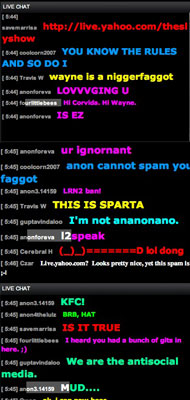
There's no question the work was done by a few anonymous malcontents, but it was eye opening to unfortunately be reminded those people are out there, and are willing to share their nonsense in an attempt to intimidate both Wayne and Corvida, in hopes of persuading them to stop. But it didn't work. As Wayne said the issue of Loren Feldman was "a wake-up call for African Americans", today's nonsense was an unfortunate wake-up call for me.

I'm glad both Wayne and Corvida maintained their professional integrity in the face of ridiculous nonsense that could have brought weaker people to tears, but there was absolutely no reason they should have had to put up with that horrible behavior, which, as it was undoubtedly intended to do, made me quite angry.

Forty years after the assassination of Martin Luther King, and with all the advancements we think we've made in Civil Rights, we still have to see this horrible, ridiculous, ignorant junk. I was appalled at what Corvida and Wayne had to suffer through, and I wish I never had to see it again. These people do exist, but they don't deserve a platform, and in this case, there should have been ways to either increase filters, block by IP address or reveal the real names of the trolls.

I am very sorry Corvida and Wayne had to suffer through that in what was otherwise a very engaging disucssion, and I hope this filth doesn't slow any person of any background down for a second.

July 9, 2008 · 3 MIN READ · BY LOUIS GRAY

How Silicon Valley Heavy Are Web 2.0 Consumers?

How Silicon Valley Heavy Are Web 2.0 Consumers?

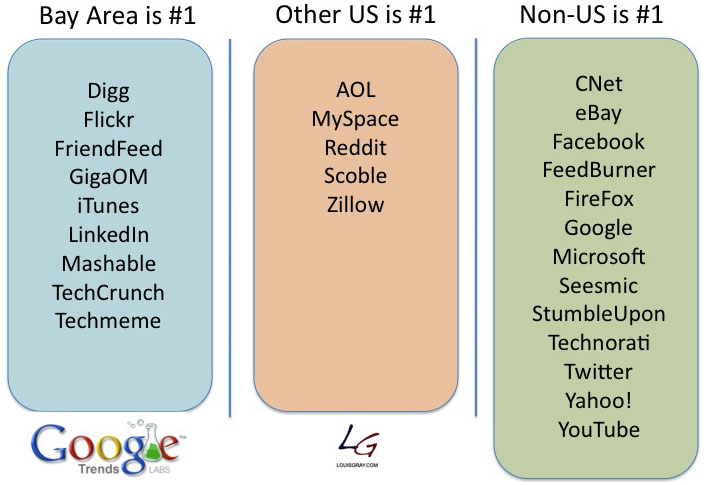
Last week, I used Google Trends to show that some Web services have largely fallen out of favor, leading to fewer searches over time. The same database also offers some hints as to where people are geographically when searching for these terms, and unsurprisingly, the San Francisco Bay Area is disproportionally weighted for many technology terms and company names. It's sometimes said that in order to reach the mainstream, Web and software companies need to escape the Silicon Valley bubble, so, according to Google, which ones have jumped?


Click for full-size image.

Let's take a look at a sampling, by no means the superset of Web 2.0:
AOL:
    #1 City: New York, NY
    #1 Bay Area: None in the Top Ten
CNet:
    #1 City: Singapore
    #1 Bay Area: Pleasanton, CA at #2 overall
Digg:
    #1 City: San Francisco, CA
eBay:
    #1 City: Birmingham, UK
    #1 Bay Area: None in the Top Ten
Facebook:
    #1 City: Hailfax, Canada
    #1 Bay Area: None in the Top Ten
Feedburner:
    #1 City: Kuala Lumpur, Malaysia
    #1 Bay Area: San Francisco, CA at #2 overall
Firefox:
    #1 City: Dortmund, Germany
    #1 Bay Area: San Francisco, CA at #5 overall
Flickr:
    #1 City: Pleasanton, CA

FriendFeed:
    #1 City: San Francisco, CA
GigaOM:
    #1 City: San Francisco, CA
Google:
    #1 City: Manchester, UK
    #1 Bay Area: San Francisco, CA at #8 overall
iTunes:
    #1 City: San Francisco, CA
LinkedIn :
    #1 City: San Jose, CA

Mashable:
    #1 City: San Francisco, CA
Microsoft:
    #1 City: Singapore
    #1 Bay Area: San Francisco, CA at #8 overall
MySpace:
    #1 City: Irvine, CA
    #1 Bay Area: None in the Top Ten
Reddit:
    #1 City: Austin, TX
    #1 Bay Area: San Francisco, CA at #2 overall
Seesmic:
    #1 City: Paris, France
    #1 Bay Area: San Francisco, CA at #2 overall
Scoble:
    #1 City: Redmond, WA
    #1 Bay Area: Santa Clara, CA at #2 overall
Slashdot:
    #1 City: Austin, TX
    #1 Bay Area: San Francisco, CA at #4 overall
StumbleUpon:
    #1 City: Dublin, Ireland
    #1 Bay Area: San Francisco, CA at #2 overall
TechCrunch:
    #1 City: Santa Clara, CA
Techmeme:
    #1 City: San Francisco, CA
Technorati:
    #1 City: Singapore
    #1 Bay Area: San Francisco, CA at #3 overall
Twitter:
    #1 City: Meguro, Japan
    #1 Bay Area: San Francisco, CA at #3 overall
Yahoo!:
    #1 City: Bogota, Colombia
    #1 Bay Area: San Francisco, CA at #9 overall
YouTube:
    #1 City: Lima, Peru
    #1 Bay Area: None in the Top Ten
Zillow:
    #1 City: Renton, WA
    #1 Bay Area: Pleasanton, CA at #6 overall
For just about every Web or tech topic, the city of San Francisco, or the San Francisco Bay Area, is represented at a much higher level than any other region, when population is considered. As Google's FAQ states, "for those top cities, Google Trends calculates the ratio of searches for your term coming from each city divided by total Google searches coming from the same city." It's no surprise that people in the Bay Area and Silicon Valley are looking for Web details more frequently than anywhere else.

What is also interesting is those companies or technologies that broke out of the Silicon Valley bubble. AOL, eBay, Facebook, MySpace and Yahoo! are not big surprises. In fact, the bigger the name, the more likely they are to get a higher share of searches from somewhere else. As many are eager to see what it takes for a product to break through to "the mainstream" and get out of the geek overload common here, Google Trends can give a little insight as to whether a service has done it.

I didn't name the hundreds and hundreds of Web 2.0 services and companies out there, but Google Trends data is open to all, so run the data yourself at http://google.com/trends and add to the list in the comments.

Related stories:

July 8, 2008

July 8, 2008 · 4 MIN READ · BY LOUIS GRAY

FriendFeed's Changing Tapestry of Users, Nine Months In

FriendFeed's Changing Tapestry of Users, Nine Months In

Ever run into somebody who doesn't like the new crowd, and wishes they could turn back the clock to "the way it used to be" before all the new guys showed up? It's a theme I've seen repeatedly played out from Web forum to Web forum and social network to social network. As I touched on in May in Just Like High School: Your Blogging Clique Will Move, online relationships change amazingly fast, and the environment on a site can be dramatically different in a matter of months, better for some, less so for others. In the nine months I've used the service, I can easily say this is absolutely the case with FriendFeed.

FriendFeed burst on the scene in October of 2007, highlighted in the New York Times, and TechCrunch. I joined two weeks later, and by the end of the month, I had highlighted the service, saying "the site is currently in beta, and ramping up, having been started by a few notable ex-Googlers."

By November, the small team added services that extended it beyond its initial stage as an aggregator. I wrote, "I first became interested in Friendfeed as the service could aggregate friends' Web activity in a single place. But in recent weeks, it's grown to be much more." And by the following month, I made 10 suggestions for the site, more than half of which have already been implemented.

February saw a rollout of statistics that showed who I followed most frequently, and who followed my items. As you can see from the chart, at the time, there was a lot of overlap between who I followed closely and who followed me, largely due to FriendFeed's small base. (This overlap is no longer common)

Even then, the site was still primarily made of friends of the founders, all of whom hailed from Google. Participating with people there at FriendFeed's earliest stages meant often getting some great insight into how Google worked, the stresses and benefits of working at one of the most successful, most secretive companies, and hearing about how some prominent projects got started. Kevin Fox himself even called it "a small beta site filled with a small group of friends". But by mid-February, some of these conversations escaped FriendFeed and gained notice elsewhere, making some become less candid.

On February 25th FriendFeed opened up, and everything changed. The open doors meant new users by the tens of thousands, and not just geeks any more, let alone such a high mix of former Googlers. The exclusivity, closeness and camaraderie some of us early users felt had been eroded. While some retreated away from the new noise, others, like me, embraced it, and engaged with the new crowds. This choice made my feeds especially "noisy", and some of the people I had befriended in FriendFeed's early months quickly unsubscribed. For every Jess Lee, Lilly Irani and Paul Buchheit who remained connected, I saw others, like Dan Egnor and Adam Lasnik, turn away.

Personally, seeing the original users I had engaged with for months unsubscribe as my feeds got more busy was frustrating, but they were supplemented by louder advocates, like Steve Rubel, Thomas Hawk and Robert Scoble, who brought their own perspective into the community. In their wake came a new mix of people focused on blogging and social media. Now, instead of talking about the innards of Google, conversations became very social media-centric, debating FriendFeed's potential or moving away from Twitter. As FriendFeed's numbers began to swell, many became obsessed, as is common in all networks, with the tabulation of stats, gaining followers, and measuring activity. It's something many of us wanted, but something we also knew would have a downside, as the jockeying for position would at times distract from the original goal, of sharing information and activity on the Web with friends.

Now, instead of internal Googlers debating puff pieces on the company, a broader spectrum of bloggers and Web enthusiasts can be found talking trends, technology news, sports and business. Instead of a small clique of acquaintances referring to each other by first name and trading perspective on shared events, you have many people engaging in longer conversations with fellow users where FriendFeed was their first interaction. And while many believe the site, at this phase, is still too heavily overweighted with early adopters and geeks, we can already see change. In late May, a post I had on where people get their sports news got dozens of comments. The site has become a repository for baby announcements and pictures, and silly food concoctions. In effect, it's beginning to resemble the real world, one where people watch sports, eat and have families, outside of their jobs and their computers.

It might have been fun to keep the friend circle small, to talk shop about Google Maps, Google Reader, GMail and Google search strategies. I enjoyed getting to know some of the Googlers a little better at the end of 2007 and beginning of this year, but with them fading into the background and being less prominent, I've met a lot of new voices I never would have found, including the vast majority of "obscure" blogs I've highlighted over the last six months. While some continue to debate whether one service will kill another, or what it will take to bring a product into the mainstream, I can easily say as one of the most visible and active users, the population has changed, away from an eclectic group of uber-engineers to something more recognizable: peers of all backgrounds. It should be interesting to see just what the service looks like by the end of the year, or next June. Could be dramatically different again.
July 8, 2008 · 2 MIN READ · BY LOUIS GRAY

Late-Night Seesmic Desperation Yields Results

Late-Night Seesmic Desperation Yields Results

Guest Post By Cyndy Aleo-Carreira (E-mail / Twitter)

I've made no secret of the fact that I'm not a huge fan of social media video sites. Videos take too much time to watch and slow me down in my daily consumption of the firehose. I'm still sitting on a 14-minute ode to copyright from Duncan Riley that I just can't bring myself to sacrifice 14 minutes of my already over-stuffed day to watch, yet I also can't bring myself to mark it as read.

That being said, when I was fiddling with Seesmic one day, my two-year-old became enthralled with the idea of people talking to her out of my laptop. She's been a long-time fan of iChat for that reason, and, against my usual parental judgment, let her record a video. She's now a bona fide Seesmic addict, begging to post a video nearly every day.

Last night, we put her to bed and were treated to non-stop screaming. At her age, it usually means she's overtired, but in this case, she was terrified after watching Pixar's Monsters Inc. earlier in the evening with her older siblings. To calm her down, I asked her if she wanted to "do a Seesmic" as she calls it, and we recorded a video talking about how she was scared of monsters.

Within a few minutes, she had a reply from Seesmic user robertp with a suggestion he's used with his own kids. She and I went on a video search through YouTube for a video that featured at least one of the voice actors from the movie, and hit the jackpot with a clip of John Goodman appearing on her very favorite show, Sesame Street. She was able to see that Sully was just an animated character voiced by a very friendly looking man who happens to like triangles, and she calmed right down. Of course, she loves getting replies, and had to post one as well, thanking Robert for replying to her "bidee-yo."


I have to take back my previous gripes about social video, however. It works better than anything I've ever tried to get a frightened toddler back to sleep. And after 10 PM, it sure was easier to get help from a virtual stranger than it would have been to phone one of my friends, who were surely already asleep.