
In a perfect blogging world, the very best writers with the very best content would get the most visitors, page views and subscribers. Every visitor would leave comments, send the links to friends, click through ads, and engage in thoughtful dialog with the author. And authors would be more than happy to pass along credit to other blogs for finding stories early, link to lesser-known voices, and admit when they got things wrong. But, alas, this theoretical utopia doesn't exist, and as a result, there's always a gap between what authors expect from readers and vice versa. And this gap can at times send even the best among us muttering to ourselves or launching into screeds when wronged.
The truth is, if you ask just about any blogger who has been active for a while, they could tell you some of their best posts withered into the dustbin of history, while a quick post that took no thought grabbed completely unexpected attention.
A couple examples on either side were visible this weekend:
On the up side: Adam Ostrow of Mashable
posted to Twitter:
"looks like I posted one of my most successful (in terms of traffic ... thanks digg) posts ever on 2 hrs of sleep from Vegas hotel room."
On the down side: Marshall Kirkpatrick of ReadWriteWeb
also posted to Twitter:
"omg pageviews are SO low on both of the posts I've put up today. dreadful. must write a big one next. i try to do 1 fabulous thing each day"
Adam and Marshall are among the most visible authors to post to their very popular blogs.
ReadWriteWeb and
Mashable are professional blogs with a staff of reporters, that rely on ad revenue to make money - making the battle for page views much more important for them than for those of us who look at blogging as a hobby, or at least, not the prime source of income.
Whether they receive a small handful of visits, or thousands per day, it's a rare blogger who doesn't look at their statistics, or at least at broad trends that tell which posts were the most popular, and whether visits are trending up and down. For the better part of the last year, I even took to posting my statistics at the beginning of each month, only recently having chosen not to as some people misinterpreted my goals as being promotional, as the numbers increased over time.
But statistics aren't why I blog. (See:
Why Do I Blog? An Introspective Look and
What I Believe: My 10 Web and Blogging Expectations for more about that.) For me, I like engaging in conversations about technology, trends, and business, and providing commentary, while learning from smart folks around the Web. That's why it's less important to me whether comments take place here or on Friendfeed and other aggregation services, and that's why you don't typically see me begging for Digg votes.
In fact, the only time I ever made the Digg front page, back in April 2007, was when
I noted that Google's Earth Day logo was an homage to global warming. It was a post that took maybe 15 minutes, and got a lot more attention than I ever had anticipated. Since then, the closest I ever got to the Digg front page was when in July,
I announced the introduction of TweetDeck. It actually reached the precarious top position of "Upcoming" before dying on the vine.
Knowing one's statistics and caring about writing articles that find an audience aren't bad things at all. Seeing which articles are most-widely read, and which topics spur engagement are often key ways to let your readers guide what you should be covering. But when page views drive ad dollars, and income, the entire foundation of why people blog changes - as blogging moves away from conversations and more toward revenue creation.
Following Marshall's comments on Friday, there was
a short discussion on FriendFeed that covered the push-pull of conversations versus page views. After I asked if it was "really about pageviews or about getting a good story and discussion", Marshall answered, "it is about good stories and discussion generally - but pageviews are also important. I do this for a living..." which had Svetlana Gladkova of
Profy hoping for a long thread on "blogging for a living vs. blogging for passion", which she saw as core to the debate. The debate wasn't settled.
If all ads on all blogs disappeared tomorrow, cutting off the revenue air supply to professional bloggers, it would be interesting to see how many of them would keep going in their spare time. How many of them would change what they cover, or change the way they write headlines, or link to other peers, once money was removed from the equation, assuming they kept writing?
Tom Foremski of Silicon Valley Watcher, in a Monday article, quoted Gabe Rivera of
Techmeme as saying that in today's competitive landscape where page views are king, that sites like "Techcrunch and the others used to link to each other and now they don't--they only link if they have to." Linking is part of the conversation, something we talked about at some length this time last year, when I said
Internal Linking On Some Tech Blogs Is Out of Control.
It seems the only way to take page views out of the equation, and reduce the number of Shouts I get from Digg on a daily basis from authors trying to promote their own blogs' articles, would be to find ways to compensate writers that are not linked to advertising. But trends seem to be going in the opposite direction.
Gawker Media has famously offered to pay reporters by the page view, a practice that came under fire
from many corners of the Web, but continues, even as those who question the landscape are some of its biggest practitioners. In fact, back in 2006, ReadWriteWeb's Richard MacManus, in an article called
Page Views 2.0, wrote, "It's funny that this page views model is at its foundation almost identical to the Dot Com days (bubble 1.0). Drive as many users to your site as humanly possible."
We all know how the Dot Com days and bubble 1.0 ended. We've already
debated whether ads and blogs are a good mix. But the idea that conversations and commentary can trump the importance of the almighty page view looks to be losing out. It's no wonder that blogs looking to keep their costs low in a time when
users are clicking on ads a lot less than they had hoped are often hiring inexperienced, inexpensive, young journalists looking to take a bite out of old media.
I know I couldn't quit my day job and try to make money from blogging, and I wouldn't want to be a slave to the page view. But for those who lay awake at night designing Google AdWords copy and trying to think of the next big headline that will take
Reddit, Digg and
Yahoo! Buzz by storm, sending a swarm of readers that send page views through the roof, I wonder if they miss the simpler time when they could write more for themselves and engage with their readers to share a story and ideas, before feeling pushed to get their next article out the door in an assembly line of online copy or finding themselves
redesigning the site to optimize for page views and increased ad displays. That's worth having a conversation about.
DISCLOSURE: In addition to his work at Mashable, Adam Ostrow is also the CEO of ReadBurner, where I am an advisor, and hold a small equity position.
 At times, it seems like the mainstream press hasn't yet figured out how to preview Apple events. That Apple periodically updates its iPods or iPhones or computers and software is really no surprise. The home runs are typically saved for MacWorld San Francisco, with big announcements sprinkled in at the company's WorldWide Developers' Conference (WWDC) and the occasional one-off event. But even when the company makes largely expected announcements, some go into severe hype in advance, and severe lows following. And like the illegal drug users who share the same spike and eventual crash, they're usually left looking for more. But behind the acid trip rainbow iPod Nanos and and upgraded iPod Touch, there was an element of real genius - as iTunes was upgraded with a new tool making it even easier to spend even more money on the popular online music store.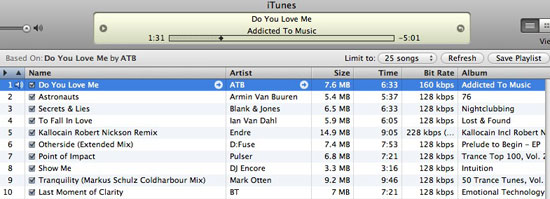
 One of the major new features of iTunes 8 is called "Genius", which will leverage your own iTunes listening history, as well as that of other iTunes users, and try to create a playlist of songs similar to that which you are listening to. Like "Party Shuffle", it will get some mixes right, and some wrong, but it's following along the path of Pandora and Last.fm to use a crowd's information to provide recommendations and guess what other songs or artists you would like.
 Apple Computer's Steve Jobs


 Sometimes the best blogging is going on well away from the most visible places. Since March, I've taken the beginning of each month to showcase some bloggers that are writing some solid content in their corner of the blogosphere. They may not post as frequently as some of us do, and they certainly don't have the readership they deserve. Just maybe, with this little boost, it can give them the encouragement they need to keep going, and get more prolific.