
Silicon Valley Technology Commentary & Archives · Est. 2006 3,033 Posts · 2006–2026

September 13, 2008

September 13, 2008 · 4 MIN READ · BY LOUIS GRAY

Statistics Are Your Friend, Even When They're Bad

Statistics Are Your Friend, Even When They're Bad

By Robert Seidman of TVbytheNumbers (Twitter / FriendFeed)

It should be no surprise that being part of a site called TVbytheNumbers that I’m obsessed with statistics and this obsession extends to all the web site analytics and statistics that are available to us.

While I hear and read things often about how Feedburner’s stats stink and Google Analytics stats stink and none of them ever sync up well, that really hasn’t been my personal experience. Using either Feedburner or Google Analytics as an intraday tool is certainly problematic, and I have had a day or two here and there where Feedburner did lose data for an hour of five that it never recovered, but mostly both are just slow and do recover. Google Analytics typically tracks visits and visitors correctly intraday within reasonable timeframes, but lags behind in counting total pages for hours. Usually, by 8am Pacific time (but not often before then) all the page views for yesterday show up. And once they do, on a page view basis, Google Analytics, Feedburner and Quantcast all seem like they wind up syncing up within 2%-3%.

Given everything involved, I find the 2% difference very reasonable and it doesn’t bother us any. We wind up triangulating between Feedburner, Google Analytics and Quantcast and it’s less of a hassle than managing our Web logs.

Because of the problem cited above with Google Analytics being slow to capture all the page views, it does make intraday monitoring fairly worthless, aside from tracking visits and visitors. All the other stats – time on page, bounce rate, pages per visit, etc. – are all wrong until all the page views are captured. But there’s little we’re doing that requires great analytics on an intraday basis. There are certainly times when it would come in handy, but even as it is, it works well enough intraday where we can at least figure out if we add something or move something around whether the desired result was achieved.

As a tool used after the fact, I find Google Analytics to be an extremely valuable tool, though I often don’t like what I see!

One thing we’ve thrown in the towel on is that referral traffic is almost always bad, no matter the source. There are some rare exceptions where linking produces good traffic (high time on site, number of pages per visit, etc), but that’s indeed rare. In fact, in almost every instance where a specific post is linked, the traffic is bad, with bounce rates often in excess of 80%. That’s whether Louis is linking to it, whether someone throws a link on Twitter, or even if Matt Drudge links to one of our stories. StumbleUpon and Digg show similar results.

Such traffic is great for jacking up visits and visitors, but bad for bounce rates, pages per visit and time on site. We’ve pretty much thrown our hands up in the air on that score and attributed it to web surfing behavior via links. As an aside, the stable link we have from Drudge to “TV Ratings” produces much better results, but if he links to specific story on our site and gives it any prominence on his site, the traffic has a very high bounce rate.

That seems largely out of our control, however there was still one stat that really bothered me. That was that if someone landed on our site via our home page, the bounce rates were still pretty high, approaching 50%. Better if someone came directly instead of via a referral, but still bothersome either way. Here's the landing page results for our site for August 1-31:


Recently, with that and a couple of other factors in mind – mainly wanting the ability to showcase more content on the home page – we redesigned the site. The bounce rate for traffic landing on our home page was around 47% for August. In the last week, post- redesign, that is now around 25%. The bounce rate for referral traffic to specific posts is still lousy, but again, we don’t feel like we can do much about that. Here are the landing page stats from September 6-12.


All of this has me wishing I’d gotten around to redesigning the site sooner. Who knows how much repeat traffic we may have lost as a result of design? I also feel silly because once upon a time I actually had responsibility for the web design/UI group at Charles Schwab. I recently had lunch with the VP who ran that group in my org and when I told her about the results she shook her head and laughed at me. My mentality had been this: our blog is a blog, pretty much like every other blog and designed pretty much like every other blog so spending a lot of energy on design tweaking didn’t seem like a worthwhile priority.

I definitely should’ve known better. I’m still not very happy about the bounce rates on referral traffic, but am quite happy about the reduction in bounce rates for people landing on our home page and would ascribe that improvement completely to redesigning.

By the way, for anyone interested, we went with the Live Wire theme from Woo Themes that we modified a little. So far I’d consider it the best $70 we ever spent. It’s not a perfect world, so the theme isn’t perfect, but setting the navigation structure (which we’ll certainly still need to tweak) and other modifications didn’t take much time. For $70 and time spent, cutting the bounce rate to our home page just about in half seems like time and money well spent.

Read more by Robert Seidman at TVByTheNumbers.com.

September 12, 2008

September 12, 2008 · 3 MIN READ · BY LOUIS GRAY

The Financial Markets' Downturn Hitting Home

The Financial Markets' Downturn Hitting Home

When the raging bull markets of the late 90s and early part of this decade ended, they fell with a tremendous thud. With the Web 1.0 boom turning to bust, combined with heightened fears over terrorism and world instability, the idea that one's investments would forever increase was dashed almost overnight. In 2008, we have a situation that's arguably even worse. Housing prices and demand for homes has plummeted. Energy prices are sky high. Financial institutions, having made many bad bets, are declaring bankruptcy and getting government bailouts. And unfortunately, the only near-guaranteed part of trickle-down economics is that the individuals at the bottom always feel the pain - and few are immune, myself included.
I've been lucky enough to hold down the same job from before the first recession through today. I saw Silicon Valley freeways go from being a gridlocked mess to easy driving, and back to a mess again. I saw billboards go from being plastered with dotcom ads to being "Available", only to return with a wider variety of advertising. And I've seen personal investments go from guaranteed profits to nearly pulling it all into cash, and later, getting back in, but trying not to be too exposed.

This ebb and flow is reaching a low point again. The entrance into our complex of condos is littered with "For Sale" signs, and more than one has a note of "Reduced Price", signaling the owner's desperation to move out and move on. Popular area lunchtime restaurants that used to have long lines out the door can now be visited without too much concern for parking. And, yes, my stock portfolios are bleeding out, seemingly getting worse by the day.

I thought I learned from some big losses the last time around, to not be invested in companies I didn't feel I knew very well, and not to hold stocks for a long time. I've become much more of a "flipper" who holds stocks for days or weeks, looking for what could be momentum. And at times, this has worked great. I recently played TiVo stock for a few days, and made enough profit to buy a new fridge we needed. At times, I've played Apple stock around earnings, essentially keeping me in Cupertino gadgets for free. And earlier this year, I even invested in some of the energy stocks, making money on them as the price of gas continued to climb.


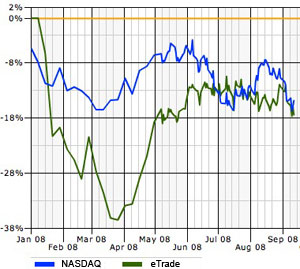
eTrade Shows the Q1 Losses Are Keeping Me in the Red

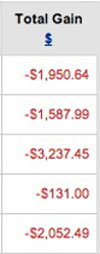
But, despite these wins, right now both my personal portfolio on eTrade and my 401k are pretty hosed. On my 401k, I've lost more than half the money I've added through donations this year. And on eTrade, I've accumulated enough losses in the stocks I'm holding now that the total deficit would essentially represent lost months of work.


The 401k Says My Rate of Return is In the Cellar

Now, we're not bankrupt. And we haven't made any big purchases of late (aside from that fridge). We don't have credit card debt, and we're paying our mortgage. So we're doing quite well, compared to others who have much greater problems.

But there seems to be an air of uncertainty and discontent that comes with having less money than you had just a few months ago, and knowing what you do have isn't going quite as far. It feels like people's fuses are shorter and they're more stressed. And at times like these, it's hard to think what's going to change things. Alternative fuels? A massive change of heart in the stock markets? Probably not. This just could mean we're in the beginning of needing to buckle down, hang on and be even more judicious about what we do with our money, before things get worse.

September 11, 2008

September 11, 2008 · 5 MIN READ · BY LOUIS GRAY

Google's Suggest And Search: Never Completely Private

Google's Suggest And Search: Never Completely Private

By Phil Glockner of Scribkin (FriendFeed/Twitter)

Recently, I have been thinking about a particular feature of Google Chrome. If you haven’t used Chrome or haven’t been following the news about it, it is a new Web browser from Google. The feature I've been mulling over is its almost-magical location bar. Google calls this the address bar, but it is also called the location bar or URL bar.

Apparently, a dedicated open-source Google project team called Chromium came up with this new address bar technology, and they call it the omnibox.

Omnibox

On its face, the omnibox is a great improvement over the more generic location bars of pretty much every other Web browser out there. It’s a URL input field combined with a Google (or user-defined) search engine front-end, and it throws in several other tricks to boot. In my opinion, the only thing that really comes close is Firefox 3’s optimistically-named awesome bar. This is different than the location bar in Firefox 3, which by default only looks through your bookmarks and history to find matching search results. Google actually uses its vast search database, using a technology called Google Suggest.

Google Suggest

However, it’s not just in Chrome. Firefox also employs Google Suggest in the search input field next to the address bar if your search is set to Google. You can also find it on Google’s classic home page (i.e. not iGoogle), and in Google’s mobile application and site (if javascript is supported). On the surface, Google Suggest is great. Just start typing whatever you are looking for, whether it be a Web site or keyword, and Suggest goes off and tries to predict what you are typing with increasing accuracy. This is especially useful on mobile devices where typing can potentially be annoying.

Privacy Concerns

The one big drawback of this technology is that your search terms are transmitted as you type them to Google’s server. They literally know everything you type, including half-finished search terms that you subsequently erase without submitting. And what if you accidentally had copied a lot of text into your cut-and-paste buffer and dropped that in the address bar? The whole buffer would be in Google’s hands immediately.You can see where this could lead to a potential problem. What if an executive of a giant company started to search for an insider-trading tip just prior to dumping a lot of stock? Could these partial search results be requested by subpoena in a resulting civil trial?

Google’s Promise

Earlier this month, Google did in fact consider this issue and updated what and how much they cache from Google Suggest. You can read the details from the official Google blog here. In summary, they promise:
  • 98% of Google Suggest searches are not logged.
  • 2% of these searches are logged with IP addresses.
  • These 2% will have their logs will be ‘anonymized’ within 24 hours of search result, starting late this month or early next month.
Keep in mind that this promise is specifically for Google Suggest searches. If you actually submit your search query, Google’s standard privacy assurance goes into effect, which you can see explained very simply in this YouTube video. It seems reasonable to believe that Google is putting forth a good faith effort to protect your privacy while balancing the needs of their search business.

Another Dynamic to Consider

Google isn’t giving you the whole picture though. Sure, having a cutting edge search engine is what made them the first name in search. However, their business revenue comes from advertising, not search.How does this affect their high-wire balancing act? Well, it’s not completely clear. However, they didn’t become the first name in Web advertising by not involving search. In fact, search is key to the effectiveness of their advertising business.

The Google banner ads you see in your search result pages, and the Web pages with even more targeted advertising when you click on a link in that result page, this is how Google makes its money.You can safely assume that Google is always feeling pressure from their profit center to hand over as much information as possible on search results to help in making their advertising even more clairvoyant.

Traditionally, Google has been clever and has worked within the very simple dynamic of search terms, geographic locations, and statistical results in order to make this advertising highly targeted. However, their brain trust is gigantic. If you can think of something, anything they could possibly use to help their ad business, they probably are developing it in the lab, or are using it on their site. Local, national and international news at the time of the query. Related geographical searches. Platform search is performed on (Windows, Mac, mobile, etc.). Which query result is chosen. Time between search and click-through. Basically, everything.

Getting Back to Privacy

So how does this affect you? Well, the bottom line is, what you do on Google’s search engine will never be completely private. Like throwing a rock in a pond, the ripples are immediately noticeable and quickly die down, but the waves might not hit the opposite shore for a while. Tiny traces will always be left, and it is those traces Google uses to improve its search, and ultimately its search-based advertising.

The Bottom Line

You do have to make a decision if you want to participate in this giant information machine Google has built behind its sleek minimalist Web site. Some people think Google Suggest is going too far. Some may think that Google Chrome’s Incognito mode will keep them safely anonymous.The answer to both of these is: Not quite.
  • Google Suggest does gather more statistical data (such as typing speed, number of corrections, etc) but anonymizes that information quickly.
  • Incognito mode only works on the client side, that is to say, it keeps your audit trail off the books on your end. If you use Google to search for something with this mode turned on, they still get all the same info they would get if you weren’t using it.
The only real privacy solution, the only way to remain out of the grand Google experiment, is to not search online at all.

Read more by Phil Glockner at Scribkin.com.
September 11, 2008 · 1 MIN READ · BY LOUIS GRAY

The Tech Adopter's Lament

The Tech Adopter's Lament

Forget Fast, I Want Instant. And I Want It Now.

My iPhone takes too long to back up.
My computer takes too long to reboot.
My applications take too long to load.
My FTP uploads take too long to transfer.
My blog host takes too long to post.
My folders take too long to open.
My e-mail takes too long to check.
My messages take too long to send.
My feeds take too long to hit Google Reader.
My Time Capsule takes too long to back up.
My updates take too long to hit FriendFeed.
My camera takes too long for iPhoto to recognize.
My downloads take too long to complete.
My Web sites take too long to refresh.
My URLs take too long to resolve.
My documents take too long to print.
My items take too long to display.
My videos take too long to buffer.
My comments take too long to be approved.
My services take too long to sync.

Time for an upgrade?