


Newton's third law of motion says that for every action, there is an equal and opposite reaction.
Many technologies have ratings features built in with equal and opposite choices these days, from the thumbs up and thumbs down on your TiVo remote control, to rating songs from zero to five stars in iTunes, and of course, deciding whether to Digg or Bury. But as social networking tools don't necessarily need to subscribe to Newton's laws, not all services offer diametrically opposed activity. You can't offer a negative share on Google Reader, canceling someone else's share out, for example, and FriendFeed limits you to "liking" items, making users oddly "like" things they hate, if only to draw attention to the item. Social Median, which is increasingly looking like FriendFeed, added the ability to "like" and "dislike" items on Monday, through what they call a "mood button", drawing more attention to the battle between love and hate. (See a discussion on FriendFeed about the new feature here)

Social Median gives articles mood, based on the like/dislike ratio
With so many people consuming as much content as we are these days, with more Web sites, RSS feeds and social networks to imbibe, services are making it ever easier to make our feelings known in the shortest amount of time, with the least amount of effort. While a year or two ago we may have left a comment and engaged with the blog author, these days, we're just as likely to vote up the number of stars on their Outbrain widget, share the item in Google Reader, or just click "like" on FriendFeed, essentially "checking the box off" on what was required for me as a reader, taking the easy way out. Often, this is done even by reading just the headline, and not the full article. (Do you really think people are reading all the items they Digg?)
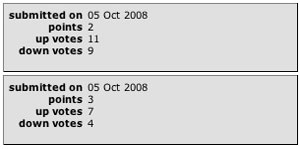 Social news sites like Reddit, Mixx and others tend to simply show the sum total of votes by its members, subtracting the down votes from the up votes to determine an item's popularity. As a moderator on the Elite Tech News Reddit, I recently found myself looking at what the community had selected as the best news items. Usually they will have anywhere from only 1 to 3 points, but by looking deeper, the actual up and down votes are more like 12 to 9, or 11 to 10. Negative voting is almost always approaching 50 percent.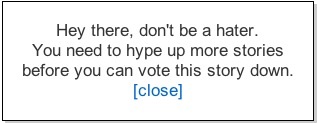
Ballhype says, "Don't be a hater"
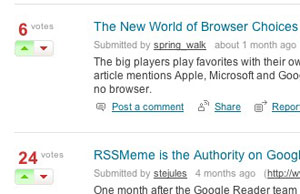 I'd always thought if I didn't like something, I should just skip it rather than calling out that I don't like it. I do bury some items on Digg, if I find them to be duplicates, from shady Web sites, or, punitively, if I see the authors relentlessly pimping for votes on Twitter, but those are exceptions, rather than the rule. So who are these people who are just as likely to vote items down as up? So far, typical social networking behavior has let you play the role of hit and run, disliking an item and taking off, if you have that option, letting you do so anonymously, even if the system knew it was you. In fact, Ballhype would put up an alert to "Stop being a hater" if you gave too many thumbs down in a row.
Social Median's new approach to "Mood" not only lets you "dislike" an item, and see the percentage of people who dislike it, but you can see just who voted it down, adding a level of accountability to your vote. I am curious to see if the community takes to "dislikes" as quickly as they took to likes on FriendFeed. It's always easy to be in a group of friends who like something, but if you say you dislike something, it begs a follow-up. Why did you dislike it? Was it the subject matter? Was it poorly written? But again, that takes you out of the realm of doing as little as possible, and actually needing to answer the questions. I bet the community would vote thumbs down on that idea!
 Microblogging is becoming more common. Especially
  The stock market is a disaster.