Silicon Valley Technology Commentary & Archives · Est. 2006 3,033 Posts · 2006–2026

October 20, 2008

October 20, 2008 · 2 MIN READ · BY LOUIS GRAY

Twine Untangles Beta, Launches Social Bookmarking on Steroids

Twine Untangles Beta, Launches Social Bookmarking on Steroids

Nova Spivack, creator and CEO of Twine, sees that networks based on its users' interests are at what he calls a "tipping point". In the last year, you've seen dramatic growth in this space, with the rise of FriendFeed, Strands, Social Median, Popego and others to name a few. And tonight, after much incubation, his own site has opened up to join the fray, delivering what he terms "Delicious on steroids."

Twine is not just a repository for you to capture interesting links from around the Web, but the service expands your content through the deployment of tags, including related people, places, etc., as Twine leverages semantic data around your content. It also pledges to discover related content to your own Twine, and help auto-discover new items, operating as a "learning machine" to help you find new items that match your interests.
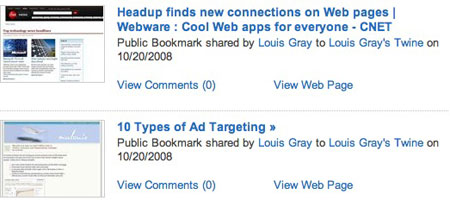

My Twine Is Populated With Bookmarks From Around the Web

Twine is engineered to leverage the collective intelligence of the Twine community - much like Social Median. The pair's similarities are many, including groups by topic, the delivery of a single stream of items you have found interesting, and through the ability to follow other users who may share the same interests. But Spivack was quick to say Twine was around first.

With so many sites jumping into the "Interest Network" space, how does Twine try to differentiate itself? Spivack spells it out. "Facebook is about your relationships. Friendfeed is about your communication. LinkedIn is about your career. Twine is about your interests," he wrote in an e-mail.
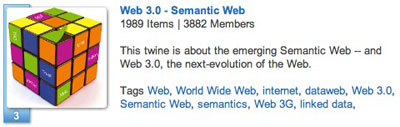
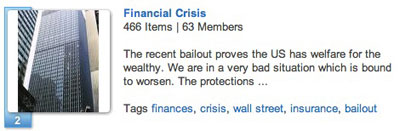

Web 3.0 and the Financial Crisis are popular Twine networks.

Services like Twine and Social Median reflect the preferences and interests of their community. Top networks on Twine, include frivolity, like "Cool", geekery like "Web 3.0" and "Web Industry Trends", but also more mainstream discussions, from "Presidential Election 2008" to the "Financial Crisis". You can see the Top 100 Twines here.
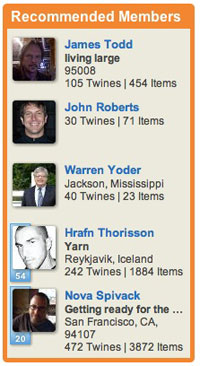
If you are new to Twine, there are tools set up that will aid your starting off without an empty feed. You can import your bookmarks from Delicious, or even from your Web browser. And as with other interest networks, Twine is not aiming to be a silent repository. You can make comments on others' items, find other users who share similar items, or see recommended Twines.

As Spivack wrote me in an e-mail, Twine has only begun to scratch the surface when it comes to its semantic engine. "We've only started to expose some of that capability -- try bookmarking YouTube videos, Amazon books, CNN articles, Wikipedia pages, Flickr photos, and see what results in Twine. In Twine you get more than just a bookmark -- you get a data record that is customizable, linkable, and connected to other things," he wrote. "We'll be enabling these to be even more customizable in 2009."

Twine, on its debut out of beta, already is set to tangle with the leaders in this space, and I'm eager to see how intelligent their service is as it provides recommendations and connects people.

You can sign up to Twine at http://www.twine.com. You can find my profile here: http://www.twine.com/user/louisgray.

October 20, 2008 · 2 MIN READ · BY LOUIS GRAY

Is Lifestreaming a Catalyst for What's Coming After Web 2.0?

Is Lifestreaming a Catalyst for What's Coming After Web 2.0?

By Mark Krynsky of Lifestream Blog (FriendFeed/Twitter)

There has been lots of rumbling lately about what the successor to web 2.0 will look like. Along with that, even more attention has been spent trying to determine what to name it. My post isn't to discuss semantics (pun intended) but more to provide some of my thoughts based on what I've been observing.

I feel lifestreaming, which I evangelize and cover incessantly, has become a catalyst for much of what's coming next. I feel we will see some of the core elements of lifestreaming penetrate other areas and watch many benefits become realized.

Companies are slowly starting to understand social media. They should also start thinking about how to improve communication internally for a well informed workforce. Creating rich workstreams by aggregating real-time data on an internal network can help achieve this. I see a resurgence of rich intranets like this starting to happen soon.

Data aggregation continues to re-invent itself in other useful ways. I was excited when I first started using Mint.com as I saw it as essentially a vertical lifestream. In this case it was aggregating all my financial accounts to provide a real-time "financestream". But that's not all that Mint.com does. It's a very special service and it actually provides the bridge to two areas where I see the web going next, recommendation engines and moving apps to the cloud.

Many services are getting really good at collecting the data and providing ways for us to interact with it. But that will only take us so far. The next phase will be creating intelligence based on the data. The first step to that will be recommendation engines. Strands provides several services including lifestreaming and has recently put up a prize to help them improve this technology. Mint.com provides recommendations on how to save money based on the data. I'm sure we will continue to see these engines applied to many new areas and perfected as they become mature.

By having more and more of my data living online it becomes increasingly difficult for certain apps to be effectively maintained on my local computer, which brings me back to Mint. I was a heavy duty Quicken user, but now it's become cumbersome having to pull in all my data. Add to that how powerful mobile phones are becoming, the pain involved with trying to sync data across multiple devices we own, and the answer seems clear. Many users will start the migration path of moving their apps to the cloud. Tying back to work again, my primary tool for managing website production is the Clocking IT service. So here I have an app hosted in the cloud accessible anywhere on multiple devices that also offers a real-time stream to co-workers.

What have you been observing? What do you think is going to start taking off?

Read more by Mark Krynsky at Lifestream Blog.
October 20, 2008 · 2 MIN READ · BY LOUIS GRAY

My Kids' Early Lives Are Already Entwined In Social Media

My Kids' Early Lives Are Already Entwined In Social Media

So far, I've held off on doing the silly thing, signing up my 4-month old twins, Matthew and Sarah, with user names to popular Web services, even though others thought I would. I haven't purchased them domain names, dedicated servers, or purchased them their own digital devices - yet.


This is because I expect by the time they're ready to use them that many of the brands will have changed, and because to have yet another login (or two) would be too tempting, and I'd find myself tweeting as an infant, and that would be completely silly. Also, who knows what kind of user names these kids will want once they've realized they have a choice? Surely not the fuddy-duddy version I'm bound to select.

In March, I said loudly, Our Unborn Kids Will Wear Your Web 2.0 Schwag. And while they're still small, and haven't grown into everything, they're doing their best. (Not that they wouldn't mind more logo clothes - e-mail me if you're interested.)

But, consider the following, all of which are true:All this has happened before the pair have learned to crawl, talk, read, or walk. But they're growing up in front of laptop screens, they've been pictured with the iPhone, and have attended Silicon Valley gatherings. Sarah met Loic Lemeur of Seesmic, and both met Drew Olanoff of Strands and MG Siegler of VentureBeat.


Matthew Goes LOLCat for Strands

Whether they realize it or not, as social media becomes more intertwined with every aspect of our lives, they too have become intertwined with social media.


Sarah Gets Chatty Last Thursday On YouTube

Today, Matthew and Sarah turn four months old, so they are effectively 1/3 years old. While I've gone light in terms of dousing the blog with their pictures, you can stay updated in a few places:
October 20, 2008 · 2 MIN READ · BY LOUIS GRAY

Apploop: FINALLY - A Useful iPhone RSS Reader!

Apploop: FINALLY - A Useful iPhone RSS Reader!

By Mona Nomura of Pixel Bits (FriendFeed/Twitter)

FriendFeeders ask time and time again, "Where do you find the things you post?" and "Why don't you ever run out of things to post?" My short answer is "Google", since my methods are quite simple... yet complicated. Discovering this app is the perfect opportunity to elaborate on one of my major resources: RSS.

I am a huge RSS junkie.

I'm all about picture + headline + the first few topic sentences. If all three interest me, I have the option to read the entire article. Most of the stuff I post is pulled from my various feeds. Since my job is computer related, I am always connected to the Internet, my reader is always up, and I'm constantly scanning the headlines. My RSS reader choice is Google Reader, since it gives me everything I am looking for:
  1. Headlines
  2. Thumbnails
  3. Few topic sentences
  4. Option to click
The problem = 98% of the readers do not include the things I'm looking for.

I've been on the hunt for a good RSS reader long before I signed up for FriendFeed. Most RSS readers (especially for mobile phones) are plain text with no visuals. Because I am a huge visual person, I don't even bother looking at my subscriptions via mobile, since a highly visual application didn't exist.

Enter AppLoop.

I randomly stumbled upon this company whilst Googling. I was floored. Not only would this simple application solve my problems while on the go, they are also a content provider. Meaning, if you have a blog / website, with an RSS feed, they will turn your blog into a native application for a phone, for any platform, and submit it to the store for you. For free. Holy wow.

Now the latter doesn't really excite me, since it would be kinda sorta mortifying to see a "Mona application" in the app store. I am ultra excited for this app because I'm hoping my favorite websites will hear about it and choose to offer a mobile RSS option using AppLoop, -- such as LOL cats, Gizmodo, Engadget, or Boing-Boing since again, I'm all about: headlines, thumbnails, few topic sentences, AND the option to click. If all my subscriptions published their content with AppLoop, I'll even go as far as to say: I foresee giving up Google Reader -- even when I'm in front of my computer.

Anyway, the demo video is finally up and they JUST launched. So take a look, the video speaks for itself. :)


iPhone Application Generator Demo from AppLoop on Vimeo

And no, I am in no way affiliated with them, just an excited end-user. ;)
So what's your favorite reader? (mobile or desktop)?

Read more by Mona Nomura at Pixel Bits
Update: For more 'techie views' visit TechCrunch: "AppLoop Transforms Blogs Into Native iPhone Applications" and by ReadWriteWeb: "Make Your Own iPhone/Android Apps With New App Generator" and Duncan Riley's Inquisitor's, "AppLoop iPhone App Generator: High Wow Factor"