Silicon Valley Technology Commentary & Archives · Est. 2006 3,033 Posts · 2006–2026

November 4, 2008

November 4, 2008 · 2 MIN READ · BY LOUIS GRAY

Are Social Networks The New In Box?

Are Social Networks The New In Box?

By Corvida Raven of SheGeeks.net (FriendFeed/Twitter)

There comes a time when an Internet addict must step out of their in box... and into another one. Anyone that receives a ton of e-mail can relate to the headaches that just thinking about your in box can cause. Can you imagine sifting through hundreds of e-mails on a daily basis? Wayne Sutton does. Major bloggers do this all the time. So, it should come as no surprise that more people are referring new connections to their social networking profiles as their default way of contact instead of giving out their e-mail addressess.

I can admit that lately, I've referred more personal connections to my social network profiles instead of my Gmail address. Why is this change taking place? Here are two theories I have:

1. It's (Psychologically) Easier to Manage

You may be wondering how hopping from social network to social network is easier than managing all of those messages in one central location. Simple: information overload. When you look at your in box and have over 100 messages to sort through, your mind may automatically drain of energy. The task ahead could seem daunting. However, if you break down those messages and place them in separate locations, it's the same as breaking down a large project. Sure, spreading your messages out could require more time, but at least you'll still be encouraged to get through them all. It also beats staying on one site for numerous hours, reading and replying to messages.


2. Mainstream Adoption

This may seem a little out of left field, but I think the adoption of social networks into the life of mainstream Web users is causing more people to use their social networks as an in box. I have no idea what the e-mail addresses are for my friends that are not early adopters. How do I contact them? Through Facebook, MySpace, and DowneLink. These are all mainstream social networks that my friends live in. Most of my friends head to these sites before checking their e-mail. In fact, some of them only check their e-mail to see if there were any notifications sent to them from their social networks, which may even be the only e-mail they receive (outside of spam). As the mainstream moves onto these social networks, you can bet your bottom dollar that they'll be directing their new friends to their profiles. It's not just about being able to see more information than an e-mail address could ever give. It's an easier and more logical way for them to manage their social network.

Are social networks easier to manage than a standard in box? For some it could be a nightmare hopping all over the place. For me, it's great. It helps me to effectively separate my personal life from my online life. For my friends, it's a default setting and one that they wouldn't change. Is your favorite social network becoming your new in box?

Read more by Corvida Raven at SheGeeks.net.

November 4, 2008 · 1 MIN READ · BY LOUIS GRAY

Search Engines, Web Sites Dress Up for Election Day

Search Engines, Web Sites Dress Up for Election Day

As with last week's Halloween celebration, which saw many prominent Web sites alter their logos to highlight the holiday, today we're seeing prominent names, including Google, Yahoo!, Ask.com and FriendFeed tweak their brands to reflect the elections being held today throughout the United States.


This morning, I voted, and got the usual "I voted" oval sticker, complete with American flag. See above how some of these sites are marking the day of the ballot box. Know of more? Let me know.
November 4, 2008 · 3 MIN READ · BY LOUIS GRAY

Now Is Not the Time To Scale Back On Social Media

Now Is Not the Time To Scale Back On Social Media


Amidst all the talk of economic recession (or worse) and politics, I have seen an underlying current of people who are tiring of social media, seeing it as "less important" than the bigger world issues, and maybe less interesting than maybe it was three, six or nine months ago. Without doing a dedicated poll myself, my gut feeling is that the reasoning is that while people retrench and worry more about their jobs, their families, their wallets and their future, all the fun of bookmarking, liking, linking and blogging falls to the wayside. But I think this is wrong, period. If anything, the economic weakness should make it more important than ever for companies and individuals to double down on social media, as these new tools have enabled less expensive ways to find like-minded individuals, who just might be your next customer.

The world of marketing, advertising and public relations is changing. It's no longer about finding tricky ways to force prospects to your Web site, your products, your content and your story. Instead, it's about going to where your customers are. And it's very likely that many of them have found solace and community in far-flung places like Facebook, LinkedIn, Twitter and FriendFeed, where they are talking with peers, with or without you. Rather than spending tens of thousands of dollars to increase the perception of your brand through print advertising, or sending a check to Google each month to sponsor search keywords, you could devote more time, but much less money, by listening, communicating and participating, bringing a human voice and face to what could previously be seen a static brand.

As the economy tightens and budgets are reduced in response, it makes sense to think differently, to borrow Apple's phrase, and find new ways to reach your prospects and partners less expensively. While not every executive in the boardroom needs to know exactly what Twitter is, they will absolutely understand that you can achieve a higher return on your investment through spending less money, and spending the right amount of time in more targeted areas, where you can attract and retain business, whether these communities are physical or virtual.


Additionally, the typical social media user is a more sophisticated buyer than the general populace. They aren't interested in your "spray and pray" methods of e-mail blasts, run of site banner advertising, or even your impersonal PR pitches. They expect and demand personalization and knowledge of themselves, by you, as an individual. They want to be wooed and to be given a seat at the table when it comes to making suggestions about your product, where you should sell it, and at what price. With proper utilization of social media, there lies a greater sense of community between the buyer and the seller, the customer and the brand, making it a collaborative effort where both parties will work together to ensure a successful transaction takes place.

There's no question that those folks who have been using social media as a time killer or strictly for recreation, to distract from work, might find their time better spent. But that's true with all things, as activities can cross from hobby to obsession, or from utility to distraction.

What has happened in the world of social media over the last few years is the growth of micro-communities whose members can be reached in new ways, regardless of location or time. To cite changes in the macroeconomic climate, or the political climate, as reasons to back away from this growing evolution in communication and marketing is short-sighted. Those companies that can take advantage of the reduced costs of customer communication, acquisition and support will extend the gap over those who sit on the sidelines.

See Also:

November 3, 2008

November 3, 2008 · 2 MIN READ · BY LOUIS GRAY

Strands Goes Mobile With New iPhone Interface

Strands Goes Mobile With New iPhone Interface

Last month, I said I believed there were three major trends in the future of social media: Unified accounts, transparency with connections to the real world, and adaptation to the mobile Web. As more consumers, including me, are seeing an increasing amount of their Web activity taking place on mobile devices, the need to create customized interfaces for all those iPhones, Android-capable handsets and Blackberries is getting ever more important, and those that don't do a good job of it will find their growth stunted.
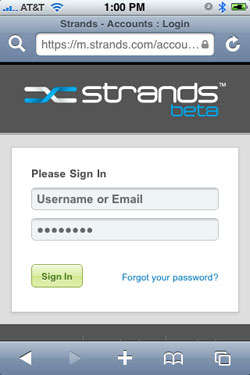
Today, Strands, the social content discovery service which at times has drawn comparisons to FriendFeed and Plaxo, took a major step forward with the introduction of their new iPhone-optimized mobile site, found at http://m.strands.com.


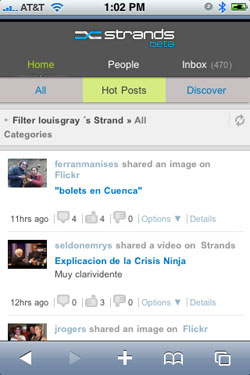
Strands Mobile, In Action, On My iPhone

Back in August, when I first discussed the lifestreaming site's beta offering, I found myself fairly critical of its user interface, saying it minimized some of the best features, including the actual feeds from your friends' activity. In the last few months, thanks to feedback from its growing user base, the team has doubled down efforts to simplify the UI, and they managed to do well enough that the site works well, even in my 3.5" wide iPhone.


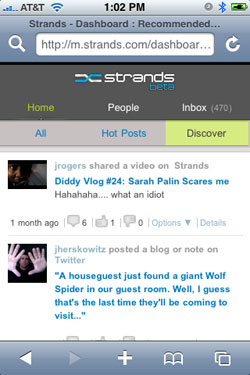
Features Like "Hot Posts" and "Discovery" Are Available On Mobile Strands

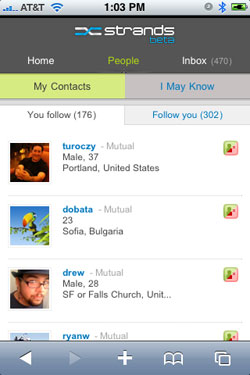
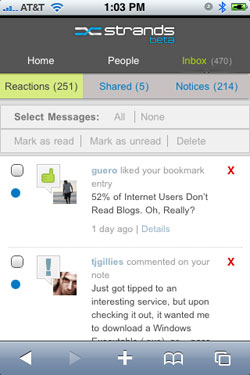
As one would expect, the mobile Strands offering operates the same way as its online companion does. You can see most recent updates from those you follow, see "Hot Posts", "Discover" new people who you might not be following, view your list of friends, and even read your in box, which can fill up with people taking action on your items, be it to make a comment, or simply flagging a "like" using their thumbs up. And you can participate by clicking the thumbs up or making comments yourself, right on the phone.


You Can Also Check Your Inbox Or Followers Via Mobile

Diehard Strands aficionados will no doubt appreciate the new introduction, taking the burgeoning social network on the go. If you are an iPhone addict, like me, make sure you bookmark their new site, and send feedback if you find issues. You can also check out an introductory video on their blog, here.