Silicon Valley Technology Commentary & Archives · Est. 2006 3,033 Posts · 2006–2026

November 15, 2008

November 15, 2008 · 2 MIN READ · BY LOUIS GRAY

When Mom's Away, Dad and Twins Play

When Mom's Away, Dad and Twins Play

My wife is in the middle of crunch time to complete a massive paper for her Masters' Degree program in World History. With her facing a 30-page submission due in the middle of this upcoming week, I've been pulling extra time covering Matthew and Sarah, including virtually all of the last 30 hours or so. Not that I mind all that much, as it's afforded me the opportunity to get more pictures on the record, post some short videos to YouTube and sync up with SmugMug. And while the most ardent followers on FriendFeed (and Twitter or Facebook) have seen much of the content already, I thought I'd share some of it here as well, retaining some of the personal nature of this blog, even as we've swayed heavily toward tech, and you've seen new writers crop up.

As not everyone is as digital as we are, we've had requests from the extended family for more formal photos of the twins, so they can share them in Holiday letters and such. But when everything is digital, it's hard to explain to my grandmother just why there's no such thing as a negative any more. So... we trucked off to J.C. Penney's last Saturday and got the twins photographed in studio. As most parents will no doubt tell you, they were worst behaved when we needed them to be good, and were smiling most just five minutes after we left. In between the cries and complaints, the team managed to snag some pretty good photos. One is below, and all are uploaded to SmugMug.


Sarah and Matthew from the Recent Photo Shoot

As Matthew and Sarah get bigger, approaching five months, they have filled out quite a bit, and are no longer needing to be constantly held. This affords for more "tummy time" and they are now interacting more with one another, even if it is just a quick poke or stare.

Their growth also affords us the opportunity to try out new toys. My favorite (and theirs) is a new jumper to bounce in our doorway. Padded with blankets, due to their small size, both Matthew and Sarah have spent some good time in the jumper, bouncing to and fro, and expending energy until they tire out and beg for food.


Matthew in the Jumpy Swing

As has been true since their very birth, their growth is being chronicled and shared with you. Some might fear for safety and privacy, but we're knowing that transparency and openness is the way to go. Kay Ballard even called it "Family 2.0". All I can say is that as we got two kids at once, maybe it's fitting.


Sarah in the Jumpy Swing

To see all our baby videos, check out our YouTube channel at: http://www.youtube.com/user/asypta.

November 15, 2008 · 3 MIN READ · BY LOUIS GRAY

Glue Tries to Become the Web's Social Network Adhesive

Glue Tries to Become the Web's Social Network Adhesive

The age of the walled garden social network seems to be fading. While you still have extremely active social networks with dedicated users, the data inside the vast majority of these sites is ripe for the taking, as you can display photos, status updates, new entries and other posted items, in new locations, thanks largely to RSS. In fact, the most widely known walled garden of the day, Facebook, is slowly opening up to the standard Web, as they recently announced Google will soon index those fan pages you have signed up for. But is there room for a different type of social network, that follows you to many different sites, running as an add-on to your Web browser?
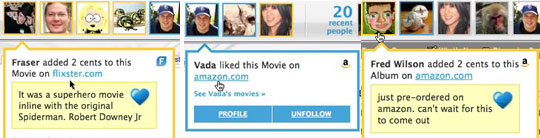
Glue, a new entry from Adaptive Blue, hopes so. Their offering, an extension to Firefox, tries to show friends' activity on a myriad of different sites, starting with entertainment items, such as books, movies, music and restaurants. As you look for something fun to do, rather than reading a review from somebody you don't know, you can see what your friends have recommended. Additionally, rather than asking you to sign in to a single location, Glue decentralizes the information, and shares it with you as you go to integrated sites, from IMDB to Amazon, Flixster and more.


Glue shows your friends comments and likes of items around the Web.

Once you have added Glue to your Firefox browser, the extension comes to life any time your Web experience crosses paths with their list of sites. When browsing a film that your friends have said they "liked" or added a comment, shown as "adding two cents", you can see that atop your browser window, running in a horizontal strip above the page's content itself.
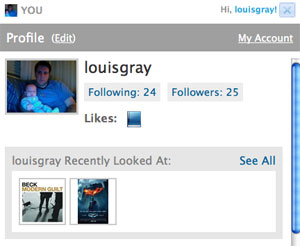
If your contacts have previously "liked" an item or added their two cents, you can put your mouse over their avatar and see what they thought. You can also click through any single individual's profile and see all of their relevant activity. If they have rated other books, films or music, you can scroll through their marked items. Instead of needing to go to a third-party service, like Shelfari or Goodreads, Glue tries to store this data, accessible from any enabled site.

As with many other services, Glue becomes more useful once you have registered your profiles with other networks, added friends and racked up activity. You can register different services, such as Facebook, Twitter, Last.fm, FriendFeed and LinkedIn, and can even use these networks to find friends who are already using Glue. Assuming you have activity on those networks, you won't have to start off lonely and without friends.

I'm not a huge Firefox fan, preferring Safari, and any time I find a new tool, I wish it had perfect compatibility, across browsers and platforms. That Glue doesn't support every browser out of the box might slow its adoption, but once it's installed, it is a very simple tool that doesn't require a lot of maintenance. If you spend a lot of time looking for new entertainment on the Web, Glue might mean you have friends coming with you to help decide, whether they know it or not.

You can "Get Glue" at www.getglue.com.

Additional coverage of Glue from around the Web:

November 13, 2008

November 13, 2008 · 4 MIN READ · BY LOUIS GRAY

Does Anybody Care About Non-Blog Commenting Anymore?

Does Anybody Care About Non-Blog Commenting Anymore?

This Spring, when the tech blogosphere discovered Shyftr, a next-generation RSS reader, had launched with comments on their service, alongside full feeds, you would have thought they'd barged into bloggers' homes in the dead of night, stealing their money, their laptops and punching them around besides. Despite comments from me and others who believed this to be a natural progression of RSS readers and aggregators, their missteps landed them on virtual page one, and they haven't really escaped the many bad things thrown their way since.

But since Shyftr's unfortunate early flub, we have seen sites that are centered around other people's contents continue to grow in popularity, and in many cases, they feature conversations that are native to the service, but don't flow back to the blog. Meanwhile, some are doing more than just featuring a headline, but have excerpts that can at times display the vast majority or the entirety of a blog post. Has the Web collectively grown numb to this, and have we accepted this as "fair use"?

One tech developer wrote me yesterday, highlighting the way many posts were being displayed on the growing news discovery site, socialmedian. He wrote, "I'm sitting here finding example after example of this on Social Median? Do you think people are giving them a pass? Do people not realize that this is happening? Or do they just not care anymore?"

As socialmedian displays upwards of 1,100 characters of any given story, shorter stories could be posted in their entirety, without the original author's permission. As socialmedian now lets its users pull in content from Google Reader shared items and other sources, the author doesn't have to explicitly provide approval for their content to make it to the site. And on that site, users can engage in conversations around the content, without that data being ported back to the originating blog.

Some examples of these short stories (plus conversations) on socialmedian are here:As Shyftr operated this Spring, before having the Techmeme crowd go after them with pitchforks and torches, socialmedian unifies each article shared to the site in one thread, showing the multiple people who "clipped" it, and unifies the comments in one siloed stream.

So how is this different than the mini-scandal that erupted just over six months ago?

I've been a vocal proponent of socialmedian, and have seen the site take off over the last several months. I have also seen that the site doesn't pull in full feeds, but instead clips longer items. I can't remember the last time I published a blog post that was less than 1,100 characters after all. So I asked Jason Goldberg, socialmedian CEO, to help explain their limits and thinking. He wrote:
"While crawling the sources, we fetch short summary and full content (if exists in feed). While displaying the story on different pages of socialmedian, we first check if we have short description and show it after truncating to a certain limit. If short description is not present for the story we truncate the full content and show it. On the story page we check if we have full content for the story and display it after truncating it to 1100 chars. If we don’t have full description, we show the truncated short description."
Goldberg's response shows the team has given the issue of "fairness" a lot of thought. Unlike Fav.or.it, who believes it has every right to show full feeds and pull in comments from the original blogs, socialmedian consciously clips the data after a certain length. And outside of the story itself, depending on the page, or whether it's in an e-mail alert, these limits are even smaller, between 130 and 325 characters.

So what's fair? We've largely accepted that aggregation and bookmark sites like FriendFeed, Digg, Reddit, Hacker News and others are allowed to post URLs and headlines and allow for conversation. We have largely accepted that it is bad behavior to keep the full content of a post and integrate comments. But in between is a gray area. Can I borrow one paragraph? Two? Can I show the first few graphics you use? At what point does it move from linking and enter the land of scraping?

I would venture a bet that as the social Web continues to evolve, we have gotten more accepting of sites centered around other people's content. I believe you can't undo the move to aggregation sites, and conversations will occur where people want them to, not necessarily on your blog. I believe that sites that offer attribution and a link back to the original source are providing their own sites as a distribution and reference medium, so I don't find fault with services like socialmedian. But it's likely that others aren't realizing their content is getting in the site, and it's not getting out. So what are the standards that one should follow? And do we care anymore?

You can find me on socialmedian here: www.socialmedian.com/louisgray
November 13, 2008 · 2 MIN READ · BY LOUIS GRAY

Are We Really That Addicted To Social Networks?

Are We Really That Addicted To Social Networks?

By Corvida Raven of SheGeeks.net (FriendFeed/Twitter)

I think we may be taking social networks a little too far or too seriously. As MySpace underwent rapid growth, we saw one cell company relentlessly market to its audience: Helio. Do you remember the Helio? They were a mobile virtual network operator (MVNO) that launched back in 2006. They marketed their phones to those who were serious MySpace addicts. Essentially they offered MySpace on the go, before all the mobile apps were made available to the public. Since then, there have been talks of Virgin Mobile acquiring Helio this past September, but you could esentially call Helio defunct at this point.

Today I caught wind of an announcement for a new Facebook phone. Is this where we are headed, people? Are the Facebook and Myspace apps not enough that we need entire cell phones dedicated to these social networks? Or are people just looking to get rich quickly off of the hype surrounding social networks? And it's not as if these have a record of working - remember Mobile ESPN?

These devices serve the same purpose as the Web site itself! Who in their right mind is going to spend money to access the site on the go via a completely different phone, when they can just as easily get an internet data plan added to their current cell phone to access the site or simply wait until they are near a computer. I'm beginning to wonder what mainstream is really thinking about when they see the hype that surrounds social networks. As much as I'm addicted to Twitter and FriendFeed, I would never purchase an entirely separate device just to access them. What's the point? I sense the beginning of a serious addiction problem for those that take things this far.

What do you think of technology like this? Is it a waste of money for both consumers and the company? Or will they become the next big thing in the future of tech?

Read more by Corvida Raven at SheGeeks.net.