Silicon Valley Technology Commentary & Archives · Est. 2006 3,033 Posts · 2006–2026

January 17, 2009

January 17, 2009 · 3 MIN READ · BY LOUIS GRAY

DandyID's Dandy Idea: Connecting Your Diverse Online Identities

DandyID's Dandy Idea: Connecting Your Diverse Online Identities

By Ken Stewart of ChangeForge (Twitter/FriendFeed)

"One place to manage you and your relationships online," the slogan goes. Although it sounds a bit like a dating site, DandyID (launched in May of 2008 by co-founders Sara Czyzewicz and Arron Kallenberg) offers an intriguing way to connect your online identities. While many aggregators offer the promise of an integrated panacea, DandyID proposes taking it one step further.

Are you connected with someone on Facebook and don't know their Twitter handle? Are you following someone's blog on Blogger, and you want to know their FriendFeed URL? Well, DandyID not only offers you the promise of unifying the varied fragments of your online persona, but allows you to explore the possibility of uncovering just where you and your friends' online lives touch.

Think LinkedIn's degrees of connection, but expand that to over 100 social media sites - and now you might just have a powerful relationship building platform.

The Good Stuff:
  1. Wordpress Widget: DandyID offers a widget for my blog, where I can publish a readily available menu of places my readers can connect with me using other services. There was no complex configuration. I added the widget, entered my e-mail address, and it synched all of my selected services right across.

  2. Auto-Population: When I was first configuring my profile in DandyID, I started with my FriendFeed account. I was amazed that it then went on to poll all of the feeds I had configured within FriendFeed - dramatically speeding that often tedious process of configuring yet another social media site to connect with all of your others.

  3. Suggested Relationships: Perhaps one of the most interesting features was the option of suggested relationships. True to their word, the makers of DandyID offered me a few DandyID subscribers (Chris Brogan and Tina aka Stupid Blogger) to connect with.

Will DandyID Become a Launch-Pad?

Launch-Pad is DandyID's answer to a closed web. It attempts to become the single portal through which you can visit over 70 of your favorite sites such as Facebook, Twitter, YouTube, Flickr, and the list goes on. DandyID's blog had this to say about Launch-Pad, now in private alpha):
Make no mistake, DandyID does not view Launch-Pad as an ideal solution to the plethora of walled gardens that exists online today; but rather as a band-aid for users who are suffering as a result of a closed web — it is our knee-jerk response to an imperfect internet. DandyID’s long-term focus is on building services that empower the user and add-value on top of [Joseph Smarr's] New Open Stack.
I have requested an invitation to the Launch-Pad alpha, and hope to have a review of it for all of the LouisGray.com viewers in the coming weeks.

Is DandyID There Yet?

I have been impressed with how smooth the integrations have been with the various services. While the overall power of a service such as this will only come through massive adoption, I have been readily impressed by the ease of configuration and suggestive logic deployed.

In reading DandyID's sparse blog, I get a feeling that Sarah and Arron are attempting to deliver a special answer to the barrage of sites to which we find ourselves subscribing - attempting to find a way to help us discover a deeper level of meaning in our community.While the service is still less than a year old, I highly suggest you take a look at what's under the hood. I look forward to seeing you around the block, and who knows - maybe DandyID can help us stitch together the scraps of fabric we now call social media.


Ken Stewart’s blog, ChangeForge.com, focuses on the collision between the constantly changing worlds of business and technology. To learn more about Ken, you may visit him at DandyID.

January 17, 2009 · 2 MIN READ · BY LOUIS GRAY

Scoble Starts His FriendFeed/Twitter Monetization Strategy

Scoble Starts His FriendFeed/Twitter Monetization Strategy


Uber-blogger Robert Scoble came under criticism in late December when TechCrunch's Michael Arrington said he had neglected his blog, in factor of spending time on FriendFeed and Twitter. Arrington said It’s Time For A Friendfeed Intervention, saying he was contributing to the popularity of those services but getting nothing for himself, adding, "How much of that value does Robert receive? Zilch." Well, thanks to a tip from one of Robert's Twitter friends, it looks like he is trying to capitalize on his popularity on these new services, through embedded Amazon affiliate links.

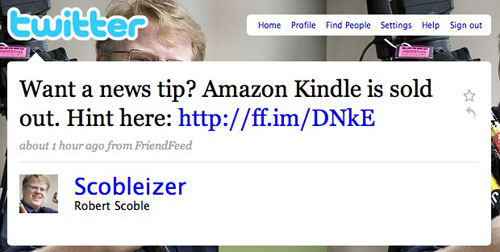
Whether it is a one-time experiment or a sign of things to come, tonight Robert sent a note to his now 25,000 FriendFeed followers, and nearly 50,000 followers on Twitter, saying: Want a news tip? Amazon Kindle is sold out. Hint here:, and adding on FriendFeed:
"I just bought a version 1.0 machine. It's sold out. Will they make more? I doubt it. So, why are they still accepting orders? I just bought one and will let you know what shows up. I'm hearing that new version comes in next few months."
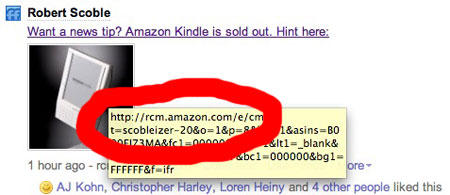
After that introduction, he gave a personalized affiliate link, which would give him a percentage of the sales made during the session of any of his followers. (See the FriendFeed thread here)


Note the Scobleizer tag in the destination URL...

As simple as that sounds, the power of Amazon affiliate links on the Web can often be underestimated. John Gruber of Daring Fireball made nearly $6,000 in just over a week by encouraging his blog visitors to buy Mac OS X 10.5 from his affiliate link instead of directly from Apple.


Scoble is caught "red handed" without disclosure...

Robert probably won't make $6,000 from this experiment tonight. Assuming he also gets 7.5% referrals from Amazon, It would take $80,000 worth of orders to get him a similar return - meaning 223 of his more than 50,000 followers would have to buy the $359 Amazon Kindle for him to reach that mark. But if he continued to drop Amazon links into his FriendFeed and Twitter stream, it could be some good spending money over time.

Of note, when Gruber asked for users to visit his affiliate page, he was very clear about what he would get from such a purchase. Tonight, I noticed and asked Robert myself if this was his "FriendFeed revenue strategy". His answer? "You caught me red handed!" I don't mind him trying out the idea, and think it's an interesting approach, but I would have preferred disclosure.
Update: As anticipated, this topic is being discussed on FriendFeed on my feed as well as that of Robert, who says I missed some important points. Also see: Free Rides Can't Last Forever from Dennis McDonald and Network World's Paul McNamara: Blogger Catches Scobleizer With His Hand in Amazon's Kindle Jar.

January 16, 2009

January 16, 2009 · 2 MIN READ · BY LOUIS GRAY

Why In the World Can't I Customize Apple's Time Machine?

Why In the World Can't I Customize Apple's Time Machine?

In March of 2007, when writing for The Apple Blog, now part of the GigaOM network, I openly speculated that Apple would debut a wireless network storage device, combining their expertise in Airport wireless devices with an external hard drive and give users a simple way to back up all their files. Sure enough, Cupertino rolled out the combination of Time Machine software and the Time Capsule backup device to do just that. And while I'm one of those Apple customers backing up my data through the air, you have to color me unimpressed with the flexibility of Time Machine - as its options are so limited, it's practically assumed I'm too stupid to make any decisions on my own. This leads to the application slowing down my computer when I don't want it to and regular bandwidth congestion for me and others sharing the network (notably, my wife).
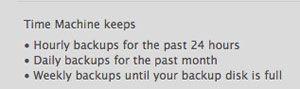

As with many of Apple's products, Time Machine assumes it is made for consumers who benefit from a limited number of options. The product, in an attempt to backup all your data regularly, comes preset to make:
  • Hourly backups for the last 24 hours
  • Daily backups for the past month
  • Weekly backups until the backup disk is full
And... that's it.

When I am at the office, away from my Time Capsule, I'm not backing up. But when I get home, every hour, for about 10 to 15 minutes, my laptop starts to slow as Apple's Time Machine whirs into action, backing up my MacBook Pro's 200 Gigabyte hard drive to the 500 Gigabyte time capsule. While I've told Time Machine to not back up some folders, to reduce the time and storage space, I can't set up Time Machine to back up with any other granularity. I can't tell it to back up every two hours, three hours or four hours. I can't tell it to only back up after 10 p.m., or in a window from 6 p.m. to midnight, if I wanted to. I can't tell it to exclude certain types of files (like MP3 or PowerPoint, if I wanted to). It's either on, or it's off. And it's on the way that Apple set it up. Not the way I did.
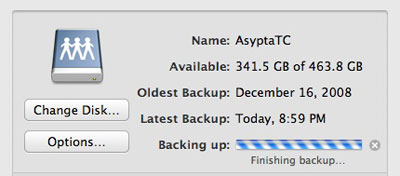


So If I have my Time Machine stuck in the "On" position, I'm doomed to have my computer slow down once an hour and stuff the network full of flowing bits once an hour. I've even switched over to my neighbor's open wireless once or twice just to make sure the backup failed and I could get my bandwidth back. While we've gotten further along than my August post where I couldn't even get Time Capsule to work right, I'm still quite annoyed that Time Machine seems to be designed so simply that I simply can't be happy with it. It's time to get more options.
January 16, 2009 · 2 MIN READ · BY LOUIS GRAY

TweetDeck's Funding Shows Good Ideas Can Still Attract Good Money

TweetDeck's Funding Shows Good Ideas Can Still Attract Good Money

This morning's great news came from TweetDeck author Iain Dodsworth, who managed to start a round of funding that when completed could be as much as $500,000. The popular Twitter application, which has only been around for just six months' time, spent very little time in obscurity, jumping out of the gate and racing to the top of the charts, alongside Thwirl and Twitterific. While most of the headlines in the financial space of late have been filled with doom and gloom, Dodsworth's strike of fortune displays the best apps showing serious momentum can still attract forward-thinking investors.

The story was broken early this morning by Peter Kafka of All Things D. (See: Another Twitter App Funded: TweetDeck Raises an Angel Round. Next Up: A Business Plan) The report says TweetDeck has been downloaded a quarter million times, and hundreds of thousands of tweets are sent from the application each day.

TweetDeck has become practically the only way to logically consume the firehose of Twitter, slicing and dicing the incoming tweets from friends into logical groups, or keeping search terms, replies, and direct messages in their own columns. And TweetDeck's done some smart things since its launch, adding on support for other popular third party services, like TweetShrink, 12 Seconds, and more. As Iain, e-mailed me today, when I sent him a note of congratulations, "Lots in the pipeline now, extremely excited."

In my 2008 recap covering the top 10 new services of the year, I slugged TweetDeck as #4 overall, saying:
"If (Iain) can get enough people to donate or pay for the application, there's no question he could make a full-time living from the resulting revenue. The question is, will people who expect a free service to have 100% uptime spring for the app that gets them there?"
I personally would pay money for TweetDeck today. I am always happy to pay for good software, which is what TweetDeck is. I don't want to forecast what's next for the service, as I do have some insight there, and don't plan to break confidence, but I have personally enjoyed watching the service ramp up following its July debut, which we covered.

See also: The Deal Twitter organizer Tweetdeck scores seed round, where the reporter says:
"(Iain) sent the program to 10 friends for fun and then watched in astonishment as Tweetdeck became an overnight hit, thanks to a glowing review by influential tech blogger Louis Gray who stumbled on it in the word-of-mouth "viral" way of social media."
That's the kind of report I love. Just like our seeing Socialmedian go from debut to sale in less than a year, it's been fun to have a front-row seat to the success. Looking forward to more success for TweetDeck and more successes for innovative startups.