
Silicon Valley Technology Commentary & Archives · Est. 2006 3,033 Posts · 2006–2026

January 24, 2009

January 24, 2009 · 3 MIN READ · BY LOUIS GRAY

Learn More About Who You Follow With TweepSearch

Learn More About Who You Follow With TweepSearch

By Jesse Stay of Stay N' Alive (Twitter/FriendFeed)

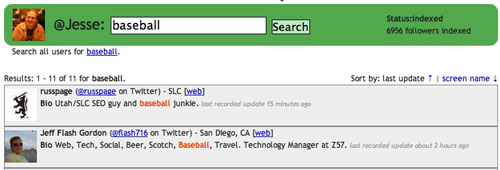
Damon Cortesi, the man behind TweetStats, DM Whacker, and First Follow, has just made my life a whole lot easier by allowing me to learn more about the people I follow through search. The service, called TweepSearch, aims to allow you to search for specific people you want to find amongst the people you follow.

Back when I joined Twitter, tracking those I follow was an easy task. I knew almost every person in my network, and was able to easily learn more about them by reviewing each of their profiles and seeing what they did through their Bios. In the beginning I was religious about this - I really care about my followers, and I really enjoy learning who is following me, and what they're interested in. However, as my network has grown from hundreds, to thousands, to now approaching tens of thousands, it has become increasingly difficult to know every single person that is following me. There are days I get in the hundreds of new followers - I think every account on Twitter has this potential. It was actually for this reason that I created my own service, SocialToo. TweepSearch complements SocialToo by letting you now search amongst the people we follow for you.

Are you in HR?

One potential application I could see for this is a way for HR professionals to find people in particular fields. What a better way to find employees than through the people already interested in your brand who are already following you? Jeremiah Owyang did a study recently in which he suggested (based on early data) most people with jobs currently found those jobs through a friend. Through TweepSearch, you can do just that, by searching for people with the skills you need amongst your Twitter friends.


I decided to, as an experiment, try this amongst my followers. I did a search for "Perl" (we are a Perl shop at SocialToo), and was surprised to find people listing Perl experience in their Twitter profile. I did a search for "Social Media", and found several Social Media experts. Searching for "marketing" revealed a whole slew of people with a focus in marketing. You can actually search this amongst the friends of any person they are indexing!

Search all of Twitter

The amazing part of TweepSearch is that it not only works amongst your followers, but you can also search through all indexed profiles on the service. If you don't specify a Twitter username, it will search for all the terms I mentioned above across a large sample of the Twitter user-base.

Damon listed several future plans for the site, which include the ability to search by proximity, meaning you can search for specific terms amongst people within a certain distance from your current location. He also plans for the ability to follow directly from the results of people you just searched. Currently, you can already search for people in a given location based on the "Location" field in their Twitter profile.

While TweepSearch comes amongst a large base of People searches around Twitter, including MrTweet, which matches people to you, and Twitter's own people search which suggests people to you and allows you to search by name, TweepSearch fills a void in that space by showing you who the people are that are following you. Give it a whirl and see what you can learn about your Tweeps!

Read more by Jesse Stay at Stay N' Alive.

January 24, 2009 · 2 MIN READ · BY LOUIS GRAY

419 Scammers Set Up Roost on Facebook

419 Scammers Set Up Roost on Facebook

The art of the largely Nigerian-based '419' e-mail scam is a unique one, but a familiar one. Anybody who has had an active e-mail account for any amount of time has seen the heartfelt pleas for assistance and funding to help safeguard huge amounts of assets that need to be moved, allegedly due to a stressful situation, be it a political coup, a horrific accident or simply death, followed by inheritance. The scams themselves have migrated from snail mail to fax machines, e-mail, and most recently Facebook, as noted by Network World back in November.
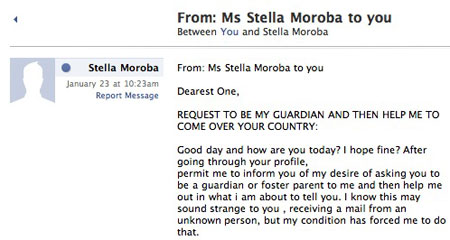
Yesterday, I got a note from a Stella Moroba via Facebook. Stella and I are not friends, so far as I can tell, which makes sense, as I doubt she is connected to anyone at all. Stella, in the most ardent way she knew how, told me she has access to "the sum of Two million Five hundred thousand United State Dollars", which I could gain a portion of on two conditions: that I "serve as a guardian to me and then assist me transfer the money into your bank account" and second, "make arrangement for me to come over to your country to further my education and then settle there parmanently". (sic)


Unfortunately for Stella, what with working full time, twins and all this online nonsense, I don't have too many cycles to pass her way to ensure her financal and personal freedom. But I did have a few, so I did a quick search on Facebook and found 214 different results for Stella Moroba, including the occasional Moroba Stella. Unsurprisingly, none of the handful I checked out had any friends, or even bothered to put up a profile picture. So disappointing!


Facebook has taken aggressive measures to ban members who violate the network's terms of service. Seemingly every day we hear about new people who believe they have been unnecessarily booted - and we covered one of those issues last summer. Before any unsuspecting victims rise from Ms. Moraba and her clones, don't you think Facebook would notice the creation of more than 200 identical accounts, and the inevitable onslaught of spam within the system? I certainly didn't accept Ms. Moroba as a friend, and don't believe she should be sending me messages. Isn't that the purpose of friending in Facebook, so you can avoid getting messages from people you don't really know?

If you are interested in helping Ms. Moroba and her family with their strife, e-mail me. I can hook you up. Even if Facebook does eventually delete her account, she helpfully provided her e-mail address and phone number.
January 24, 2009 · 2 MIN READ · BY LOUIS GRAY

Skyworks' iPhone Games Decrease My Need for Dave & Busters

Skyworks' iPhone Games Decrease My Need for Dave & Busters

The local Dave & Busters at the Great Mall in Milpitas can practically be called Chuck E Cheese for adults. Combine a sports bar with pool tables, and add a sit-down restaurant with rows and rows of arcade games, ranging from shoot 'em ups to racing games, slots and even simulation bowling, golf or boxing, and you start to get the idea. But no matter how amazing the graphics and simulation of some of the more top-line arcades, I have always found myself gravitating to a pair of old mainstays: Skeeball and Hoops. Both involve multiple balls, simplistic scoring, and the incredibly annoying feeling that you should do better, but you never quite master it.

As with practically all good things these days, Skyworks has moved both games to my iPhone, meaning I can now find myself rolling balls up the ramp in a futile attempt to hit the ever-elusive 100 point hole, or shooting ball after ball, and racking up the bricks.


The Familiar Skeeball In an Unfamiliar Place

Arcade Bowling, for a mere $1.99 will see you playing a lot more on your iPhone than 4 cheap 50 cent tokens at the real thing. The game offers two modes: Classic and Progressive. The Classic mode tabulates your 9 rolls, with points from 10 to 100 on each. The Progressive mode sets a goal of 200 points in the first round, and if you reach it, you go to the next round, and a new goal, as your points accumulate. Also, a fun wrinkle for Progressive has it so one ring is randomly selected for five times its point value - meaning if you need 130 points to get to the next round and the 30 point ring is flashing, you've got to be precise.


You Can Score Big Points in Progressive Mode

Arcade Bowling eggs you on as you make trick shots, saying "Nice Shot" or admiring your "Mad Skillz". It's a trip. And no matter if you nail the highest score, you always want to play again now that you think you've got the hang of it. But you'll never be fully satisfied with a "perfect" game.

Arcade Hoops Basketball, also only $1.99 replicates the rapid-fire feeling one has when they have to make as many baskets as possible in a sixty second period. As with Arcade Bowling, you have the option for Classic Mode, or you can do Progressive, which moves the basket forward and back, giving you the chance to nail some long-range shots for 3, but largely making you feel like a dork as you swipe your finger up and down the iPhone repeatedly.


Make All Your Shots Before Time Runs Out

Dave & Busters still trumps the iPhone when it comes to delivering healthy portions of unhealthy food, so until the iPhone can add to my waistline and not just hang on my belt, it does have that advantage. But when it comes to games, I'm finding I can leave the D&B behind.

January 23, 2009

January 23, 2009 · 3 MIN READ · BY LOUIS GRAY

The Danger of Changing The Baseline

The Danger of Changing The Baseline

By Rob Diana of Regular Geek (Twitter/FriendFeed)


There has been a lot of discussion regarding the recent announcement about Twitter's API limiting. The SocialToo blog has a very good overview of the situation. Granted I am not a fan of the limitations, but that is not the reason for this post. Changing the limits is the real problem.

The baseline for any application is when it is released. Any updates or new features added to an application reset the baseline to a higher level. The user and developer community are your best friends during this cycle. It can be argued that Twitter would not be nearly as popular if there was no API or third party applications for it. However, if you decide to change something in an application, and the net effect is a decrease in functionality, it feels like you have taken something away. For example, Jesse Stay, the founder of SocialToo, realizes that these limits now change the way applications can use the API:
Many of the services you have come to love for Twitter, including those of our competitors, and many other Twitter-based services are in jeopardy. This is scary news as an entrepreneur and Twitter developer. Twitter has basically just limited how big any Twitter-based business can grow.
Changing The Baseline

The real problem is that these limits appeared long after the API was released. Twitter has consistently removed functionality during peak traffic periods as well. Things like deleting direct messages or viewing older messages often gets disabled. This does not provide a good user experience.

Twitter is not the only one doing this either. Google has also recently done this for their Google Apps product.
When Google Apps first launched up to 200 user accounts could be created for each business under the free version. But that limit was quietly reduced to just 100 user accounts. And then when the reseller program was announced earlier this month, the limit was cut in half again, to just 50 accounts.
Obviously, this is bad for the users and good for Google. However, lowering this limit is devaluing the service that Google is supplying. Sometimes a company will have a promotion when first launched where the account limit is temporarily raised, but it is also known that it is temporary. In Google's case, the Apps offering has been around as long as Twitter has. So, it is not the case of a quick change, it has been changing over the course of years.

The Danger

The real danger appears after the changes take effect. If the changes or limits are drastic enough, the popularity of the application could decrease rapidly. In some instances, your users could rebel or even start building an alternative product. The idea is that the application must always move forward. In some cases, moving forward may mean a small step back, like a little used feature that is poorly implemented gets removed until a rebuild of the feature is ready.

For startups, losing popularity or even a small decrease in users or hype could mean the end of the line. In the case of Google Apps, lowering the number of free users may actually drive small companies away from them. Many small companies may be using Google Apps because it is free, and they can grow with the service. Now, with a limit of 50 free users, companies need to make decisions on Google Apps or other online application suites shortly after hiring employees.

In reality, you want to push change for the better. You want to keep your customers as happy as possible. Enforcing new limits long after releasing features can just alienate your users. Some level of trust will be lost because it feels like they were tricked by your earlier kindness.

Read more by Rob Diana at RegularGeek.com.