Silicon Valley Technology Commentary & Archives · Est. 2006 3,033 Posts · 2006–2026

January 25, 2009

January 25, 2009 · 3 MIN READ · BY LOUIS GRAY

Watch for the Telephone Game in Your Short Attention Span World

Watch for the Telephone Game in Your Short Attention Span World


One of the recurring themes on this blog has been how to handle a seeming overflow of information. We've discussed creating a social media consumption workflow. I addressed a new concept I called continuous parallel attention. I said how you handle the information overload Is up to you and later said there is no social media overload and cautioned bloggers to relax, because nobody is keeping score. But we still see problems crop up when a story gets passed from person to person and details get lost. It's the modern equivalent of the popular "Telephone" game we all played as kids, where the last phrase was never close to how it started.

Take a look at an example from this weekend, after Erick Schonfeld of TechCrunch wrote a piece saying FriendFeed had seen site growth that reached almost 1 million visitors in December of 2008.

Seems straight forward enough. The data came from Comscore, which shows a higher growth rate for FriendFeed than do other services, including Quantcast and Compete.com. Compete reports 700,000 visitors or so to FriendFeed in December, by the way.

But then, Robert Scoble, a good friend, good blogger, and fellow FriendFeed user relayed the story a little differently, saying that the report said FriendFeed had surpassed a million user accounts.

Using that as the baseline, Robert stated the 26,000 or so subscribers to his feed represented one of every 39 users. (See the FriendFeed thread here) But that only exacerbated the flub. Having used the site myself for quite some time, I'd be shocked if there were more than a million registered accounts, and FFHolic estimates the number to be closer to 200,000 total accounts, one fifth of a million. This of course makes Robert's penetration even higher, as that means one of every eight users follows him, but that's not the major issue.

If you're FriendFeed, and you know your actual user count, you can't exactly issue a correction saying that you "only" have a quarter million users. And if they did announce such data, which they don't, it might seem to be a letdown now that the higher, incorrect number has been released.

The service is now becoming a destination site as users share links on Twitter, their blogs, Facebook and elsewhere, so it's no surprise that the unique visitor count is higher than the number of users. After all, if I visit from home and on my wife's laptop and the office, doesn't that count as three unique visitors?

This is but one example, and I know practically all of us have made the mistake of reading stories too quickly, or coming to conclusions and extrapolations based on only partial data. For example, Stowe Boyd wrote a great piece tonight saying I was "Wrong About Twitter Funding", but he had only seen one of the two posts, which had taken point/counterpoint positions. That's not a victim of the telephone game, but he is a busy guy, like the rest of us, and no doubt overlooked one of the items.

When we're reacting to other items, or relaying them, we should be careful that we're not making new stories based on data that's not true. We're all going fast, and maybe reading a ton of RSS feeds, seeing thousands of Twitter updates, and rushing in an effort to post quickly. But there's something to be said for watching for the telephone game.

January 25, 2009 · 3 MIN READ · BY LOUIS GRAY

There's No Way Twitter Is Worth $250 Million Today

There's No Way Twitter Is Worth $250 Million Today

See Also: Twitter Is Worth A Lot More Than $250 Million

In the Web 2.0 space, it would be extremely difficult to find a more-successful, faster-growing service than Twitter, who has carved out a significant niche for itself in the microupdates space, as people from around the world tell you what they're doing, right now, even if you didn't ask. The service has an estimated 6 million active users, and recently surpassed the 1 billion "Tweet" mark, if you count all updates. But the company hasn't yet made a buck in traditional revenues. (Although I can't claim to be privy to their books, and they just might have recognized something somewhere) Word comes this weekend, via TechCrunch and others, that Twitter is embarking on a new funding round that could see the company valued at $250 million. And while I already made the case that Twitter will get its funding, and could end up being worth a lot more than that number in short order, it is pretty easy to also poke holes in that analysis.

Quite simply, now is a very difficult time to attain a high valuation. Venture funding is dropping dramatically, and positive exits for companies are rare. Practically nobody is talking about going public, so to make money, you would have to do it the old fashioned way, through profits. And Twitter has grown its user base rapidly, but has done so on the backs of users who are used to getting something for nothing. We've already seen users revolt when Magpie launched with the possibility of inserting ads in one's tweets, and you could expect to see the user base shudder when being asked to shoulder any of the revenue themselves - so you can practically forget about monthly fees. Given that scenario, site ads and ads inserted in third party applications, like TweetDeck, would have to be one option, but an unattractive one, as the ad market itself is tailing downward.

Additionally, what Twitter does is incredibly basic. It's sole functionality is one that it is easily replicated. You can provide status updates on Facebook, on GMail, on FriendFeed, and the whole process rolls back to AOL instant Messenger, when you would set an "Away" status to say you were "At Lunch" or "In a Meeting". So that's not hard.

A recent post by Paul Buchheit of FriendFeed, called Communicating with Code, showcased a prototype offering of FriendFeed that borrowed heavily from the look and feel of Twitter. Given FriendFeed updates include those from Twitter, and then build on with additional services, it can be considered a superset, while Twitter is simply one service of many. So the barrier to entry to compete with Twitter is not that hard, leaving the company's major assets as the community and its developers.

But communities are incredibly fickle. None of Twitter's six million users were using the service five years ago, and maybe, five years from now, they will be doing something else. If people use Twitter for conversation, they can replace that with e-mail, with IM, with FriendFeed, Facebook or other social destinations. I've talked about the five stages of being an early adopter before. One of the final stages is when you grow tired of an environment, and leave, begging your followers to come along. It happens with news groups. It happens with e-mail lists, and it just might happen with social networking tools, including Facebook, FriendFeed, Twitter and others.

Today, Twitter is among the hottest, fastest-growing brands out there. But no matter how you multiply its current revenue to try and guess at a market capitalization, the answer is still zero. At a time when real brick and mortar businesses are seeing their own valuations decimated, how can a virtual company with a free user base and a low barrier to competition expect to be valued so richly? Whoever does invest should exercise extreme caution.
January 25, 2009 · 3 MIN READ · BY LOUIS GRAY

Twitter Is Worth A Lot More Than $250 Million

Twitter Is Worth A Lot More Than $250 Million

See Also: There's No Way Twitter Is Worth $250 Million Today

Michael Arrington of TechCrunch led the weekend news cycle Saturday evening after revealing Twitter is in the middle of a funding round that could see the still pre-revenue company valued a cool quarter-billion dollars. Not only do I believe the company will end up getting the money they are looking for, but whatever investors choose to pony up could eventually be seen as having gotten a bargain - because Twitter, with the increased investment, looks prepared to 'double down' and become a must-use utility in our increasingly realtime, increasingly connected, digital world.

Despite the company's many failings, be it with uptime, developer relations, or seemingly blaming its most active users for aggressive activity, Twitter has, over the space of 24 months, cemented itself in a position where it is a critical part of the way we share information, communicate with others, and in times of news and change, can learn from the firehose of tweets from all corners of the world.

Twitter's rise to prominence has been largely in part due to its simplicity. It does two things - let you send short updates to followers, and let you see updates from those you follow. The addition of many third party services, including the since-acquired search capabilities, and scads of desktop or Web tools, have only served to let people consume and distribute the data as they wish, as Tweets can be issued automatically from mobile phones broadcasting location info, sent from blogs using RSS, or from a host of updating services, including Ping.fm and FriendFeed.

Twitter, amid pressure from users and developers to add the ability to display photos and video, to extend the number of characters to beyond 140, to add threaded comments, and to find a business model - any business model - has simply continued doing what it does, even as competition has faltered. Pownce shut down altogether. Jaiku disappeared into the Google black hole. And FriendFeed dances to its own drummer, acting as a great complement for Twitter even as people occasionally say it could knock Twitter off its pedestal. Facebook's status updates are probably the closest thing to being a head to head fighter to Twitter out there today, and many simply pull their updates from Twitter to the social network, as I do.

Twitter will find a business model. It will very likely include some form of advertising, even in a tough economy for ads. It may also charge for premium options to users, and might find a way to break into the enterprise, eliminating the need for Yammer and other copies. And investing in Twitter today means you're buying into a company that already is #1, by a long shot, in its self-built market, before it has truly hit the mainstream, and among the Web 2.0 set, Twitter is the closest to do so - being featured frequently on CNN and used by prominent figures, including the new president's team as part of his social Web strategy.

And don't be fooled into thinking Twitter is just for consumers. Savvy business users are recognizing that Twitter is a vital audience to be communicated to and to listen to, for product mentions, feedback and competitive updates. Twitter is part of the noise, and you can either embrace it, or ignore it, to your own peril.

How can Twitter be worth 1/4 billion today without any revenue? Take a look at the market capitalizations of Web companies today, even after the stock market blowout. Yahoo! is worth nearly $16 billion. Google is worth more than $100 billion. And in traditional media, even the very damaged New York Times is worth more than $800 million at its current price. As I have mentioned many times on this blog, I find Twitter's search capability to be even more important than that of Google for breaking news. Given the company's incredible momentum, and inability to get knocked off its pedestal, we would be foolish to think Twitter can't continue to grow and increase its user base and offerings, and be worth more than $1 billion in very short order.

If I had cash sitting around to put into Twitter and they came knocking on my door, I would ask plenty of questions, but at the end of the day, I would be investing. This will be a deal to watch for sure.
January 25, 2009 · 3 MIN READ · BY LOUIS GRAY

Socialtwist's Widget Puts New Twist On Social Content Sharing

Socialtwist's Widget Puts New Twist On Social Content Sharing

By Eric Berlin of Online Media Cultist (FriendFeed/Twitter)

When reading a blog post, it's not uncommon that you will see a "Share This!" button at the bottom that you allows you to do such things as share it with friends or to publish it on your own blog or social media profile. A new Tell-a-Friend widget, produced by SocialTwist, aims to expand on that idea by enabling distribution to such communications platforms as instant messaging services and by allowing easy selection of contacts through e-mail and social networking address books. Here's how they describe it:
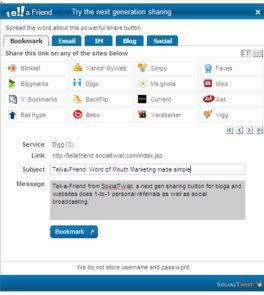
Unlike other sharing utilities, Tell-a-Friend stands unique to give you a single button which enables both one-to-one personal recommendations and social broadcasting. Tell-a-Friend is the only sharing widget to support Instant Messengers (chat) and personal messages to friends on social networks. That's clearly the best of word of mouth marketing rolled in one.
The idea is that the widget is easily installable, highly customizable, supports more than 80 services, and comes packed with analytics so that you can monitor your "viral campaigns." With support for all major instant messenger services and social media services spanning from Bebo to Yardbarker, it's hard to think of a place that you can't use Tell-a-Friend to send to. And the fact that Tell-a-Friend displays as a pop-up within the Web page that you're visiting makes for a seamless and easy user experience. I also really like the tabbed interface that allows you to easily select that type of service you'd like to use to distribute the content.


It's a pretty cool and timely service as it builds upon already available services and aims to please publishers who are always eager to enable the distribution of their content. And the ability to track the metrics of that distribution is potentially important in quantifying the ever elusive notion of "influence."

So if everything about the Tell-a-Friend widget makes sense and is looking good, I think the challenge will be to make it as easy as possible for publishers to understand and install. The Web site showcases a really cute and well produced explainer video:


But I was left wondering, "Where's the Tell-a-Friend widget?" I realized that I didn't know what it looked like! To be fair, a sample version of it is sitting in the middle of the homepage, but it took me some time to track it down.


And so if that leaves room for argument that I'm slow on the uptake, keep that in mind while I explain that I had some trouble getting the widget installed and running. I began by trying to install Tell-a-Friend on a Blogger site, figuring that would be the easiest way to test it out.

However, I couldn't get the widget to publish. I followed the step-by-step instructions that were provided, but could not get the widget to appear.


Even though there were several screenshots given to help me, there was no final screenshot showing the widget displayed on a "live website" so that publishers can see what the widget is supposed to look like on a published webpage. Translated, I did not see any written or visual instruction that tips the audience off that Tell-a-Friend is supposed to appear directly beneath the bottom of each article.

After trying to "hack" the Blogger template in a few different ways, I gave up and moved onto a WordPress site. That one proved to be successful, though it does take a little bit of technical knowhow to get it running: You have to download a .zip file with the widget code, FTP it to your WordPress plug-ins folder, and then go into your WP management tools to activate it.

Overall, I believe that there's a market for widgets that are truly useful to both publishers and Web site visitors, and Tell-a-Friend is certainly a part of that conversation.

Read more by Eric Berlin at Online Media Cultist