Silicon Valley Technology Commentary & Archives · Est. 2006 3,032 Posts · 2006–2026

April 6, 2009

April 6, 2009 · 5 MIN READ · BY LOUIS GRAY

FriendFeed Reloads With Real-Time At Its Core

FriendFeed Reloads With Real-Time At Its Core

FriendFeed's rise through 2008 was one of the bigger successes in the Silicon Valley startup space in what was a difficult year for practically every one else not named Twitter or Facebook (and both those companies had their challenges). But even while a growing number of enthusiastic users flocked to the site, it too had growing pains. Many people, including me, cited the interface as too complicated for average users, and remain concerned about how it can cement itself a central role in the extremely competitive social networking and information discovery sphere.

Today, the site relaunched with a goal of simplifying the aggregation and sharing service and focusing on the real-time Web. The new interface constantly loads in new updates from your feeds and those from all those you follow, much like TweetDeck for Twitter - becoming an information firehose.
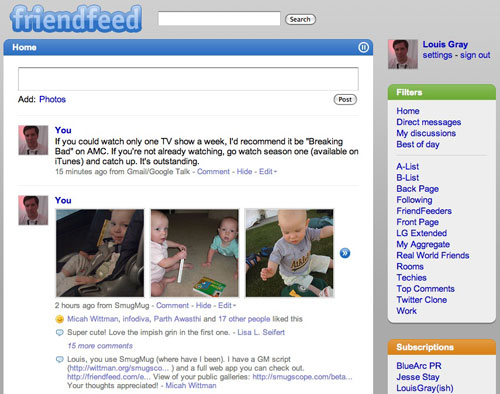

The New FriendFeed Interface - In Beta
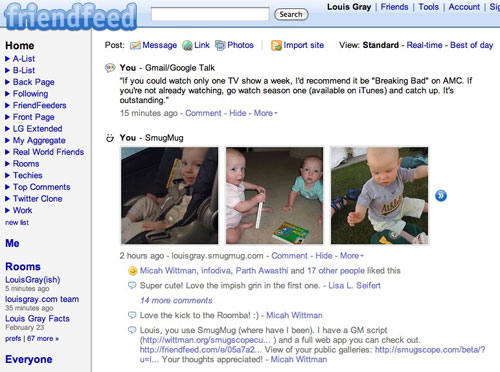


The Same Information - In the Old Version

In a presentation held at the company's headquarters in Mountain View, California on Thursday evening, company co-founder Bret Taylor explained that the product, introduced in October of 2007, had seen growth akin to "starting a one bedroom house and adding a bunch of wings, rather than a real nice house," following the addition of a robust search engine, and an array of features and customization. The result was something that many existing users adored, but others found intimidating. So the small company went back to the drawing board - watching how customers used the product and looking to enhance the site to become a better vehicle for discussions with friends.
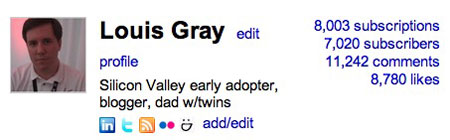

My New FriendFeed Profile

The result is a brand new, revamped site, in beta, that defaults to real-time updates in every part of the interface - with some long-awaited key additions, including the launch of direct messages, similar to those on Twitter, short user profiles for every account, and significant customization and filters that can help visitors find the content they're looking for more easily. Users can also hide that which they don't want to see - including the ability to block specific users, or save keyword searches (including vanity searches).
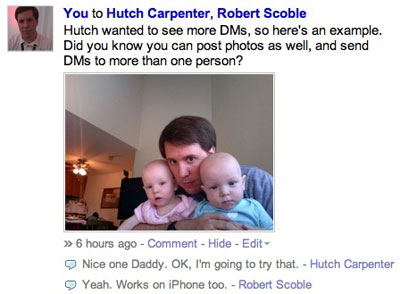
FriendFeed's direct messages share some similarities with those on Twitter, in that you can only send notes to those who are following you, but they differ in that you can send direct messages to more than one user at a time, and can even include photos. But once you've started a thread via direct message, you can't add another person to the thread.

While direct messages and profiles were much-requested from users over the last 18 months, they are merely window dressing on top of the core architectural changes that are introduced in this morning's release. Bret and Paul Buchheit said on Thursday that there is a major move toward real time communication and sharing, and that FriendFeed expected to coexist alongside other players, like Twitter and Facebook, who have gained the lions' share of visibility in the social networking space of late.

"When something is this new, it can be hard to explain," Paul said. "Like blogging or anything else, there will be multiple services, and that's where this medium will be headed. We will be one of the more significant providers."

The company, which continues to be focused on building a great product, rather than be "distracted" by monetization talks (their word, not mine), also saw the service's user interface completely retooled, replacing a spartan grey text on white background UI seen on the site to date with more color, calling out lists of friends and subscriptions in dedicated floating boxes on the right side of the page. And while that may seem a small change, no interface edits are taken lightly, we were told Thursday.

"Everyone here (At FriendFeed) really cares about UI," said Bret. "We are aware of the shortcomings of the old interface, and it's fun to rethink the product around the usage patterns. That's how we feel now, and we are ready to launch it."

In the new UI, gone is the focus on the dozens of service icons that littered the screen, highlighting the Google Readers and SmugMugs and YouTubes of the world. In their place, instead there is more emphasis on who shared it, as the users' avatars are prominently featured (like on Twitter), with the accompanying update. You can see the service still, but it becomes less of the story. And of course, that's absolutely intentional.

"Service icons have been replaced with profile pictures, to make it simpler," Bret said. "People would see thousands of icons they hadn't seen before. Lost would be the detail of what friends had shared the item."
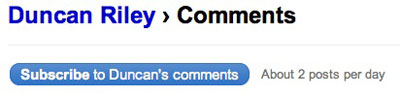

Subscribing to Duncan Riley's Comments on FriendFeed


The new FriendFeed beta comes with many other smaller changes under the hood. Instead of relying on FFHolic for user statistics, FriendFeed, like Twitter, now shows the number of people who you follow, as well as the number who follow you. Also showing are the total number of likes and comments you have made on the service since you signed up. And if you look at any other user's profile, you can click on their comments and choose to "follow" their comments, just like any other user. Should you be crazy, like me, you could add comments from some of your friends into a dedicated "filter" or list. I call my collection "Top Comments". And your own discussion threads are also tracked in their own feed, called "My discussions".
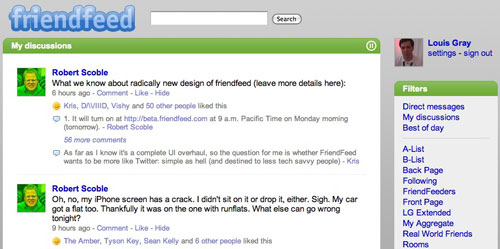

Tracking My Own Discussions on FriendFeed

The Subscriptions section also watches your own activity and selects those users with whom you most frequently engage. If you are a frequent visitor of Mona Nomura's feed, she might be listed there, or if you comment with Robert or Alex Scoble, they will be there. And if you think that's not who you want displayed, click Edit next to Subscriptions and select others who you follow.

But if you follow a ton of folks, be prepared for an onslaught of information. If people thought FriendFeed delivered a ton of information before, just wait until you see the beta. The realtime flow means an item might move lower in the page while you're still reading it. You might click like on the wrong item. And you probably aren't going to get the chance to read everything. That's why there is a pause button at the top. You might find yourself hitting pause just to catch a breath. But if you're an information junkie, there's really no better source.

April 5, 2009

April 5, 2009 · 2 MIN READ · BY LOUIS GRAY

As FeedBurner Flails and Fails, Feedblitz Fights

As FeedBurner Flails and Fails, Feedblitz Fights

A week and a half ago, FeedBlitz announced it would be taking Google head on, offering a much-needed alternative to FeedBurner in the RSS automation space. (See our initial post) At the time, they said they would "rapidly evolve", and they weren't kidding. In the ensuing ten days, amidst what seems to be yet another Web-wide statistics failure on the part of FeedBurner, the company has written how to guides on leaving FeedBurner behind, how to merge multiple feeds into one, how to keep your own domain associated with your feed, and how to migrate away from FeedBurner once and for all.

For the large part, the blogosphere has grown accustomed to FeedBurner flaking every now and again. We've grown weary of long lag times between posts hitting RSS readers after they were written, and in seeing inconsistencies in reader counts, often proudly worn as a badge on users' sites. But what we've also grown accustomed to is FeedBurner's basic nature - it sends your blog out, period.

FeedBlitz is recognizing the world has changed since FeedBurner's debut. They even offer the option to display the most recent updates from social sites, such as FriendFeed and Twitter, along side your feed. At this point, for many, their microblogging is just as full-throttle as their full-length blogging, so that makes sense.

As they have expanded their offerings, FeedBurner and Google seem to not be on speaking terms once again. It happens so often now, nobody blogs about it but not too long ago, such a miss would be ripe for the gnashing of teeth. But said miss has dropped my counts from the 4700 or so range to 1400 and 1800. Who knows why, but the number is pretty random. Even my wife's family-oriented blog dumped from almost 50 subscribers to less than 20. Ouch.

So if you're sick of FeedBurner burning you, I strongly suggest giving FeedBlitz a try. I'm working my way over to switching myself. You can see my FeedBlitzed feed here: http://feeds.feedblitz.com/lg

April 4, 2009

April 4, 2009 · 3 MIN READ · BY LOUIS GRAY

BurnURL Unveils ShareBar 2 With Moods, E-mail and Social Sharing

BurnURL Unveils ShareBar 2 With Moods, E-mail and Social Sharing

The world of URL shorteners is being hotly debated this week, and seeing tremendous change, with bit.ly making news by raising a new round of venture funding, and the release of DiggBar. In this wake, Danny Sullivan of Search Engine Land asks openly, "which URL shortening service should you use?". Joshua Schachter says they add a layer of indirection to an "already creaky system", and Jason Kottke adds on, saying they "suck" in general.

But as the use of Twitter explodes, so does the use of shorteners, as many are debating the number of characters they have left for tweets, or what one service gains them over another, as Twitter's built-in limitations make their use a necessity.


The New BurnURL ShareBar 2.0

Amid this backdrop, I have been closely watching the development of a URL shortener which does things differently - not requiring any software download or login, and not being married to any one social service - and working to determine the intent of the sharer, and mood of those who read the destination content. Round 2 of BurnURL, a URL shortener and share bar from the team at ReadBurner, where I am an advisor, is aimed to not only help information distributors pass links to friends on Twitter and other services, but to help information publishers gain feedback on their content.


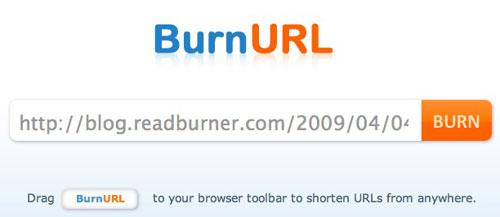
Burning a link on the BurnURL site


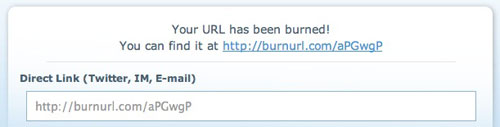
Getting a "Burned" URL to share

The new BurnURL ShareBar, released this morning, is retroactive with the more than 20,000 BurnURLs that have been issued since its initial launch, and adds on some features which I believe will make it extremely competitive with some of the more well-known products out there, including:

Integrated Sharing to Many Social Services

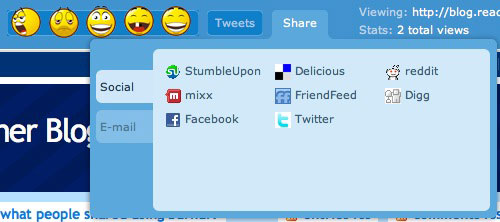
Every BurnURL ShareBar shows a "share" button letting visitors of the page further distribute the content, to social sites including StumbleUpon, Delicious, Reddit, Mixx, FriendFeed, Digg, Facebook and Twitter.


Sharing to Social Services via BurnURL


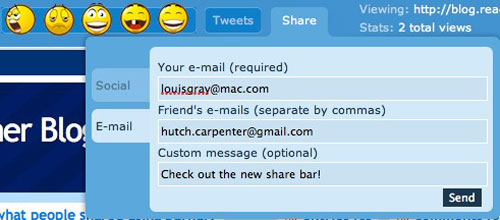
Sharing by E-mail via BurnURL

E-mail Sharing

From the new ShareBar, you can now e-mail the content of any Web page to any number of friends, just by clicking Share, and selecting the e-mail tab. You can send it to multiple friends, and add a custom message.

A Tweets Button that Shows Mentions of the BurnURL

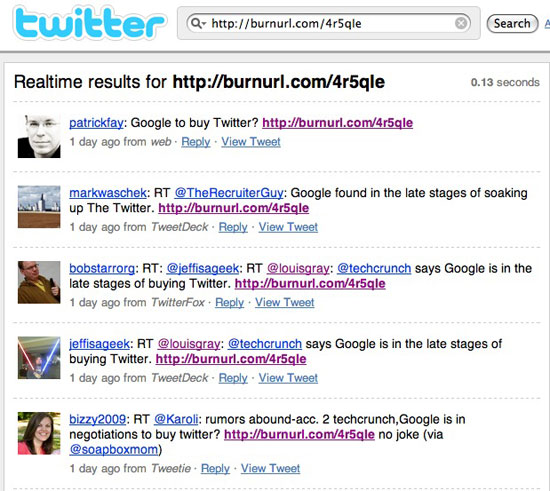
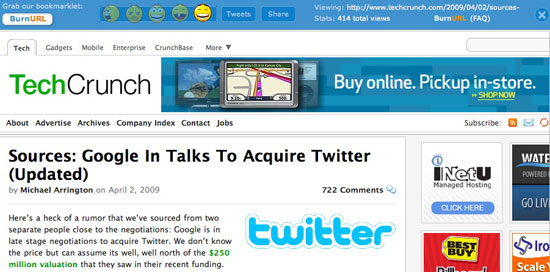
By clicking Tweets in the ShareBar, you can see all mentions on Twitter of that specific BurnURL. For example, see how widely my highlighting of TechCrunch's post rumoring Google was in late stages to buy Twitter was disseminated by clicking this saved search.


The new ShareBar integrates Twitter search results for the "burned" URL

Mood Mining Ratings

Rather than a simple up or down vote, Digg or bury, like or dislike, BurnURL is looking to get the mood or emotional feedback from readers by using emoticons. Now, instead of voting a story down as "bad" because you disagree with its premise, you can tag the link as funny, interesting, boring, sad, or even exciting.

Statistics

Information distributors and publishers are also likely interested to see how far and wide their shares have gone. For example, my share of that TechCrunch article has already gained more than 400 unique impressions. The new ShareBar now shares both unique views of that link and the total number of views. And as the post on the ReadBurner blog reads, you can expect more statistics to be developed in the future.


BurnURL shows more than 400 visitors from my shared link

A former TinyURL advocate, I have been using BurnURL exclusively since its initial launch - not because of my relationship with ReadBurner, but because I like the product's flexibility and promise. Techies can argue all day about whether URL shorteners are a good idea or if there are some better than others, but I believe BurnURL is taking a different approach that is social and informative, in a world when shortening is still necessary.

You can try out BurnURL yourself by starting out at http://www.burnurl.com. If you have more questions, there is an FAQ available.

April 3, 2009

April 3, 2009 · 3 MIN READ · BY LOUIS GRAY

Stop Telling Me How to Use Your Products

Stop Telling Me How to Use Your Products


In recent weeks, there have been a number of incidents where high profile online services have gotten into something of a battle with their users. Be it the on again off again user interface debate between Facebook and its user base, or Twitter's deciding just what is the right way or the wrong way to use their service, both products have ended up telling their own customers that they know best, and you should just suck it up. During these debates, some have said the best way to drive a product forward was to never compromise and listen to your users, while others celebrated the users getting a voice at the table.

But we're missing a major issue that I want to address. I'm fine with companies making changes to their interface, or adding features, or even deciding to prioritize some issues over others. That's business. But don't tell me how to use your products. Don't tell me what is the right way or the wrong way to use a product, when you've given us tools.

Take for example the hubris from Biz Stone at Twitter in his note to individual customers who were relying on their providing autofollow capabilities. Most specifically, he said:
"We’re going to discontinue autofollow because this behavior sends the wrong message. Namely, it is unlikely that anyone can actually read tweets from thousands of accounts which makes this activity disingenuous."
Oh really? What a bunch of junk this is. What's next? Google Reader telling us that there should be a limit to the number of RSS feeds we subscribe to, or that Yahoo!, Hotmail and GMail will limit the number of new e-mails we can receive in a day? After all, couldn't they write that "nobody can actually read e-mails from thousands of people which makes this activity disingenuous"?

Here's the reality - people are going to use products the way they want to, especially if you build a product that is flexible. And they will often use them in ways you never expected, or had even considered when you were first designing. And as you continue to build your service out, the solution is not to tell users there is "one right way", but instead to consider how you can make your product even better to an increasing number of people.

What I have seen from companies like Twitter and Facebook is a belief that you should only be connected to people you know in real life, and that you should only have a small number of people to be connected with. Yes, Facebook's dismissing the 5,000 limit, and yes, they're opening up to companies and fan pages, but they still require you to enter your true first and last name, and demand a synchronous follow.

Twitter's limits are even worse. What's so bizarre about this most recent volley about users being "disingenuous" by using auto-follow is how it impacts their most popular users. Where's the outrage that Barack Obama clearly uses auto-following software? Do you think Twitter is going to tell Obama that he can't actually follow 586,000 users? Do you think they are going to tell Robert Scoble that it is "disingenuous" to follow 85,000 people?

I also use a third party auto-following service from SocialToo (where I'm also an advisor). I use it because Twitter, thanks to other limitations in their product, will let me send direct messages only to those who follow me, and I want to let them contact me directly.

What Twitter and Facebook are doing by trying to tell their users that they know the right way to use their products is putting themselves above the users, and acting in an authoritative, but naive, manner. I think Biz' comment that it was "disingenuous" to follow thousands of accounts is covering the fact that Twitter's infrastructure wasn't meant to support such activity.

At risk of echoing Thomas Hawk's comment that I'm "Mr. FriendFeed", it's worth noting again that FriendFeed doesn't tell me how to or how not to use their products, and they aren't setting limits. They put out a service, and let the users have at it. That's impressive, and a major reason of why I'm bullish on what they do. For the rest of you developers who keep setting limits and claiming it's not your fault, but your users, you're wrong.