Silicon Valley Technology Commentary & Archives · Est. 2006 3,032 Posts · 2006–2026

June 13, 2009

June 13, 2009 · 2 MIN READ · BY LOUIS GRAY

Facebook Parks Some Vanity URL Seekers in Purgatory

Facebook Parks Some Vanity URL Seekers in Purgatory

Tonight's tech event that saw Facebook unleash millions of vanity URLs to its fanatic user base has to be considered an unqualified success. It raised significant awareness for the social network, and managed to deliver hundreds of thousands of new IDs every few minutes, without showing any signs of system failure. But while some elite hand-selected users were given their names in advance, another, likely small, group, is in an odd in-between land where the user names were shown as unavailable, but didn't look like they were owned by anyone.

Visible social networking folks, including myself, Jesse Stay and TechCrunch's Michael Arrington were among those remaining somewhat befuddled at our situation - unclear if we were singled out for user name reservations by a well-meaning Facebook employee (who will tell us eventually?), or if instead, we're just in line to be completely out of luck.
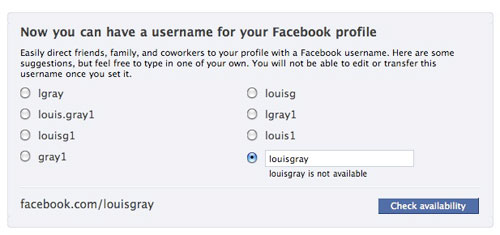

This is the URL that makes the most sense.

Like most good digerati, at midnight Eastern, I logged in to grab my username - aiming to get "louisgray" there, just like everywhere else. Fail. It said it wasn't available (at 12:01 a.m.). Neither was "louis" or even "louis.gray". In parallel, Jesse found that "jessestay" and "jesse.stay" were blocked, and on Twitter, Arrington reported "arrington, michaelarrington and michael.arrington were all not available."
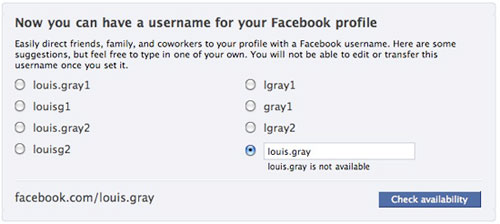

This would be a fallback choice, and much less preferred.

While oddly, each of us individuals probably shouldn't care so much about a simple user name we've locked down everywhere else, the uncertainty has us a little befuddled. I want to take the optimistic approach and expect that this will be resolved in a matter of hours, but remain curious as to just how many hours, or if there is a problem with the database that has prevented folks like ourselves from getting the desired names - for whatever reason.

So, for now, while many in the social networking space exult in their being recognized for the names they got at birth, we'll still hold on to our number right now. I'm not compromising on a non-standard ID just for the sake of having one.

June 12, 2009

June 12, 2009 · 1 MIN READ · BY LOUIS GRAY

Podcast: TheSocialGeeks: I Want the Post, Not the Pre

Podcast: TheSocialGeeks: I Want the Post, Not the Pre

Thanks to bumps in my schedule, including work, and of course, the twins, combined with the complexities of trying to get seven people in three time zones to get synched up, it has been some time since we got to participate in TheSocialGeeks podcast, chaired by Chris Miller (otherwise known as IdoNotes).

But on Wednesday, we made it, and got the chance to record. In addition to Chris and me, were Sarah Perez and Wayne Sutton.

In the podcast, which I have made available for download below, we discuss:
  • Facebook's Vanity URL Rush
  • LiveFlows
  • Floxee
  • Monetization of Twitter Streams
  • Social Identity Management
  • The Palm Pre
  • SocialToo and other premium Twitter apps
You can read more about it in Chris' site, or Download the Recording Now. You can also: Subscribe in iTunes

.
June 12, 2009 · 1 MIN READ · BY LOUIS GRAY

Video: The Social Web TV: Early Adoption and the Open Social Web

Video: The Social Web TV: Early Adoption and the Open Social Web


On Thursday, I got a chance to visit Plaxo headquarters in Mountain View, and site down with two smart folks - John McCrea and Joseph Smarr, to talk about the open, social, Web, including how communities are improving with single sign-on capability, the evolving of social conversations, and how we consume content.

It was a fun, quick, high-quality conversation that just scratched the surface, and I am hoping we get the chance to engage again.

June 10, 2009

June 10, 2009 · 2 MIN READ · BY LOUIS GRAY

Spokeo Debuts Social Mining Tool Based on E-mail Addresses

Spokeo Debuts Social Mining Tool Based on E-mail Addresses

Spokeo, having long since given up its initial plans to aggregate all your friends' activity alongside RSS feeds, in what could have been an interesting mashup of FriendFeed and Google Reader, has meandered ever closer to the darker side of Web, positioning itself as a tool to uncover details about people, most likely without their knowledge, and certainly without their implicit permission. The company took another step forward with this plan today, unveiling an "email research tool" that lets you search and find all the online activity associated with that address - crawling more than 40 networks.

If you remember your Spokeo history, back in October of 2008, the service declared Web 2.0 "over" and ditched its initial plans of posting trusted friends' updates with ads everywhere. So of course, this new research tool is not free.

To save you the trouble, I ponied up $35.40, the equivalent of $2.95 a month for 12 months (which automatically renews), to see what damage I could do by querying a few friends e-mail addresses. Luckily, I haven't had to pay per address, but can query as many as I like, to find what secrets they might be hiding.


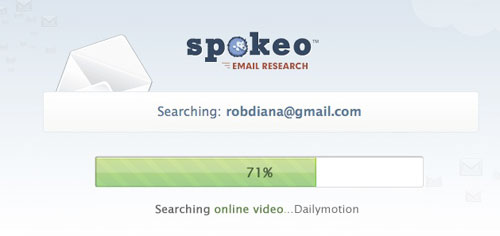
Looking up one friend using Spokeo's research tool...


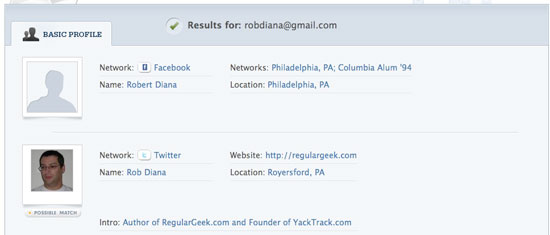
Results! Spokeo turns up Rob's activity around the Web.

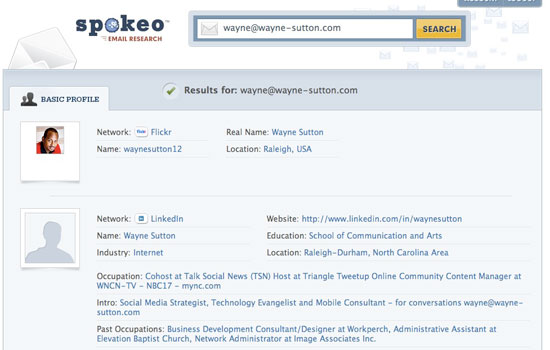
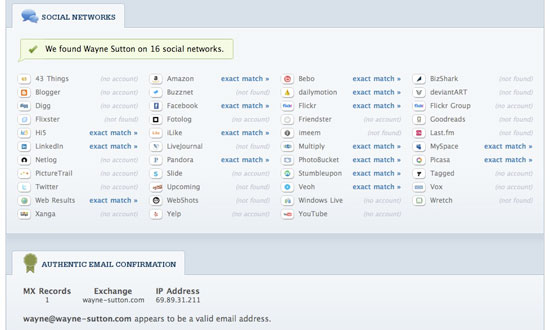
For those friends I already follow on other aggregation services, the results were hardly eye-opening. The data was accurate for me, gathering results from every network from Friendster to Flickr, LinkedIn and a ton of stops in between. Spokeo also was able to dredge up the personal details of folks like Wayne Sutton, who was spotted on 16 different social networks.


Wayne, unsurprisingly, was found everywhere.

For friends not quite as active online, the service was not always as accurate. One friend of mine was falsely reported as a Hector Hernandez in one case, and in another case as Holly Hensley. Neither was the right profile. But for another, it found a Facebook profile I didn't know existed.


Spokeo found my blog posts, tweets and links to me.


Spokeo also found my registrations across networks.

Unlike some Web 2.0 companies who have either clung to broken or missing business models, or instead, closed their doors, Spokeo is trying to make a go of it, leveraging the technology that once looked up your friends, and now, for a fee, will look up anyone you like. They won't even know. After all - isn't it their own fault for putting that data out there?