
Silicon Valley Technology Commentary & Archives · Est. 2006 3,032 Posts · 2006–2026

June 18, 2009

June 18, 2009 · 2 MIN READ · BY LOUIS GRAY

eTrade Delivers Long-Awaited iPhone Application for Stock Trading

eTrade Delivers Long-Awaited iPhone Application for Stock Trading

No matter how many iPhone applications I have downloaded over the last year or so, I have known there has always been a big gap - that of a dedicated eTrade application, set up to let me trade stocks, transfer funds and check balances while on the go. But eTrade, until now, has stuck with an exclusive contract with BlackBerry (which we discussed in March), leaving those of us with iPhones on the outside looking in. But in the quiet shadows of Apple's iPhone 3.0 operating system release, eTrade finally rolled out their app - and even though the markets were closed tonight, my testing of the application shows it delivers exactly what I would expect, in a clear and intuitive way.
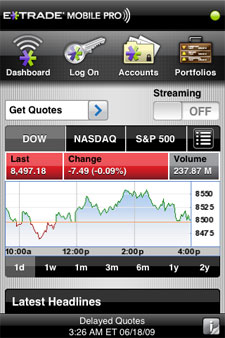
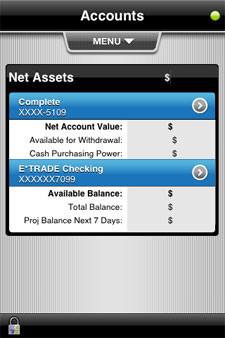
eTrade's iPhone App Highlights the Market and My Accounts

For most traders, sites like eTrade offer an important combination of both company news and trading activity. The iPhone application is no different, featuring near real-time stock prices for the markets at large, and the top news for those stocks any time you query a specific ticker symbol.
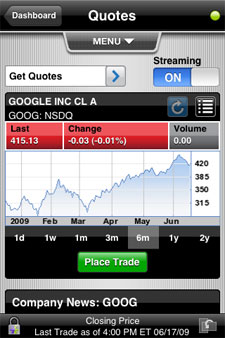

eTrade's iPhone App Lets Me Highlight Stock Charts and Trades

eTrade's iPhone application gains me access to all of my account data, from my stock portfolio to my checking account, showing balances, gains and losses, and of course, making it very easy to make stock trades - off which eTrade makes good money.

Just like on the standard eTrade site, I was able to set up alerts that would notify me if individual stocks reached a certain milestone. I could check individual stock charts for durations of days, months and years, and I could place trades from any quote.


I Can Get Detailed Quote Data and Set Up Alerts

Placing a trade on the iPhone is very easy. Testing with Apple, Google and others, I could make a bid for a stock at a limit, and could enter the number of shares of stock, assuming I had available funs to see the trade execute. I could even set up my quote data to be streaming, which I assume will push the real time upticks and downticks straight to my iPhone.

eTrade's iPhone application is one that I've personally been calling for since the first day I got my iPhone. Now that it's here, I can be ordering stock trades from my phone as easily as sending an e-mail.

June 17, 2009

June 17, 2009 · 1 MIN READ · BY LOUIS GRAY

BackType Takes On TweetBeep With BackTweets Alerts

BackType Takes On TweetBeep With BackTweets Alerts

Two of the most valuable tools I have been championing over the last several months are BackType and TweetBeep. The first searches through all comments around the Web for keywords you define, while the second watches Twitter search and delivers results to your e-mail. In tandem, the pair can essentially run on auto-pilot, giving you a real-time look into what the world is saying about you, your company, or your product.

Today, BackType extended its service to let you monitor Twitter, searching for links on Twitter that contain keywords you define. Like with its core service, and with TweetBeep, the new BackTweets Alerts system will pass on mentions from within Twitter to your e-mail, as quickly as you like, from immediate, to daily or once a week.

As I told John McCrea from Plaxo when I met him for Social Web TV last week, TweetBeep has made it so I don’t have to sit in TweetDeck all day and monitor keywords. Similarly, BackType doesn’t have me chasing through comments and reading every post, but I don’t miss much because I let these strong search tools do the work. (That's also a big part of why I said there is no information overload)

Will BackTweets Alerts be so good that I can do away with TweetBeep and turn to BackType for everything? I'm going to sign up and find out.
June 17, 2009 · 3 MIN READ · BY LOUIS GRAY

Google’s Apps Surround Search, Pulling a Reverse Microsoft

Google’s Apps Surround Search, Pulling a Reverse Microsoft

As the discussions around Bing continue, I found myself often thinking of how the product would need to not just be marginally better than Google search for me to switch, but dramatically better - not due to an inherent bias on my part, but because of how the landscape has changed. Under our nose in the last decade, Google has grown to represent much more than just a search engine – essentially recreating the major pieces of the operating system experience around their crown jewel, with a large number of hooks that have me choosing their search over others, even if competitors are “good enough”. And the more I think about it, Google has pulled a “reverse Microsoft”, not so much in an anti-competitive sense, but in terms of how they have created customer lock-in.

Microsoft is in an unenviable position many times when it comes to the Web. Nearly two decades of underperformance on search, portals and Internet access have the Redmond giant constantly changing its approach as it tries to fend off more nimble competitors. But as we all know, it ripped its way into the Web discussion in the mid to late 1990s through leveraging its operating system monopoly to push Internet Explorer to the #1 position against Netscape, adding onto its leading position in office productivity suites, and yes, the OS.

Microsoft customers could be seen climbing the ladder of Microsoft lock-in from the bottom up – starting with the operating system, adding the office suite, the e-mail application, the Web browser, and sometimes, the MSN portal or search engine.

In contrast, Google started with its search engine and has worked the other direction – adding a formidable e-mail option in Gmail, an office suite with Google Docs, a Web browser with Chrome, a portal with iGoogle, and many utilities designed to make us come to Google as our information engine – from Google Maps and Earth to Google Reader.

Meanwhile, as Microsoft came under fire for bundling its browser as part of the operating system and forcing OEMs to preload it and not its competition, Google went out and signed deals making its engine the predetermined default in practically all non Internet Explorer browsers – including Mozilla’s Firefox and Apple’s Safari browser, making it a formidable barrier for other engines, Microsoft's included, to gain share. And as we discussed previously, late last year, in the debate on mobile phones and Web browsers, where I argued that the new tactics will be “all about the hooks”, there’s no question that Apple’s iPhone, combined with Google’s Android platform, will extend the share of Google’s engine even further on the mobile Web.

So far, Google has escaped serious drama in the world of anti-trust, a benefit its competitor from Redmond does not enjoy. As Microsoft is forced to contend with pulling its browser from the operating system in Europe, or seeing flack for Bing taking over as the default search engine in Internet Explorer 6, Google continues to make deals that make its kingpin position even more secure, and add new applications that make me even less likely to leave the site. After all, if I switched to Bing, I would still have no intent to ditch Google Reader. Microsoft has never really competed with Google Maps, making that a no brainer, and though Google’s office suite online isn’t the best or biggest, arguably, at least when I am using Microsoft’s office suite, I am doing it offline, away from the real battlefield of tomorrow.

When Google first debuted and we were measuring its success in the speed of response, or simply by the number of pages in its index, I don’t think we foresaw how it would turn one of the most aggressive tech monolith’s advantages on its head. While I recognize Google Search might not be dramatically better than Bing or even Yahoo! Search at this point, once you take the brand names away, it’s the hooks that have got me.

June 15, 2009

June 15, 2009 · 2 MIN READ · BY LOUIS GRAY

Die? Thrive? Are You Conflicted On What You Want from Old Media?

Die? Thrive? Are You Conflicted On What You Want from Old Media?

If you’re one of the millions who saw the Daily Show last week, you probably saw a clip where Jason Jones took apart the New York Times, asking a staffer to find any news that happened “today”. The paper, exemplifying the “yesterday’s news” mentality that has a rapidly-increasing chasm between it and today’s real-time world, is bleeding red ink as news consumers turn elsewhere for their updates – including many of us to the Web and to blogs. But over the weekend, as the situation in Iran unfolded, and old media, including CNN, was famously slow to respond, there were practically digital pitchforks out – highlighting what was characterized as a massive failure, compared to the personal 1-1 immediate reports we got from Twitter and elsewhere.

So help me understand… Many of us are flat-out refusing to be consumers of the world’s news media, from newspapers like the New York Times and news channels like CNN, chewing away at their ad revenue. Some exult in the bad news as it streams forth – as newspapers close and journalists are sent packing. Others revel when old media makes stupid mistakes in the new world, like the AP demanding you not excerpt their stories, or other sites threatening to sue when linked to. But when a real newsworthy event hits, we hold them accountable for not being there, first to respond.

Journalism is not a charity event. Its reporters cost money, as do papers and stations’ branch offices, travel expenses, and equipment, yet many of us on the bleeding edge are all too excited to mention how we’re not paying them a dime.

There are really two ways I can look at this. One is that CNN and others are being ripped on as a way to further show how out of touch and useless they are compared with first-person reports. The second is that we want to bash the old media when we don’t need them, but flock to them when we do.

So which is it? The New York Times, Newsweek and other print publications made a name for themselves often not because of the speed of their reporting, but because of their access and their willingness to go into harms way, delivering the news in detail, often with many different reporters contributing to the story. Are individual bloggers, stationed around the world, going to pick up the slack? Can the top blogs like a Huffington Post or a TechCrunch replace the type of detailed reporting and unfettered access the mainstream old media has historically enjoyed?

That CNN did not lead the way in covering the Iran conflict this week, after decades of our relying on them to be there, as they were in Desert Storm, Operation: Iraqi Freedom, Somalia, Bosnia and others, is not up for debate. But the question is – did we really not want them to fail, or are you happy that they did?