
Silicon Valley Technology Commentary & Archives · Est. 2006 3,032 Posts · 2006–2026

July 11, 2009

July 11, 2009 · 3 MIN READ · BY LOUIS GRAY

Seesmic's Web Offering Is the Best Twitter Browser Interface Yet

Seesmic's Web Offering Is the Best Twitter Browser Interface Yet

Since reversing the company's strategy away from short video clips and more toward the world of status updates, Loic Le Meur and the Seesmic team have forged ahead in working to deliver a strong alternative to TweetDeck, letting Twitter and Facebook users update their status, view friends' updates and manage their social networking accounts from their desktop - complete with multiple account support, multiple columns, and all the standard features you would expect, from profile viewing to direct messages and search. Yesterday, at the TechCrunch CrunchUp event, Loic demonstrated not just a new version of Seesmic Desktop, but also a Web version that operates completely in the browser. And guess what? It's good - easily the best Web interface I've seen for Twitter yet.
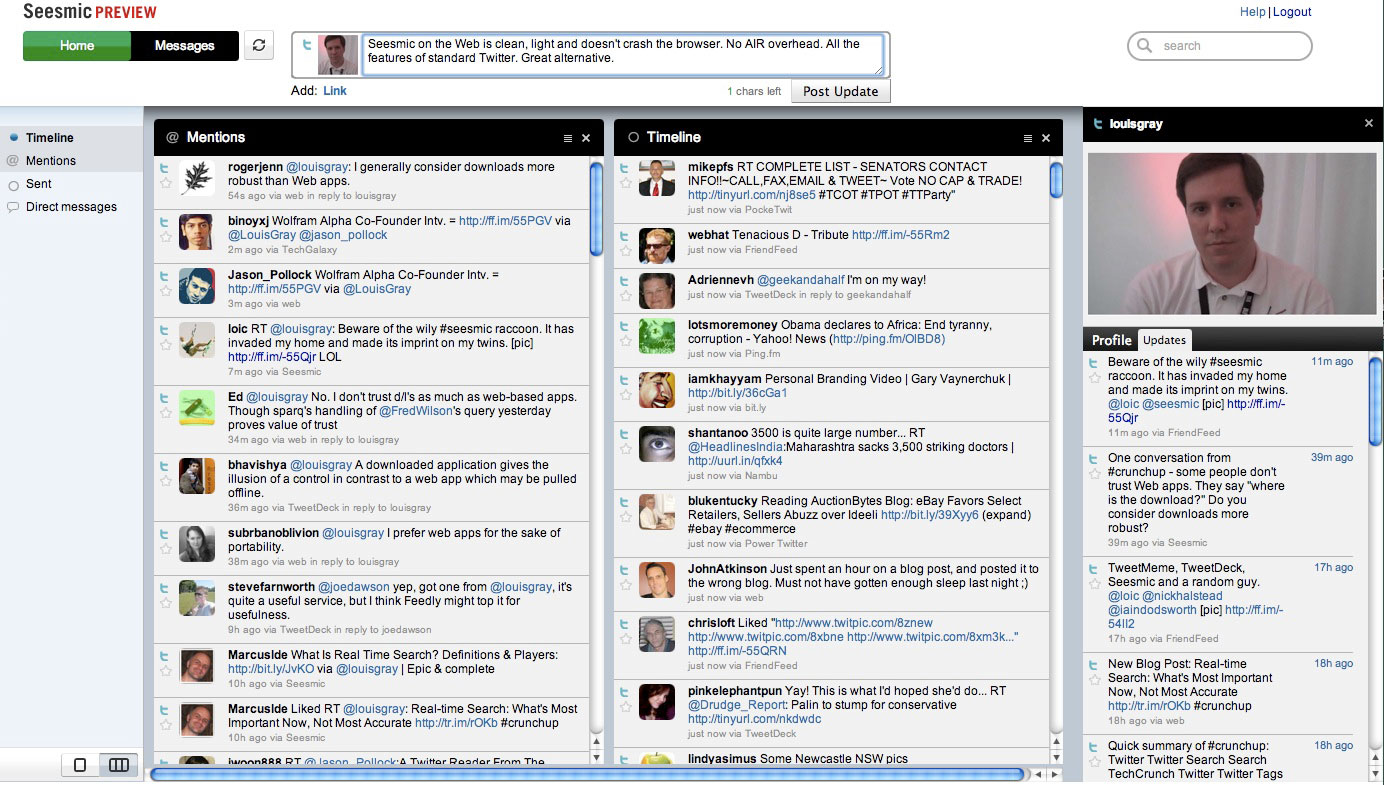

The new Seesmic Web interface (Click for full version)

For those Web-addicted souls who spend a good deal of their day buried in Twitter, seeing their friends updates and exchanging conversations, most software options have required the installation of Adobe AIR software, which to date has whirred your CPU to life, turning on laptop fans, and chewing through memory. The work to throttle down load on RAM and CPU is a constant battle, which both Loic's team and Iain Dodsworth of TweetDeck have been working on since their products debuted.

In contrast, logging into the new Web version of Seesmic doesn't feel like you've sacrificed your computer power to get your Twitter fix, and you don't give up features either.

To get started, go to http://seesmic.com/app/ and connect to Twitter, using OAuth.
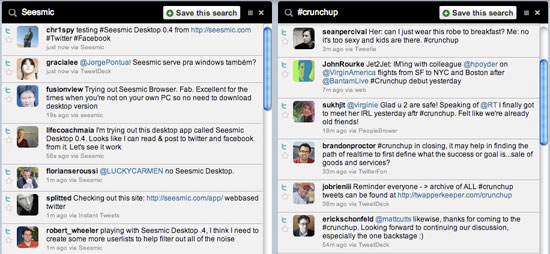

Two Columns Displayed In Seesmic Web

Like the standard Twitter interface, Seesmic displays the "Timeline" of your friends updates, but it offers multiple columns, customized as you wish. And since you have logged in to Twitter, you even get the saved searches you may have added to the site, but displayed on Seesmic. Like with TweetDeck, you can add multiple columns to display in parallel, and can add as many as you like. As you add more, you will need to scroll to see them all. On my standard 1440 pixel width setting on my 15-inch MacBook Pro, I was able to see almost three full columns - usually sticking with the public timeline, Mentions (the new name for replies) and a saved search.
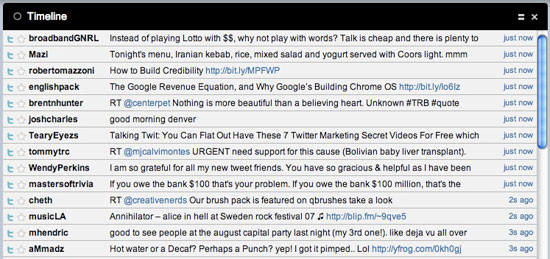

Collapsing Updates in Seesmic Web
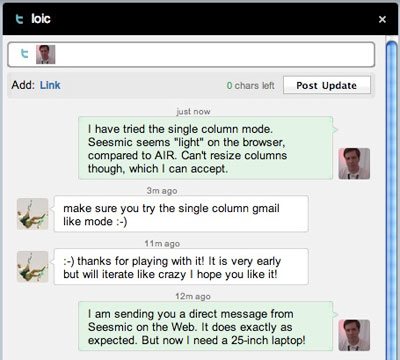
Seesmic has done more than just clone its Desktop version in the browser. The new service has a new feature that collapses updates into a single line, looking like the headline-only version of Gmail or Google Reader, essentially letting you see more updates than ever before in one place. Also, clicking on Direct Messages brings all the DMs to the fore, so you won't get confused and think one conversation is public while another is private. In fact, there is a toggle at the top left of the screen between "Home" and "Messages", with Messages getting you to your DMs. Like with Tweetie, the DMs are organized by individual and you can see how many messages are in each conversation.

Interestingly, in talking with Loic about the introduction yesterday, he said many people believe a download version of the product is more "robust" than a Web version, and there has needed to be some evangelizing for this new introduction to be accepted. As he said, they ask, "Where is the download?". But there's no download needed for this one. You could get the AIR app, which was also upgraded yesterday, but it's the Web one that I'm going to keep using. After getting used to my computer overheating any time I tried to run Seesmic Desktop or TweetDeck, the simple, clean and quiet interface of Seesmic on the Web makes it a strong contender for my Twitter usage going forward. I know a great deal of my Twitter activity comes from FriendFeed, but for when I want to dabble in the 140 character world, the new offering is very solid.

July 10, 2009

July 10, 2009 · 3 MIN READ · BY LOUIS GRAY

Real-time Search: What's Most Important Now, Not Most Accurate

Real-time Search: What's Most Important Now, Not Most Accurate

This afternoon, at TechCrunch's Real-Time Crunchup event, representatives from many of the innovators in the real-time search space had a quick round table aimed at furthering the discussion, framed by a question by moderator Erick Schonfeld, who said that some on the panel may believe real-time search is defined by Twitter Search, while others believe it is "everything on the Internet, but with a freshness or recency component". And while many different companies, including the standard-bearers, like Google and Microsoft, are looking to take on this new challenge, how they are doing it differs greatly.

Danny Sullivan, author of Search Engine Land, said, "We need better definitions of what it is, so as consumers and users, we understand what we are interacting with. Through Twitter and a few other services, you have the option to publish in a few seconds. Maybe you call it social sharing search." (He also posted a summary of the players last night)

Some of the participants could be defined by how large a percentage of their data was initiated through Twitter, and how they worked with the data, including filtering.

"I would define it as what are people saying in real time about my topic," said Gerry Campbell of Collecta. "It's not what is most important, but it's what is in real time now."

This bifurcation of the "one right answer", often championed by the existing search leaders, versus what's most right "now" is helping to separate the old school search engines from this new breed. But don't think that the more-established companies are taking this lying down.

Google's Matt Cutts, who has been at the company since 2000, said "we have always talked about freshness of content." He relayed a history of his time at Google, saying they once had a "war room" of how they could refresh their search index as frequently as a month. By 2003, the company had moved from monthly updates to daily updates, and a few years later, in 2007, integrated the company's Blog Search product into its main search results. "We have rearchitected our system to be as recent as possible," Cutts said.

As updates flow in at an ever-increasing pace from all corners of the Web, search engines have the daunting task of getting accurate responses out there, while ignoring off-topic or harmful data, such as spam. And those who manage to get the formula right will have a serious leg up over those who don't filter well, making their results more noise than signal.

"Drinking from the firehose is a ticking time bomb," said Kimbal Musk of OneRiot. "Even by filtering 90 percent of what is going on with the Iran election, you're still only going to get a tiny slice, and a good portion of that is spam. If you don't filter content, you are going to get more and more spam." He later added, "If you stick to Twitter alone, you will have a spam-filled and biased data set."

With Twitter's API getting to a point where more and more companies are relying on it as their engine and data source, each is working of a common data set, and how they interact with the information will make the difference. And yes, Microsoft or Google may give you one result that is most accurate, but not for this moment, and not with any kind of impact from your friends or in terms of how that data is being interacted with in real time.

Sean Stutcher of Microsoft clearly stated this information is becoming more relevant, saying, "The sentiment around a link could be changing, and that might become very relevant to a user."

In an isolated search world, where an index is an index and the right answer is the right answer, that might not matter. But in real-time, it could matter immensely. As each of these companies works through their user interfaces, their data sets, and improves filters and social aspects, it should be very interesting to see how they separate from the pack and help define their goal.
July 10, 2009 · 2 MIN READ · BY LOUIS GRAY

FriendFeed Plans Features to Stem Conversation Flare-Ups

FriendFeed Plans Features to Stem Conversation Flare-Ups

After a testy exchange with Leo Laporte during a taping of the Gillmor Gang last month, Mike Arrington of TechCrunch saw a boom of negative reactions across the Web, from pointed YouTube mashups, comments on TechCrunch, and a flurry of conversations on FriendFeed, where the live conversation for the Gillmor Gang was scheduled to take place. In the aftermath of the blow-up, Arrington closed his FriendFeed account, later blaming what he called "mobs" for having congregated and piling on. During a panel today at TechCrunch's real-time CrunchUp, Mike talked with FriendFeed co-founder Bret Taylor and Robert Scoble about the situation, and Bret promised changes were being worked on at the service, which would help stem future flare-ups from happening.

While Arrington aggressively tried to position FriendFeed as encouraging mob mentality, Bret touched on an interesting point that helped explain the scenario. Essentially, most conversations are decentralized across social networks. But on FriendFeed, conversations are centralized. While not threaded, all of the site's users have the ability to make comments on any open public conversation - meaning those people with extremely popular accounts can have a high amount of comments, and as comments come in, these items are pushed to the top, making them visible again.

Bret said that new tweaks are going to soon come available on FriendFeed that would enable users to stop comments on particular entries, or on the person's entire feed itself. This means that if Arrington were to re-enable his account, as he said he would do today, he could opt to mute threads that got out of control, or simply post his feed and make it unavailable for interaction. Interestingly, Bret said that the conversations on those accounts that had either a small amount of followers or a large amount were of the lowest quality.

Scoble, the most-popular person on FriendFeed, who had trouble getting his audio into the conference from London, actually agreed with some of Mike's assertions, saying "there is a mob mentality, and we caused it". He added. "We brought a huge crowd... and people are going to get in the bleacher seats and throw rotten tomatoes every once in a while."

Bret did not give a timeline for the new features, but if FriendFeed's speed of feature improvements thus far is any indication, they won't be too far away.

You can also see a timeline of this panel here: Mike Arrington, Bret Taylor and Robert Scoble starting the "Online Mobs" discussion.
July 10, 2009 · 1 MIN READ · BY LOUIS GRAY

JS-Kit Declares the Death of Comments, Launches New Echo Platform

JS-Kit Declares the Death of Comments, Launches New Echo Platform


There is no question that as activity on social networks has broadened, conversations have become decentralized and distributed. Only a short few years ago, bloggers could anticipate their posts would rile up deep conversations on their blogs, through comments below each post. But for many people, the trends have been for conversations to happen elsewhere - on Twitter, FriendFeed, Facebook or practically anywhere people wish them to be.

As a result, new tools have cropped up to monitor the conversations, or to unify them, regardless of their source. Among the most visible has been BackType, which offers comment search, as well as a tool called BackType Connect, which centralizes reactions for Wordpress-powered blogs.

Today, one of the most popular comment engines, JS-Kit, says they too are moving to this model, and not just halfway. Their old platform is dead. Period. Starting today, users will be presented with a new platform called Echo that integrates reactions from around the Web, including those from these diversified, decentralized conversations, alongside standard comments. Existing users of JS-Kit will be upgraded to the Echo platform.

"We are here to announce the death of comments," said Khris Loux. "What's interesting about these new forms of communication is that they are parallel channels away from your blog. We are discontinuing JS-Kit comments because it no longer reflects the conversation around the blog."

Echo is a drop-in comment replacement platfom. Now, they say, references to your original content will be automatically displayed in real-time.

"Echo-enabled content is now the richest source of the conversation. They can go to your blog and see the entire live stream," Loux said.

Loux and Chris Saad, also of JS-Kit, said that bloggers who are using alternative platforms, like Disqus, could use the tool for future conversations, and they could import and export comments from platforms like Blogger.