
For the world's leading RSS reader, integrating social functions hasn't always been drop-dead simple and easy. With each new addition, be it the recent "Send To" features, the addition of "likes", or the ability to selectively enable friends to make comments on your shared items, the service needs to scale in a way that has brought many other Web-based feed readers to its knees - compounded by
Google Reader's accelerating user base. And while the company works to make sharing and engaging simpler, I am already seeing a rapid rise in conversations within Google Reader, both on my own posts, and on those from others I share. Recently, the total number of comments on some posts has even eclipsed those natively here on my site, or on
FriendFeed,
Facebook or anywhere else.
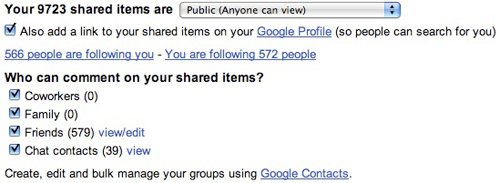
Almost 600 people can comment on my Reader shares.Since starting my shared items link blog in Google Reader a few years ago,
I've passed along almost 10,000 links (a point I may pass by the end of the month). I recognize my pace of sharing
between 20 and 30 items a day is on the high end, but these selections represent the top 4 to 5% of all articles I see online, with the intent of passing on only the best to those who consume the shares downstream. I've even had some people say they have unsubscribed from reading feeds directly, trusting me to be a human filter. That's a little daunting, but a task I can take.
You might remember that
back in March, Google turned on comments on these shared items. Though activity was initially slow, I have seen increased velocity, especially after reorganizing my contacts.
As Google Reader does not have public comments on shared items that are visible to everyone, they have taken the middle road - showing these comments to those who are also subscribed to the shares, and only enabling those people to comment who have been added to a specific group by the sharer. After several hundred people had signed up to follow my shares, and I was seeing only a little activity, I realized the problem was mine, so I took some time to organize all my contacts, and enable everyone who follows with the ability to comment, just like in FriendFeed or Facebook. This part is critical, so if you do have a lot of people following your shares, go to your sharing settings in reader, and make sure that they are in a folder that has access.
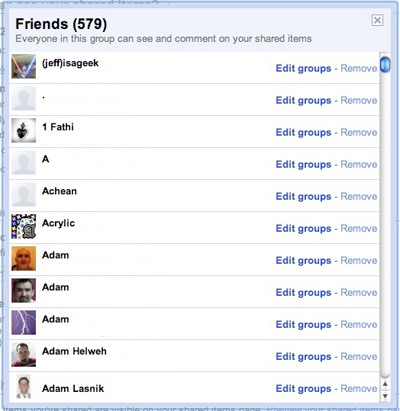
Each of My Friends Is In a Group that Has Access to Commenting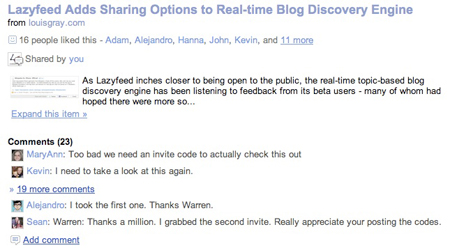
This Article On Lazyfeed saw Dozens of Comments In Google ReaderWith that change, people who may previously have been watching the shares go by, but couldn't comment, now can - and the results have been very interesting. Some of the more popular threads on shares from me have seen on the order of dozens of comments, even when the original post may only have shown a handful on the original blog.
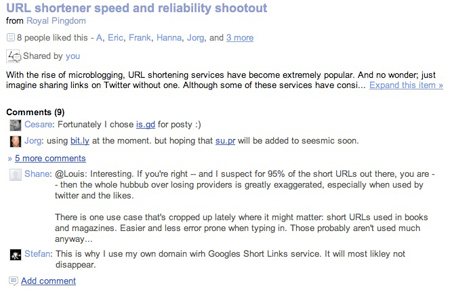
Another Popular Topic of Discussion Within the Reader SharesWhile a few years ago, this could have been considered the end of the world by some bloggers, the social Web has grown to understand that distributed conversations are taking place. By Google Reader enabling conversations to happen through their application, readers can act on the news immediately, without having to open a new window and participate there. It's also had me rethinking whether I should be self-sharing, in effect sharing my own posts when they get into Reader. I've personally tried to share only a subset of what I consider the best, but now that I have seen people engage right from within the app, it makes me think I should just share them all and enable the comments to take place where my readers are comfortable.
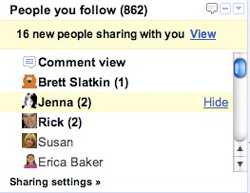
Now, every time I log into Google Reader, not only do I see new feed items to read, but I see new follower requests looking to see the shared link blog - and also, in bold, a "Comment View" which takes me to see all the comments, not just on items that I have shared, but on items shared by people whose shares that I follow. Google Reader, in a matter of months, has become a very serious part of the conversation. In light of the uncertainty around FriendFeed and how that company will integrate with Facebook, I am betting that some people are looking back at their RSS reader for information consumption and now, social discussion.
So go ahead, comment on my items in Google Reader. I don't need all the comments here. To find my shared items, head to:
http://www.google.com/reader/shared/louisgray, and let's get connected.
 Sunday, August 23rd came and went without a peep from Google's Blogger Team, despite the service celebrating its tenth anniversary from its initial founding at Pyra Labs. Cynically, you might construe this silence as Google's not making the product a top priority, or maybe, you could even think that Blogger is ceding the visibility game to other challengers, such as WordPress. But that's far from the case. While WordPress might have a higher level of geek cred, Blogger has many more users, and the company has prepared a slew of updates that should roll out in the next few weeks - which will be welcomed. Don't expect a mass revamp on the level of a "2.0" moniker, but instead, many smaller iterations, either catching up to the competition, or taking advantage of the service's large installed base.
 The Web is speeding up, and