Silicon Valley Technology Commentary & Archives · Est. 2006 3,031 Posts · 2006–2026

September 25, 2009

September 25, 2009 · 2 MIN READ · BY LOUIS GRAY

Apple's Dashboard Widgets Comatose As iTunes App Store Skyrockets

Apple's Dashboard Widgets Comatose As iTunes App Store Skyrockets

Prior to the debut of Apple's iPhone, software developers wanting to make miniature applications to reach Macintosh users had a direct route to customer's desktops through the development of Mac OS X Dashboard widgets. Billed as major functionality debuting in Mac OS X 10.4 (Tiger) in early 2005, Dashboard, much like Konfabulator before it, featured widgets including weather forecasts, stock updates, calculators or simple utilities, like a dictionary or thesaurus. Over time, developers managed to make a number of creative uses for these apps, from delivery updates to flights' status, or even lightweight arcade games.

But four years later, Dashboard is dormant, while not yet completely dead. A quick calculation of the total number of widgets listed on Apple's Web site is just over 4,500, of which 820 are international. In remarkable contrast, Apple's iTunes Store loudly proclaims its haul to be more than 75,000, of which a massive 1,394 were posted just last Friday.

Want to know how many new Dashboard Widgets were posted last Friday?

Zero.

Interestingly, Apple's Dashboard Widgets site highlights the last 50 "Just Added" to the Web site, and for whatever reason, between September 9th and September 21st, no Dashboard Widgets were posted. Maybe the one guy whose job it is to get them approved was on a two-week vacation?

And in the week, starting with Monday, only 39 total Widgets made it into into the directory, including fascinating titles such as the "Iowa Hawkeyes Football Schedule" widget or the "Countdown to Thanksgiving" widget.

With iPhone app developers having a fast-growing audience of millions ready to spend real money on applications for their mobile phone, the idea of creating a miniature application for the desktop, for free, probably doesn't have much pull. It's no secret that the iTunes App Store's runaway success has played a big role in making any discussion about Dashboard completely unnecessary.


The louisgray.com Widget as posted in 2007

Just a few years ago, many thought widgets were going to be the next hot thing in desktop apps. Konfabulator was purchased by Yahoo! and turned into Yahoo! Widgets, which claims nearly 6,000 desktop widgets. And way back in 2006, I even made a dashboard widget for louisgray.com, which I later updated in 2007 and still works. But the talk of widgets faded, as people primarily chose to use the Web browser and their iPhones as the conduits for Web data, preferring not to have a gazillion little widgets floating about their screens.

Considering the dramatic drop-off in buzz around Dashboard widgets, and a corresponding meteoric rise in iPhone deployments and penetration, it's no surprise to me that you see this gulf, which now measures almost 20x in favor of iTunes applications. It's enough to wonder if Apple will ever bring up the Dashboard again, except maybe to provide a place where iTunes applications purchased for the iPhone today can sometime live. They won't kill it outright, but it sure looks like a dinosaur, after only four years.

September 25, 2009 · 3 MIN READ · BY LOUIS GRAY

Framed: Should Microsoft, and Would Apple... Fight Back vs. Google?

Framed: Should Microsoft, and Would Apple... Fight Back vs. Google?

Wednesday's announcement from Google that they were releasing a Web browser plugin called Chrome Frame for Internet Explorer gave IE users many of the same core elements they would receive by surfing with the native Chrome browser - namely support for HTML 5, and massively improved JavaScript performance. Google's goal has largely been seen as setting the stage for Google Wave, working to get Web surfers off older, outdated browsers, like Internet Explorer 6, and providing them a richer experience. But this process, as noble as it may be, has me wondering if its competition, Microsoft, won't be finding a way to shut it down. After all, I am pretty sure Apple would if given the same choice.

Many across the tech Web are lauding the move as easier for Web consumers to perform than a rip and replace strategy to ditch IE and turn to Chrome, despite its clear benefits. After all, it's said users are comfortable with plugins like Adobe Flash, and Chrome Frame would just be a simple plugin. But isn't this a lot more like what Palm did in faking us all out by pretending its Pre mobile phone was really an iPod, in order to gain access to iTunes?

While Google didn't make any noise about looking to similarly decapitate Safari, and put Chrome in Apple's browser, there are definitely times when I find my preferred browser lagging behind the most-popular surfing options. Even Google's Toolbar, which includes the new SideWiki we discussed on Wednesday, does not have a native version for Safari, but maybe, if Google found a way to push Chrome in Safari, it would.

Matt Mastracci, co-founder of DotSpots and a sharp Web developer, reminded me this evening that Safari "isn't built to be extensible", making Toolbar integration or Chrome Framing a real challenge, but even if they could somehow pull it off, I don't see Steve Jobs and Cupertino sitting idly by. No doubt the next system update, or Safari point release, would knock it out of the sky, the same way they have updated iTunes in the past to stop jailbreaking of iPhones, or the way Microsoft posts Windows Updates to stop malicious code from hitting their user base.

Microsoft is already whining and saying that running Chrome Frame as a plug-in increases the potential for bad code and malicious scripts to hit customers. (See: Microsoft: Google Chrome Frame Makes IE Less Secure) It is not my tendency to jump on Redmond's side, and I certainly don't believe their scare tactics, but they have to be hotly debating their next move. It would not surprise me if the opportunity to disable Chrome Frame was being thought about as part of the next "Critical" Windows Service Pack update, executing a high-stakes game of cat and mouse between Microsoft and Google, and potentially the Justice Department - who didn't ever get its wish of splitting Microsoft up after its monopoly games with Netscape.

Apple's recent ploys to knock Palm Pre out of iTunes, and its controversial blockage of Google Voice make it clear they have every intent to control their users operating system and iPhone experience. In fact, as they have not really been taken to task in the way Microsoft has for anti-competitiveness, I would see Cupertino more likely to be proactive in trying to fight Google here. The only question is, will they ever get the chance to do battle?

September 23, 2009

September 23, 2009 · 3 MIN READ · BY LOUIS GRAY

I Don't Want To Hear About Distributed Conversations Any More

I Don't Want To Hear About Distributed Conversations Any More

This morning, Google introduced a feature called SideWiki for Google Toolbar users that lets people add comments and annotations to Web sites. This is not a new approach, and it has been tried with varying lacks of success in the past, as most people without an agenda don't want to spend time marking up third party Web pages. But as predictable as rain, we again see people railing that there is potential for this service to take even more control away from bloggers and site administrators in terms of how their content is positioned, or where the conversations should take place.

Led by Jeff Jarvis, who simply said "Danger" and echoed by others, including Steven Hodson of the Inquisitr, who called it "a bad idea - very bad", the same stories I thought we had beaten into the ground almost 18 months ago in the Shyftr debacle are coming back - even after more than a year of a greater level of distributed conversations, as comments are now strewn all over the Web - not centralized on the originating blog.

Jarvis says: "Google is trying to take interactivity away from the source and centralize it," and adds "It takes comments away from my blog and puts them on Google. That sets up Google in channel conflict vs me. It robs my site of much of its value."

In parallel, Hodson says: " Sidewiki is nothing short of an attempt by Google to take control of the conversations that happen on blogs... It takes away one of the most important parts of a blog – the conversation – and locks it on the Google."

Here we go again.

Let's stop kidding ourselves. The battle for control over conversations and the silo of discussions is done. Any blogger who believes that they can control the conversations and prevent discussions in far-flung social networks is deluding themselves. And yet, every few months, a new innovation, be it comments in Google Reader, or something like this, freaks the old guard out.

Jeff and Steven's comments are mirrored by Josh Schnell, who in a guest post for Tamar Weinberg on Techipedia cries out that Content Aggregators are Killing Content Creators.

Here's the reality: Conversations have moved to where the reader wants them to be - and the best content creators shouldn't care if they get to have conversations on their content in any of these networks. The best content creators and the best Web brands shouldn't care about what people may say on their SideWiki, any more than they should panic over reviews that happen on Amazon's Marketplace or in the iTunes store. People are entitled to their opinions and their commentary, and any further efforts to try and force people to have these conversations in a single place should be extinguished.

In April of 2008, I once asked, "Should Fractured Feed Reader Comments Raise Blog Owners' Ire?" and apparently, some people continue to be ticked. But we need to evolve. That's why there are new services like Echo, who famously declared the death of comments and the new version of Disqus, which also aims to pull in reactions in real-time.

Mark Hopkins of the SiliconAngle sees beyond the scare tactics and recognizes that SideWiki is much more and not just about "stealing conversations". He says:
"The fact is that in the golden age of the social web, conversations will spring up more and more places outside your silo, with or without you. You can work to leverage them or you can get upset."
Congratulations, Mark, I'm proud of you. Now, it would be fantastic if more people would evolve and move forward instead of crying foul about the way it used to be.

September 22, 2009

September 22, 2009 · 3 MIN READ · BY LOUIS GRAY

Find Similar People and Interests With Simler's Microblogging Platform

Find Similar People and Interests With Simler's Microblogging Platform

One of the most challenging issues with today's social networks is rapidly finding people who share the same interests. As you migrate from network to network, you can find commonalities between platforms, but the most likely route taken to gain a base of connections is an import of your friends from a different network, forcefully pulling them with you - even if they are not interested in the same things you are. A new invite-only network called Simler is trying to solve that issue by connecting people with the same interests - resulting in a fast-moving stream containing conversations on topics you like and enabling you to find people you may soon like, with many features you've grown accustomed to on other networks, from FriendFeed and Twitter to Google Groups and old-school discussion boards.

Simler Connects You Based On Your Tags to Conversations

At the core of Simler is the service's reliance on tags, which help to organize discussions. For example, you can start conversations on basics, such as Apple, "Spotify" and "Baseball", or branch out to other popular topics, including "Grammar Nazis" or discussions around TV shows like "Mad Men" or "Arrested Development".


As You Add Friends, Simler Recommends New Possible Connections

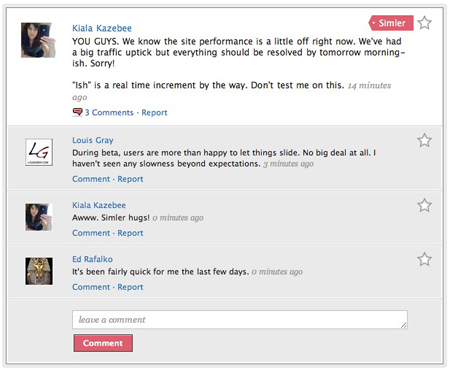
Posting new entries to Simler is a lot like starting a new tweet in Twitter or a native entry in FriendFeed. It doesn't contain photos, but also doesn't stop you at a mere 140 characters. The entry, like in FriendFeed, can be responded to in line, and active conversations pop to the top of your Simler. It's likely that those active in the conversation will be similar "or Simler" to you, and you can see, by clicking through their profile, if you share the same tags of interest. The more shared tags, the more likely you are to find value and get connected.


One Active Conversation on Simler With Multiple Comments

You can make comments on any Simler conversation, even if you haven't selected that topic as one of your tags. You can browse the tag directory alphabetically, or find the most popular discussions, and get started. And once you make a comment or make a new post, you will get notified on the site, or by e-mail, letting you know if anybody else added a comment and extended the thread.


Two Simler Posts In the "Apple" Forum


Some of the More Active Tags In Simler

Simler, featuring much talent from Portland, Oregon, was just recently discovered (and covered) by Silicon Florist's Rick Turoczy, also found Simler moved the needle forward, making the site more about the subjects of the conversations than on the people themselves. He says, jokingly, I hope, "I mean, if we didn’t want interactions, we’d all just start blogs."


Notices From Simler Come In Through the Site Or On E-mail

Talking about things with friends is fun. Talking about topics you are interested in is more fun. SImler hopes that its network can enable you to discover new friends via shared interests. It will take some time for the site to grow en mass for this to happen, but it is extremely easy to use, and just makes sense. It has some good polish, and despite some slowness, the site works as advertised.

As for getting in yourself, each new Simler account comes with 10 invitations. Half mine are gone already, so I have five left. It would be fantastic if you would openly share your own invites in the comments here and get people into the site. Once you do, you can find me here: http://simler.com/user/louisgray/