As
Google has grown as a company, its reach has extended well beyond its initial foundation as a massive search index. The company now represents many things - including a mobile handset platform, a Web browser, Web-based e-mail, a social network, and a wide variety of software programs. Like Microsoft in the 1990s, it is often hard to see a viable business where the company does not play a role - and a significant one at that.
With
Danny Sullivan revealing Google CEO Eric Shmidt's favorite product is the Chrome browser, I began thinking about my own preferences, and thought I would share - inviting you to do the same.
1.
Google ReaderGoogle Reader is my starting point for finding the day's news quickly. The RSS reader is the very best way that I know of to get all the blogs and news sources I read in one place, and it provides me with simple keyboard shortcuts to read through them rapidly, choosing to share them on my link blog to downstream social networks, including
FriendFeed,
Twitter,
Facebook and
Socialmedian.
As Google Reader has expanded its social capabilities, I have also recently enjoyed a near-explosion in active conversations on my shared feeds, and find I am spending even more time inside this product than in months past.
Though it may sound crazy, I believe the quality lead Google Reader has over its competition exceeds even that of Google Search's quality lead over its relative competition. I would rather have Reader and be forced to use Yahoo!/Bing than use Google Search and use some other RSS reader.
2.
BloggerThe Blogger platform, now 10, doesn't get enough respect. The simple blog publishing and hosting product makes it easy for me to add new posts, categorize them, and update my templates, multiple times a day. Having moved well beyond its initial reputation of being something like a spam blogs haven, Google has put real effort into clamping down on bad behavior. Meanwhile, outages that used to impact the service have practically been eliminated.
Blogger is the platform of choice not just for my blog, but for my wife as well, giving us one place to log in to update either site.
3.
FeedBurnerWhile the product hasn't seen a ton of updates since its acquisition a few years back, FeedBurner hasn't received much challenge (with the exception of
FeedBlitz) when it comes to distributing RSS feeds from millions of blogs, mine included. On top of making sure that my posts get distributed, FeedBurner also keeps tabs on statistics in terms of total subscribers, click throughs and site visits, and enables the ability to customize each blog post with feedflares, adding additional interactivity.
4. Google Search and
Google Blog SearchGoogle Search just does its job, period. Even as the Web has grown dramatically, Google's ability to return the "one right answer" solution when guessing what I am looking for is unmatched. It may lack the real-time capability of other sites, but imagining an alternative Web without Google search is daunting.
Similarly, Google Blog Search has largely replaced
Technorati for most and is the default engine for finding new content on blogs around the Web.
5.
GMailWhile I have been using .Mac e-mail since well before GMail ever launched, the product changed the game in terms of what online e-mail represented. GMail, at its debut, offered storage space 20 times higher than the competition, integrated search and other features, such as labels and automatic filtering that make it both light and flexible. While other free e-mail products have gained a poor reputation online, seeing a GMail address doesn't make me turn away in scorn. I recommend that any business starting an online media strategy obtain a GMail account to centralize related e-mail.
6.
YouTubeThough, like FeedBurner, not born at Google, YouTube is one of the most recognizable brands on the Web. Like Google Search, it has become the default service on the Web for what it does - enabling people to share videos and view videos, from silly family pictures to professionally designed music videos or corporate interviews. It is through YouTube where my wife and I share home recordings of our twins, and embed them on our sites. The ease at which we can port YouTube content to Facebook, FriendFeed and blogs is a big reason we use them above any other competitor.
7.
Google MapsEver since I acquired a GPS unit for my car, my reliance on Google Maps has plummeted. But if in a pinch, if in another car, or needing to look up a route quickly on my iPhone, there is no substitute. While I once used Mapquest to find my frequently-lost self around town, Google Maps is now the trusted standard. As TechCrunch recently noted, only Google was sharp enough to recognize the recent closure of the Bay Bridge in San Francisco, alerting potential travelers accurately.
8.
Google ChromeA decade following the peak of the initial browser wars, between Netscape Navigator and Internet Explorer, we have an interesting tussle for browser market share once again, this time involving Microsoft, Google, Mozilla and Apple. (With Opera still not dead yet) The debut of Chrome, first for Windows and Linux PCs, with stable Chromium builds for Mac here as well, introduced more stable browsing, simplified favorite pages, and speedy load times. Let not the low ranking fool you - compared to Schmidt's #1 position. For me, it's a good product, but not the market leader in the way its brethren Google Reader, FeedBurner and Search are.
9.
Google DesktopGoogle Desktop brings the power of Google Search to your desktop files - helping to find everything from text files and e-mails to rich media content embedded in office documents. While in years past, much of its functionality could be found in Apple's Spotlight, or the Mac's integrated search in Finder, the latter is just too slow and unreliable, with Google Desktop gives you the familiar and trusted approach you know from the Web. Its ability to crawl through previous dates to see when documents were created is especially useful.
10.
Google AnalyticsFew self-respecting bloggers go too far away from their Web traffic statistics, and many have two, three or more packages going simultaneously, to ensure they have enough datapoints to consider themselves experts. For no cost, Google Analytics provides detailed stastics, not just for the last 4,000 visitors (as
Sitemeter does), but for all visitors, letting you compare time periods, dive deep into demographics of visitors, and see trends in your publishing and content.
Close but not included: AppSpot, iGoogle, Google AdWords, Google Earth, Google Docs, Google Finance, Google Groups, Google News
What are your top ten Google Applications? Did I miss your favorite?
 Even though
 There's no question that an ever-growing number of Internet users are spending more time creating and consuming data online. While a great deal of attention in recent years has been spent focused on the creation of and access to rich media files, including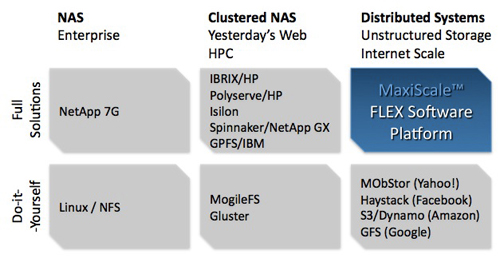
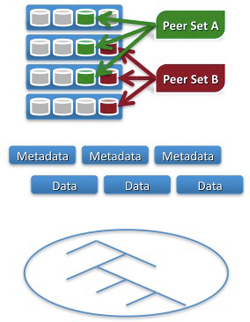 Why have companies like Yahoo!, Facebook, Google and Amazon each created new approaches to the traditional world of file systems? Because their exceptional needs pushed requirements that standard offerings could not meet, growing too costly, or introducing issues of downtime or latency. MaxiScale calls this new world the "Era of Billions", be it tens of billions of photos at Facebook, streaming of a billion songs at MySpace, hundreds of billions of YouTube video views a month, or exceeding 100 billion ads served by AdMob - the company's first named customer. It's a new world of big numbers.