
For the most part, starting a successful business in Silicon Valley and having to raise money from venture capitalists (VCs) practically go hand in hand. Like most things here in the Valley, there are no guarantees. Raising $100 million doesn't guarantee success. Raising funding from specific venture firms with solid track records doesn't guarantee success. And, depending on the stage of a company's lifespan, raising money can be viewed negatively as much as it can be a positive thing. Meanwhile, if you're curious as to how much attention should be paid to valuations of private companies, well, trust me, that too can vary widely, depending on market conditions, momentum, founders' goals, and individual firm's enthusiasm.
Since starting my career in the Valley back in 1998, I've seen much of this process up close. I've worked at a company that once raised a $1 million seed round of funding, but I've also worked at one that raised $72 million in a single round - part of more than $200 million raised, thus far. I once saw a company I worked at close down because investors stopped funding outright, worked at another that found itself acquired by a big name tech firm months after I left, and also worked at one that filed, and later withdrew, its IPO bid. And while I wasn't sitting across the table from the VCs asking for their funds, in most cases, I certainly helped position each company in advance, and saw the effects each round played in the company's lifecycle. I mention this to add some level of background for why I thought to add my two cents to some of the discussion has been teetering in the blogosphere of late, especially following the news of
Twitter's latest round of funding, rumored to be as much as $100 million.
Why would investors put money into a company to begin with? There are a few most-common outcomes:
- The company could later merge with another firm, or be purchased outright (M&A)
- The company could eventually go public and have an IPO.
- The company could remain private and be self-sustaining.
- The company could eventually close down, through bankruptcy or other means.
Of these scenarios, investors are most interested in potential M&A opportunities or the potential for going public. Obviously, investing in a company that will shut down is not a good way to use one's funds, and a company that has no real "exit strategy" but plans to meander forward, private and independent, will not provide the big returns hoped for by venture capitalists. In the reverse scenario, why would a company raise money?
- To gain initial capital to start the business.
- To gain capital necessary to expand the business, be it through marketing, human capital, new product lines, through geographical expansion, or even through acquiring other companies.
- To avoid running out of money and needing to close its doors.
- To obtain a level of valuation that sets a mark for potential acquirers.
As tempting as it can be for a company to raise the largest amount of funds possible, to have this cash available in the bank, the greater the amount raised typically also means the greater the reduction in control - as the company's initial founders see third party VCs take a higher percentage stake in the company. They may gain multiple seats on the board of directors, and gain influence that can be used to push the company toward one direction or another. Should they gain enough of a stake, it can be possible they end up pushing out the company's CEO or management team altogether, especially if expectations are not being met.
Thus, many entrepreneurs suggest a company raise as little money as is necessary to run the core business - and no more. In many cases, as soon as venture capitalists are involved, the pressure to reach stages one or two (M&A or an IPO) increases, and as time goes forward, or more capital is invested, the heat can intensify.
In parallel, if a company has determined it should raise a specific amount of capital, and has been fortunate enough to gain access to it, the preference would be to give away as little of the company as possible, essentially valuing the company at a higher rate than if more were sold for less. This valuation can be set based on the company's current sales numbers, its projections for the future, market competition, market dynamics and often, a combination of all factors.
Given this, if you examine the news around Twitter from last week, it has been written that Twitter sold ten percent of the company for $100 million, which valued the company at $1 billion. It has been said that Twitter raised the $100 million despite having a significant amount of money in the bank (up to $30 million) from its previous funds. So why would they raise now, and why this amount? Without having asked Ev, Biz and the team myself, you can see above just why now would be the time. First, the company, despite having little to no revenue to speak of, is in an incredible position. The service's growth over the last two years has been nothing short of phenomenal. Second, the company's internal projections, as we understand them, are aggressive - and third, many different news stories have shown practically all the large players in the Valley, from Microsoft to Facebook to Google, as having been interested in acquiring the microblogging company.
Similarly, we saw Facebook raise a massive $200 million in May of 2009 at a $10 billion valuation, following a $240 million round raised from Microsoft in 2007 that valued the social networking giant at $15 billion. Huge numbers on all counts, from the amount raised to the total valuation - again meaning how much would be needed to buy the entire company at that price.
For Twitter, raising the $100 million sets the company up to expand their business in terms of human capital and its technology infrastructure in a big way. While $100 million is not a bottomless trough of cash, it certainly helps. It puts the idea of the company running out of cash far out of the picture, and absolutely succeeds in driving the price higher for potential acquirers, should the service not be aiming to go public in the near future.
For Twitter's leadership, raising money now is a fantastic move. It's improbable that the company could find remarkably better terms in the coming months, and it sets in stone now where potential suitors would need to begin to even entertain discussions. Meanwhile, those investors who just ponied up the $100 million would want to see a positive return on their investment, and thus, would expect Twitter to hold out for an even greater number.
But once the money is in the bank, so begins the pressure. It may not be visible in three months or six months, but outside observers, and no doubt, internal participants are going to want to see plans for that cash, not just in how it is being spent, but in terms of how it will be converted, either into a large acquisition, be it to Google or another player, or if the company finds its way into reaching the public markets.
So what could go wrong? If neither of the above were to happen, and in parallel, Twitter were incapable of growing revenues to approach its level of expenses, the company would remain private, and see its cash balance decrease. Over time, as pressure grew inside the firm, they would be forced to raise money again - likely at a lower valuation, given reduced prospects, meaning the company would have to give up more to get less. You can see this often as you watch companies in the Valley go from the euphoria of their seed and A rounds, followed by less-enthusiastic B, C, D rounds and beyond. And if you hear about a "mezzanine" round, that's the one that truly, finally, should bring the company to break even, or catapult it into position for a near-term public offering. And if it doesn't, let's just say that's not good - as the "burn rate", the monthly expenses that draw down the company's finances, force action, and it won't be at a level the company had hoped for, especially after such lofty beginnings.
In the wake of 37 Signals' tongue in cheek press release that
they were valued at $100 billion (with a B) following a brazen 1 dollar investment, one can scoff at revenue-light companies like Twitter saying they should be measured on par with public companies that have real revenues and real growth. But part of being a venture capitalist is that first word, "venture". It's an adventure. It's a risk, and a gamble, and one that relies on promises and potential. Twitter is worth $1 billion dollars, according to these investors, not because of what it is today, as strong as it is, but because of what it is in the future. Had Twitter chosen to sit on its laurels and not raise the money it did, at the valuation it did, the company could not expand to the level it has planned, and it would be at a much higher risk for potential acquisition, something they look disinterested in doing.
Ev Williams and Biz Stone, as well as the other Twitter employees and investors, know they are on to something. Be it vapor or be it real, the company has seized the minds of the Valley in a way unseen probably since the debut of Google on the stock market earlier this decade. Not even Facebook, who is larger and better funded, seems to be as visible as the scrappy San Francisco startup best known for its limitations - 140 characters. With $100 million in tow, the company is set to continue its growth independently, set to work on reducing its burn rate, with a much longer runway.
Meanwhile, don't let the nine-figure number fool you into thinking this is now a slam dunk. The valley is littered with companies that have gone this route. Procket Networks, which raised $272 million from VCs,
sold to Cisco for $89 million in 2004. Caspian Networks raised more than $300 million and
closed its doors in 2006. And that doesn't even get into the $800 million raised for WebVan or the $250 million for Kozmo.com in the headier Web 1.0 days. (See also:
The 20 Worst Venture Capital Investments of All Time)
While we have seen the
internal strategy of Twitter "laid bare" earlier this year, we won't be the ones spending Twitter's money, or staving off their burn rate. That's up to them, and up to their board. Gaining the $100 million on top of their preexisting cash horde was the right thing to do to potentially reward some of their founders, who may have sold stock in this round, and also to prop the company up and make it stronger against formidable competition. This Valley is more than just a hub for innovative technology. It's also home for some of the greatest wealth creation the world has ever seen. Now, we get to see, in public, how this particular investment plays out.
For more reading on this, please see:
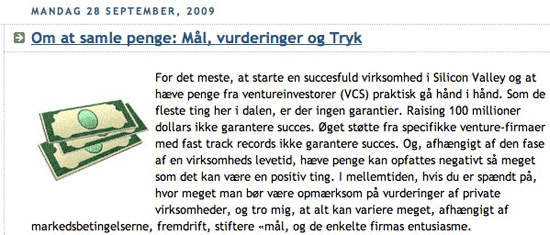
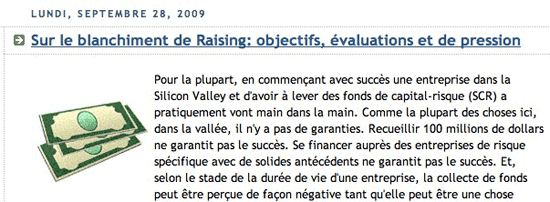
 According to my Google Analytics statistics, about 25 percent or more of the visitors to my blog over the last 30 days prefer a language other than English. Given I tend to use more words than pictures, it would be assumed readers would either be multilingual, or that they would take the URL and throw it into a translation service - be it Google Translator or Babel Fish. But today, Google made it even easier for site owners to bring their data to readers in the language of their choice, with the introduction of a new translation widget that, on the fly, without requiring visitors to install anything, displays the content in their preferred tongue.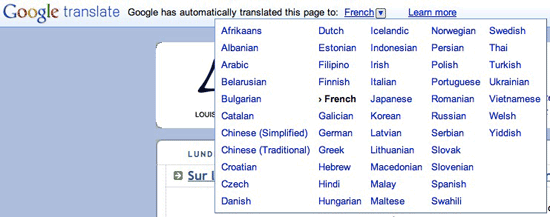
 On Tuesday, we talked about
 For the past year,