Silicon Valley Technology Commentary & Archives · Est. 2006 3,031 Posts · 2006–2026

October 4, 2009

October 4, 2009 · 4 MIN READ · BY LOUIS GRAY

Wanted: A Magical TiVo With Sub-Program Alerts

Wanted: A Magical TiVo With Sub-Program Alerts

If you own a TiVo, you can't fathom using a television without one. The ability to have your DVR record multiple channels at once so you never miss a program, pause live programming, skip commercials, and have it constantly searching for new shows to recommend or show you when your favorite actors or directors are starring in a program, is without equal. But as Web search queries and alert capabilities become ever stronger, I've been thinking of the potential for a future TiVo product to pinpoint programming down to levels much more granular than an individual episode.

Let's start with the required elements that are already in place.
  1. We already know that TiVo can pop up an alert for you when you are watching a channel if something else you have told it to record is going to possibly preempt your programming.
  2. We know that there are many many other TiVo users who are watching TV, so there is a high probability that somebody out there on the service is watching one of the stations at any given time, and if not, TiVo has the capability to tap into that channel's feed.
  3. We know that automated close captioning and transcription tools are gaining incredible improvements over time, practically matching natural speech.
  4. We know services like TV Eyes are constantly searching for content within TV shows.
On the Web, I have the ability to get alerted in near real-time if the brand I am watching (or my personal name) is mentioned online, be it in a blog comment (via BackType), in a blog post itself (via Blog Search), or on a social network like Twitter (via TweetBeep) or FriendFeed. Weather programs can alert me if there is an advisory in my area, or if a temperature reaches a certain level. Stock trading sites, like eTrade, can send me an alert if a watched stock reaches a pricepoint, and if lucky, I can even have it trade on my behalf if I have sufficient funds and an order in place. Each of these is an example of what I think could be the next generation of programming discovery and recording for TiVo or other DVR services - especially if users could utilize something like natural language to specify what they are looking for. Think about the possibilities that could be obtained with an intelligent next-gen recorder.
  1. Post a visible alert when the channel I was previously watching live returns from commercial.

    This way, if a program I was watching cut to commercial, and I switched to another channel, I would know to return back to my original show.

  2. Post a visible alert for specified occasions in a sporting event.

    I could program my TiVo to alert me when my favorite baseball team returns to bat, or if my favorite football team had recovered possession of the ball. Similarly, I could set an alert to highlight me when a specific batter came to the plate, or if the game's score differential had decreased to a specified amount. (Example Alerts: The 49ers are within 7 of the Bills, trailing 21-14 or Albert Pujols is batting.)

  3. Post an alert when a specific stock is being mentioned on a business channel.

    If I hold Google or Apple stock in my portfolio, I could set an alert with TiVo that would pop up if Jim Cramer mentioned the companies on CNBC.

  4. The TiVo could record subsegments of a show, not the entire program.

    What if I could tell the TiVo to record Conan O'Brien's monologue and skits, but to skip over the interviews? That's mostly what I do anyway, by hand. Similarly, can we record Jon Stewart and Stephen Colbert, but never have to see the guests?

  5. The TiVo could learn my "preferred" news network and watch for coverage of topics.

    If I told TiVo I preferred MSNBC, CNN or Fox News, and asked the unit to watch for mentions of individuals, like the Clintons, or topics, like the War in Afghanistan, TiVo would watch the live broadcasts for me, and pick up the relevant clips for recording.

  6. TiVo could integrate with network news' or ESPN's Special Report interruptions.

    While the concept of "Breaking News" has been watered down a great deal with the advent and growth of 24 hour cable news, the networks still can get your attention through Special Reports that interrupt regular viewing. But if I am on a cable channel watching something else, or am watching a recorded show on TiVo, I would want an alert that NBC had broken away to cover a critical live event.
Over the years, TiVo has become much more than just a recording vault for my favorite shows. The service now lets you search by show's descriptions to say, record every show with the phrase "Silicon Valley" in it, or every movie starring Johnny Depp. But I want more. The Web has spoiled me in terms of delivering real-time alerts and getting my attention right away. In contrast, TiVo's old-school episode by episode, show by show, hour by hour chunkitude almost seems wheezy. Even if we can't get to all my requests right away, I can't help but wonder how soon it will be before we can start getting alerts and recordings that are in smaller selections than the rules we have today.

If you could tell your TiVo to crawl shows you watch, or even those you don't, how would you customize this magical TiVo of the future?

October 3, 2009

October 3, 2009 · 5 MIN READ · BY LOUIS GRAY

It's Twitter's World: The Second, Parallel, Internet

It's Twitter's World: The Second, Parallel, Internet

It's Twitter's world. We all just live in it. I just looked out the window from my home north toward San Francisco and saw the sky tinged with a teal blue that spanned the horizon. While at this time last year, you could only see the faintest blue with a telescope, over the last several months, the blue light has grown ever brighter - almost blinding, to the point I can't even see Moffett Field from my condo in Sunnyvale. I've heard that SFO has even had to divert flights from landing on its North-facing runway after sundown thanks to this radioactive-like glow emanating from Twitter headquarters, as it has proven distracting to pilots who more than once have fallen into a trance-like stare, unblinkingly gasping in 140 characters or less. And I fear even with these precautions, it's only a matter of time before something bad happens. You can retweet that.

Try as I might to not be in this Silicon Valley bubble, I can't practically go anywhere or talk to anyone without hearing the word Twitter. "I've got to Tweet that!", one person exclaims. "Overheard!" cries another. "Hold on - let me check into Foursquare," says another guest at dinner, with the white artificial light glowing from his iPhone to his chest, tucked away behind the dinner menu. A phone call comes... "Did you see my tweet? Isn't that cool?" Even my iPhone apps, which I invited into my home, want me to tweet my high scores.

Sigh.

And if that weren't bad enough, many people practically expect that I have reserved Twitter user names for my 15 month-old twins. They can't yet talk, and their excitement around a laptop is practically limited to smashing the keys and being fascinated by the green light on the Caps Lock, but I am supposed to have secured their Tweeting future. Negatory on that geek rite of passage.

To be honest, it's not as if I am a hundred percent opposed to this change. If my life is to be "live tweeted" for the rest of my days, and future marital contracts will include a clause on whether one's twitter handles will change on the day of matrimony, so be it. I can accept the fact that this product, bluer than Viagra, which makes you type out messages as if you were stoned on marijuana at the speed of a crack addict, is habit forming. It's infrastructure - the new e-mail. It's the social networking glue that connects my phone and my RSS to various downstream networks. It is home to a community of people who have made their own "tweetspeak", who engage in "tweetups" and read books made "for dummies" to use Twitter - since clearly, it's so hard.

Regardless of whether you think Twitter is worth a billion dollars or a bazillion dollars, or think it's just Monopoly money, I can't help but think Twitter is running an end-around play on Google. While Google has the broadest horizontal index of pages, and is busy scouring an amazing mountain of sites to get their every word, Twitter, in a vertical approach, is getting the world's updates, and a similarly overwhelming number of links being shared. While I don't have the numbers behind me now, it would not surprise me if at some point soon, the absolute number of links (including duplicate links) shared via Twitter exceeds the net new URLs discovered by Google each day. And you can forget about linking instead of retweeting. That's the old way for Web 1.0 dinosaurs.

Twitter is practically becoming a parallel Internet. It may live on HTTP, but don't let that fool you. Over time, most folks may tell you the T's in HTTP stand for "Tweet Tweet".

In February, I said Facebook's success made it the social media prism, through which other activity would be referenced and measured. But the sheer volume of updates from Twitter is drowning all the downstream networks. If you have an aggregation service, be it the Facebook news feed, FriendFeed (now part of Facebook) or Ecademy's NetNews, you almost have to seek out posts that are NOT Twitter to find the diamonds in the rough.

Twitter is a firehose, not just for those who have glued their eyelids open, working hard not to miss a single update in TweetDeck or Seesmic, Tweetie, Brizzly, Hootsuite or a million other apps, but in terms of its sheer mass being able to render competing networks irrelevant. Facebook may be bigger today by a large margin, but it is Twitter that has the buzz. It is Twitter that is forcing the change in language, and making our LOLspeak the new standard.

Twitter was supposed to be simple. Update me what you are doing. But the community saw beyond that, helping make this product, best defined by its limitations, something else entirely. Products like TwitPic were made which helped users easily share images and videos. Users found ways to use hashtags to rally around events and causes, introduced retweeting to forward interesting items, and @replies to talk directly with one another. Directories like WeFollow were set up, without Twitter's help, to more easily discover like-minded users, and sites like Tweetmeme debuted to show the most popular links out there.

Like it or not, Twitter has become the standard for short communication. For the many of us who liked our own favorite service which we believed did more and had more flexibility or options, we were vastly outnumbered by the masses who are drinking the bright blue Kool-aid. Even as I, and others, may drag our feet reluctantly, we know we don't have a choice. Businesses who scoff at the usefulness of "The Big T" now recognize it is just another marketplace, and everybody is selling something - be it a real product, or a personal brand. Spammers love it. And that's a sure sign that you're on to something big.

To question if Twitter is going to crash and burn now under its newfound publicity and ridiculous expectations is like saying Bing's decision engine is going to make Google go bankrupt. You might as well rail against e-mail and hope it dies a quick death. Twitter owns you. Just check their recently updated terms of service. It's in there. And I promise you that you are a nobody until you've been selected to join the Suggested Users List. That's where all the cool people are. It's Twitter's world.

October 1, 2009

October 1, 2009 · 5 MIN READ · BY LOUIS GRAY

Google Wave Hits Shore. Flash Flood Warning In Effect.

Google Wave Hits Shore. Flash Flood Warning In Effect.

As you already know, Google released a waterfall of 100,000 invites to the Google Wave preview over the last day or so, giving bleeding-edge early adopter and information addicts a new playground to exchange conversations in real time. After months of hibernation and anticipation, Wave's arrival has everyone's tongues wagging, as we all get an early look into Google's plans to redefine messaging, delivering a real-time platform that includes rich media and extensibility through gadgets.

Since Wave's introduction earlier this year, I have seen a number of differing ways the product has been described. From a new development platform to a suite for business collaboration or an (insert popular social service name here) killer, the guesses have ranged far and wide. Interestingly, however, in an interview with the Wall Street Journal, Lars Rasmussen defined Wave as "a modern version of e-mail", adding that e-mail is "an old-fashioned technology". So it makes the most sense, at this point, to look at the Google Wave preview as a potential replacement or enhancement to today's e-mail systems, notably GMail.

Having received an invite to Google Wave via Denton Gentry, a Google employee who is also a frequent commenter here on this blog, I jumped into the Wave fray late last night, and found the system to be extremely stable and much faster than anticipated. For a "preview" release, Wave is very good, especially considering the complexity that is involved.


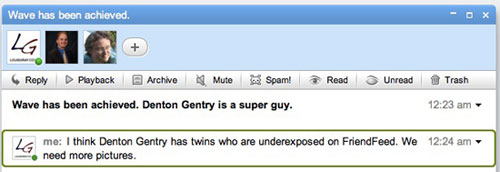
My first "wave" seemed simple enough.

Google Wave takes on traditional e-mail systems and incorporates chat-like or instant messaging technology all in one. Instead of a typical "I send you a message, you receive it and you reply" type of exchange, Wave encapsulates conversations between people and shows real-time responses in line, more like threaded comments than individual messages. If you and I are having a conversation in Wave, you see me type out my responses, typos and all, as I pound out a reply. To respond to my note, just click below the last message and extend the thread.


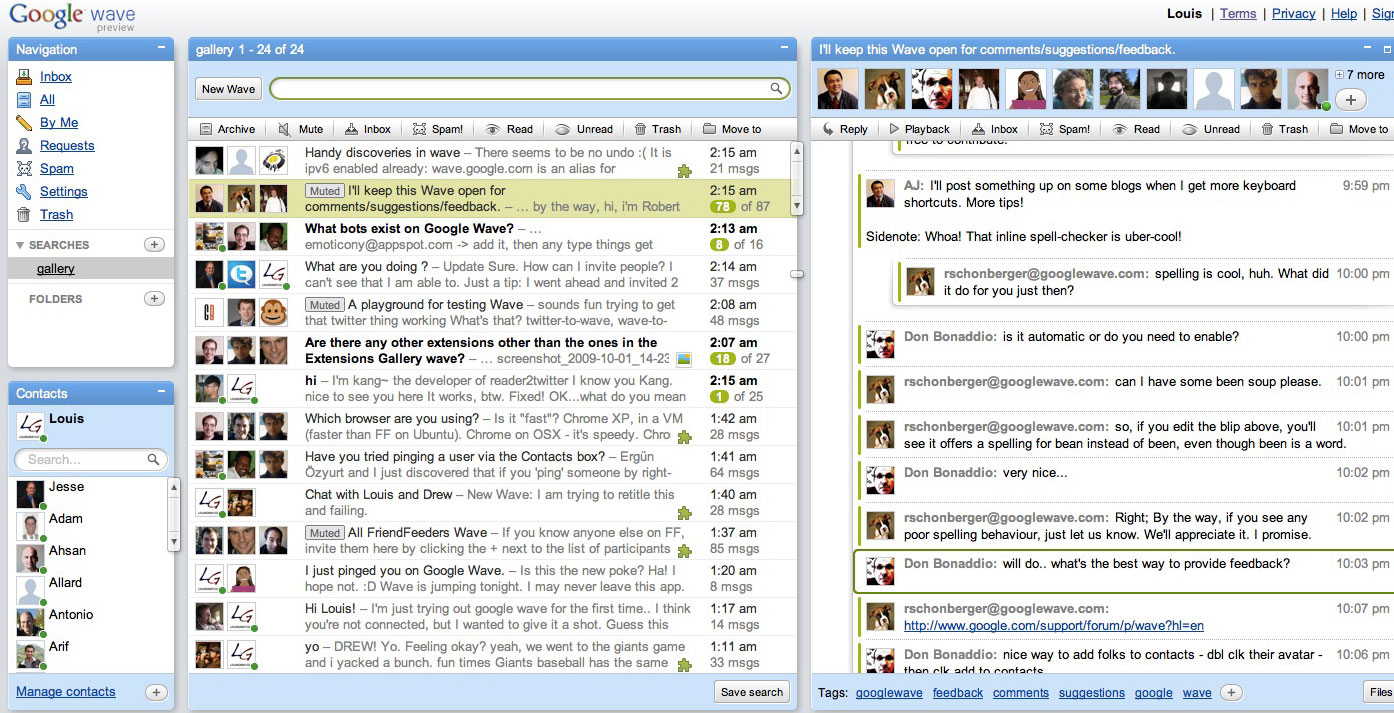
Almost immediately, my Wave filled up with conversation.

(Click for full-size image)

As this specific "wave" (lower case) is being updated, new waves can pop into our in boxes from anyone. Like traditional e-mail, if anybody has your address, you can be copied on a note. But Wave enables anyone to add contacts from their address book to any thread at any time. So while you may initiate one conversation, you could be dragged into another one that already has 60 entries. The good news is that Wave has a "Playback" button which enables you to watch the conversation occur, in the order it was entered, but the bad news is if you are in enough active threads, the act of watching each one can be time consuming.

Like most early discussions around new services, the vast majority of conversations are actually about the service. Just like FriendFeed-related items get liked more item on FriendFeed, and Twitter-related tweets get retweeted, last night's Wave swarm was full of conversations all about Wave. Does it work? Where are the gadgets? Who doesn't have invites, but needs them?


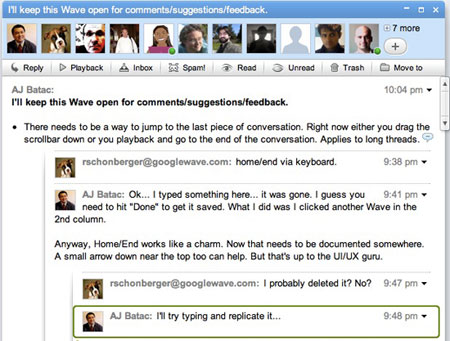
One active wave shows participants and nested comments.

Because of the real-time nature of Wave, I quickly found that if I engaged in one wave (lower case) and gained replies in another, the other contact might feel that I had "left" that thread. Since I can't yet be in two places at once, the real-time aspect was more like when you have multiple chat windows open in Google Chat or Facebook Chat than if you had more than one e-mail message. So staying on top of all active waves can be a tremendous challenge - one that practically promises to keep you embedded in the application until every single message is muted and all your contacts go do something else (which may never happen).

The instantaneous nature of Wave immediately makes other assumed "fast" programs seem slow. For example, adding comments to FriendFeed for a live conversation now seems slow, as it requires the entire message to be completed before being posted. In comparison, in Wave, I see you type it immediately, and can actually formulate a response as you're writing.

Google Wave, as should be no surprise, is integrated with Search. You can insert videos discovered on YouTube and photos from Picasa or other services into Wave, and make them part of any conversations. You can play back YouTube videos below text, or post new videos to those you're talking to.

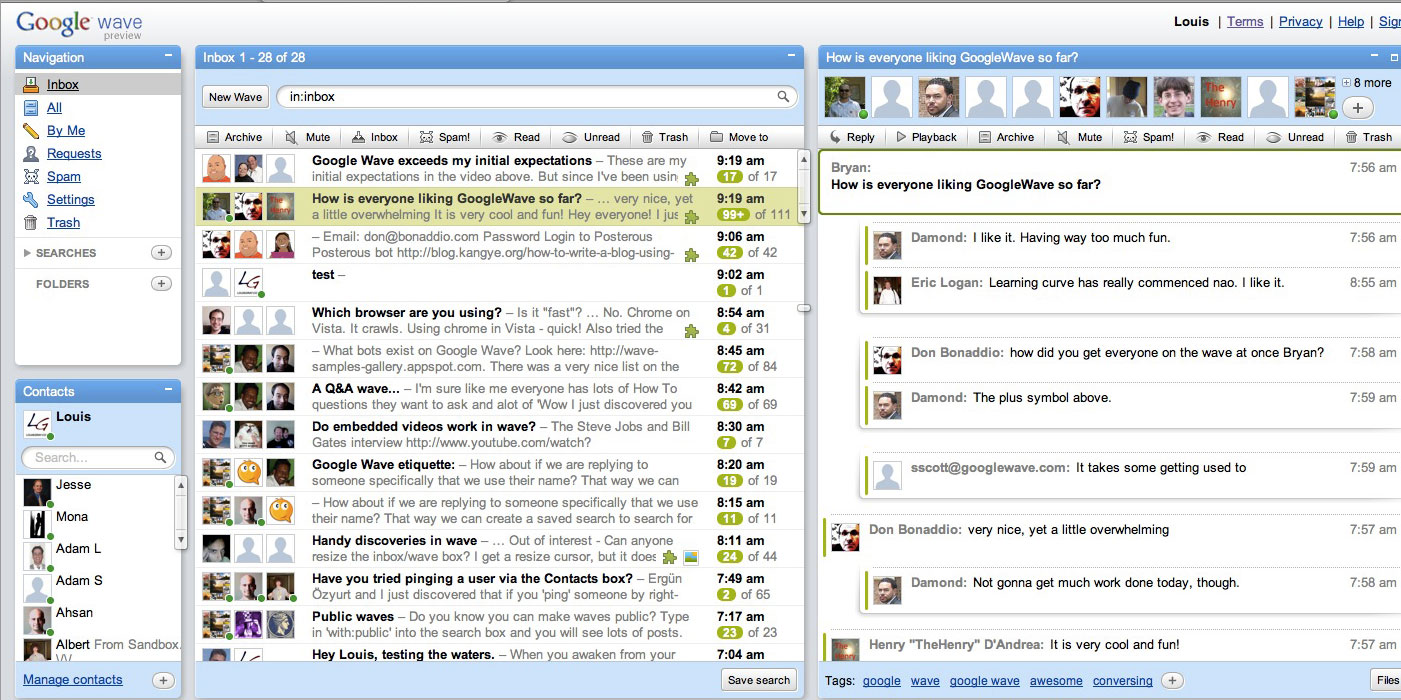
But yes, as you are watching a video, more waves are crashing into your in box. While you may not get the feeling that you have hundreds of unread messages, as you do with traditional e-mail, every single wave conversation shows how many new entries have been made since you last viewed the thread. Every single wave can have dozens of new entries, depending on the number of contacts and conversation that is there.


A typical Wave "In Box" after a night's activity.

(Click for full-size image)

Meanwhile, until Google Wave is integrated into GMail or other Google services, checking your Wave becomes yet another place to go so you're not missing conversations directed your way. So for somebody like me, who has a personal e-mail address, a work e-mail address, a GMail address, and e-mail addresses for company clients, Wave is yet another inbox and place to go to check in. And the new address ([email protected]) is another place for people to send me things.

I can see how small teams may use Wave for real-time collaboration. Its nature offers an opportunity to further eliminate distance and improve information exchanges. The ability to add people on the fly to conversations is very interesting, as is the ability to ping somebody and have a 1-1 conversation in the middle of any wave, or in a dedicated side exchange. I expect the company is set to debut more widgets to further extend the platform, both bringing content into Wave and content out from Wave. For example, last night, Jesse Stay and I had an exchange where he added a Twitter gadget, but thanks to something I would consider a security bug, I was able to send a tweet on his behalf because I was engaged in the thread. (See the tweet I made here)

Wave, like many Google products, also supports keyboard shortcuts to aid in navigation. I hopefully hit J to go down and K to go back (like I do constantly in Google Reader), but found it is the space bar that you hit to go step by step. Wave is an extremely interesting platform, and I would bet that after the initial surge of curiosity, normal conversations and information exchange will eventually take over, so this initial spike may be an exception rather than the new rule. But if you're diving into this new technology, expect do be exerting a lot of energy to stay on top of it, because messaging just got accelerated.

Also see: Scobleizer: Google Wave Crashes on Beach of Overhype

September 30, 2009

September 30, 2009 · 1 MIN READ · BY LOUIS GRAY

Twitter Readying Public Lists for Recommendations, Grouping

Twitter Readying Public Lists for Recommendations, Grouping

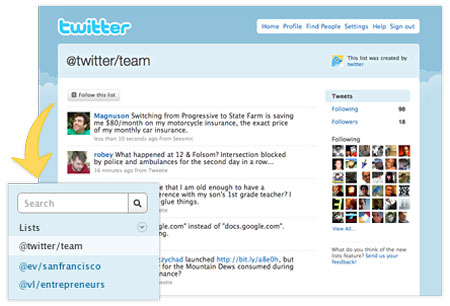
With plenty of cash in the bank and a growing talent horde, Twitter looks to be taking the next step forward - which is finally getting around to introducing features that have long been core differentiators brought to the table by third party clients. Following the recent addition of trending topic definitions (following Brizzly's lead), Twitter now has announced it will soon debut lists, which is already being tested to a "small subset of users". For most of us, the term "lists" has heretofore been known as groups, made famous by TweetDeck.

Most interesting about Twitter's move is that these lists are going to be "public by default" even though you have the option to make them private. In fact, these lists are going to be linked from your profile, just like your messages and your favorites are today - letting other Twitter users subscribe to your lists, a big move forward for recommendation-based discovery, along the lines of "Follow Friday", but official.


Twitter's List Feature Displayed Via the Twitter Blog

As Twitter wrote in its official blog post today, they started to work on the feature thanks to "frequent requests" from people "who were looking for a better way to organize information on Twitter". And they promise that these lists will not be siloed on the Web site, but extended to other programs via a new API, enabling developers to add Lists support in their apps.

Interestingly, the Lists announcement comes on the same day that Lunch.com introduced their own ability to enable Twitter Lists. I hope to show you a few I was working on once I don't overwhelm the system. (I tried earlier today, unsuccessfully)

After some time where it has looked like Twitter was standing still, just trying to keep afloat, the features are making their way out the door, and they are welcomed for the many users who don't know where to go next once they have an account.