Silicon Valley Technology Commentary & Archives · Est. 2006 3,031 Posts · 2006–2026

November 23, 2009

November 23, 2009 · 1 MIN READ · BY LOUIS GRAY

my6sense Update Adds Time Filters, Social Enhancements

my6sense Update Adds Time Filters, Social Enhancements

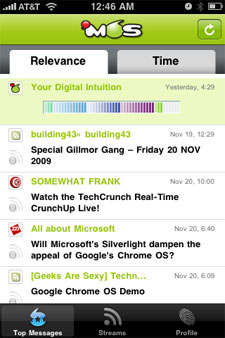
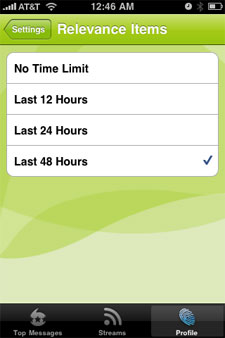
At the end of last week, my6sense, an iPhone application focused on digital intuition, helping you reduce information overload through focusing on content most relevant to you, introduced version 1.1 of their service to the iTunes application store. While the company mentioned the update as being "full of goodies", the top update that impacts my usage is that of filtering of relevant items by time, ensuring my focus in on items relevant both in content and in recency.


my6sense Offers Time Filters on their Relevancy Stream

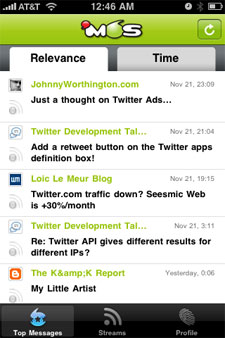
my6sense's approach thus far has been to surface the most relevant items from your RSS feeds into the application, even if the article was published weeks or months ago. With the latest push, you can limit the "Relevancy" tab to the last 12, 24 or 48 hours, while the company's algorithms still apply.


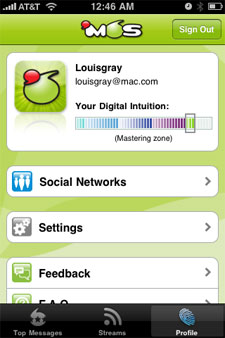
The Updated Stream, Which I am Mastering, Highlights New Items

As you can imagine, for somebody like me, who reads practically every article through Google Reader when at the desktop, poring through thousands of items on a small screen like the iPhone can be a challenging task. my6sense's move to reduce clutter in my stream is a good thing, and making sure the items are new is just as important a step. The move is a major reason I recently progressed through the company's levels of digital intuition, reaching "Master" on Sunday. I've been told there are 2 or 3 more levels to go to improve.

Disclosure: my6sense is a client of Paladin Advisors Group, where I am Managing Editor of New Media. My comments on the company's product are always independent, and do not pass their way in advance.

November 22, 2009

November 22, 2009 · 4 MIN READ · BY LOUIS GRAY

Finding Value Even If I Were the Last FriendFeeder...

Finding Value Even If I Were the Last FriendFeeder...

Since the site's acquisition by Facebook this summer, I have not talked much about my thoughts on the future of FriendFeed, aside from the initial response saying it was not "dead". There hasn't been a major compelling event to do so, but it keeps coming up, so I thought I would share my thoughts, in light of what we've seen since August.

On Friday, I mentioned there are three cores to a successful social service - namely technology, relevancy and community. How one perceives community can be very different depending on one's perspective, and the network's community is a fluid one, depending on little things like the time of day, the day of the week, or the stage of evolution - particularly noticeable by services that first are overrun with geeky early adopters, only to see the mainstream eventually find footing. In light of my heavy use of FriendFeed for the last 2+ years, and the last few months of insecurity on the site in terms of its future, which has seen significantly reduced traffic and use, I have thought a lot about how much time I should invest in a site that, in theory, is seeing some parts of its community reduced.

After much thought, I can see myself deriving real value from the site, even if every single other person I communicate with there regularly were to disappear. For while it's incomparable fun to trade discussions and debates with the tight community there, and to rack up comments and likes, or to contribute my own, like scattershot, through my feeds, there are many different reasons I have been making FriendFeed my social media nervous system, which have nothing to do with the "Community" aspect - and try as I might to reset my browser home page to another address, I keep going back to the old standby, because FriendFeed works so well.

1. It's Still The Best Aggregator In Town

While there have been many attempts at aggregation services over the last few years, FriendFeed made the most robust and easy to consume aggregation service out there. FriendFeed can provide a single page to view all of my activity, just as it originally set out to do in late 2007.

2. It Still Has All My Friends' Content In One Place

Even if people stop using a site, their content continues to flow through FriendFeed - with the small exception being the handful of users, who for whatever reason, deleted their accounts outright. This means that, in addition to Google Reader, Twitter Lists or other services I am using, I can click out and find interesting news.

3. It Still Acts As A Fantastic Distribution Engine

FriendFeed lets you send specific services' updates to Twitter automatically, based on your preferences. This means that, if I choose to, bookmarks I make on Delicious automatically can flow, through FriendFeed, to Twitter. So too can my updates on SmugMug, while I try not to drown my Twitter followers with Google Reader shares. Having this take place automatically is still much easier than using the "Send to" feature in Delicious for every single item.

4. It Still Has The Deepest Social Media Search Online

Twitter's search utility still only goes back a few days. New partnerships with Google and Bing, as well as many different third party search engines are trying to make things better, but they don't compare with FriendFeed, which lets you search all FriendFeed users' updates, going back to the beginning of the site. Using the site's advanced search functionality, you can search specific services, specific people, or even find specific posts that had comments from a single individual.

5. It Had Saved Searches and Lists Long Before it Was Cool

Before Twitter introduced lists, FriendFeed had already enabled me to set up lists of folks I follow, so I could reduce my entire social stream to specialized groups. It also provided the option to save searches, including advanced searches, in my sidebar. So rather than invent the wheel somewhere else, and redo effort, my customized experience is already set to help me find data fast.


So What Is the "Future" of FriendFeed?

At Friday's Real-Time CrunchUp, hosted by TechCrunch, Paul Buchheit, co-founder of FriendFeed, now working at Facebook, said the site was not destined to go away any time soon - even if working on it hasn't been front and center for him or for his colleagues, who are said to be working on infrastructure projects within Facebook, hopefully making that social network even more special.

That the FriendFeed blog has not updated since August, added on to the news that two of the team's small developer base have already left for alternative non-Facebook pastures (Ben Darnell and Gary Burd are the known exits) hasn't helped the community feel reassured that all is well for the future of the site. In interviews, it sounds like work on the site has fallen into elective "20% time", familiar to Google watchers, and many regulars who participated on the site in the last year have chosen to leave.

No matter how you try to massage popular sites, like Twitter and Facebook, they do not equal the product that FriendFeed produced, from a technology standpoint. Now that the community is changing, and some are resigned to a different world, there are pressures on some to consider alternatives, but until I can find tools that solve for each of my issues, as outlined above, there are tons of reasons I will continue to use the product - even if it's assumed I'm looking denial straight in the face.

November 20, 2009

November 20, 2009 · 3 MIN READ · BY LOUIS GRAY

Embrace Our Twitter Ad Overlords, Assuming Relevancy

Embrace Our Twitter Ad Overlords, Assuming Relevancy

Those of you who have some history with the blog know that I am not a huge fan of advertising. I skip commercials on my TiVo. I don't click on banner ads online. I switch stations when listening to the radio, assuming I am not listening to my ad-free iTunes library or ad-free Sirius XM radio app. I once said, to some controversy, that most bloggers don't deserve any ad revenue at all, and also took considerable effort to report many Facebook advertisements as being offensive. But despite all this, with official word from Twitter COO Dick Costolo coming that the service will indeed include advertising in the very near future, I am fine - pending any future annoyances. Why? Because I am not anti-advertising. I am pro relevancy.
In my rant against bloggers who don't add clear value trying to get a piece of revenue, I aggressively said "services offer real value, bloggers don't", adding, "Web services are adding real value to the Web by changing the way we interact and communicate. Bloggers, myself included, are not. We are more like consumers than producers in this case, and the last time I checked, consumers pay, they don't get paid, no matter how excited we might be about a product."

After much debate, Twitter, a service which provides value to millions, is looking to bring ads to the table in what they promise will be a unique way. With the growing talent base at the company, there's no doubt they see what has happened to traditional advertising models, and they don't likely want to see a race to the bottom in terms of quality. In order not to damage the trust they have accumulated with users, they will need to provide a new and differentiated approach to this model that derives real value - for the company, for the advertiser and for the viewer. I don't want to see yet another copy of AdSense. I want to see something very new.

Overwhelmingly, most of us in the Tech Web want Twitter to succeed. Despite the many concerns we have had about the service and its occasional hiccups, we recognize its growing role in the world of communication, and see it as a growing player in infrastructure, taking share from e-mail, and my personal favorite, RSS. That the company would have to grow from a revenue-free model to one that has a revenue stream was clear, barring an early buyout from a stable tech leader.

Much of the problems with today's ads, which have seen lower rates for advertising across the board, has been tied to a lack of relevancy. I asked that ad companies would leverage my social profile and give me accurate ads downstream, through utilizing my content-rich Facebook profile or some other site. Twitter has a unique opportunity to know not just what my social profile looks like, but they know what I talk about, what I share, they will know, through geolocation, potentially where I am, and how I am characterized, thanks to lists.

I do not hate advertising. I hate bad, wasteful, untargeted advertising. If advertising is accurately targeted and provides value, it is much like finding a new blog post on a topic I like, or finding a product I really do want to buy. I have seen page after page after service after service that has taken the easy way out and slapped up advertising just because, but if somebody can get the formula right, it can only be good for the Web in general. Good services deserve revenue, and good customers deserve good, relevant, ads. I will hold my breath and hope that Twitter gets this formula right.
November 20, 2009 · 3 MIN READ · BY LOUIS GRAY

The Chrome OS Release Is Not About Now, It's About Next.

The Chrome OS Release Is Not About Now, It's About Next.

Yesterday, as most tech outlets noted, Google previewed their much-awaited Chrome Operating System - and in parallel released the code for the operating system to the open source community. By the end of the day, sites like Gdgt had compiled virtual machine capable installs of the early alpha system, and geeks, including me, were tinkering with the system. Unsurprisingly, there were near-immediate reviews, and some calling the news a disappointment. But for me, the news was not so much about Chrome OS being ready to go, but instead Google delivering on a promise, and showing its cards, before they had to, to let us know what's progressing in Mountain View.

Google's success and growth over the last decade has not been without its detractors. The company, which could once simply be described as a search engine, now has its reach in a dramatic number of Web applications and services. I tend to be rosy on the company's expansion, and even asked last month if it was at this point possible for somebody to use Google software exclusively and not lose functionality.

Google's preview of the Chrome OS was more than a product release. It was a milestone in a vision of a Web-centric world, one in which we are increasingly living. For the vast majority of my own activity, I am online, not using software. I intentionally use some applications, like Microsoft's Office suite or Adobe Photoshop, quickly, and then close them just as quickly, as to not slow down my computer's performance. Google's Chrome OS is the latest development in a vision that says our activity will be online, our data will be stored in the cloud, and applications that have traditionally been desktop software will make their way online.

Under no uncertain terms, I agree with their vision. This is happening and it is happening fast.

When I booted up VMware Fusion last night, and turned on the Google Chrome OS for the first time, it didn't come with an instruction manual, asking me only for my login and password - which corresponded with my GMail account. Logging in took me to the now-familiar Chrome browser, the starting point for the next generation of computing. While today, the experience is not dramatic, thanks to us already being familiar with their browser on Macs and PCs, it was a checkpoint that this was real and happening. There was no way to move the browser off screen and get to the equivalent of a desktop, for it didn't exist. There was no C: drive or System folder. Just the browser and an infinite Web that is capable of taking me anywhere.

So with due respect to my good friend Jason Kaneshiro, who writes: Google Chrome OS: I Don’t Get It and ReadWriteWeb's Sarah Perez, who asks Was Chrome OS a Disappointment?, the main concerns I have seen voiced around limitations on what the OS can or cannot do are much like the concerns people had when the first-generation iMac shipped without a floppy disk drive and ditched Apple's proprietary cables for the new Universal Serial Bus (USB) standard.

Google promised us a new operating system built on the Chrome Web browser. They delivered. They gave us more information yesterday showing that they were working on it. They immediately gave back to the open source community and gave us a way to start tinkering. This is not a situation of ditching the Mac or a Windows 7 machine today, but instead, about pushing us forward to a new reality. If we choose to stay in one place clinging to our old ideas, we will only get further behind.