Silicon Valley Technology Commentary & Archives · Est. 2006 3,031 Posts · 2006–2026

January 1, 2010

January 1, 2010 · 4 MIN READ · BY LOUIS GRAY

2010 Computing: Lighter, Faster, Mobile and Connected.

2010 Computing: Lighter, Faster, Mobile and Connected.


The remarkable changes that took place in computing, networking and storage in the last decade finally moved us beyond the battle of megahertz and arguments over Moore's Law, as computers' true speeds are now measured in megabits and gigabits instead. While we continue to need the horsepower to crunch data with PhotoShop, and to run Office, the virtual move to the Web (or Cloud, if you prefer) has realigned our priorities. While I long since gave up desktops, saying I would never buy one again, whatever I get next may not be measured primarily by its processing power or hard disk space, but instead by its form factor and ability to access all my data from anywhere.

Amid all the noise and discussion around whatever Apple has planned with the much discussed and never truly seen Tablet (or iSlate... the current moniker being bandied about), my 2007 era MacBook Pro is getting somewhat long in the tooth. Compared to the MacBook Air line, it seems clunky and thick. Compared to today's leading solid state disks, its serial ATA drive is a slowpoke. Compared to netbooks, it looks expensive. Compared to mockup dreams of tablets real or imagined, it looks archaic.

Every couple of days, I head to the Apple Store online and price the MacBook Air. I roll my eyes at the 64 gigabyte solid state disk models, and scrunch my nose at the seemingly low 2 gigabytes of RAM and 128 gigabyte version, while completely ignoring the SATA alternatives, where the S may as well stand for "Slow". I've even looked at Apple's list of refurbished Macs to see if I can pick up the ultralight, thin, machine for just over one grand and make the move. But I haven't.

Much of what is stopping me from making the switch lies in our current state of trajectory. Just like I said on Monday when I mentioned you would have to be insane to get a new iPhone now, you would have to be similarly blind to get a new Apple laptop so close to next month's promised event when Cupertino shows its cards, and when Google's Chrome OS is being built for the next decade.

As an old hand when it comes to watching Mac rumors, I have learned to ignore the massive amount of noise and predictions about Cupertino. Practically nobody has any insight, even if they all seem to have conjecture. But what we can expect is that the trends that saw advances in the iPhone and introductions like the MacBook Air are going to continue.

The Tablet, as well as Apple's next line of MacBooks and MacBook Pros, will be thinner than today's models. The next machines are going to be designed with ever faster connections to wireless networks, and faster hard drives aimed to reduce wait time. And until the day when all our data is stored in the cloud, our hard drives are going to need to be increasingly large, to hold on to all the rich media, from videos to audio, and photos, we are creating and downloading. My 200 GB hard disk, almost 75% consumed, will need to be replaced with a 256 GB solid state disk or larger, and it will happen in a thinner computing device than the one I have now, one that offers faster access to all my Web services, from anywhere. This will be made even easier with expanded access to metropolitan WiFi networks, MiFi cards, and 802.11n WiFi access.

The last few years saw an incredible move toward mobile in terms of how we consume the Web, and more recently, how we create content for the Web, best exemplified by the video recording capabilities of the iPod Nano and iPhone 3GS. The next few years will no doubt expand this trend, as more efforts are made by hardware manufacturers and software developers to increase our ability to create and consume all our data from any location.

I am waiting for the Tablet, not necessarily to ensure I get my grubby mitts on the first version, as I am still waiting to see how it fits in my electronics ecosystem, alongside the MacBook Pro and iPhone, but to see if this further drives forward the proofpoints of smaller, thinner, mobile and connected. Elements of this Tablet will not only impact Apple's mobile lineup for years to come, but those for the entire industry. And whatever laptop I end up getting, after the Tablet's introduction, it will be impacted by whatever Steve Jobs and team tell as at the end of January. Then, the fun is just getting started, as the Windows minions follow suit in copy/paste central, and Google tries to make inroads to change the game themselves.

December 31, 2009

December 31, 2009 · 6 MIN READ · BY LOUIS GRAY

The Top 15 Stories on LouisGray.com in 2009

The Top 15 Stories on LouisGray.com in 2009


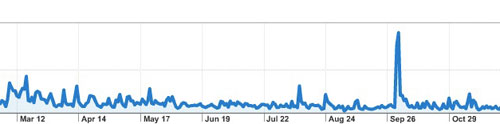
Ever since I stopped doing my monthly summaries on blog statistics, as some had judged them as internal navel gazing and self-gratification, I haven't talked much about statistics and numbers, hits, page views or visitors. But in the interest of sharing, and wrapping up the year 2009, I thought I would expand on my yearly summary post from last week and show just what visitors were looking for that drove traffic. In aggregate, I should mention that total traffic in the year was not dramatically higher than 2008, which I take to mean more people read the content via RSS or in aggregators. In addition, there were fewer posts on the site in 2009 than in 2008, thanks to reduced guest posts.

The Top 15 stories authored in 2009, in order of highest traffic to least:

1. Google Wave Hits Shore. Flash Flood Warning In Effect.
October 1, 2009

The summary of my initial reactions to Google Wave was surprisingly visible. Although I felt as if my thoughts were actually late to the game, the post ended up being far and away the highest trafficked article of the year. The spike was led by Robert Scoble posting how much he thought Wave was overhyped. Subsequently, someone posted our pair of posts to Slashdot, and Der Spiegel of Germany also highlighted the summary. Although I was not overly negative of Wave, I did say it was very busy, and my reaction often got lumped in with Robert's much more critical response.

2. 40 Key Elements to Getting Started In Social Media
January 5, 2009

At the beginning of the year, Mike Fruchter wrote an extremely detailed guide on the necessary tools required to be engaged in social media. His effort was rewarded through the post being among the most bookmarked on Delicious, and being highlighted by Darren Rowse of ProBlogger. Mike is one of those talents that I hope to be working alongside someday, should I ever get the chance.

3. The Story of Google's Closure: Advanced JavaScript Tools
November 8, 2009

When Google released Closure tools to the Web, response to this was fairly neutral. Most folks tended to just repeat the news. But I thought it made more sense to ask Google developers how they had benefited from the tool while in house. Mihai Parparita of Google Reader gave a wonderful first person account of his use, and other geeks appreciated it. It was featured on Hacker News.

4. FTC Disclosures Made Simple For Bloggers With Conflicts
December 4, 2009

Among my most fun posts of the year was a collaboration with Jeannine Schaeffer earlier this month on some icons to help bloggers disclose relationships to the FTC. It was a fun idea, and Jeannine came through in a big way. Mashable and others highlighted the story, and I've enjoyed seeing the humorous icons make their way around the Web in the weeks since.

5. Facebook Drops the Walled Garden, Opens Up Possibility for Track
March 16, 2009

Jesse Stay, a preeminent expert on both Twitter and Facebook, highlighted Facebook's increased openness and the ability to let updates leak into Google and the wider Web at large. He is the author of multiple books on Facebook worth checking out if you ever want to write Facebook apps or just learn more about the largest social network in the world.

6. Twitter's Search Engine Is Very, Very, Broken
May 21, 2009

As Twitter has grown well beyond initial expectations, the service's fragility has shown in a number of ways. Among the most visible has been the disappointing index from the company's search engine. It's now widely known that the engine only goes back a few days, and it doesn't index some of the most visible accounts, making data discovery and retention difficult. It would be wonderful if this were to be solved in 2010.

7. Could A Real Apple Fan Completely "Go Google"?
October 29, 2009

At risk of having to throw away my Apple fanboy card, I became more entranced by Google in 2009, thanks to the company releasing solid product after solid product, many of which competed head to head for my attention with Apple's well-known suite of offerings, including iLife and the iPhone. The more I thought about it, the more realistic I thought about switching, and I am definitely watching this space closely.

8. What FriendFeed Needs to Do To Grow and Keep New Users
January 2, 2009

At the beginning of the year, seeing a lack of growth on FriendFeed's part that met my own aggressive expectations, I gave some unsolicited feedback as to how I thought the company could improve. They had other ideas, and launched many great tools, but didn't go the way I had thought. Months later, they were absorbed into Facebook.

9. The Newest Annoyance on Twitter: Follow and Refollow Spam
March 7, 2009

Twitter's problems weren't limited to their own back-end infrastructure. Users often got tired of being bombarded by different types of spam, either on the service itself, through direct messages, or through what I found as refollow spam. Some automated accounts were following my account every few hours to get in front of me and my connections. This annoyance was thwarted in time.

10. iPhone Call Recording: It Makes Too Much Sense Not to Do
August 9, 2009

While BlogTalkRadio's CinchCast product has largely filled this need, it seems to me that Apple could easily enable us to record phone call conversations for interviews and podcasts. So far, my understanding is that applications posted to the iTunes Store that accomplish this very thing have been slowed or stopped outright.

11. How To Cleanly Separate Personal and Work Social Media Personalities
March 22, 2009

Many people are looking for a way to act in social media on behalf of their company, while maintaining their own personality. Having accomplished this myself, I thought I would share how. It seems many others were curious and this post remained popular and shared through the second half of the year.

12. Blogger Quietly Turns Ten, Plans Slew of Feature Upgrades
August 23, 2009

As one Blogger holdout who hasn't moved to WordPress, I watch the platform closely, and Blogger turned ten years old this fall, without fanfare. Following my quick summary, this surprisingly hit the front page of Digg (only my second time ever), which was appreciated, but befuddling, as it was not a huge story, in my opinion.

13. Hi Facebook, It's Me, FriendFeed. This Relationship? It's Complicated.
August 10, 2009

The announcement that Facebook acquired FriendFeed struck the many people who like FriendFeed in a very personal way. I have talked to many top users of the site who felt as if the announcement had hit them emotionally, as no other simple merger or acquisition had before. Much of the concern lies in the fact that Facebook has a reputation that runs contrary to what some hoped FriendFeed would become. My amusing tongue in cheek response tried to explain just how we were feeling, rather than encapsulating the news like many other sites already had.

14. Feedly Explore Highlights Recommended Blogs, Reader Activity
September 26, 2009

Feedly, a 2008 debut here, has been among the most popular ways to get RSS updates. The service's Explore feature enhanced feed discovery. After posting this piece it was highlighted within Feedly and many users came to the blog to see what was new.

15. Twitter Caps Following Limits, Denting Auto-Follow Services
April 20, 2009

In a year I wrote many good things about Twitter, it's no surprise the more negative stories gained traction. Among them was a move that blocked some Twitter developers from using advanced auto-follow tools, reducing the option for some accounts to be automated.

In a year with more than 500 posts (the fourth straight above 500), these 15 top ones showed me that people are always eager to learn more about Google and Twitter, and how to best use these social media tools. While I don't let traffic define what I intend to cover, it's always worth making sure I keep on topic for what the readers want to see.
December 31, 2009 · 3 MIN READ · BY LOUIS GRAY

10 Predictions for 2010 In the World of Tech

10 Predictions for 2010 In the World of Tech

Following on to predictions for 2009 and for 2008, as well as their results. (2009 | 2008)

Keep in mind I would rather not predict the obvious.


1. Twitter Manages to Complete 2010 With No Major Hacking or Security Incidents

Despite a strong 2009 that saw the microblogging service graduate from the geeks to more mainstream appeal, Twitter remained plagued by a number of uptime issues and some extremely visible hacking and security incidents that led to slowness and downtime. As part of the company's maturation process, Twitter will build the personnel and infrastructure necessary to withstand such future attacks, and 2010 will go major incident free. There may be some slowness, but no outages via the dark corners of the Web.

2. Seeing Android and iPhone, Windows Mobile Will Aim for Parity, and Fail

Microsoft, jealous at all the consumer and media attention around the iPhone, and now Android, will try to remain relevant, launching a new version of Windows Mobile, and hyping its own apps, just like they did when they launched the Palm PC line (later Pocket PC) following the PDA's rise to power. Their approach will not be seen as comparable to Android or iPhone and will not change their market share in a positive way.

3. Apple Will End Exclusivity With AT&T, Adding T-Mobile and Verizon

With AT&T being a massive black eye for Apple's iPhone in the US, the company will finally end exclusivity with the telecommunications carrier, and strike deals with both T-Mobile and Verizon. Consumers will be able to switch carriers and keep their numbers. Unsurprisingly, users may find that those networks aren't perfect either.

4. Facebook Will Announce a Migration Plan for FriendFeed Users

The mystery around Facebook's plan for FriendFeed will become clear in the first half of 2009, as not only does the company improve its network with FriendFeed-like elements, but existing users of FriendFeed will be given guidance on how the two networks can converge, while protecting their existing content and contacts.

5. Google Wave Will Exit 2010 Still In Beta

While Google Wave will continue to improve and may open up to all visitors, without requiring invites, the product will still be seen as experimental, and will not shed its beta tag, keeping it through the end of the year, much like GMail and other products from Mountain View before it.

6. Facebook, Zynga, LinkedIn Will All Go Public

After a dearth of IPO activity in the last two years, 2010 will see a resurgence, especially from Silicon Valley VCs, who are eager to make profits to help assuage the wounds of losses from the last few years. Facebook and LinkedIn will be among the larger IPOs, with Zynga also filing, and other smaller companies following suit.

Twitter may file, but will not be public by the end of 2010.

7. Chrome OS Netbooks Will Be Available from Major Retailers

Google's Chrome OS will reach a maturity level that it will be sold on netbooks alongside more traditional offerings from major retailers including Best Buy.

8. Many Social Media Experts Will Launch Mediocre Agencies

Many of the self-proclaimed social media experts will leave their corporate day jobs and strike it out on their own, looking to convert the world to Twitter and Facebook fan pages. A good number of them will find that the world of business relies a lot more on revenue than it does on retweets and @replies, and may walk away disappointed.

9. Google, Facebook and Apple Will All Make $1B+ Acquisitions

In addition to the new public market activity, acquisitions will again become trendy. Google and Apple will make full use of their growing cash hordes, and will make at least one ten-figure transaction in the year. Facebook, fresh off its cash raised from the IPO, will do the same, largely in stock.

10. The Real-Time Search Market Will Consolidate

One or more of the active dedicated real-time search companies will find differentiation difficult, especially with Google, Bing, Twitter Search and others participating. The trailing market share participant will either merge with an existing site, will close down, or look for a low-budget buyer.

December 30, 2009

December 30, 2009 · 3 MIN READ · BY LOUIS GRAY

Like Convergence, Aggregation Is Better In Theory

Like Convergence, Aggregation Is Better In Theory

There always seems to be a tug of war in technology between those who want a converged, multi-purpose device that does everything, or those who want a dedicated device that does one thing (or just a few things) extremely well. For every successful hulking converged printer/copier/scanner/fax machine device, there are utilities like toasters or microwaves that just do one specific function. The truth is that when differing technologies converge, it usually leads to a single unsatisfying experience where none of the functions are high quality. More common is the practice of product diversification, where one device turns into a family of devices, with differing features for differing price points.

On the Internet, many of us are creating a ton of content in a ton of different places, and in most cases, this content differs by the site. I may use Flickr or Smugmug for photos, and use Twitter or Identica for microupdates. I may use last.fm or Pandora for music streaming, and Blogger or Wordpress for more lengthy pieces. The solution, which I've long championed, has been the development of an aggregator, which takes all this disparate activity and presents it in a single place. This aggregation is what is at the heart of sites like FriendFeed, and more recently, Cliqset, Arktan and, increasingly, Facebook. In parallel, there has been this development of personal lifestreams, which can capture all our content in one place, and be hosted on our site or on a third party URL.

It sounds great. But despite my excitement and evangelism around such tools, for the most part, they have not flourished. It seems that, instead, people want to enjoy the content in its native environment, or keep things simple. I look at the developments behind Arktan and Cliqset, and wonder, does the world need to develop a perfect aggregator, again?

It's possible that the disappointing answer is no. It's possible that while an aggregator is among the fastest ways to get caught up on individuals' activity from around the Web in once place, that getting the downstream data at the aggregator instead of at the source somehow reduces the quality or impact of that message, in the same way that the iPhone isn't the best cell phone on the planet, or the best Web browser, thanks to it being a converged device and not a specialized device.

Hardware specialization enables products to be refined and refined until they cannot be completely virtualized or emulated by software. A good example of this is the DVD player. The DVD player on your computer, and its associated software, is good, but it's not as good as the dedicated device in your entertainment center. And that convergence of your media player and your TV hasn't really been a success either. The VCR/TV combos were never a good idea, and WebTV wasn't exactly considered the quality leader. Convergence always sounds wonderful, but ends up coming up short.

For the past two years plus, I have been among the loudest proponents of aggregation. For me, an odd person at one end of a data consumption curve, it solves a need that I have to concentrate my activity and discover my friends' updates from around the Web. But for the more common user, they just want a few things to work well. They have chosen Facebook as their social network. They have chosen Twitter as their micromessaging platform. They have chosen LinkedIn for their business platform. Even those who have chosen all three aren't crawling the Web looking for a single site solution the way some of us early adopters have.

In his 2009 wrap-up post, Lifestreaming advocate Mark Krynsky confirmed that he "didn’t see many things this year that took Lifestreaming to the next level," adding "Lifestreaming was pretty stagnant." 2007 and 2008 saw a lot of new services come to the fore, and 2008 was the year that FriendFeed looked like it could change the game, threatening sites like Twitter and Facebook. But as polished and professional as the site was, it just wasn't capable of converting those away from the original, refined, source of the data.

I have to believe that aggregation tools are interesting, and useful to a small minority of people. Lifestreaming tools are fun for individuals to highlight their activity. Sites are out there that do a good job, and more are coming, but I am thinking that "aggregation" is the new "convergence". It looks great on paper, and some people will carry a Swiss Army Knife with them everywhere, but most won't.