 Last week, Facebook made some big announcements at the company's F8 conference, including a few aggressive moves to extend the company's presence to third party Web sites. The plan consisted largely to enable people to "like" content from around the Web, transmitting their downstream activity back to Facebook, and also - garnering an incredible amount of backlash from those opposed to the company's approach to automatically opt users in - they introduced the opportunity for partners to personalize your Web experience based on your profile. Facebook's introductions, as close as they are to exactly what I have been asking for over the last few years, are running contrary to what the company's large user base expected from the network, and the company's methods are presumably violating the public trust. While I do not have plans to delete my profile out of protest, as many have, I do not plan on acting as if any of my content placed on the site is done under the realm of being private. I expect my data, all of it, to be publicly searchable, shareable and indexable by the company and its partners, forever, and will act with that in mind.
In April of 2009, I practically begged for ad companies to "truly leverage our social profiles", specifically Facebook. At the time, I wrote:
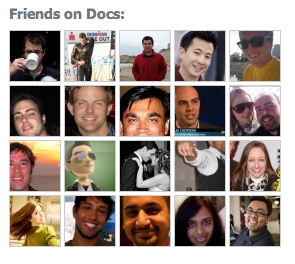
" I think the real money is in Facebook offering to team up with all the major advertisers on the Web (Google/Doubleclick included) and letting said advertisers tap into our personal profiles, giving them a cut of the downstream revenue. Facebook has proven they know us, even as their ad team does not. Turn over the right data to ad people who do know what they're doing, and maybe I'll stop being annoyed by ads that have nothing to do with me."Last week, Facebook opened up my profile to a select few partners, including Pandora, Yelp and Docs.com, a Microsoft front for their Web Office plans. While the ads are still terrible on Facebook (and other sites), presumably these three starter sites are going to be customized just for me. Sure enough, logging into each presents a "personalized" experience, featuring avatars of friends with whom I am connected. In theory, my recommendations on Yelp get better, my musical recommendations from Pandora get better and Docs... well, I have no idea. But two out of three's not bad, right?

Docs.com Uses Facebook to Personalize My Experience
I can't get too riled up about Facebook trying to make the Web a better place through leveraging my social profile. To be honest, I want this.
I want these downstream sites to tap into my personal profile and use the data they find. And I also believe that I am acting in a way online that doesn't have any skeletons in the closet, if all the data becomes public some day. I have seen Facebook work to extend to a more "public" (not open) status, and expect all my content to go with it.
From what I have seen, the major concerns around Facebook's moves are two-fold. First, there is a concern that they made these "special agreements" with the three mentioned merchants, and that this might be the tip of the iceberg, as they gain more relationships, and extend the ability for these relationships to see more and more of your content. Second, there is a concern, one I believe to be accurate, that the overwhelming majority of Facebook users will not only not understand what has changed, but they also will not know how to opt out of the process. It is clear that getting out of the process requires many steps, many more than it took to get into the process, effectively zero.
The flareup of response around Facebook's move has spawned more feedback from the network's blog, which aims to quell some of the concerns. In a post today, prefaced by "answers to your questions", Facebook said "Our highest priority is to keep and build the trust of the more than 400 million people who use our service every month," adding "None of your information—your name or profile information, what you like, who your friends are, what they have liked, what they recommend—is shared with the sites you visit with a plugin." The company also pointed to a help center, which tries to explain what is shared with whom when. The response wasn't very reassuring, but was better than nothing.
I am reminded of the phrase "first do no harm", which is often incorrectly attributed to the Hippocratic Oath. If Facebook has changed the rules in the middle of the game, and is slowly exposing more customer information than before, after they had an assumption of privacy, then that is wrong. But the question is, has Facebook violated users' trust based on the letter of the law, or the intent of the law? It seems to me that there are those who feel no data from Facebook should ever be shared with third parties without your explicit permission. But there are others, no doubt some at Facebook, who think you should be able to share as much as possible, until reaching the point where somebody could get hurt. So we ask, "where is the harm?" The benefit of a customized music station that borrows from your friends' likes seems fairly innocuous, as does personalized restaurant reviews. But then, what next?
One prominent tech geek I talked to on Friday asked me if I would be comfortable knowing my insurance carrier had shared my medical history with a third party, without giving me the opportunity to decline - suggesting Facebook's moves were the same - as one "trusted" resource passed along personal private data I had not intended to be public. While I understood his point, I did not share the outrage, as I never assumed my data on Facebook would be safe. In contrast to Blippy, Mint.com and others (which I discussed yesterday), I never had an explicit relationship with Facebook whereby I would give them information that, if it leaked, would fall into violation of contract or even legal territory.
As the tumult continues to rage, I think we are in an odd position in the industry, where we are in serious need of independent third party leadership who has our own data protection and privacy in mind. Many of the biggest names in the open standards front or in the privacy game are now working hard at the very companies who have a vested interest in monetizing our data. It's both a great thing and a bad thing, but when a company like Facebook makes moves like they have, it seems like we don't have anyone trustworthy to stand up and say "This is wrong" if it is indeed wrong, and spell it out. That's why on Saturday I posted a quick note to Google Buzz asking the leaders of these companies to find a way to help users without taking potshots at each other. I posted that note on Buzz, rather than this blog, as it was a casual and personal note, and it reached the people I hoped it would. But it also led to some tremendous conversation in the comments about why we need independent voices that have impact, and right now, it might have to be the government's oversight that lays down the law.
We are already seeing U.S. Senators asking for a solution to problems like those posted by Facebook and other companies who have our personally identifiable data and look to be cavalier about sharing it. Charles Schumer is already pushing the FTC for guidelines. But the case, as with most cases involving the Web, innovation and changing culture, is not cut and dry. There is not a "good guy" and a "bad guy" in this case. Take for example, David Recordon's position when he wrote: "Why f8 was good for the open web". I believe David thinks what Facebook is doing is the right thing, just as much as I think some prominent Googlers and other techies think that Facebook is doing absolutely the wrong thing. It's a measure of whether you think Facebook is on the path to violating your trust, or if they already have, and depending on your experience, upbringing or personal preference, your results may vary.
As far as I am concerned, Facebook is in a very difficult position in terms of being able to make change and do so without upsetting the apple cart. The company enticed nearly a half-billion users into sharing some of their most private activity into the network, and now the company needs to grow in new ways that will require this data to be mined and shared. The company probably doesn't feel like it has the luxury of asking a percentage of its users for permission to share their data, because they know very few will outright, without convincing. To do so automatically and asking them to work hard to get out of the situation is a much more lucrative and beneficial position for them in terms of revenue and growth. It's very similar to what Dare Obasanjo of Microsoft said when we were at SXSW this March, when he suggested that users and companies' goals were in conflict.
Facebook has such a strong position in the social Web that they can do practically anything and keep users. My family uses Facebook for their networking, photo sharing and commenting. Even if they are vaguely aware of changes, they aren't going to delete their Facebook accounts because Facebook started being aggressive with its partners. And they know this. Facebook has an opportunity now to leverage their social capital and grow to be more of the rest of the Web - even if their users would not have given them permission in advance. Whether you think we are approaching the point of no return, or if we already crossed it, that's the direction and you can't undo it. Just plan on your data online being public - all of it.
27 Comments
Just because they "are vaguely" aware doens't mean that it's all right for FB to continue. To take that argument to the extreme, Hitler chipped away at liberties - just enough to outrage but not cause outright rebellion until people got used to them and then he pushed further.
People joined FB as a CLOSED private network to share data with their friends. Not to give FB information about themeslves to share, nor to give data to third party to build dossiers on their private inter-activity.
FB is moving further and further away from this and ought to admit it. They say their goal is to build trust, but their actions speak much louder than their words.
I am not saying Facebook is right. What I am saying is "here's what has happened", "here's how it's interpreted" and "what can we do?"
Facebook is morphing as the world around them changes so they can stay not only relevant, but in front.
Mike,
I think you are right on this. We did not join Facebook to be used as focus groups and test marketing tools down the road.
Users aren't stupid and will ditch them just as fast as Myspace.
Great discussion of such a pertinent issue, Louis. (I love all your posts, btw - you're in my Social Media Experts friend list on Facebook so I read your stream almost every day, though don't often take a moment to comment!)
I have a policy regards what I share in public (whether online or offline), period. And, that is, everything I'm cool with being found in a Google search, plastered across the front page of the NYT, say, or proud of my mom/family to see, I share. But, absolutely everything in my *private* life only ever gets shared with close friends and family in person (or other means of private communication).
Thing is, Facebook's members have grown to trust the privacy element of the site and have indeed shared all manner of highly intimate information. What is troubling is when this information is used against the users by investigators, insurance, tax and government officials, etc. And now, of course, even more customized advertising.
Btw, re being in serious need of third party leadership for data protection and privacy - is the EFF a candidate?
Thanks, Mari. I recognize many Facebook users always thought their data was private. I think we need to keep messaging that going forward, they shouldn't expect that.
As for the EFF, that's not my call. What power do they have?
Ya true - caveat emptor and all. But like you said "do no harm" - I rather think most people would prefer the option of opting in, vs having to opt out.
Re EFF, I don't know a whole lot about the organization or the powers they have; just happened to be surfing their site the other day on a post about Facebook privacy. http://w2.eff.org/deeplinks...
The issue for me is that FB is a closed silo and will continue to be closed....the "open" graph is not open....you have to be a member of FB to use it....so its not "open"......I come from a time where "Open" had a meaning that was not bent and shaped by companies....For me "Open" means that no company "Owns" either end the process....In the case the the FB Graph.....(Note I m calling it the FB graph as this is what it is.....) FB owns the entier process....Its interesting to note how times have changed in my opinion for the worse....At one time Microsoft attempted to do the same thing that FB is attempting to do....and then developers and the tech "community" were up in arms....Why would we allow a company like MS take control of our identities and the internet ? Well then we said that we would not allow this and it did not happen.....I think that some the reason that FB has been able to continue to push their attempt to close off the internet is that when journalist write about or repeat the FB pr line, their is not context given....If the current coverage of the FB Closed Graph included the "Facts" concerning FB's total lack of respect for member privacy as well as for third party developers, I think that the outcome and perspectives would be very different......As for the developers inside and outside of FB that are building and extending FB's attempt to close off the internet....you are all complicit, and as a developer myself....I know that all of you know the implications of what you are doing....Mark Zuckerberg cannot close off and pollute the internet without the participation of developers......You can pretend you set silently at your computers writing code without understanding the very real implications of what you are doing....but we all know that this is not true...Developers have always been the vanguard of an open internet and we need to continue with this fight..........As developers we have allowed a company with the track record of zealous tyrannical dictator to steal a "standard" that should be owned by the internet community at large...There is no magic in what the litter dictator is proposing.....A group of developers could and should create a truly open graph so that any one can create and consume the data....The sad and horrible fact is that instead of doing this the very developers that have been entrusted to keep the internet open have created the tools that will be used to close it off....
http://www.factoetum.com/fa...
The debate of what is open and what is not has gone around the tree several times. I believe strongly in Google's moves toward open standards, and others doing the same, even though Google is doing the best job messaging it.
Facebook is big and is wielding its power where it can, and keeping proprietary where it can.
+1, as do I..
Facebook is always looking for ways to extend their reach and to also maybe increase their profits and i think that's a characteristic of a corporation that knows what its doing.
FAP Turbo Review
Louis, A thoughtful post and a useful one because it sidesteps the rhetoric and religion that has fueled too much of the discussion. But... quite apart from your feeling that nothing on Facebook is truly private anymore (a reasonable conclusion) I'm a little perturbed by your absence of outrage at the absence of ethical behaviour on Facebook's part. Facebooks succeeded - wildly - because they made it really simple to talk and share with your friends. They created a safe space - not a truly public one, but a safe one - where users felt some confidence they could talk as if no one but their friends was listening.
I know that core value makes it really hard to make the easy money, but anything less than protecting those values is abusing their users expectations.
I'm a little disappointed that your only reaction to that is to retreat into pragmatism (not asking permission from their users " is a much more lucrative and beneficial position for them in terms of revenue and growth") without dealing with the ethical failure.
Are we to abandon all hope of being dealt with ethically by corporations?
Bill, I will never abandon hope of being dealt with ethically. You mention being perturbed by my absence of outrage, but in this case, it's seeing an untrustworthy site act as I pretty much expected them to. It's like the kid brother who always screws up, and when you hear of his latest issue, you're too fatigued to yell agian.
Not protecting users abuses expectations. Facebook is publicly messaging that they are committed to ensuring privacy and doing business in a different way. The outrage from others primarily comes with the way they went about it, more than the actual result. I just never expected them to be clean.
BIll - You said it better than I did.
Louis, are you saying that FB is unethical and/or that you don't really trust them and never did (and therefore are not disappointed by their behavior)?
(or perhaps I should have said not surprised by their behavior...)
1. I am not surprised by their behavior, even if it is disappointing.
2. I have been acting with the expectation that my data will be public and shared from the beginning.
But most people are NOT "acting with the expectation that my data will be public and shared" and therein lies the problem.
Friendester lost it because it didn't listen to its users and did not innovate fast enough. FB can also tip the bucket and start annoying people with its constant changes and in your face features that cause them to trickle away.
Unlike Google/search, which we all need, FB is expendable if something better comes along. I know they are scared of this, which is why they want to "stay in front" but if they push too hard they may find people pushing back. Already many younger people are saying FB Is for old folks. Often the trendsetters start the migration.
FB's behavior is not surprising at all. Most people see facebook (and others) as benevolent companies (lol) and for the most part, blindly trust them. Facebook then gets play's off people's pre-conceived notions.
[btw nice google docs image, i used something similar on my blog earlier with the cursor over NO THANKS to learn more..]
I've deactivated my Facebook account. I'll probably delete it over the weekend. But I'm also taking other steps to minimize the amount of my content that's being published that isn't under my direct control. I am about to delete my Yahoo and Google accounts, and I am not signing up for anything new. I have pulled down all the book reviews and lists I put up on Amazon over the years. And so on.
By the end of April, I will have my blog, my Twitter account, my LinkedIn account and a Microsoft account. I need the Microsoft account only to get software updates for my Zunes. The rest of it is going away. It's a dead waste of my time to create "content" for free, to write reviews for Amazon so *Amazon* can sell books to my "friends". I blog and tweet for self-expression and self-promotion, and I maintain a LinkedIn profile to avoid having to send resumes out. The rest of the "social media" landscape is a time sink and a privacy sieve.
While i like your points (self expression), aren't you being a little too drastic? My only thought would be to hold on and just let them wither whilst doing all you can to eliminate privacy concerns (opt out, not posting over there, et cetera et cetera.)
Yes "time sink" is exactly what they WANT, one big fat over-hyped TRAP. The "normals" won't really get it... ;-)
Btw if you're really serious try this app that will KNOCK you off the social media cluster all together http://suicidemachine.org/ Good luck..
[update: having hovered over there it looks like the site is DOWN. Hmmmm wonder why? ;-)]
I don't think I'm being drastic enough, frankly. I've been on LinkedIn since 2005 and Twitter since 2007. I'm not getting enough out of the other services to justify having to remember another password. ;-)
I think the lack of information on how to disable/customise the sharing is probably the worst of the misdemeanour's !
Hmmm. Sounds like the old adage--it's easier to beg forgiveness than ask for permission. It avoids entanglements with that pesky "No."
In the real world of business, it may be "easier" to beg forgiveness than ask for permission, but it's a *very* bad idea. It's an even worse idea in a litigious society like the USA.
It'll be interesting to see if anyone actually takes this to court, and on what basis. An expectation of privacy? Just given the way apps behave on Facebook makes this a non-starter. There really can't be any serious expectation of privacy here. Privacy and Facebook are concepts that are already almost polar opposites.
It's clear that their reasoning behind doing it the way they did was to avoid asking for permission, or at least that's one of the basic premises behind the original editorial.
My comment was meant as an observation, not as a moral or (gawd forbid) a legal judgment.
Actually, in a sense "someone has taken it to court" already. When US Senators start asking the questions they're asking about Facebook, it's time for a lot of forgiveness-begging, followed by *prompt* corrective *action.* Mr. Zuckerberg, are you listening?
I seriously think Facebook will face a backlash, and like you said, lose public trust of these moves. Otherwise known as the "MySpace Effect."
FB will try and overextend their reach by trying to create a large downstream of content pointing back to their site, and they too will come across as spammy and out of touch.
In regards to sharing information 3rd parties, just like financial and health care reform and anything that gets out of control, congress will step in and regulate social networks.
The minute you take advantage of public good will and overstep your bounds...big brother will always come knocking on your door.
Agree with many things here - I tried to solve the problem with a service called KindClicks. But thanks to the crunch that has not yet happened. Basically I believe that individuals spend their entire lives building up their capacity to buy stuff= (consumer power). Then 3rd party network application vendors sell that person’s consumer power (as embodied in their keywords, attention, behavior, information) to support the provision of what are mostly commodity services. Software has become a commodity- value is in the crowd. Yet clearly the value of the data and attention of the people exceeds the costs of the services provided – yet consumers have no idea by how much so they do not know the value they receive . Net, today we have the technology for consumers to control, manage and profit from their online attention, information and behavior. This seems the logical end game.