Silicon Valley Technology Commentary & Archives · Est. 2006 3,047 Posts · 2006–2026
Showing posts with label Webnerd (7 posts). Show all posts

November 12, 2026

November 12, 2026 · 4 MIN READ · BY LOUIS GRAY

Webnerd.ai Debuts News View from Feeds and Blogs

Webnerd.ai Debuts News View from Feeds and Blogs

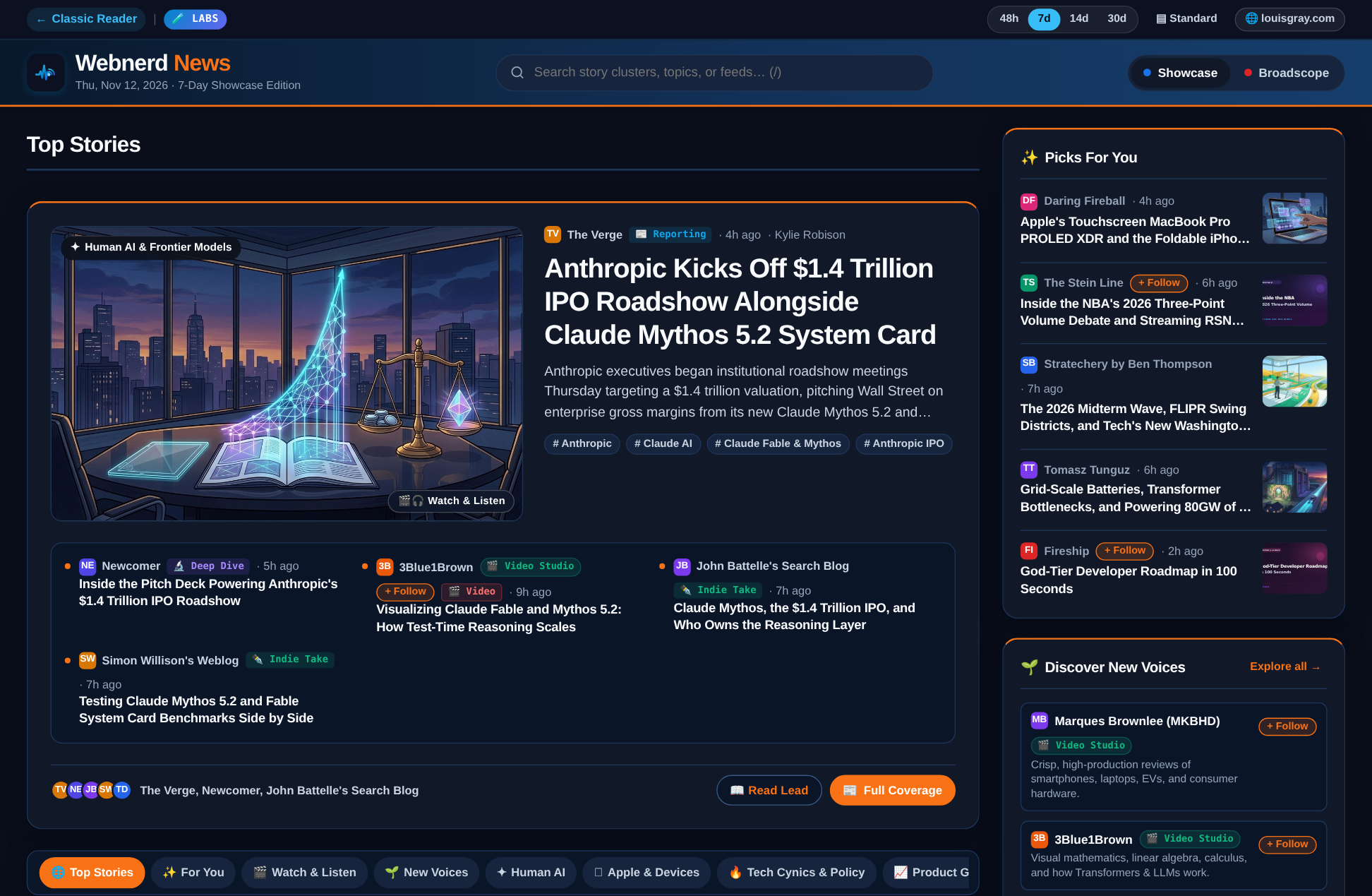
Webnerd News Showcase Edition in the midnight-cobalt and orange louisgray.com theme showing a clustered lead story, perspective badges, Picks For You, and Discover New Voices
Webnerd News (in Labs) brings visual clustering to top stories and streams.

Webnerd News Magazine on Webnerd.ai

An algorithm-free stream of updates, sorted chronologically, ensures you never miss a single post. Bringing that classic RSS reader feeling back, including recommended bundles and sharing, has reinvigorated the discovery loop for me after a dark decade dominated by social feeds fueled by ragebait, attempts at viral videos and headlines that left you questioning what stories were all about. But there's also value from automated or hand-selected curation you see from sites like Techmeme and major news hubs like CNN or Google News.

Typically, these sites are fed by their own first party sources or editor curated content. As a viewer, they may slightly adjust based on their incremental levels of personalization, but for the most part, you get the same view everyone else does -- and your headlines or top stories are the ones they see.

What if you could combine the at a glance view of what's most important, including story clustering when many sources cover the same topic, but built on a foundation of the sources you choose to read? That's the idea with a new view in Webnerd.ai -- a fun experiment that combines the feeds you personally subscribe to, augmented by the starter packs I engineered into the site from the first day, ensuring you always have something to read, and constantly have new sources to discover and subscribe to.

Building on the web platform, and offering a direct connection from the publisher to the reader is an important foundation of what makes RSS special. If everything is a feed, you can point that feed and shape it every which way. We remember this from the 2010 era wave that saw Flipboard unveil its social magazine on the iPad alongside Feedly, Plaxo Pulse, Ninua and many others, even as plenty of pundits rushed to declare classic feed readers dead. I pushed back at the time saying RSS or RIP, the Results Always Trump the Methods, arguing that consumption tools aren't a zero-sum game. Sometimes you want the raw river, item by item. Other times you want an editorial front page that groups the noise into a coherent briefing. After watching filtertainment eviscerate our informed monoculture over the past decade, building both modes on top of open feeds feels overdue.

So let's have fun with it.

Clustering Your Subscriptions With 14 Starter Packs
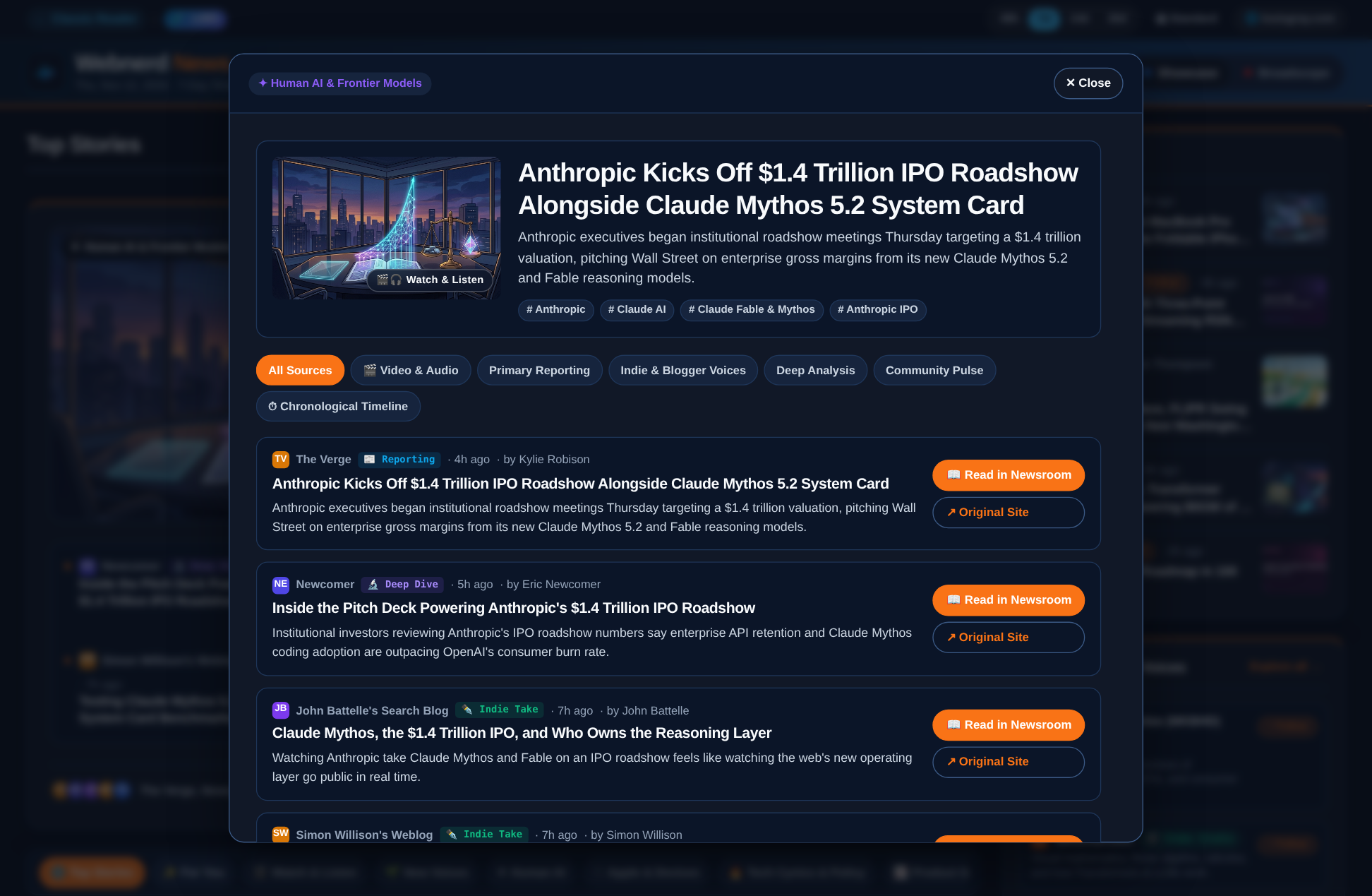
Webnerd News Full Coverage modal grouping Primary Reporting, Deep Analysis, Indie & Blogger Voices, and Video & Audio on a single story
Tapping Full Coverage lines up reporting, deep dives, indie bloggers, video, and podcasts on the same story.

The engine underneath Webnerd News starts with every blog, newsletter, YouTube channel, and podcast you have connected, then blends in active coverage across all 14 Webnerd.ai Starter Packs. Strict source diversity caps keep any single high-volume site from flooding the page, and if you still haven't tried Webnerd.ai yourself, and take a look without logging in, it defaults to an edition generated from my own subscriptions so you can kick the tires right away.

Instead of repeating duplicate headlines, related posts converge into a single story cluster tagged by the role each piece plays, offering:

  • Perspective Tags & Full Coverage: Every item carries a clear badge -- Reporting, Deep Dive, Indie Take, Community Pulse, Video, or Podcast. Hit Full Coverage to compare every angle side by side or step through a chronological timeline of how the story unfolded.
  • Inline Starter Pack Discovery: When a writer from a Starter Pack you don't follow lands inside a story cluster you're reading, or surfaces in the Discover New Voices rail, you see which pack brought them in alongside a one-click + Follow button that subscribes and files them straight into a matching folder.
  • Zero Unread Anxiety: Browsing Webnerd News is strictly read-only against your classic reader queue. Flipping through the magazine never marks articles read behind your back, and stories you already read earlier in the morning still stay on the board for context

This is very much day one of a broader buildout and another fun volley in vibe coding to victory. I plan to keep tuning the clustering weights, tightening how personal folder signals steer the front page, and expanding the Starter Pack catalog beyond tech and media. Take Webnerd News for a spin on your own feeds today and let me know on Bluesky what clicks, or what you'd love to see next.
Disclosures, per always: I work at Google and use Gemini and Antigravity tools a lot. I built Webnerd.ai, its Chrome Extension, and this blog's CMS with Antigravity's help. Nobody at Google reviews my posts, ever. Not even those folks who make the excellent Google News.

November 09, 2026

November 09, 2026 · 4 MIN READ · BY LOUIS GRAY

The Internet Turned Into TV, but Television Has No Blue Links

The Internet Turned Into TV, but Television Has No Blue Links

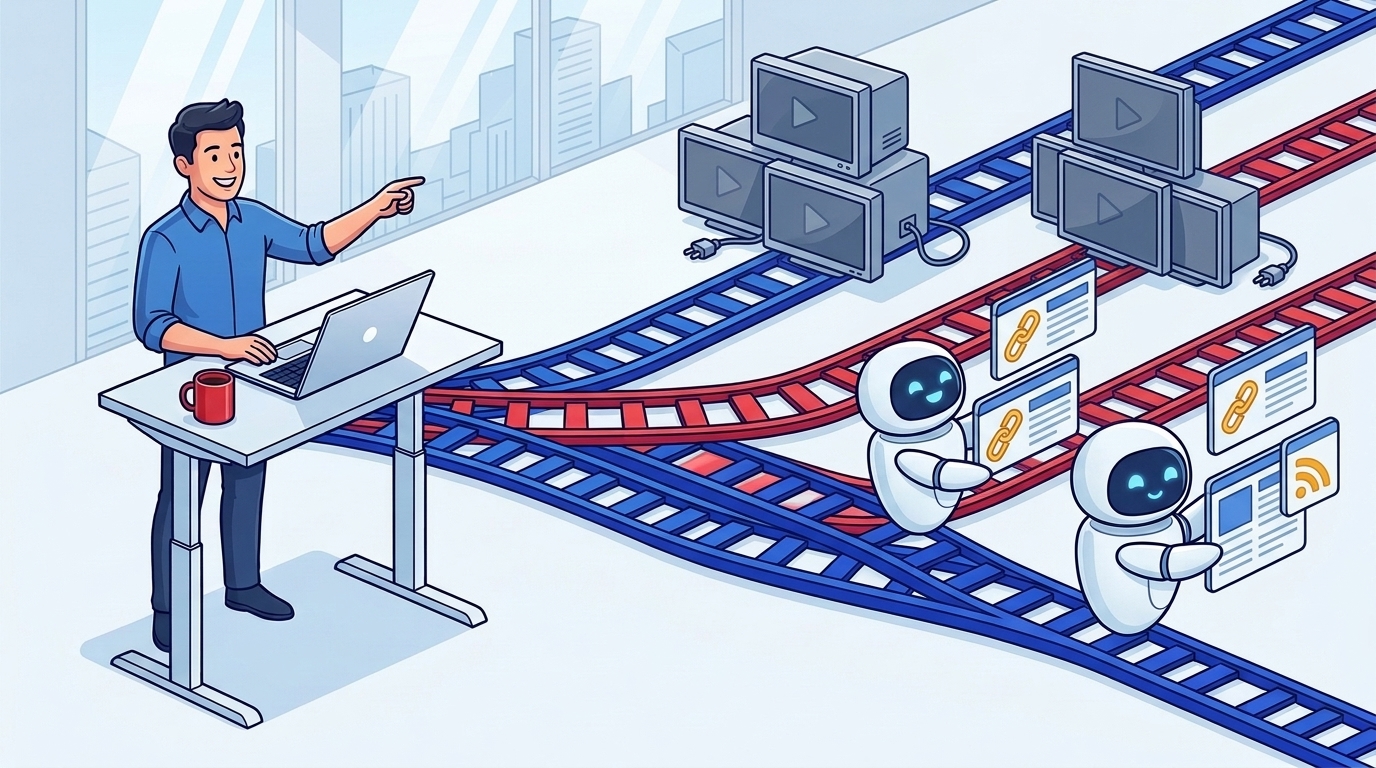
Routing blue links past unplugged TVs [Image via Gemini]

One of my favorite web authors, Ryan Broderick, who I read religiously, dropped another one of his truth bombs today in Garbage Day, decrying the continued decimation of text-based content that once defined the web, only to see it morph into something that is video first, or as he says "officially TV now". As we've observed over the last two-plus decades, Web behavior has rotated from newsgroups and reading full text articles, following links across the web, to short-form video consumption and Netflix-style episodic bingeing, with powerful algorithms suggesting you keep watching -- with sleep as the natural enemy.

Like I've said recently, you can't force old habits on new people who have been raised in a world of infinite bandwidth and infinite choice any more than you can ask kids to turn off the cartoons or put down the YouTube and pick up a newspaper. In today's post, Ryan calls time on the old "internet of libraries, replaced by an "internet of televisions", where, as he puts it, no one is famous, everyone is a celebrity on rented terms, and getting real traction with written words gets harder by the month -- made even more real as the hub and spoke model of RSS readers and centralized discovery lost momentum each year in favor of chasing ephemeral likes and practically non-monetizable "views", whose definition changes regularly to suit the platform.

Just a few weeks ago, I highlighted Garbage Day when saying how filtertainment eviscerated our informed monoculture. Every leap in bandwidth eventually fills the container you give it. We marched from static text sites passed around via links and email, to real-time social streams, to pocket screens pumping high-definition video straight into our earbuds. Not that this really comes as a surprise. In 2010, I warned about accelerating information streams on connected devices with "no off button, ever." When you give a tired population a choice between demanding prose and effortless video dopamine, the couch wins almost every night.

Video winning the mass-market feed isn't a mystery, if that's the market you want.

What breaks the open web for writers is a simpler mechanical truth: television has no blue links. When someone leans back into an algorithmic Reel, a video podcast on YouTube, or a zero-click chatbot answer, there is no natural exit ramp carrying a curious mind three hops deeper to an unfamiliar blog. I traced the roots of this choke point back in 2018, examining how a decade of silos throttled open content distribution and left the web linking less and talking more.

Publishing has always rested on creation, discovery, and distribution. Once Google Reader, FriendFeed, Digg, and Technorati disappeared, dominant platforms stopped acting as filtered pass-throughs. They actively throttled outbound URLs to hoard watch time, training creators to perform natively inside the silo for instant feedback while an essay on your own domain sat waiting for visitors who never arrived.

Waiting around for algorithmic cable boxes to hand text writers organic reach is a losing game. If the giant social apps want to be television, those of us who still think, build, and connect through reading have to wire up our own switchboard again. That conviction is why I built Webnerd.ai, which I introduced last month as a personal project that has no expectations of millions of users, but rejuvenates that feeling of discovery and sharing.

Do your part by cutting out the broadcast middleman: subscribe directly to blogs, personal newsletter inboxes, feeds and publications in folders you control, backed by practical AI summaries and stream audio that save time while still sending clicks straight to the original author.

Even more important is solving the traction gap where open-web discovery always worked best -- from person to person. Algorithms optimize for passive session length, while human readers vouch for voices worth keeping. Curated starter bundles help newcomers find active blogs on day one, while one-click sharing inside the app or right from the browser toolbar with the Webnerd.ai Chrome Extension turns every reader into a distribution node. When I flag a great piece, it lands on my public shared stream, cross-posts to Bluesky, and feeds its own subscribable RSS stream, keeping those blue underlines traveling across the open web.

Broadcast TV never killed books or independent magazines, and Instagram's binge button won't kill sharp writing either. Let the big platforms fight over the living room. The library is still open -- we just have to pass the good reads around ourselves.

Disclosures, per always: I work at Google and use Gemini and Antigravity tools a lot. I built Webnerd.ai, its Chrome Extension, and this blog's CMS with Antigravity's help. Nobody at Google reviews my posts, ever.

November 08, 2026

November 08, 2026 · 2 MIN READ · BY LOUIS GRAY

Human Curation from the Webnerd.ai Stream: v2

Human Curation from the Webnerd.ai Stream: v2

webnerd v2 option2 signal switchyard 1794206654413
My job: Finding the best articles and amplifying them out. [Image via Gemini]

Signal From the Stream: Handcrafted Words in a High-Wattage World

With Webnerd.ai bringing fast paced consumption and sharing back to my daily routine, the muscle of scanning, filtering and amplifying is back. This week is no different.

After a decade's effort in building out siloed social networks that aim to keep their content boxed in, independent blogging has endured and continues to push back. I'd be remiss if I didn't point out Paul Ford's post, The Web Is More Than Enough, where he showcased launching an entire browser-based office suite where all activity lives right in the URL, reminding us that the open web remains the most durable application platform on earth. Over at Techdirt, Mike Masnick called out Reddit bricking up login walls, saying its defensive posture runs against Aaron Swartz's open access roots.

What we all saw this week with the US midterm elections is that closed networks force closed thinking. Republicans learned that X is the echo chamber. It was an inevitable result after Elon's acquisition and government meddling chased away all the left-leaning free thinkers to new places.  As Andy Baio called out, we know closed social feeds confuse algorithmic echo chambers with real-world consensus.

(I told you already that X was toxic, but maybe the right wing has figured this out now too?)

We are all continuing to learn where AI fits in our workflow and how much we invest in it. This is true at the corporate level as well. Tomasz Tunguz ran the math on an 80-gigawatt AI ceiling for 2027, showing how doubling GPU rental rates are pushing inference bills to new heights, while cheap AI intrusion tools are straining security teams at unprecedented levels.

AI is doing incredible things in terms of resetting expectations for employees at all levels. It's reset expectations for middle managers and reset expectations for new hires. At Anthropic, Felix Rieseberg said he has retired traditional coding interviews because hunger beats whiteboard tenure in an agentic world. And John Battelle captured the emotional knot of modern tech workers in Baring It All To Claude, which can mean trusting a model with your life's work, and hoping for the best.

When platforms wall themselves off and algorithms chase outrage, sitting down with an RSS reader and sharing good writing by hand isn't nostalgia. It's how we keep the web human. I'll be doing my part over at Webnerd.ai, and sharing out to RSS or Bluesky or wherever you like. That's what standards are for.

Disclosures per always: I work at Google. No doubt some of the companies mentioned here are partners, competitors or customers. Don't interpret my interest as being filtered with that lens. I built Webnerd.ai (and have no plans to monetize it).

November 02, 2026

November 02, 2026 · 4 MIN READ · BY LOUIS GRAY

Webnerd.ai Chrome Extension Debuts to Subscribe and Share Faster

Webnerd.ai Chrome Extension Debuts to Subscribe and Share Faster

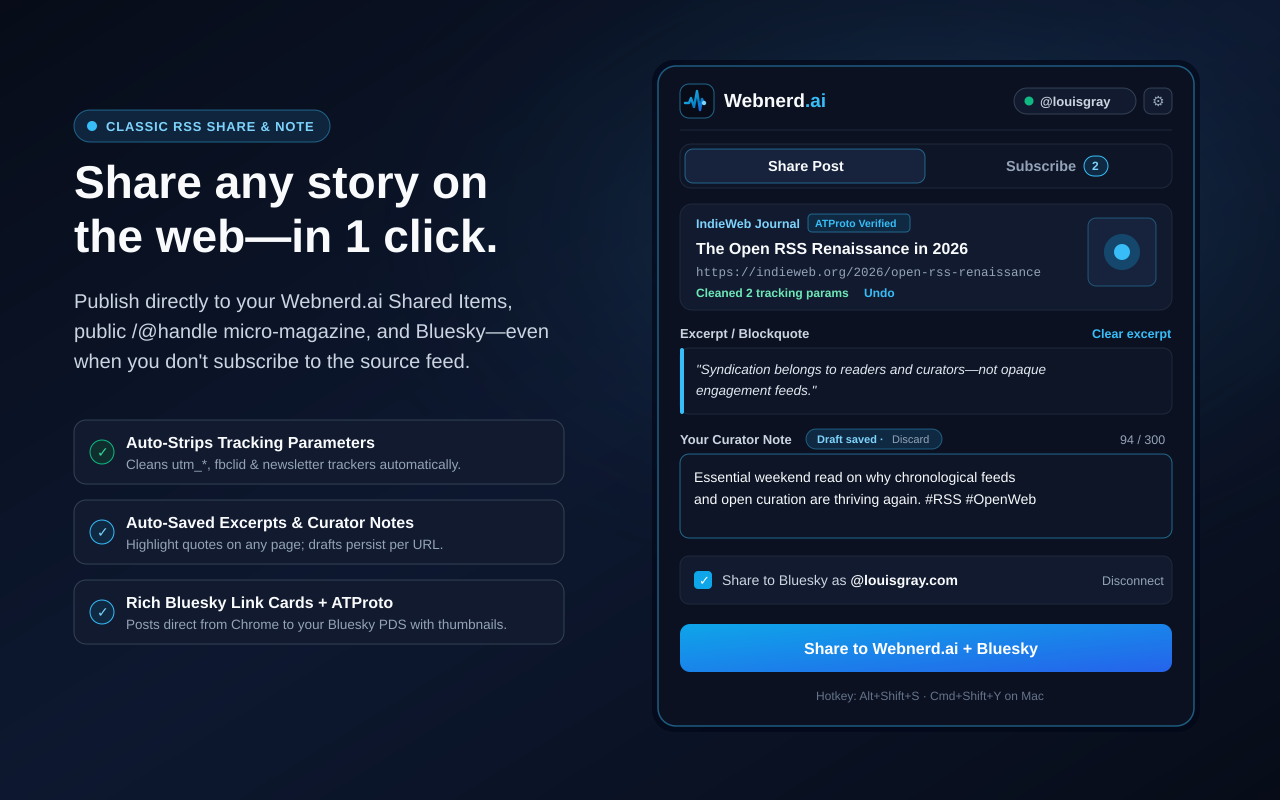
Webnerd.ai Chrome Extension Share Post tab showing cleaned URL parameters, highlighted blockquote excerpt, auto-saved curator note, and Bluesky cross-posting
Webnerd.ai Share & Subscribe -- live now in the Chrome Web Store.

Webnerd.ai Chrome Extension

The Web content model consists of three major parts: creation, discovery and distribution. The last decade-plus has seen tremendous turbulence as one-time hubs came and went, and content creators lost a grip on how their content could be consumed and shared easily from both dedicated fans and casual visitors. Couple that with shorter attention spans and all matter of marketing hacks that have distracted core audiences, and it's a tough slog out there for journalists and bloggers.

One of the motions I've missed in our consumption and flow has been the fast option to share and subscribe as I encounter the best content on the web. So I've built a Chrome extension for Webnerd.ai that has three major functions:

1. Subscribe to new sources and add them to your folders as you browse.
2. Add individual items to your shares in Webnerd.ai, even without subscribing.
3. Share directly to Bluesky, with optional caption.

Starting today, Webnerd.ai Share & Subscribe is officially public on the Chrome Web Store, working across Chrome and other modern browsers, such as Brave, Arc, Vivaldi, and Edge.

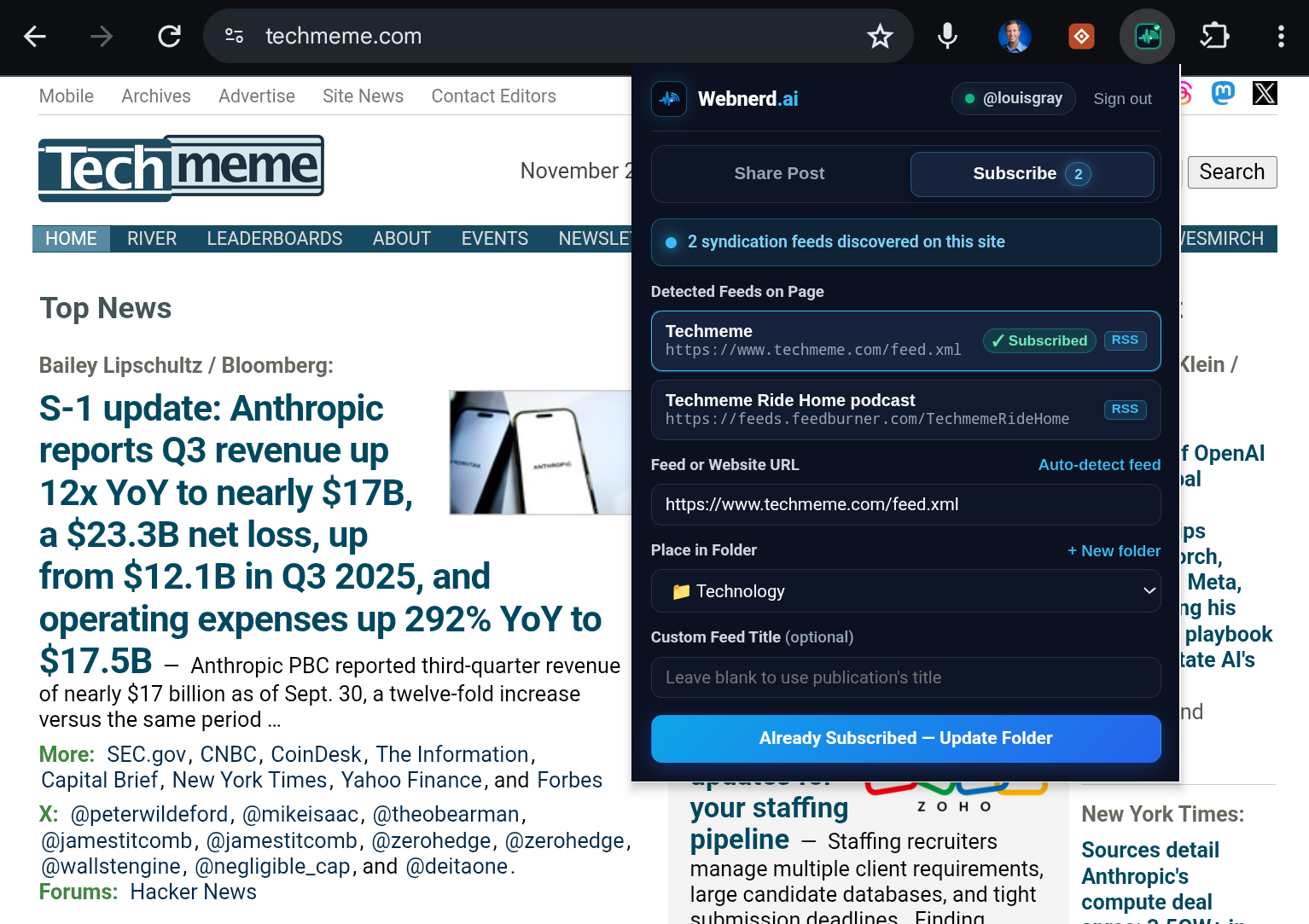
Screenshot 20261102 075333
With the Webnerd.ai Extension, discover available feeds and add them.

Back in our Web 2.0 peak, I had bookmarklets for Google Reader and FriendFeed as mainstays in my browser and I could see top stories spread from person to person. The act of sharing content helps expose great new sources to my network, and in turn, I learn from them.

Here are some benefits of the Webnerd.ai extension:

One click publishes the story directly to your Webnerd.ai Shared Items, your personal curated stream (like mine at @louis-gray), and its accompanying RSS feed.

The extension is tuned for fast link-blogging while you read, including:

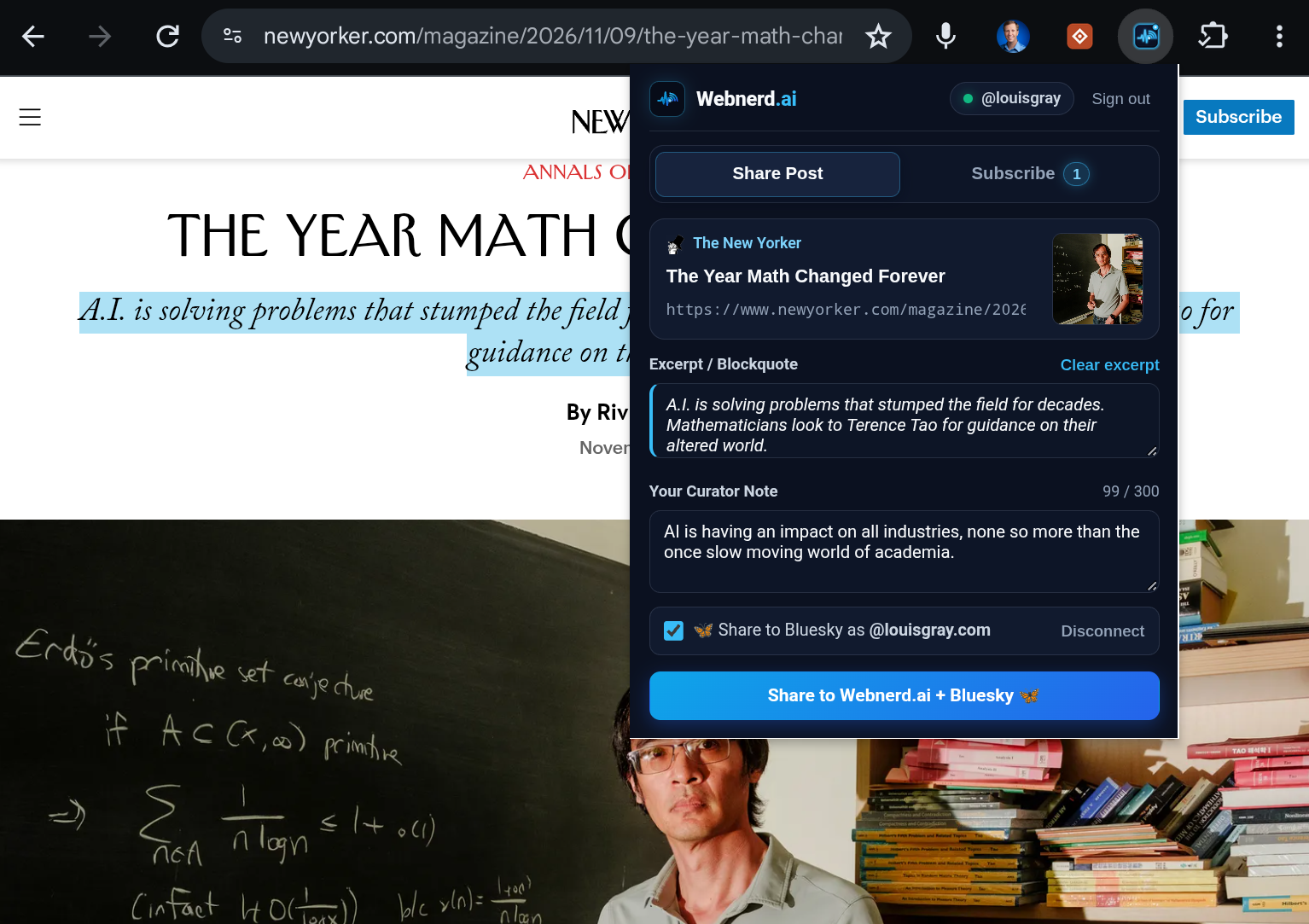
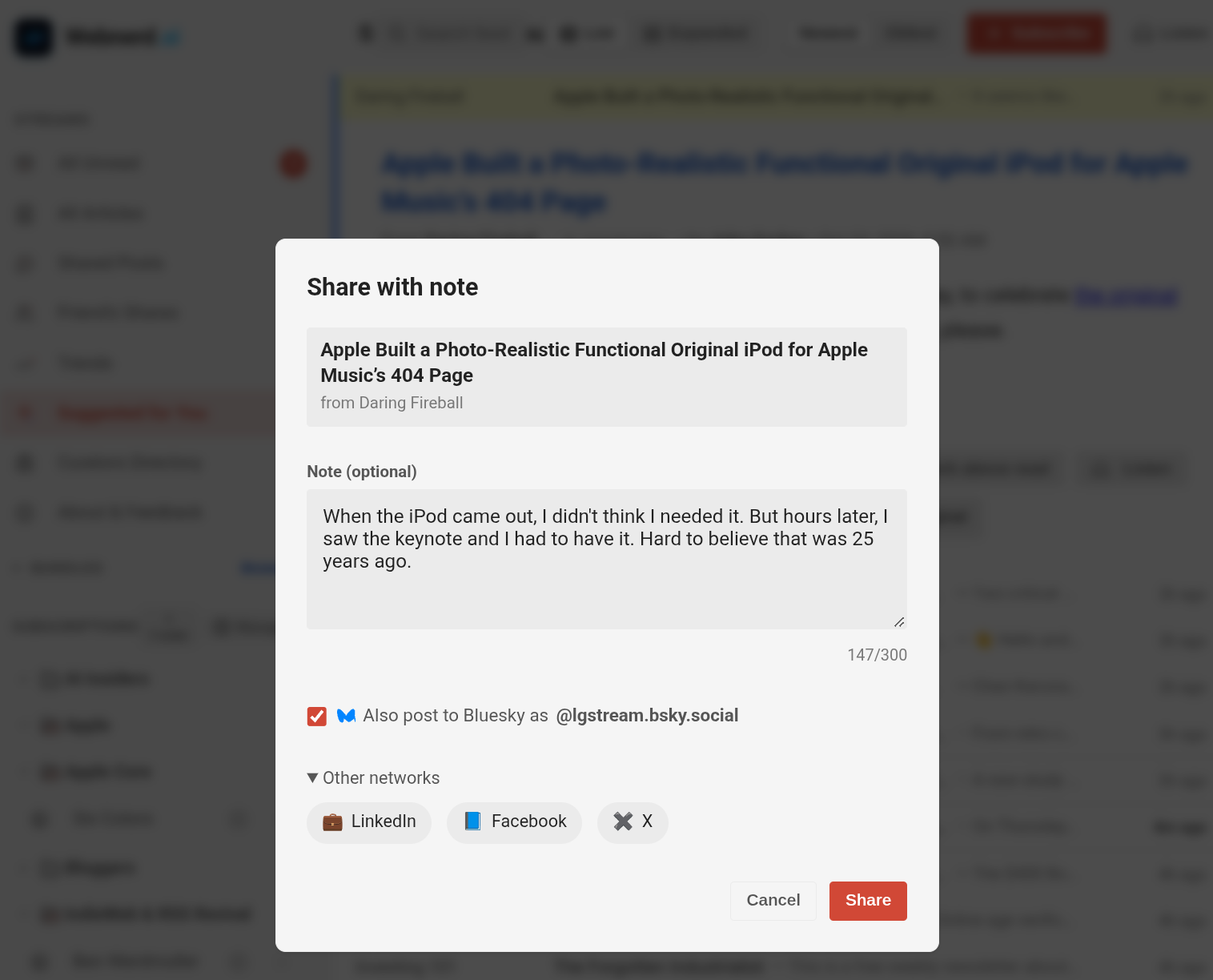
  • Auto-Saved Quotes & Notes: Highlight any passage on the page before opening the extension and it drops right in as a clean blockquote.
  • Automatic Tracker Stripping: Marketing parameters like utm_*, fbclid, gclid, and newsletter tracking tokens get scrubbed automatically before you share.
  • Simultaneous Bluesky Cards & Standard.site Endorsements: Keep the Bluesky box checked to cross-post straight to your feed (such as my LG Stream) with rich OpenGraph link cards, compressed thumbnails, clickable hashtag facets, and cryptographic site.standard.graph.recommend endorsements via AT Protocol OAuth 2.1.
Screenshot 20261102 075508
You can share articles to Webnerd.ai or downstream, with comment.

Live Feed Radar, Cadence Previews, and One-Click Folders

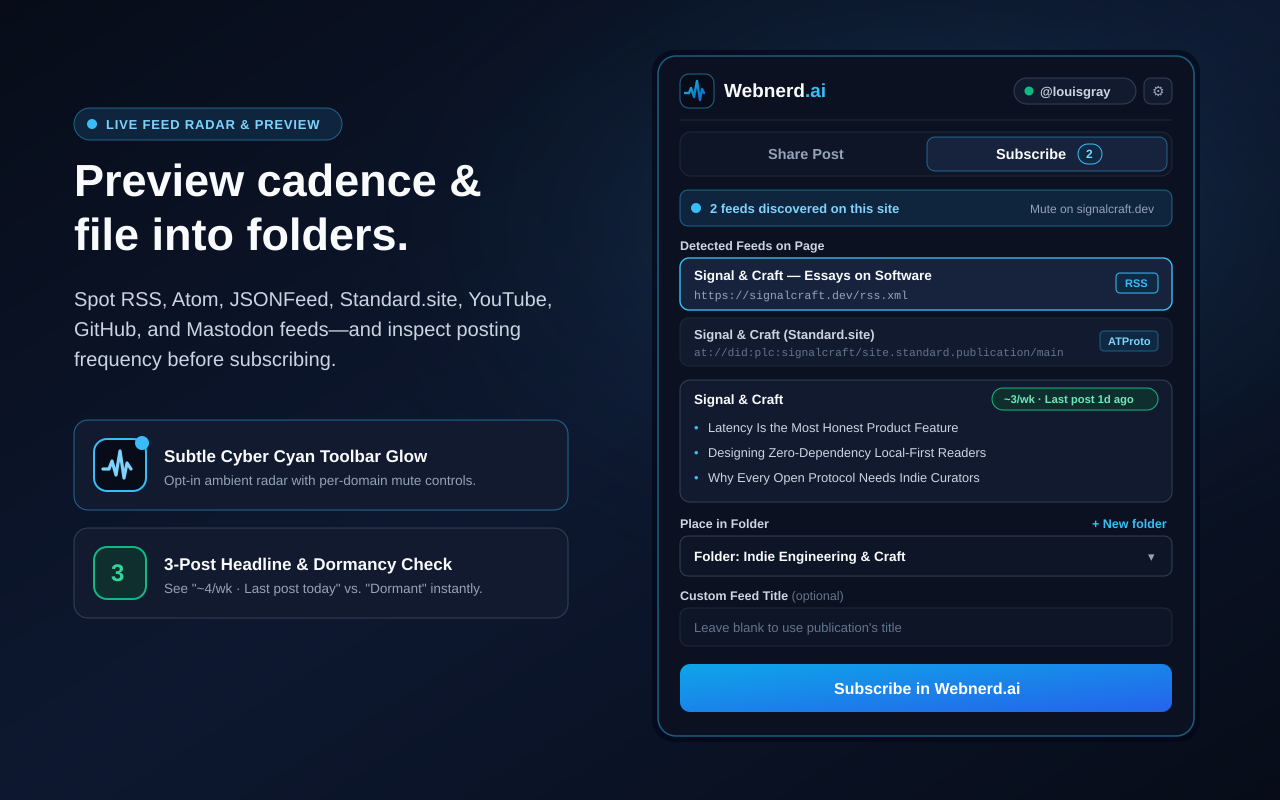
Webnerd.ai Chrome Extension Subscribe tab showing detected RSS and ATProto Standard.site feeds, a 3-post cadence preview, and folder selection
Spot hidden feeds with an optional glow, check the posting cadence, and add as you go.

Modern browsers stripped the orange RSS icon out of the address bar years ago, indicating millions of readers that feeds died when they were actually hiding in plain sight. Turn on the extension's opt-in Toolbar Glow  and the toolbar icon gently illuminates whenever a page publishes RSS, Atom, JSONFeed, or AT Protocol Standard.site publications -- including subscribable channels and profiles across Substack, Medium, YouTube, GitHub, Mastodon, Bluesky, and Reddit.

And if you are worried you're going to subscribe to a site that posts way too often, you can previews a feed's latest three headlines alongside an instant cadence check, so you know right away if a blog is active. From there, file the writer directly into any of your existing Webnerd.ai folders or spin up a new folder inline.

Right-Click Quick Share and Privacy-First Permissions

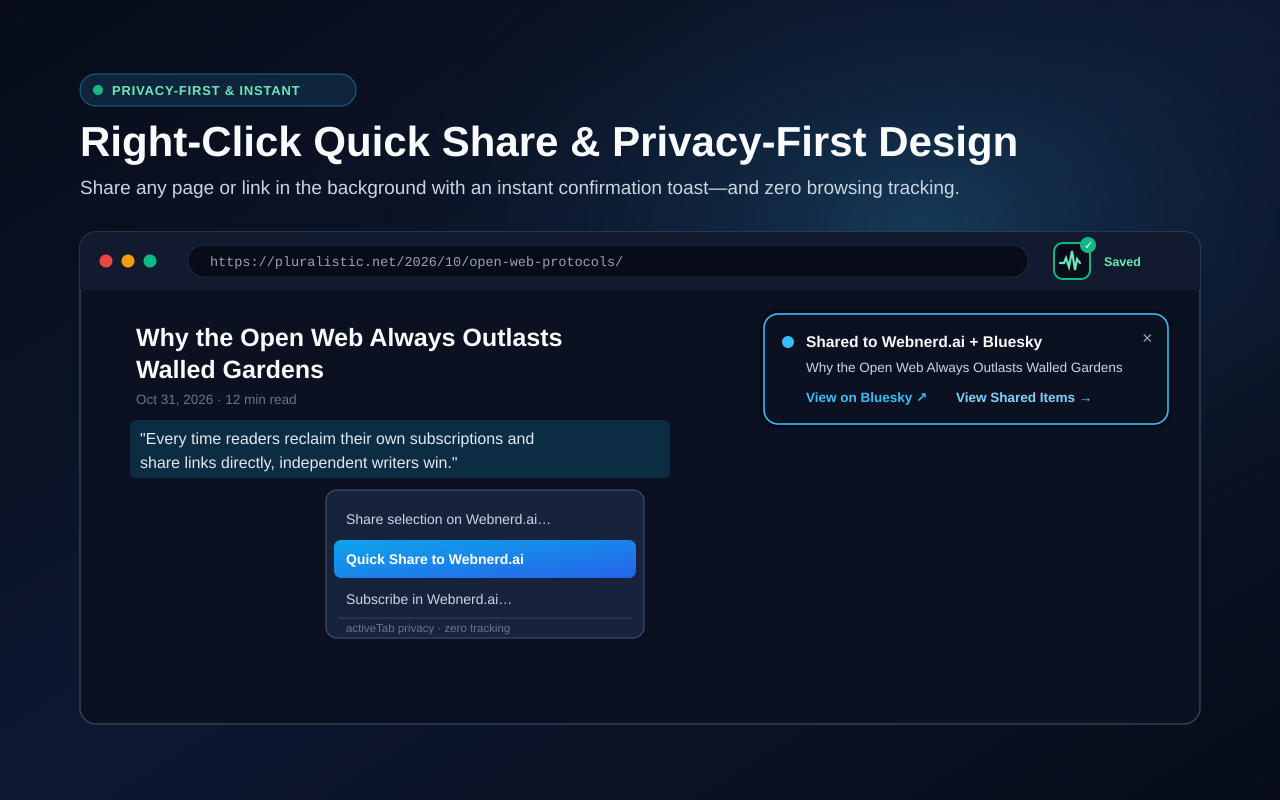
Browser view showing right-click Quick Share to Webnerd.ai context menu, activeTab zero-tracking notice, and on-page Shared to Webnerd.ai + Bluesky toast
Right-click any page, quote, or link to Quick Share in the background with zero browsing tracking.

When you're moving fast, right-click any page, highlighted quote, or outbound link and hit Quick Share to Webnerd.ai. It publishes in the background and pops a clean confirmation toast in the corner of the page with direct links to view your post on Bluesky or in Shared Items.

Just as important is what the extension refuses to do. Too many browser add-ons demand blanket access to read every page you visit around the clock. I couldn't care less about your browsing history. Out of the box, Webnerd.ai runs on minimal activeTab permissions -- zero background tracking of your browsing activity -- only inspecting the current tab when you click the icon, tap the hotkey, or trigger the context menu (unless you explicitly opt into the ambient Feed Radar glow).

install Webnerd.ai Share & Subscribe from the Chrome Web Store, pin the pulse icon to your toolbar, and tap 1-Click Pair over at webnerd.ai/extension to connect your existing Webnerd.ai session. Give it a spin on your open tabs today and ping me on Bluesky with what you want to see next -- the native Android app is up next.

Disclosures, per always: I work at Google and use Gemini and Antigravity tools a lot. I built Webnerd.ai, its Chrome Extension, and this blog's CMS with Antigravity's help. Nobody at Google reviews my posts, ever.

November 01, 2026

November 01, 2026 · 3 MIN READ · BY LOUIS GRAY

Human Curation from the Webnerd.ai Stream: v1

Human Curation from the Webnerd.ai Stream: v1

Curating and sharing the week's sharpest open-web stories on Webnerd.ai [Image via Gemini]
Even in an AI world, the human filter provides value. [Image via Gemini]

Signal From the Stream: Looking Back at My Week on Webnerd.ai

The web has always been about discovery and sharing. Whether it was from blogrolls or a bullet list item of links on our blogs, we have acted as curators, showing our audiences what we found valuable, and inherently filtering out the noise. In the peak of Web 2.0 experimentation with classic RSS, I could add an item to Delicious and it would flow through Friendfeed to Twitter, or I could share an item I found in Google Reader and have it show up downstream in Buzz. What a time.

Building one-click sharing directly into Webnerd.ai brought that muscle memory back. Every story I flag lands on my public shared page, syndicates to LG Stream on Bluesky, and publishes its own dedicated RSS feed anyone can subscribe to in their reader of choice. In the meantime, old school bloggers like Dave Winer have continuously posted links to share the best of the web on their domain. I respect it. I used to do a better job of highlighting individual blogs, so let's bring that muscle memory back too.

It seems wacky to think Anthropic's IPO filing was just this week. CNBC (via Techmeme) highlighted the company's more than $131 billion in cash and short-term investments, while Timothy B. Lee said its business was surprisingly strong. Latent Space highlighted how Anthropic uses Claude itself, and The Verge focused on how Anthropic can keep Wall Street pressure at bay.

But the week wasn't by any means totally bullish. Like many other companies, Microsoft is continuing to optimize spending by reducing headcount, offering voluntary buyouts to 60,000 employees. Tom Warren and Azeem Azhar at Exponential View connected the dots plainly: when capital spending continues to accelerate, payroll cuts make room for machines. Meanwhile, long time Google watcher John Battelle put a rattled Friday market selloff in long-term Silicon Valley perspective.

Beyond the money line, Sean Goedecke published a pair of excellent posts, arguing that getting good at AI takes deliberate practice, and reminding developers that you can just ask AI to do things when agency becomes your bottleneck. Go subscribe to Sean right now.

That builder energy showed up across the product beat too, from Simon Willison testing webframe as a headless browser sandbox, to Google shipping Gemini 4 Carbon and Genie 4, pricing the Google Xreal Aura glasses at $1,099, and Waymo tapping Toyota's bZ4X for Tokyo robotaxis. Yes, I work at Google, but we're a big enough company that sometimes seeing this news is like being happy for your cousins. Go team and such.

Like I said last night, AI is impacting just about everything, and humans need to adjust. Alex Kantrowitz at Big Technology captured burned-out security teams enduring "Black October" as AI uncovers software flaws faster than defenders can patch, and Molly White traced why a $6.4 billion Binance heist pointed straight back to North Korea. Add Reddit forcing everyone to log in just to read human answers, and the open web lost another front porch. Algorithms optimize for lock-in, not discovery. Curating links by hand, and tapping share in Webnerd.ai so good writing travels further, is a great way for us to help discovery continue.

Disclosures per always: I work at Google. No doubt some of the companies mentioned here are partners, competitors or customers. Don't interpret my interest as being filtered with that lens. I built Webnerd.ai (and have no plans to monetize it).

October 29, 2026

October 29, 2026 · 7 MIN READ · BY LOUIS GRAY

Webnerd.ai Levels Up with AT Protocol, Newsletters, Audio and more

Webnerd.ai Levels Up with AT Protocol, Newsletters, Audio and more

Webnerd.ai

When I debuted Webnerd.ai last weekend, the goal was pretty straightforward: bring back the fast, high-signal, human-curated morning reading ritual I loved in the heyday of classic RSS, updated for how the open web actually works in 2026. But just as much as I've enjoyed returning to that routine,  I've appreciated steering the roadmap with Antigravity. A decade plus ago, I'd point to companies that blogged weekly with their updates and bug fixes as leaders in their space, communicating to readers what was new. Now, I can make multiple updates daily, or make fixes in minutes myself -- and have even debuted a release notes section you can subscribe to from right within the app. It's an RSS inception, basically.

Over the last few weeks of living inside Webnerd.ai whenever possible, curating my shared stream and pushing links out to LG Stream on Bluesky, every "I wish it did this" or "I wonder if it could..." moment has turned into working code rapidly. Sean Goedecke, whose blog has rapidly become one of my favorites of 2026, published a piece today titled "You can just ask AI to do things", and honestly, there is no better summary of the world we live in now. If you can think it, you can build it.

Because things have moved fast since the weekend, here is a quick highlight reel of new features in Webnerd.ai right now.

First-Class Open Identity: AT Protocol OAuth, PDS Sync, and Standard.site

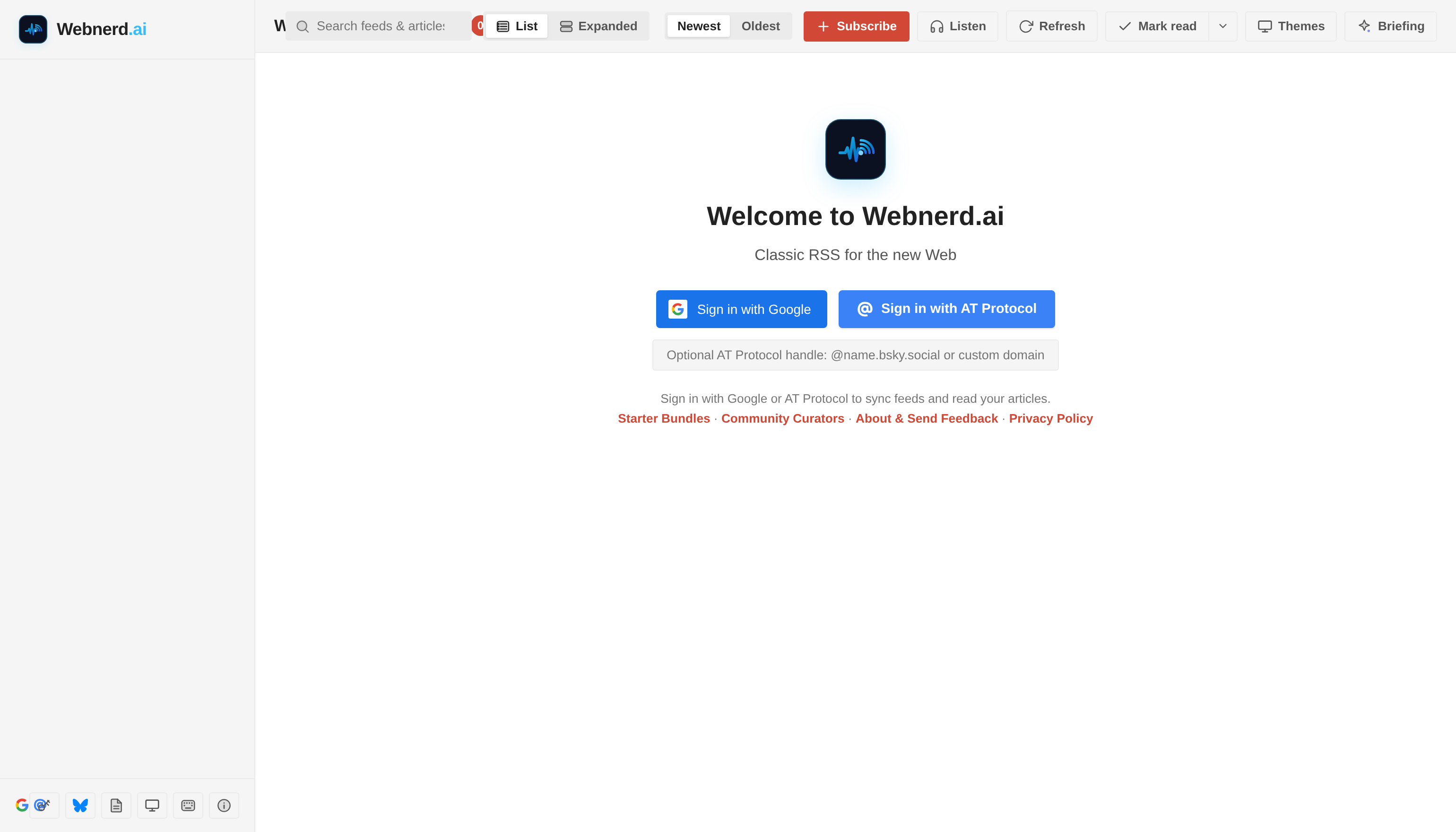
If you're going to build a home for the open web, you shouldn't lock people's reading identity behind a single provider. Current employer aside, I started with Google sign-in because that's what I knew. But in fast response to public request,  Sign in with Google now sits side-by-side with native Sign in with AT Protocol. Whether you use a bsky.social address or verify with your own domain like louisgray.com, you can jump straight in without extra modals or app-password gymnastics.

Refreshed Webnerd.ai welcome screen with 1-click Google Sign-In alongside native AT Protocol login
One click with Google, or bring your decentralized AT Protocol ID.

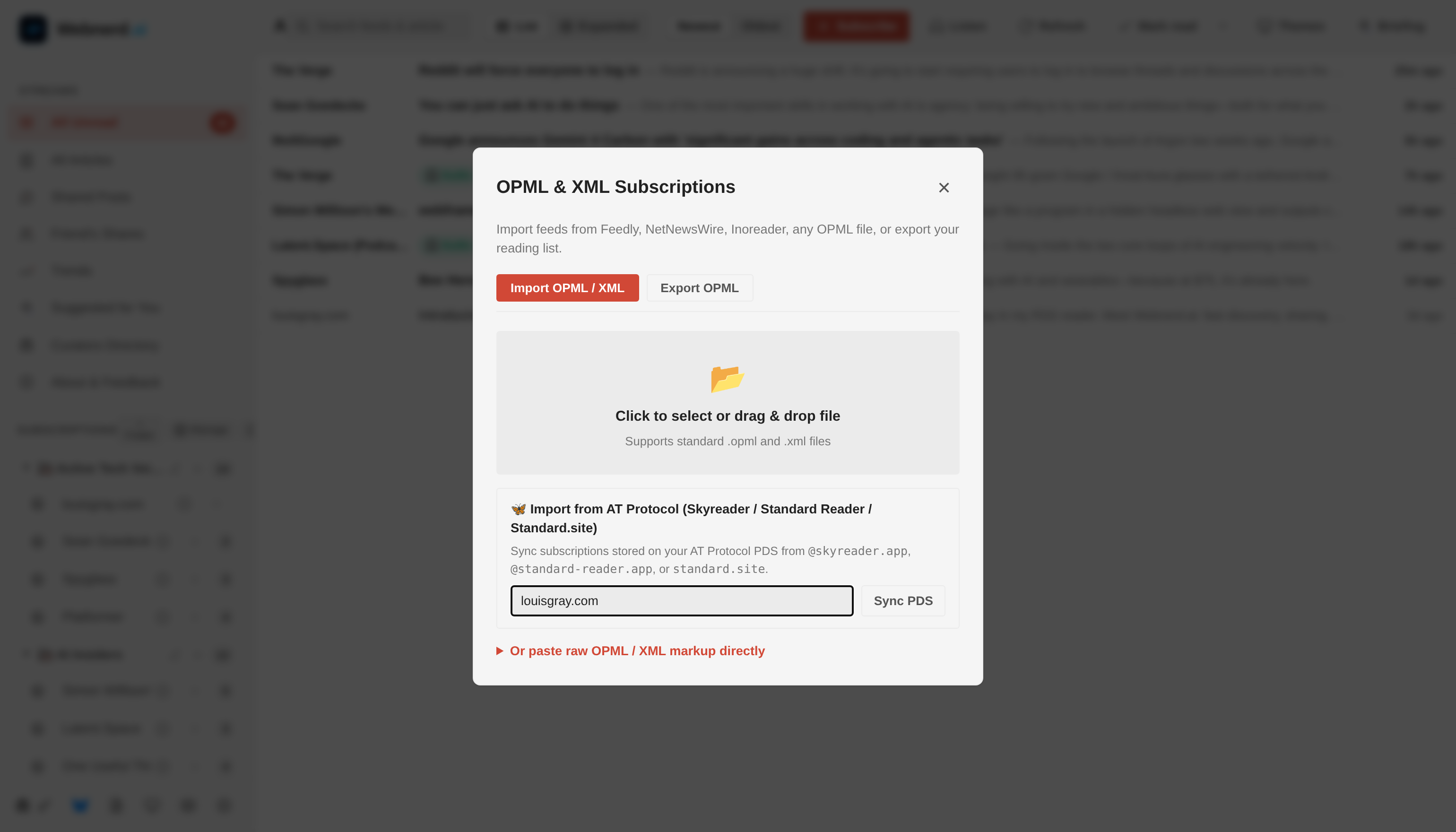
Even better, your decentralized identity isn't just a login badge, it carries your reading graph. Inside the OPML & Subscriptions hub, you can still drag and drop a classic XML file, or you can hit Sync PDS to pull decentralized subscription lists straight from your Personal Data Server across tools like Skyreader, Standard Reader, and Standard.site. Think about that for a second. Am I an expert on those? No. Could I work with Antigravity to build support here? Yes. So I did.

OPML & XML Subscriptions modal showing traditional OPML import/export alongside 1-click AT Protocol PDS sync
Classic OPML portability meets one-click AT Protocol PDS subscription sync.

Webnerd.ai also now speaks native at:// and standard:domain publications directly in the Subscribe dialog, and when you share a story from a Standard.site publication, Webnerd automatically writes a cryptographic site.standard.graph.recommend endorsement record to your PDS (and cleans it up if you unshare). Open standards work best when apps actually interoperate instead of just talking about it or seeing an acronymn as a checkbox.

Rescuing Newsletters from Inbox Purgatory

As much as I appreciate newsletter platforms like Substack and Beehiiv quietly keeping RSS alive under the hood, plenty of great writers still send email-only newsletters, and in my view, an email inbox sandwiched between flight confirmations, calendar invites, and shipping receipts is not the best place to read long-form writing.

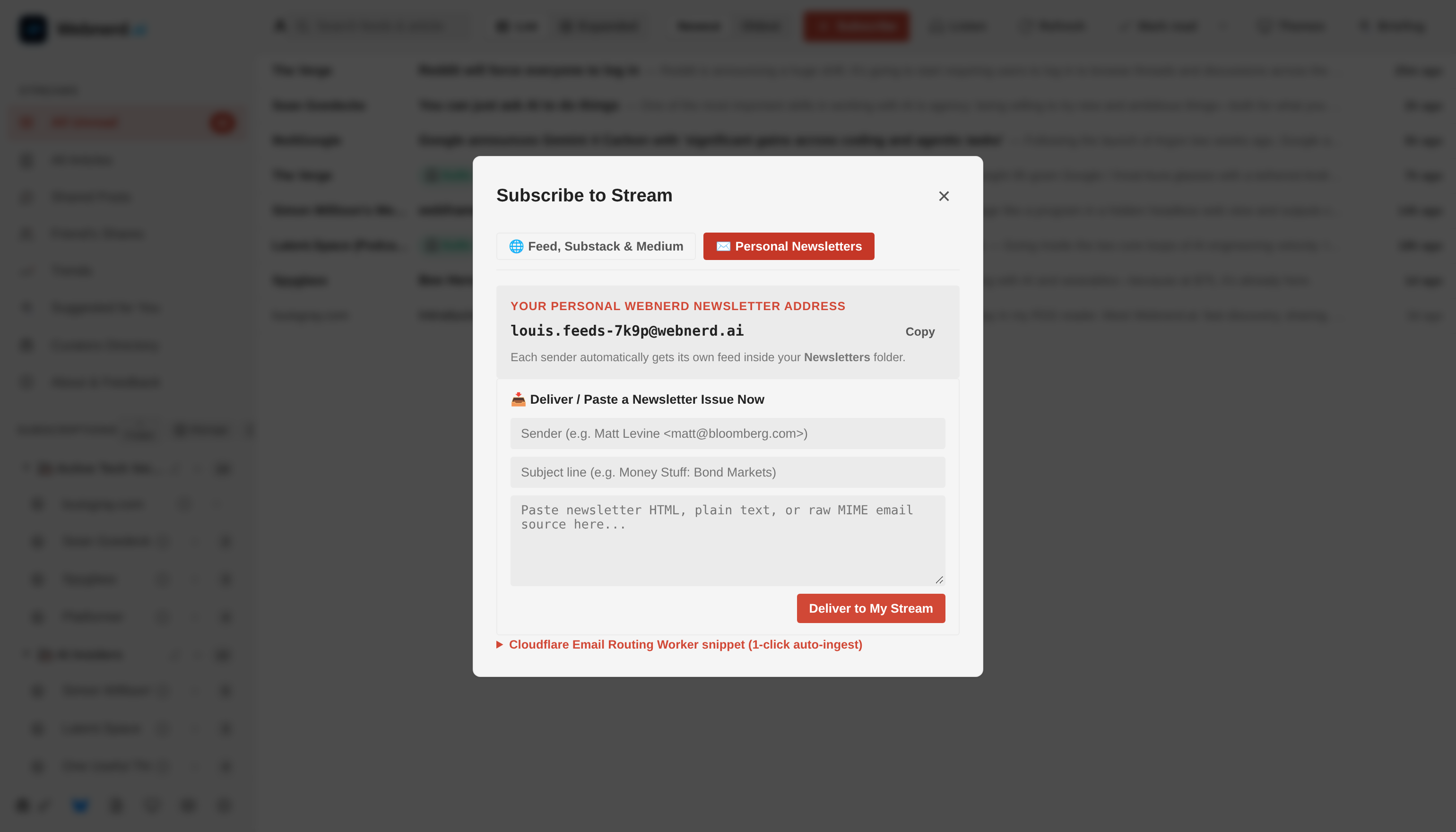
Subscribe to Stream modal open on the Personal Newsletters tab showing a dedicated @webnerd.ai inbox address
Every account now gets a personal @webnerd.ai newsletter address that turns email dispatches into clean RSS feeds.

You can now open + Subscribe and switch to the new Personal Newsletters tab, and you'll find your own dedicated @webnerd.ai address. Use it when signing up for newsletters (or forward existing ones via Gmail filters or the included one-click Cloudflare Email Routing snippet), and Webnerd automatically spins up a separate, clean feed for each sender inside your Newsletters folder. Newsletters belong alongside the rest of your reading, not competing with work email.

Listening to Your Stream & Real Power-Reader Triage

Sometimes even my eyes need a break from screens, or I want to catch up on my feeds while walking the dog. Hitting the new Listen button in the top bar (or on any individual post) launches a docked audio player right at the bottom of your stream.

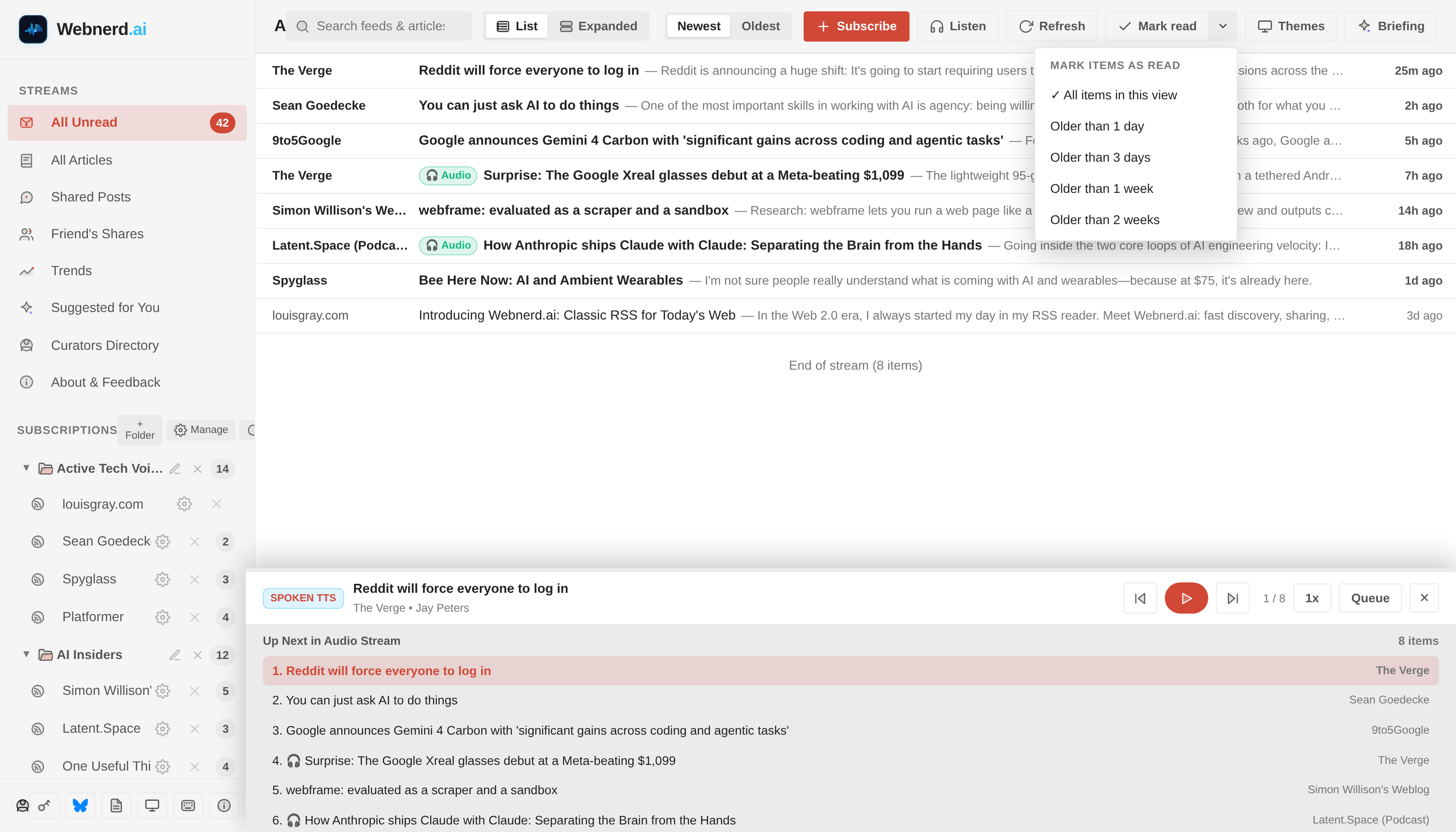
Signed-in Webnerd.ai power-reader view showing the top toolbar, granular Mark-as-Read menu, and docked Audio/TTS Stream Player
Listening through my morning feeds with the docked Audio & Spoken TTS queue.

If a feed item includes a native podcast or audio enclosure (flagged with an Audio badge), Webnerd plays the original audio directly; if it's a written post, it seamlessly reads the article aloud via a spoken Text-to-Speech queue with 1x to 2x playback speeds, an Up Next drawer, and automatic mark-as-read as each story finishes.

And because anyone subscribing to 100+ feeds may eventually face inbox-style bankruptcy, I've gone deep on power-reader ergonomics:

  • Granular Mark-as-Read: A new split dropdown lets you clear items Older than 1 day, 3 days, 1 week, or 2 weeks, or Mark above as read as you scroll — so you can declare peace on Tuesday's news while keeping this morning's stories untouched.
  • Folder & Subscription Management: You can now add, rename, drag-and-drop, delete, and merge folders inline or from a dedicated Manage Subscriptions view, toggle Newest / Oldest sort order, and pull Full Text readability views on stub feeds that only publish a sentence or two in XML.
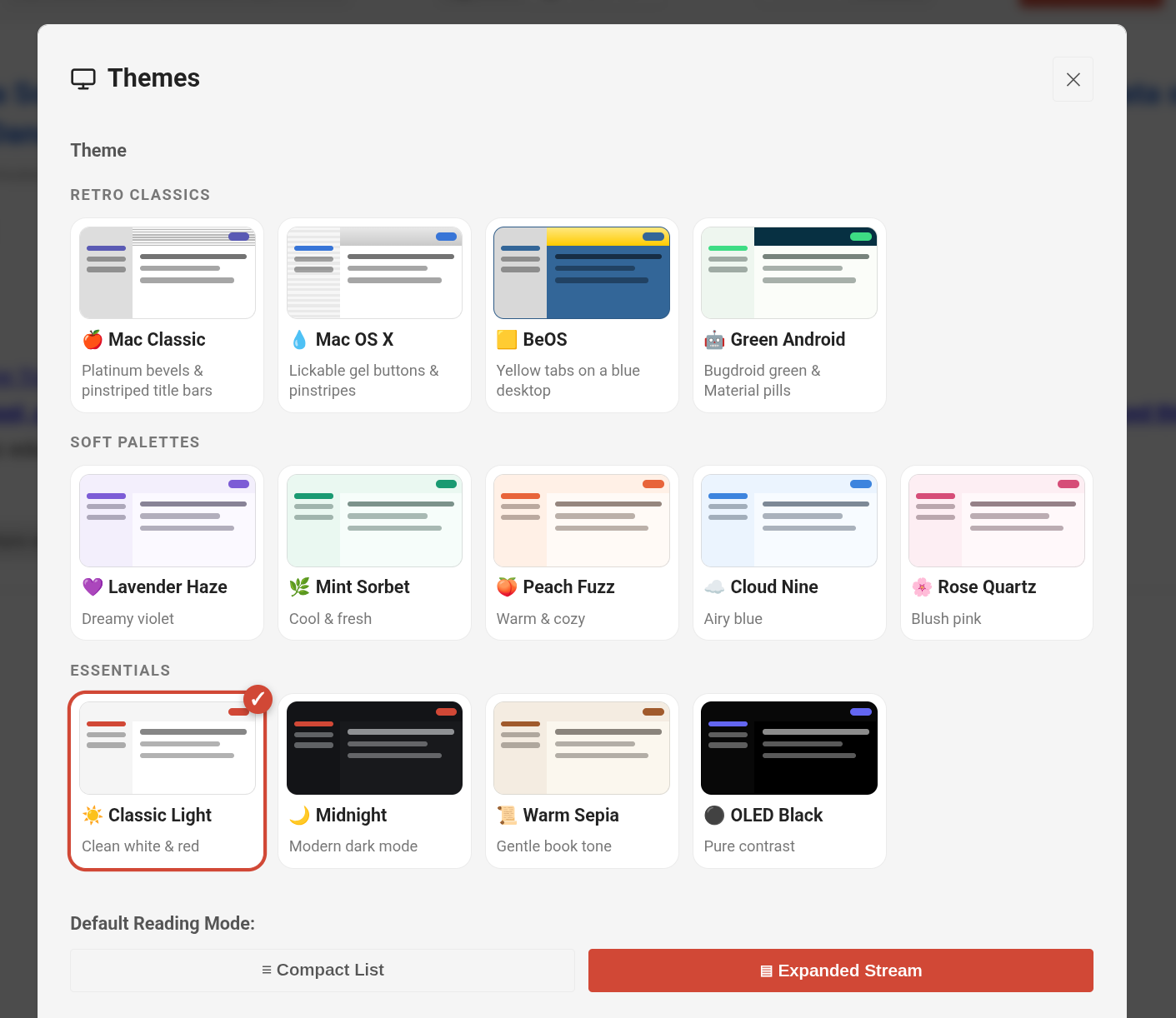
  • More Classic Themes: Alongside Cloud Nine, Warm Sepia, and OLED Black, desktop nostalgia nerds can also switch into Mac Classic, Mac OS X Aqua, BeOS, and Green Android.

AI on Your Terms — Never Between You and Your Feeds

I wrote earlier this month about how filtertainment eviscerated our informed monoculture. The whole point of an RSS reader is that you choose the sources, and nobody hides a post  because an algorithm decided outrage would keep you scrolling longer.

Where AI does shine in a reader is synthesis on demand — when you explicitly ask for it.

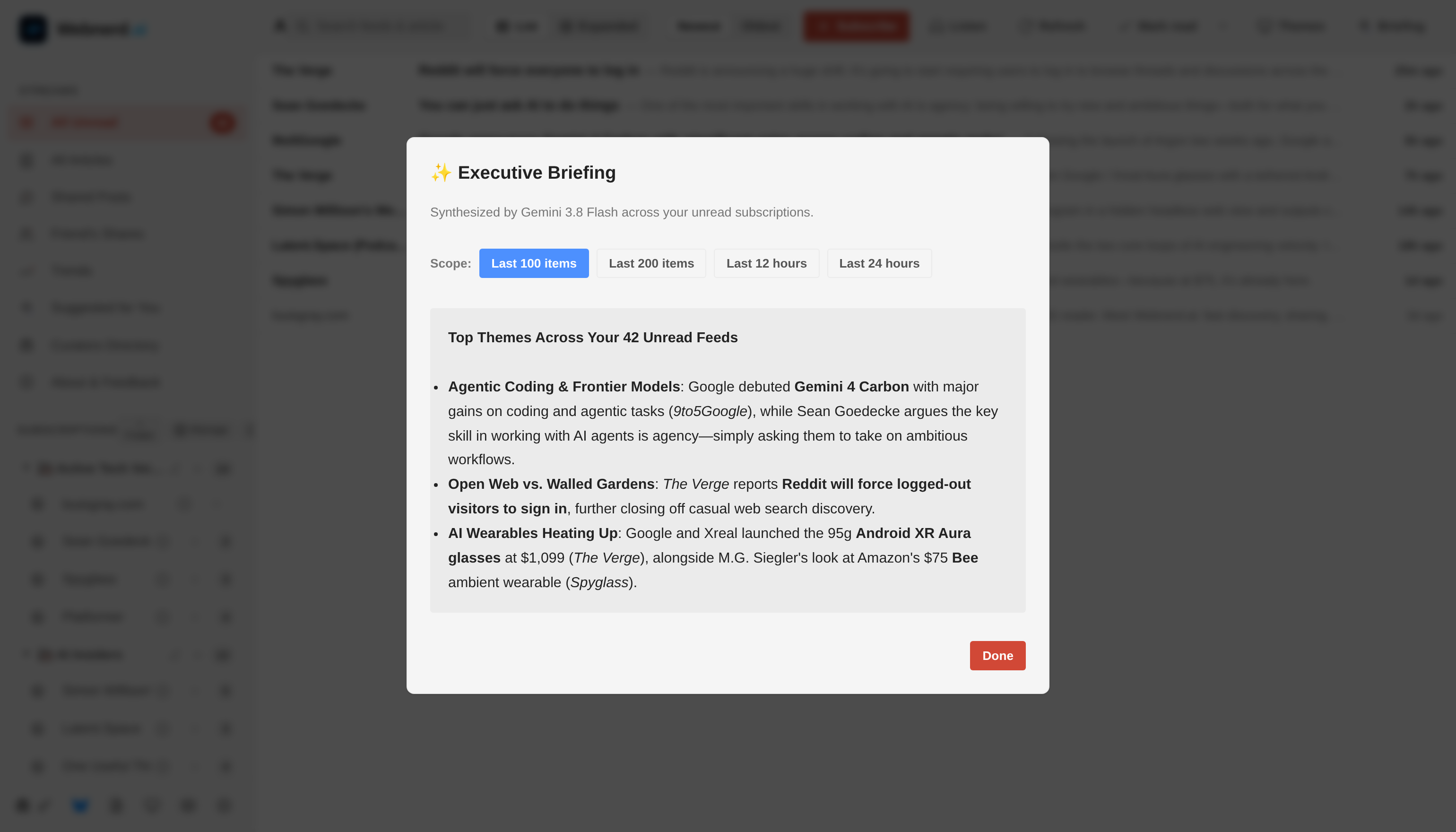
Executive Briefing modal synthesized by Gemini 3.8 Flash across unread feeds
Optional Executive Briefings synthesize what happened across your feeds.

Tap Briefing in the toolbar (or hit B on your keyboard) and Gemini 3.8 Flash synthesizes an executive summary across your unread stream — scoped to your Last 100 items, Last 200 items, Last 12 hours, or Last 24 hours — clustering breaking storylines and citing the exact outlets in your subscriptions. Every expanded card also has an optional one-tap TL;DR button when a 4,000-word essay drops five minutes before your next meeting. AI acts as your research assistant, never your gatekeeper.

Mobile Overhaul, Instant Startup, and Eating Our Own RSS Dogfood

Under the hood, Webnerd.ai now boots through a single-round-trip bootstrap endpoint paired with a local snapshot cache for sub-16ms first-frame paint — so opening the tab feels instantaneous even on spotty mobile Wi-Fi.

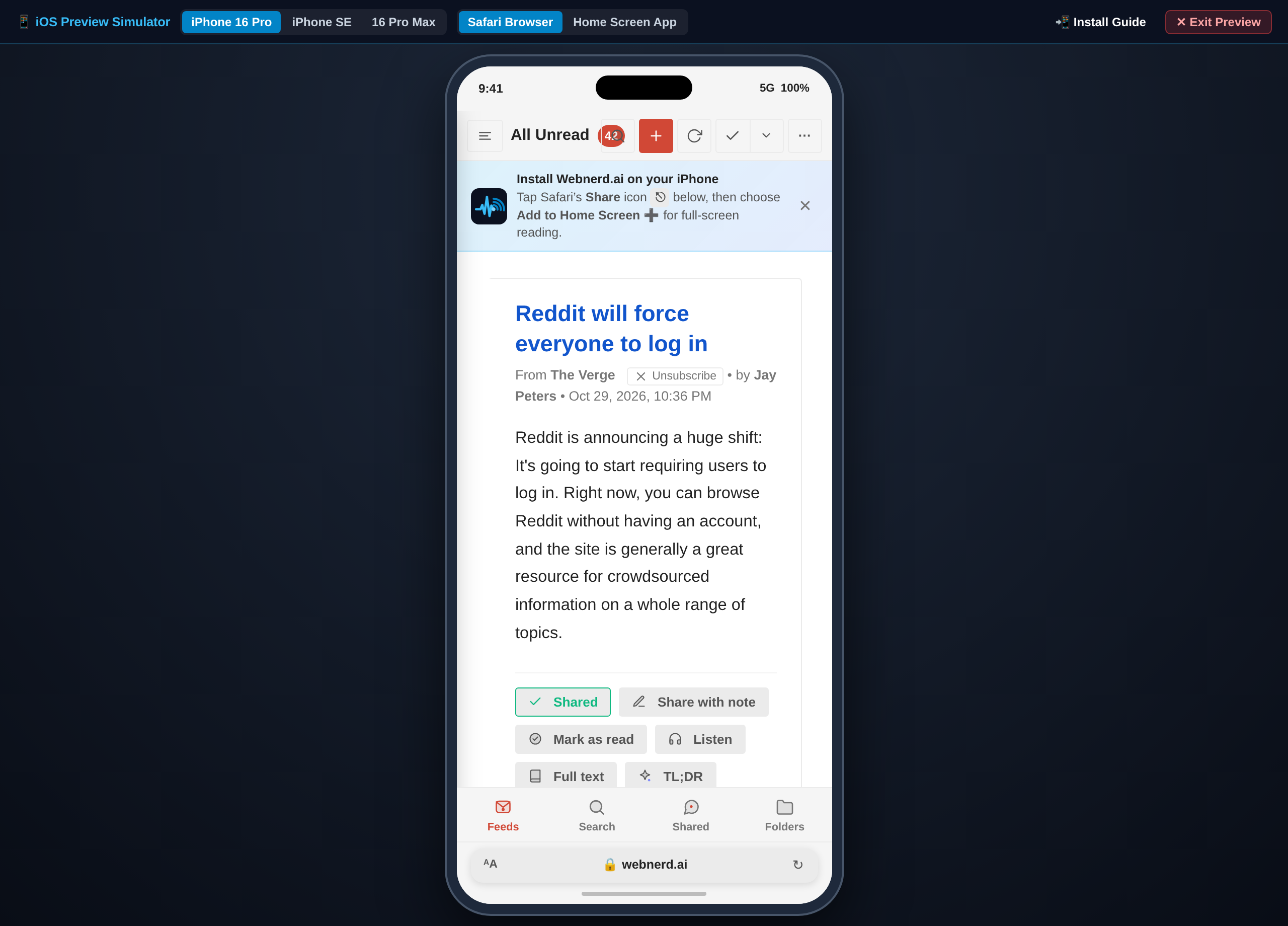
On phones, we replaced cramped desktop menus with a thumb-friendly 4-tab mobile layout (Feeds, Search, Shared, and Folders), edge-swipe gestures, and a guided Add to Home Screen full-screen web app setup on iOS while I continue working on a native Android companion app - coming soon.

Mobile Webnerd.ai iPhone view showing the Add to Home Screen prompt, expanded card actions, and 4-tab bottom navigation
The redesigned four-tab mobile experience and full-screen iPhone web app.

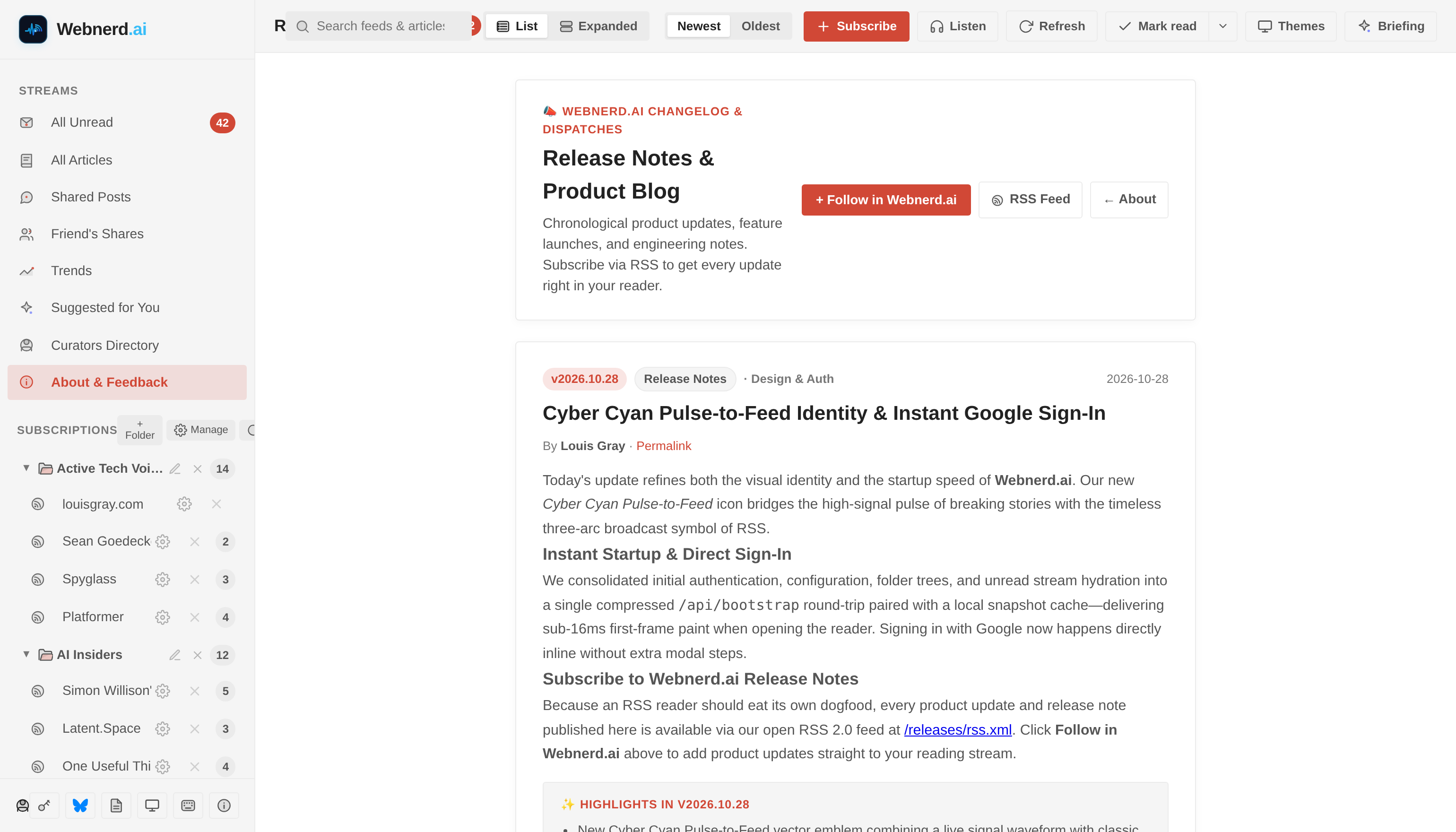
Finally, you can't build an RSS reader and not publish your own changelog via RSS. Webnerd.ai now has an official Release Notes & Product Blog at webnerd.ai/releases, complete with a one-click + Follow in Webnerd.ai button and its own RSS feed at webnerd.ai/releases/rss.xml.

Webnerd.ai Release Notes & Product Blog at /releases with native RSS feed subscription
Eating our own dogfood: Webnerd.ai's product changelog lives at /releases with its own RSS feed.

If you tried Webnerd.ai over the weekend, or haven't yet, take the new audio player, newsletter inbox, or AT Protocol sync for a spin. If something bugs you or you have an idea for what an RSS reader in 2026 ought to do next, ping me on Bluesky — there's a pretty good chance Antigravity and I will have it shipped by the next weekend.

Disclosures, per always: I work at Google and use Gemini and Antigravity tools a lot. I built Webnerd.ai and this blog's CMS with Antigravity's help. Nobody at Google reviews my posts, ever.

October 24, 2026

October 24, 2026 · 5 MIN READ · BY LOUIS GRAY

Introducing Webnerd.ai: Classic RSS for Today's Web

Introducing Webnerd.ai: Classic RSS for Today's Web

Webnerd.aiIn the Web 2.0 era, I always started my day in my RSS reader. A mainstay of this blog at its peak was covering the debuts and new features from many different approaches to staying caught up on friends and the news, not just from Google Reader (RIP), but Feedly, Lazyfeed, Flipboard, TweetDeck, Shyftr, my6sense and too many others to mention.

In the ensuing years, as some of those products have come and gone or evolved, we've also seen that the open web is thriving in new ways. New blogs and countless newsletters on Substack, Beehiiv and Medium mean top voices are publishing incredible work every single day. But I have missed out on that classic RSS reader feeling. So I made my own.

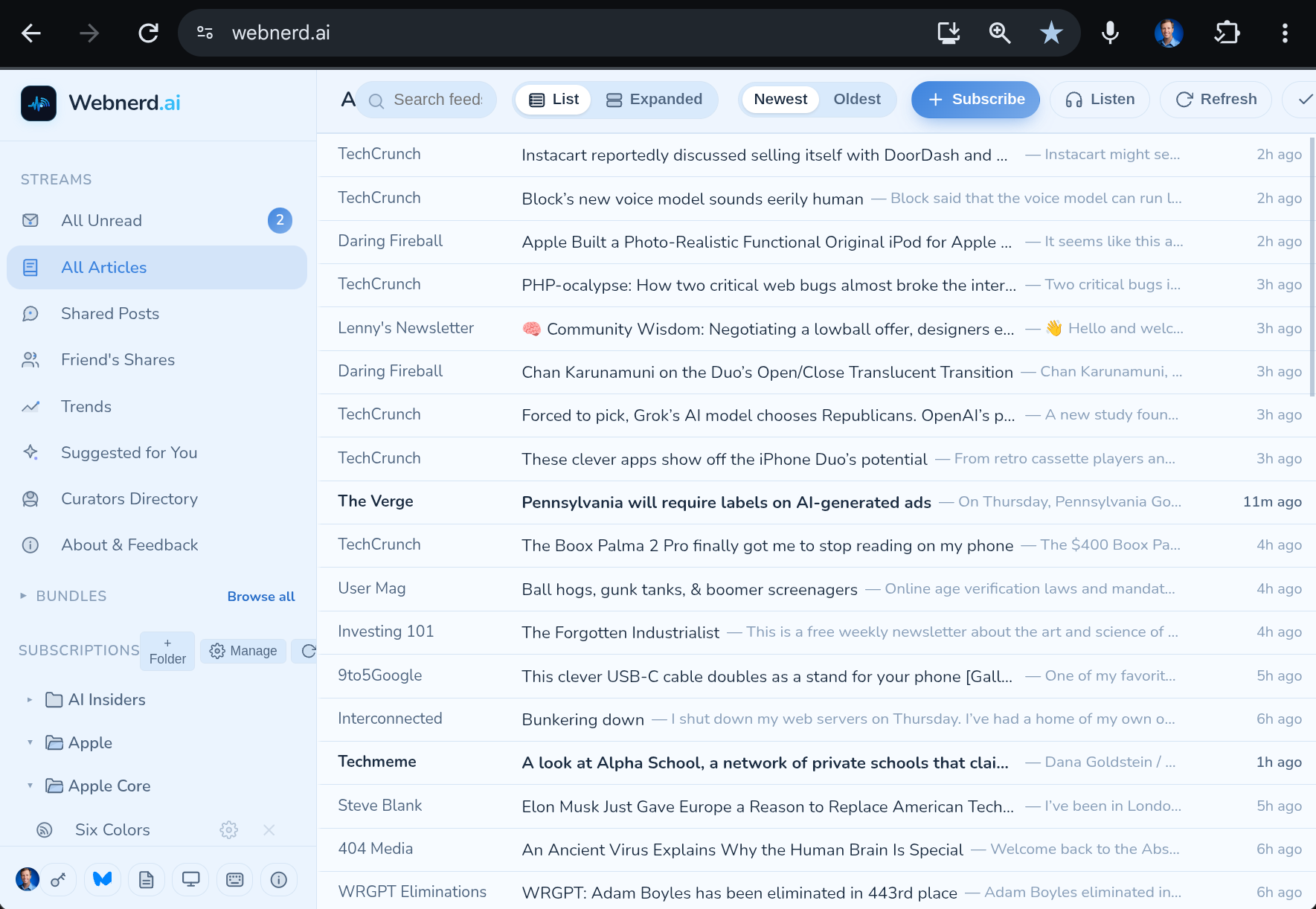
Screenshot_20261024-114435.png
Webnerd.ai -- with the Cloud Nine theme.

With Antigravity, I can now transform my ideas into reality. It's called Webnerd.ai. I've been enjoying it myself for weeks, and I figure it's time to share it with the rest of you. I do not expect millions of users, but for those who love RSS, designed for power readers and sharers, I think you'll like it.

Screenshot_20261024-112745.png
Pick from many themes to browse with color.

For old-school RSS junkies, Webnerd.ai should feel really familiar. It features trends, you can follow other curators, see recommended items, and the basics you would expect, keeping feeds current and alerting you to new posts.

Screenshot_20261024-113818.png

Reading and curating the best of the web on Webnerd.ai.

Webnerd.ai is built in the spirit of the original open web: subscriptions to your favorite sources you trust, simple discovery, and one-click sharing, just like we all used to, including your own shared items, which has its own RSS feed, and even straight to Bluesky -- my preferred space (lacking the toxicity of others), but if you must, Facebook and X work too. I've been sharing as lgstream on Bluesky already, and it works great.

Screenshot_20261024-113228.png
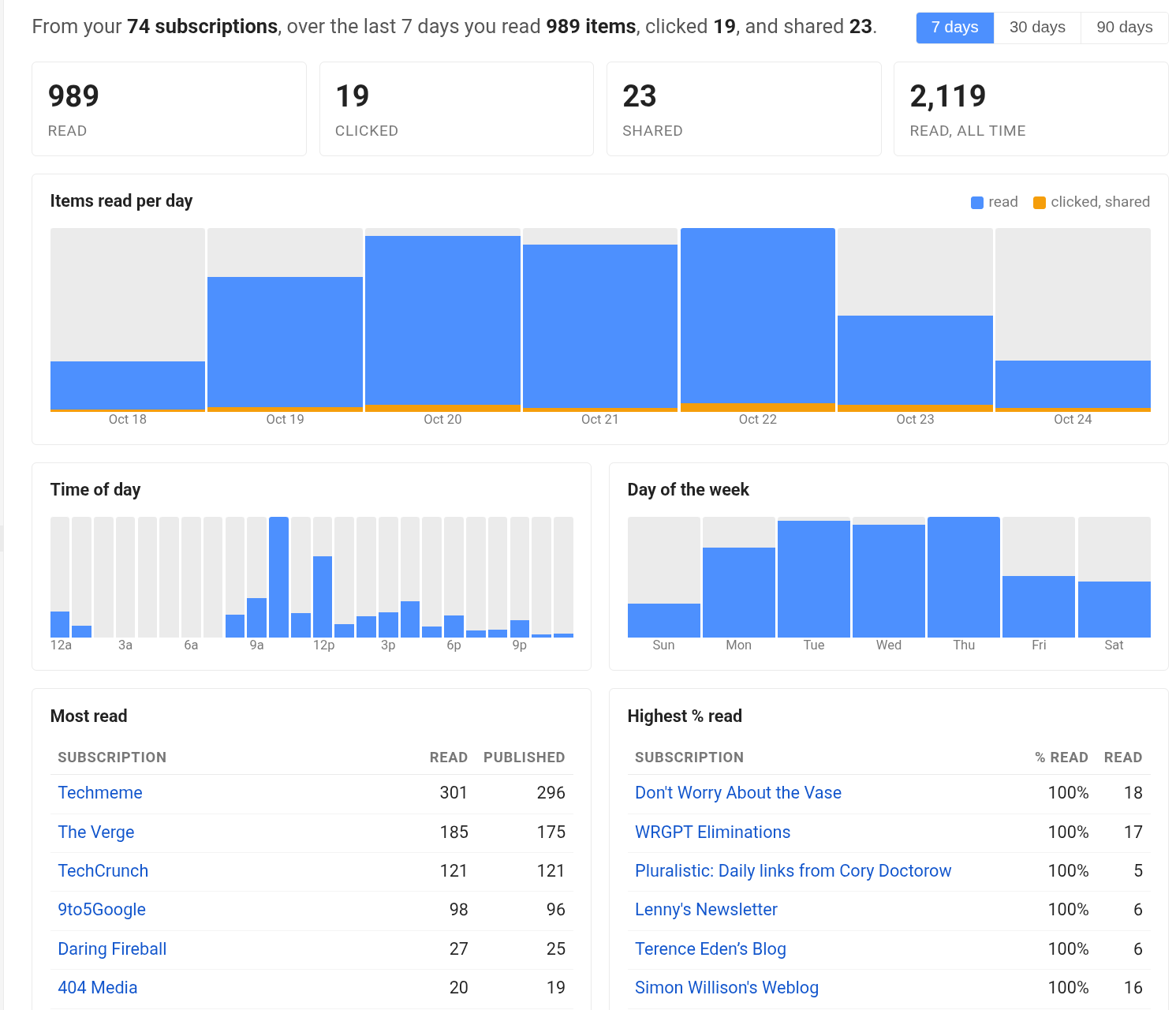
My Webnerd.ai reading stats from the last 7 days

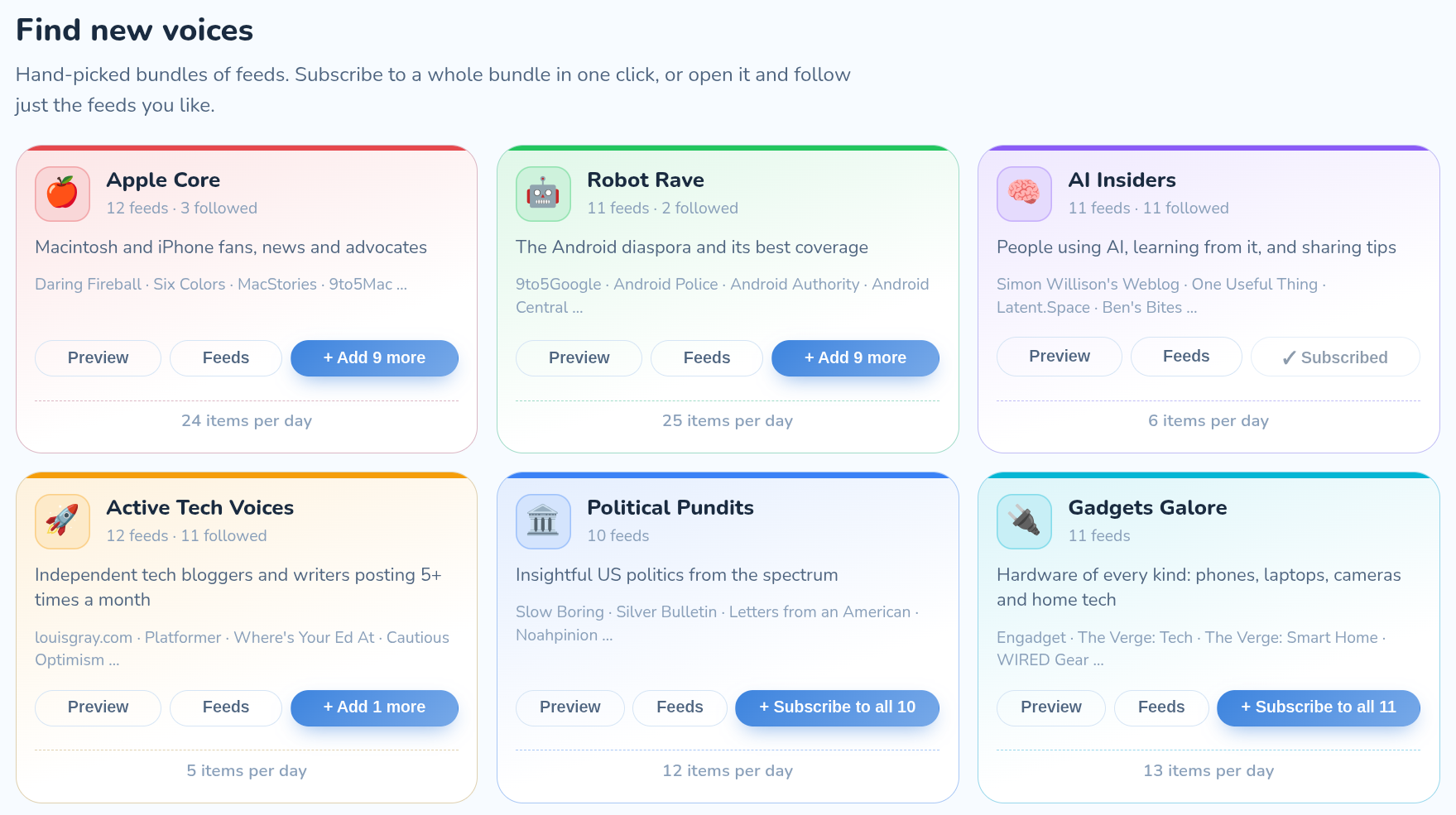
For those of you nerds (like me) who have OPML, bring it and get started. Or just pick from the many curated bundles I've spun up (with Antigravity's help) to start filling your feeds.

Screenshot_20261024-115517.png
Webnerd.ai comes pre-loaded with content. You can preview the feeds and subscribe.

What's in Those Curated Bundles

Every feed in these 12 bundles has been verified for active publishing so you can preview the stream and subscribe with a single click. On day one, here are the 128 voices powering our launch bundles:

To get started, sign in with your Google account at Webnerd.ai, grab a bundle or two, and start reading and sharing. Webnerd.ai works great on desktop, and mobile continues to get better! Android app soon. See you in the feeds, and let me know what you think.

Disclosures, per always: I work at Google and use Gemini and Antigravity tools a lot. I built Webnerd.ai as a fun personal project with Antigravity and Gemini on my Googlebook. Nobody at Google reviews my posts, ever.