Silicon Valley Technology Commentary & Archives · Est. 2006 3,045 Posts · 2006–2026
Showing posts with label RSSmeme (35 posts). Show all posts

November 1, 2011

November 1, 2011 · 3 MIN READ · BY LOUIS GRAY

Google Reader Evolves, Gets Tighter With Google+

Google Reader Evolves, Gets Tighter With Google+

This afternoon saw the delivery of updates to Google Reader that brought the product's design in line with Google's simplified look across many properties, and added support for sharing to Google+. With the launch, which I've been participating in since shortly after arriving at Google in late August, the dedicated friending/following network within Reader, and dedicated shared link blogs from Reader, were shut down.

This last bit has gained the majority of feedback as users anticipated the changes in the last week-plus since the preannouncement, and impacts some of the most active users, myself included. But if one unwinds the immediate reaction of being reluctant to change, the product's direction was telegraphed as Google has promised an evolved product experience,  regularly adds features to Google+ and recently announced the planned wind-down of Google Buzz, which was closely tied with Reader's existing commenting model.

In discussing the changes, I walk a fine line of respecting the tremendous hard work that went into Google Reader from the products' founding team and core engineers in the last five years, while also recognizing its role in feeding the product where I am currently focused as an employee. As a user, I have spent more time with and more loyalty to Google Reader than any other product on the web in the last decade, with the only possible notable exception being a web browser, either Safari or Chrome.

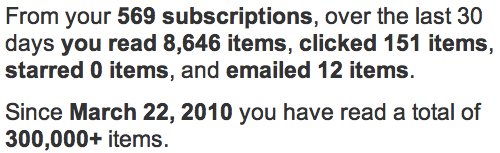
In the last month, I've continued to crank through Reader, in the new interface.

At various times, I've said I'd give up my Gmail before Reader. I even wrote a blog post two years ago saying I wouldn't accept $25,000 in cash to give up Reader. This is because Reader has played a central role for me to find all the updates from around the web in a centralized way, and let me share out the best to my downstream network. In years past, as you've seen here, I've rallied for feature adds to Reader, and highlighted the ecosystem of products, from ReadBurner to RSSmeme, Feedly, Toluu, and my6sense.

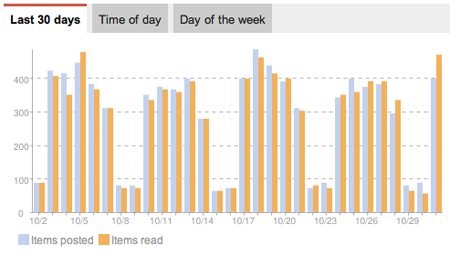
A Day In the Life of My Reader Feeds, Graphed

You can't be a bigger fan of information discovery and consumption than me, unless your name is Marshall Kirkpatrick. But one thing to note is that the web has changed quite a bit since I first started drooling over aggregators like FriendFeed and Google Buzz, and the shared items trackers that sparked to life in 2008 are universally dead. Users have voted on the web to share with social networks like Twitter, Facebook, LinkedIn and Google+, and the new additions to Reader make that easier.

Sharing from Google Reader to Google+ Includes Circles and Commentary

I've personally been using the new Reader, or something close to it, for more than a month, and every time I'd log into the existing version, the difference was notable. Change is hard, but like a new haircut or or new home furniture, it grows on you. Now, instead of sharing 10 or so items a day to the anonymous group of people following me in Reader, I selectively share less often, and to more targeted circles in Google+ which I built by hand. And if the item is interesting to an even wider group, I share it to Public. (More tips here on Google+)

Since the launch this afternoon, I am already seeing a lot more items shared to Google+ from others in my circles, and it's interesting to see how they have adapted to the new functionality, even though others are more wary about the changes. As Alan Green outlined in his blog posts this week and last, Google recognizes the changes may not mean the new product is perfect for all users, and the tools are there to let you take your data with you. But I hope people do see the value of leveraging Reader as a smart RSS feed engine and share selectively to Google+ circles. After a few shares, it becomes second nature, and the world could surely benefit from a streamlined social experience. Trust the team is listening to all feedback from all corners. It's a privilege to have an impact on a product that has played so large a role for me for so long.

August 31, 2010

August 31, 2010 · 4 MIN READ · BY LOUIS GRAY

The Five Stages of Filtering, Relevance and Curation

The Five Stages of Filtering, Relevance and Curation

Tonight's news of Gmail taking on information overload directly, using a combination of intelligent algorithms and your own feedback to build in box personalization is yet another hallmark move to taking on the increasing deluge of content approaching us from all directions - be it our e-mail, static Web pages, audio and video, or the many different social streams which we have subscribed to. There is no question that content creation and sharing is exploding and people are completely incapable of giving every single message and item their full attention. And many smart folks are looking to bring solutions to find the best and ignore the rest.

As I see it, there are five major ways companies and individuals take on the topic of relevance.

1. Editorial Filtering

Loose definition: I am the smartest person. I know best for you, and I deserve to decide for you what is the most important.

Example: The New York Times, Wall Street Journal, CNN and most mainstream media outlets today, who for years have been trusted arbiters to find the most important news and bring it to us in the way that they decide.

New media examples: The Drudge Report, which has grown from one man's curation and sorting to a full team, and Techmeme, which was once almost completely algorithm driven, and now is staffed around the clock by savvy editors who pluck the best of the tech Web.

Of course, it is easy for an individual to be a curator. I share a lot of content, manually, through @lgstream on Twitter, as well as on Google Buzz, FriendFeed and Facebook.

2. Global Popularity Filtering

Loose definition: The will of the people can be trusted, and they will decide what is most important, thanks to the most votes.

Examples: American Idol, Digg and Reddit. He with the most votes wins and gains a coveted front page slot.

New media example: Twitter Trending Topics display the most frequent topics and hashtags, not necessarily the most important. Also, you can see tools like Tweetmeme and FavStar which watch for number-driven popularity online.

This would also have included RSS shared items counters of the past, such as RSSmeme and ReadBurner.

3. Social Filtering

Loose definition: What your friends like, you will like. If it's important to them, it's important to you.

New Media Examples: Facebook recommended friends and pages, which display how many friends like them, Google Social Search, which pulls results from your friends content, and FriendFeed Best of Day, which shows the items from your friends that gained the most activity over a time period.

4. Explicit Personalization

Loose definition: You told us what you like or don't like, and since you know yourself best, you know what's important.

New media examples: Netflix's star ratings and TiVo's Thumbs Up or Thumbs Down feedback mechanisms, as well as Kosmix's MeeHive project.

5. Implicit Personalization

Loose definition: Just be yourself. Read what you want, do what you want, and the system will learn from you, continuously updating.

Examples: Amazon.com, my6sense.

There is a time and place for practically all types of filtering. Mona Nomura of Pixel Bits today talked about the serendipity algorithm and what it means to marketers looking to leverage machine learning. With Gmail's announcement, ReadWriteWeb's recent coverage of TrapIt and ChatterApp in an article on consumer information overload, and the high visibility of Facebook's News Feed, against the recent feed, the challenge has grown to a level where you no longer have to convince people there is a problem in filtering, but instead, you need to make a concrete decision as to how to approach that problem.

I believe that there is a role for trusted curators of news, people who have unique access or unique insight, who can get to news more quickly than anybody else, or dive into it more deeply. I believe that social similarities are a good hint at an individual's interests, but they cannot replace your own preferences - which go beyond your ability to fill out a form and try to tell the truth on what it is that you really like. The best systems, as Gmail is trying to do (with some help from your own feedback on whether they are getting it right), happen naturally and transparently in the background.

It's natural I would think this given my work with my6sense, but I have long believed in there being a perfect place for humans to act as curators and guides, while there is another perfect place for machines to provide, to the best of their ability, resources to aid your discovery. So when you are challenged with a mountain of information coming at you from any angle, think of the best way to get it handled. Should you turn to an editor, to the will of the people, to your friends, or to code? The options are all there, and more tools are coming to help you attack the noise - because there's little chance it will fade away any time soon - and a very strong chance it could get much worse very quickly.

Disclosures: I am vice president of marketing at my6sense. ChatterApp and TrapIt are assumed competition. In addition, Kosmix.com is a client of Paladin Advisors Group, where I am a co-founder. I was also previously an advisor to ReadBurner, since closed.

May 13, 2009

May 13, 2009 · 1 MIN READ · BY LOUIS GRAY

InFeeds the Latest Service to Calculate "Top Shared Items" Online

InFeeds the Latest Service to Calculate "Top Shared Items" Online

For more than two years, we've been talking about services that could democratically tabulate the most popular shared items on the Web, using Google Reader link blogs (like mine) as their data set. In early 2008, there was a practical explosion of such services, started by Feedheads, and rapidly followed on by ReadBurner, RSSMeme, Shared Reader and others. And while it's the earliest of days for a new service called InFeeds, developers continue to see this as a project worth tackling.


The service started gobbling up popular shared item blogs this morning (as you can see on Twitter), bills itself as a "shared items feed aggregator" and asks, "what's interesting in your feeds?"

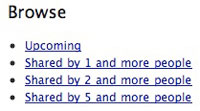
Like the aforementioned competitors, InFeeds looks like it is going to show you items that have received the most shares from registered link blogs, sorting by 2 or more shares and 5 or more shares, for example.

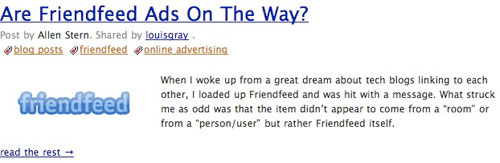
If you look at its spartan "Upcoming" page, you can see that individual shared items are displayed with the original headline and author, who shared the item, and a number of tags, such as "Facebook", "iPhone" or "Google".


One Item I Shared Via InFeeds, Displaying Tags

With RSSmeme founder Ben Golub working at FriendFeed, and the ReadBurner site currently being down for repairs, there could be an opportunity for somebody like InFeeds to sneak in and be interesting. So while I may advise the ReadBurner team, I think it makes sense to hop over to InFeeds and provide your Google Reader shared links URL to give this developer a little push.

You can submit your URL here: http://infeeds.com/

January 9, 2009

January 9, 2009 · 6 MIN READ · BY LOUIS GRAY

10 Ways to Maximize Your Google Reader Link Blog

10 Ways to Maximize Your Google Reader Link Blog

I've been sharing articles I've read in Google Reader for the better part of two years. I don't know exactly when I started, but I'm fairly sure I'm nowhere near finished. And while I admittedly started sharing to a link blog without having a clear goal in mind, I'm finding that this massive shared items repository is becoming an incredibly versatile information hub that benefits me, the authors of articles I've shared, and the consumers, be they friends in Google Reader, or in many other locations.

I believe that while Google Reader has grown in visibility, arguably becoming the most popular RSS reader on the Web, the utility of shared link blogs is less known. Here are ten ways you can maximize your Google Reader link blog - most of which I'm doing, and probably didn't anticipate when I first started sharing items into the ether.

1. Act as a trusted information filter.

Regardless of how fast a reader you are, there is no possible way you can read every single news source and blog on the Web. Neither can anybody you know. And regardless of how closely your feed match percentage is on Toluu, there are feeds you read that your friends don't. By sharing the best items of what you read every day from Google Reader, you are hand-selecting the best of the Web and "endorsing" those items to your link blog subscribers.

Do so with some regularity, and you might be surprised as to how people come to rely on your manual intervention and news discovery. I first became cognizant of this in February when "SeekGround" reported "I discovered that I had shared more of louisgray's shared items than anyone else's in the last 30 days". In May, Duff's Device similarly wrote: "I saw another article that I received from Louis Gray'sGoogle Reader Shared Items again. Thanks for keeping on top of the world for me Louis. :-)"

As of tonight, ReadBurner reports I have nearly 8,500 articles shared on my Google Reader link blog. While there are others who have shared more total items, I know that I have shared those items I believe are most interesting to me, and others I believe are following along.

2. Share your items with Google Friends.

Though Google hasn't nailed the "what is a friend" issue, you can add friends through GMail and Google Talk. If they are also Google Reader users, and share items, you can opt in to seeing their Google Reader shares, and they can see yours. If they subscribe to your shared items, your shares are mixed in with all the other feeds on their list. Of course, if you don't want to see their lists, click "Hide" next to their name, or "Show" to bring them back.


3. Embed your Google Reader link blog to your own blog or Web site.

When I first started sharing to my link blog, I had this odd feeling I was sharing posts and nobody knew about it. After all, the link blog URL isn't the most intuitive on the planet. But you can embed a widget on your blog to display a subset of your recently shared items, and visitors to your blog can click out to items you've shared.

4. Add your Google Reader link blog to your Google profile

Your Google profile is a fairly blank slate, for you to add or delete as you please. While it's very common for people to add links to their Twitter page, their blog or their LinkedIn profile, I'd suggest it's just as important to add your link blog to the page. Mine is here.

5. Share items to Facebook, FriendFeed or Socialmedian.

2008 was the year of personal news aggregators, which took updates on your services from around the Web and put them all in one place. While this trends was best exemplified by FriendFeed, Facebook also offers the option to feature your Google Reader shared items, and Socialmedian will pull them in as news, going so far as to check the shares by topic to place them in the right categories.

You can see my Google Reader shares on FriendFeed here. And to avoid duplication of items, if I share items from louisgray.com, I manually delete them from FriendFeed. Takes seconds, and reduces the noise. (My Socialmedian page is here...)

6. Add your share count to ReadBurner, RSSmeme or Feedheads.

Feedheads, the pioneer in tabulating popular Google Reader share counts, was joined by ReadBurner and later RSSmeme, in early 2008. As some people are turning to ReadBurner and RSSmeme as a democratically sorted Digg or Techmeme, sharing items you like will add your vote to the list.

Be sure to add your feed to ReadBurner here.

7. Replace your bookmarks with Google Reader shared items.

At the end of the year, I said that RSS Has Practically Eliminated My Need for Browser Bookmarks. As I thought about it more, it's my Google Reader Link blog that is essentially my rolling bookmark list, highlighting those items which are the best, and which I will want to return to. While Delicious is also a good Web-based bookmarking system, the link blog is a good way to find recent items of interest.

8. Expand the visibility of lesser-known sources.

Sometimes, I get in a routine of reading my RSS feeds and then sharing, without thinking about how the shares are effecting the downstream author. But I've gotten e-mails saying the shares have generated attention beyond what I expected. Last month, one blogger wrote, "When you pop an article on (the linkblog), I'll get 60-70 hits and get pumped to the first page, that is pretty averge for the support you give me." Earlier this week I got a similar e-mail from a second author, who wrote an e-mail titled "Thanks yet again", adding "Your Google Reader share really lit up that discussion."

In a tech blogging world where there are so many different sources of news, and so many people writing about the exact same thing, you can make a difference by choosing lesser-known sources of news, and highlighting the best content, not just the loudest. I've tried to share items from those who have done original reporting or are thinking differently than the echo chamber, and it in turn can deliver greater visibility.

9. Use your linkblog as your "to comment" list.

As part of my online new year's resolution, I said I would be making more time to comment on other blogs through the year. But as you know, my full-time job doesn't work all too well with browsing the Web and making comments throughout the day. Instead, I've found I'll go back to my own Google Reader linkblog, and open the items in a new tab, and go through to add comments one by one, left to right, so I've given the authors feedback and participated.

10. Create your own leaderboard of news sources.

Google Reader tracks statistics on what your most-shared news sources are over the last 30 days, which can report on who you've found most interesting in the last month. Given each person's individual tastes, the results can be very different than more public leaderboards which tend to feature those who are most popular and have a deeper subscription base. While my own link blog does tend to feature popular sites like TechCrunch, Scobleizer and ReadWriteWeb, I can see that I've also shared a high number from lesser-known sites, including TechWag, Regular Geek, The Future Buzz, Andy DeSoto and Chuqui 3.0. And if you're stat-oriented like I am, you can check in and see how this changes over time. (See my blog leaderboard from last July)

So... are you sharing your Google Reader items? I am. You can find mine here. For the betterment of the community, it'd be great to see your shared item links in the comments.


DISCLOSURE: I am an advisor to ReadBurner.

December 14, 2008

December 14, 2008 · 4 MIN READ · BY LOUIS GRAY

My 2008 Tech Predictions Look Bad As Year Nears a Close

My 2008 Tech Predictions Look Bad As Year Nears a Close

It's a year-end tradition for many media, blogs and individuals, to predict what will happen over the next year. Some prefer to make their guesses fairly straight-forward in an effort to be right (Example: Apple will release new notebooks with a faster processor at MacWorld) and others will make their guesses seemingly outlandish, so that if they're right, they're seen as virtual psychics. Others, somewhere in between. At the conclusion of 2007, I made ten predictions that I thought would be fun, and as we're coming on the one year anniversary of that post, it's a good thing you didn't bet your home mortgage on my list. (What? You say there are other issues with your mortgage? Oh.)

See: 10 Predictions for 2008 In the World of Tech

In the spirit of reducing my ego, here are how those ten predictions in the world of tech stand:

1) Google Will Trump Both TechMeme and FeedHeads

Wrong. I expected that Google would start to tabulate its shared items and most popular feeds via Google Reader, and that using this data, Google could provide a democratic version of Techmeme, or at least pull Feedheads outside of Facebook. Instead of Google doing this however, it was ReadBurner, followed by RSSMeme and others, including Feedheads, who started a site at www.feedheads.com. Later in the year, Google Blog Search did introduce the option to show hot topics in tech, but it's largely been a stale effort. At this point, Techmeme is still more important than Google in this regard, and Google Reader has declined to show most popular feeds or shared items.

(Disclosure: I am an advisor to ReadBurner and took the position in August.)

2) Facebook Will Buy Digg in an All-Stock Transaction

Wrong. I thought Facebook would use its expensive stock and buy up some smaller companies. Digg continually sounded like it was shopping itself, but it never sold, and the company's CEO often denied talks were occuring with anyone. Also, given the stock market crash, Facebook is no doubt valued much lower these days, making a stock transaction less likely.

3) eBay Will Sell StumbleUpon to Yahoo! or News Corporation

Wrong. So Far. In September, TechCrunch and others reported that eBay planned to sell StumbleUpon, but no sale has taken place yet. At this point, also, with Yahoo! crumbling, they are less likely to take on the service.

4) Twitter Will Add Video, Photography Support

Wrong. Twitter focused on growing and not crashing this year. Still just text.

5) Apple Boot Camp Will Morph to Be Like Parallels, VMWare Fusion

Wrong. I hardly hear anything about Boot Camp these days, likely because VMWare Fusion and Parallels have become entrenched, and nobody cared about Apple's "restart" alternative. My comment that Apple would "slowly take over the market" in this space also looks quite dumb, as did the expectation that Windows applications could boot alongside Mac apps. The question is, why not?

6) At Least One Major Browser Will Embed Ad-Blocking

Wrong. And it's too bad! Sure would change things a bit if somebody could figure out how to check a box and have graphical ads or text ads disappear.

7) Assetbar and FriendFeed Will Gain Early Adopter Audiences

Wrong and Right. AssetBar, in its attempt to replace Google Reader, failed fast. FriendFeed, however, did much better than I could have guessed at the time I wrote the post. Obviously, I played a small role in evangelizing FriendFeed through it coming out of beta in early 2008, but it got bigger than even I expected. My comment saying that "neither would be acquired by the end of 2008" did manage to be true.

8) Video Blogging Will Remain Unpopular, Unprofitable

Right. While there are some bloggers who prefer video and are using it, from Robert Scoble at FastCompany TV to Loic LeMeur at Seesmic, it hasn't become as second-nature as standard blogging or mciroblogging. And so far as I know, nobody is making money on this in a consistent way.

9) iTunes Video Rentals Will Decimate Netflix, Blockbuster, Hurt Box Office

Mostly Wrong. Netflix didn't blink against iTunes' charge. They instead branched out with their "watch instantly" feature and partnered up with TiVo and others. Blockbuster is still a disaster, and I certainly am not going to the box office thanks to so many alternatives. But iTunes video rentals cannot be said to have hit Netflix and others all that much.

10) Fast Company Will be a Fast Stay for Robert Scoble

Wrong, So Far. Robert joined FastCompany at the beginning of the year, and is putting up some interesting content. That said, FastCompany has seen changes in focus and leadership, and I am curious to see how his show evolves in 2009. Scoble continues to be a mainstay on the social Web and at industry events of course, so even if 2009 sees him somewhere else, it won't be far from the limelight.

So wasn't that fun? Now you see you can largely ignore my predictions, or maybe, I should try harder to be right. Maybe, if I'm good, I can put a 2009 prediction list up by the end of the year...

December 9, 2008

December 9, 2008 · 10 MIN READ · BY LOUIS GRAY

10 Top New Web Services of 2008 and Their 2009 Forecast

10 Top New Web Services of 2008 and Their 2009 Forecast

2008 has been both an exciting year and a very trying year for the world of Web innovation.

When the year kicked off, we were still in the middle of Web 2.0 fever. We were just two months removed from Microsoft having invested $240 million in Facebook at a stratospheric $15 billion. In the first week of January, Yahoo! CEO Jerry Yang made his first appearance at CES and promised the company was "ready and excited". By mid-month, Pownce launched to the public to offer an alternative to Twitter. And by the end of January, Twitter crashed hard - for the first time.

It turns out that Twitter's crash might have been the canary in the coal mine. Even looking at January 2008, and considering what has happened to Facebook's valuation, Jerry Yang's reign as CEO of Yahoo!, and the eventual extinguishing of Pownce in the ensuing months and it almost seems unbelievable. Of course, as you know, Twitter crashed again and again throughout the year, and in parallel, so did the fortunes of many Web companies, from the smallest startup looking to raise funds, to the monoliths, including Google and Yahoo!, who have had to rapidly make changes as the economy changes under their feet. Meanwhile, as business conditions deteriorated, the public markets were closed and valuations were decimated.

But before the doom and gloom hit, a good number of Web services pushed and shoved their way out the door in the first half of the year, and look to be here for at least the near term. Even as the second half of the year saw a drying up in new services and very little innovation, as we start to look toward 2009, there are new brands that many of us know were but a glimpse in an engineer's eye when 2007 finished and 2008 took over. And while no list is complete, here are some of the best that can claim 2008 as their birth date. I expect this will miss quite a few, so please make sure to nominate your favorites and tell me why I'm wrong!

1) Summize (Twitter Search)

Search is still king, and real-time search is having a huge impact on the way people find news, share ideas, and see trends. Summize built its business around being a search engine for Twitter, and soon became more stable, and theoretically, more useful, than Twitter itself. The Twitter team, in desperate need for more engineering help, acquired the company and absorbed into the microblogging service.

Expected Exit: Acquired - Already Complete

Twitter's acquisition of Summize was a smart move, considering how real-time search is becoming critical in times of breaking news. Many, including myself, are turning to Twitter search instead of Google, Yahoo! and the traditional news wires to hear reports from people on the ground, unfiltered.

2) Socialmedian

While many different sites have conquered the online activities aggregation space, Socialmedian went about the process in a different way than all the others, letting people not only follow friends and pipe in their shared content from a wide variety of 3rd party sites, but organized it in terms of categories. The category feature was so successful, CEO Jason Goldberg has been able to showcase specific events, including the 2008 election, and the financial crisis, and make Socialmedian a go to site to interact with "newsmakers". The site, starting from scratch in the Spring, has risen up to challenge FriendFeed, Digg and other sites for social news - and continues to grow at a rapid clip.

Expected Exit: Acquisition by First Quarter of 2009

With Goldberg and team having raised so little capital to get the product off the ground, and having kept costs very low, with the development team in India, the bootstrapped Socialmedian looks to be a ripe target for an acquisition, in my opinion. Without strong revenues and the public markets the way they are, Socialmedian would be smart to find a strong content or media partner, to join forces and enable the service to continue its growth.

3) BackType

Technorati and Google Blog Search, as well as many other directories and search engines have typically focused on the blog as the central nervous system for their offering. But as many would agree, it is the comments and conversation, no matter where they are, that have real meaning to blog authors and participants. While everyone was busy trying to see who could land on the Techmeme leaderboard or break new ceilings in Technorati Authority, BackType debuted a site that tracks comments by individual, lets you follow individual commenters across a wide variety of sites, be alerted when comments with keywords take place, and see charts that display keywords' momentum.

Expected Exit: Acquisition in Second Half of 2009

The BackType founders are working together on their second startup, having abandoned the first when it didn't gain traction. While BackType doesn't yet have an amazing market presence, they have forged a unique foothold that so far looks unchallenged. With any luck, I would expect the BackType team to deliver more enterprise-capable brand and identity management tools that would enable the service to gain revenue and exposure, letting the service to remain independent through the majority of 2009 before finding a place within WordPress, Six Apart, Google or Twitter.

4) TweetDeck

TweetDeck isn't a Web service, but this Adobe AIR application introduced new functions to Twitter usage that changed the game in terms of how people use the service. By introducing a multi-columned app that features groups, integrated search, direct messaging, and replies functionality, many are swearing by TweetDeck, and it looks like it may soon overtake Twhirl as the most popular Twitter application. Busy Twitter addicts including Guy Kawasaki swear by it.

Expected Exit: Remaining Independent through end of 2009

Iain Dodsworth is continuing to upgrade the product, and it's widely rumored he may soon integrate multi-account support, as well as integration with additional services, outside of Twitter. If he can get enough people to donate or pay for the application, there's no question he could make a full-time living from the resulting revenue. The question is, will people who expect a free service to have 100% uptime spring for the app that gets them there?

5) Strands

While FriendFeed, Profilactic and others were first out the gate in 2007 with their lifestreaming and social activity aggregation tools, Strands has worked on their own social news and lifestreaming site, in beta, since mid year. Focusing on delivering a clean interface for their Web, mobile and iPhone application versions, and keeping a strong emphasis on tracking musical preferences, Strands has developed a loyal following who find the site less noisy than some services and cleaner than others. Strands, instead of marketing to early adopters, like me, has given a great deal of focus to converting the more mainstream user, and acting as an evangelist for other third party applications, ranging from Pandora to Twitter.

Expected Exit: Remaining Independent through end of 2009.

Strands' history both bodes well and plays against them. Their VC funds offer them a strong balance sheet, but may also force the company's investors to seek a return that would be unavailable, given current market conditions. The company will need to find a better way to differentiate against FriendFeed and others, and hope that appealing to mainstream America works.

6) ReadBurner

A service that would tabulate the most frequently shared items from Google Reader was high on my list of sought-after sites in 2007. The catch is that I always thought Google would do it themselves. When ReadBurner debuted in January, it was a delight, and the simplicity of the service bred many clones, including RSSmeme. Later in 2008, its older cousin, Feedheads, broke out of the Facebook garden and entered the general Web. ReadBurner, and others like it, serve as having the potential to unseat less-democratic popular news hierarchies, such as Digg, assuming they execute well. As an advisor to the service, I'd like to say they are on the right track, or rate the service higher on this list, but development has been slow of late, and needs to get going again.

* Not Listing an Expected Exit Due to Assumed Bias *

7) Feedly

Like many other smaller services this year, especially those around the Google Reader and Twitter ecosystems, Feedly takes an existing popular product and makes it better - giving a news magazine feel to what previously had been a standard RSS reader. Feedly launched as a Firefox plugin in the middle of the year, highlighting recommended articles from friends, popular feeds, and integrating with Google Reader, so when you made changes to your Feedly, those changes tracked back to Reader.

Expected Exit: None

Feedly's founder recently noted his excitement over earning the service's first dollar, after a user Tweeted that she'd gotten distracted by an ad within Feedly and clicked through. Given most other RSS based apps haven't found any revenue yet, a single dollar is a lot more than zero, but Feedly doesn't look like it has any kind of mass that would push it to the mainstream, let alone turning into a viable business. For now, it's just an interesting twist on data consumption. The site will only go away if its developers get bored of it.

8) Gnip

With sites like Twitter, Facebook, Flickr, Delicious and others getting pounded all day by third party services tapping into their API and sucking down their users' updates, Gnip recognized these external sites might soon see backlash from the data sources, as too much of their own infrastructure was being used to power other programs. In light of Twitter's up and down summer, Gnip debuted to act as the middleman, essentially making data portability easier, reducing one-offs between services.

Expected Exit: Acquisiton by end of 2009

It's hard in life to be the middleman, trying to play equal with every service. Should Gnip really start to become the Akamai of data portability, it's likely that one of the biggest data producers would want to snap up the service for themselves, and either limit competitors' access to it, or start charging fees. In a world when VC money is hard to come by, Gnip would be smart to take the offer.

9) Toluu

You'll note two major themes regarding hot services in 2008: RSS and friends. Finding out what your friends were reading and sharing were key facets of most of the new products that gained my attention this year. Toluu, developed by Caleb Elston, offers a site where you can upload the OPML file of feeds you read, mark your favorites, and see how compatible you are with other users of the site, helping find new feeds, and new people. Over time, the service enabled me to see new blogs my friends were subscribing to, and you could even notify Twitter if you had added a new blog to your reading list.

Expected Exit: None

Toluu is a geeky hobby for Caleb. He's recently also gotten behind Kallow.com, a gift recommendation service. Toluu hasn't been monetized in any way, and is unlikely to develop into an acquisition target, unless another service wants to use his recommendation engine.

10) SocialToo

Twitter and Facebook have become such a part of the blogging ecosystem, that new services have sprung up to make it more useful and intuitive. Among them is fellow louisgray.com author Jesse Stay's SocialToo. The service looks to act as a bridge between multiple social networks, including Twitter, Identica and Facebook, letting you automatically follow those users who follow you, offering a black list of people you never want to follow you, setting up an automatic message to those who choose to follow your account, and recently, the addition of surveys that can be distributed by Twitter and tabulated on the site, much like SurveyMonkey and PollDaddy.

Expected Exit: Remaining Independent through end of 2009.

SocialToo contains some advertising, and if I were to guess, it may offer premium features, as the survey functionality could be improved a great deal, possibly even going head to head with sites like SurveyMonkey. While Jesse is unlikely to get rich off SocialToo, it's smart in that it's not tied just to one service (Twitter), but has the flexibility to add on new networks as they rise in prominence.

Also on the list but outside of the Top 10:
12seconds.tv, BlogRize, Identica, LinkRiver, OneSpot, PeopleBrowsr, Plurk, Rejaw, RSSmeme, Shyftr, Yokway

October 6, 2008

October 6, 2008 · 2 MIN READ · BY LOUIS GRAY

Hackr WatrCoolr: Tech News Aggregation With No Mouse Required

Hackr WatrCoolr: Tech News Aggregation With No Mouse Required


A couple weeks ago, in an article about Microspaces, I said that Web entrepreneurs are finding new ways for you to navigate their sites, and many are now incorporating keyboard input, to jump to new comments or pages. Though I mentioned it in a quick tweet on September 25th, I thought it was worth highlighting the Hacker WatrCoolr, a site that displays headlines from many popular tech news sites, and lets you quickly flick through them using only your keyboard - no mouse required.


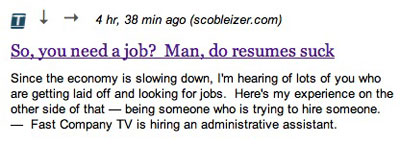
A Headline from ReadBurner on WatrCoolr Tonight

WatrCoolr shows the latest headlines from Digg, Hacker News, Del.icio.us, Techmeme, Reddit, RSSmeme, Slashdot, Yahoo! News and ReadBurner. Each headline shows its recency, and the destination URL (e.g. nytimes.com or makeuseof.com).


Scoble's Post Hits Techmeme and Makes it to WatrCoolr

But unlike many other news aggregation sites, the Hacker WatrCoolr doesn't shoe-horn them into one busy page, like AllTop. Instead, it displays one headline at a time. To scroll through older items from the same source, you just need to hit the down arrow key. To see a new source, hit the right or left arrow. And to read the article, you just have to press the "r" key, or press "n" to have it open in a new window or tab.

While Hackr WatrCoolr is not looking to replace your RSS reader, some of the functionality is very similar to that of applications like Google Reader, and it's a very easy way to get all the top stories from each of these sites in one place. It may be a little experiment, but it hints at one way the Web could go to make the process of our news gathering even that much more easy. I hope to find more Web developers who are thinking different about how we navigate today's often-formulaic and static Web sites.
DISCLOSURE: I am an advisor to ReadBurner, and hold a small equity position.

September 2, 2008

September 2, 2008 · 2 MIN READ · BY LOUIS GRAY

Ben Golub of FFToGo and RSSMeme Joins FriendFeed Full-Time

Ben Golub of FFToGo and RSSMeme Joins FriendFeed Full-Time


In the world of online companies and overnight Web sites, things can move pretty quickly. What might take years in the world of the enterprise can happen in weeks or months - as successes are claimed and lost, friends are made and disposed of, and new relationships are forged.

Over the last seven months, I've been witness to seeing Ben Golub launch a number of interesting sites, including RSSmeme (post), a Google Reader shared items tracker, DearLazyWeb (post), a service to get answers via Twitter, Tweet2Tweet (post), a way to see Twitter conversations, and finally, FFToGo (post), a mobile version of FriendFeed.

Now, today, it can be finally said he's chosen to settle down, as FriendFeed has hired him on full time, following more than a month's worth of part-time consulting for the company, where he helped chase down bug fixes and provide support to the service's growing user and developer bases. As FriendFeed co-founder Bret Taylor wrote in an introductory blog post, Ben's efforts on FFToGo, RSSmeme and in the developer forum all combined to make him the team's latest hire, one of a rare breed who hadn't previously worked at Google, where much of the team hails from.

I first learned of Golub's direct work with the FriendFeed team when I gave him the courtesy call on August 13th to let him know I'd be helping to advise ReadBurner, an assumed competitor to RSSmeme. At the time, he'd asked me to keep it quiet, saying it was only in a contributory role.

But a week later, when FriendFeed published two months of changes in their ChangeLog blog, chronicling updates to the service, Ben's efforts could be seen, going back to July 16th. This of course led to questions, but when I sent him a note asking if it was time to announce his role, his quick e-mail back, said, "Nothing to see here. I'm just consulting, and sometimes that does mean committing code. As you can tell from the logs most of it has been fixing things up here and there."

It looks like that "nothing" soon became something of real value. Now, Ben is joining one of the more exciting companies in Silicon Valley, and FriendFeed has essentially roped in one of their most dedicated users, much like they did with Gary Burd, the author of Mail2FF. Marshall Kirkpatrick of ReadWriteWeb lauds the combination of Golub and FriendFeed, although I believe he incorrectly speculates that FriendFeed has acquired RSSmeme, as this was not mentioned in the announcement.

As I told Ben on the phone this evening, I'm glad to have helped bring visibility to some of his projects over the last few months, but my efforts were a small thing compared to the dedicated code-authoring Golub has put into each of his sites. FriendFeed has grown even stronger with this hire.
DISCLOSURE: I am an advisor to ReadBurner, an assumed competitor to RSSmeme and hold a small equity position.

August 24, 2008

August 24, 2008 · 4 MIN READ · BY LOUIS GRAY

There is No Social Media Overload

There is No Social Media Overload

Every day, there are more and more great services to investigate in the world of social media. Each one breaks new ground in terms of features, focus or user interface. There are many different sites that target general social networking, some are for business, some are for dating, some are for microblogging, and others for service aggregation. And there will be many more. While some are calling for a pause in the innovation, somewhat fatigued by the implied redundancy or overwhelmed by chasing down comments and conversations in new places, it's worth noting there's time in the day to manage a good number of sites, and not all the winners have yet been crowned.

To have a full deck of social media tools, you essentially need the following:
  • 1 or more blogs that you manage.
  • 1 or more accounts on an RSS feed reader.
  • 1 or more microblogging identities.
  • 1 or more accounts on a business networking tool.
  • 1 or more accounts on a social network.
  • 1 or more accounts on a service aggregator or lifestream.
(Also helpful: A social bookmarking site, online photo site, music recommendation service, etc.)

For me, this means I blog here, use Google Reader, Twitter, LinkedIn, Facebook and FriendFeed as my core applications for each category. But below these headliners are others.

For RSS, I also use Shyftr and liked AssetBar before it went away. I've tried Bloglines, FeedEachOther and NewsGator as well. There are also tools that interact with RSS, like Toluu, which helps you find feeds your friends like and integrates with Google Reader, and the sites dedicated to finding the most shared items in Google Reader, like ReadBurner, RSSMeme and Feedheads. (Disclosure: I am an advisor to ReadBurner)

For microblogging, beyond Twitter, you have Identi.ca, Plurk, and now, Rejaw. I'm signed up at each, but use Twitter primarily, copying posts to Identi.ca, via Posty. I need to check out Rejaw more, but am no expert.

For business networking, there's also Plaxo, which has morphed into a lifestreaming application.

For social networking, many still use MySpace, or Friendster, but Facebook has the momentum and the development on its side. Orkut never got the traction expected.

As for lifestreaming and aggregation, I am absolutely overweighted here, and I enjoy it. Justin Korn referred to it as "Super Kickass Social Network Following Power", but if you're interested, it's fairly easy to be engaged on sites like FriendFeed, Social Median and Strands all at once, like I'm trying to do.

I like FriendFeed because it easily pulls in my activity from around the Web and has a sharp community with good conversations and hiding. I like Social Median because it lets me just see news and posts on topics I pick or from people I follow. I like Strands because it has similar elements to FriendFeed, but more filtering and some good potential. I also know it can continue to improve because it’s early. Just in the last 36 hours, I've gone from being a nothing on Strands to having more than 100 people whom I can interact with.

Below this crust of leaders, you also have smaller sites like Yokway and LetsProve, where I'm registered, but haven't done much of late. FriendBinder doesn't seem to have taken off either, and BlogRize, though interesting, got quiet fast, and seems to have gone away, as did Mergelab. The truth is that we don't know which sites are going to win, and it makes sense to be registered everywhere and active on those places where you find the best community and the best content.

Of course, just because I sign up for something, or find something, doesn't mean that you're obligated to try it out. Not all sites are for everyone. But I'm far from being overloaded with Social Media. You just have to find balance, time, and keep remembering there is no quota and you don't have to read everything. Contrary to some belief, I'm not constantly on each site. I just read quickly, decide quickly and respond quickly. None of these sites is a real big time sink, unless you force yourself to read everything. It's easier to let your friends decide the best pieces, and for you to rely on search tools to get the rest, whether it be through Twitter Search, or pre-determined Google blog searches.

The only way you get social media overload is if you don't manage it well, just like you can get RSS overload or e-mail overload, or so I've heard. Even as there are more services to engage with, the number of hours you have to work with them is still the same. So do check out as many as you think have potential, and stick with the ones that offer you the community you're looking for, the engagement you need, and the best feature set. You'll find your niche.

See Also:

August 10, 2008

August 10, 2008 · 2 MIN READ · BY LOUIS GRAY

Feedheads Breaks Out of Facebook to Compete In Shared Items Arena

Feedheads Breaks Out of Facebook to Compete In Shared Items Arena

Before ReadBurner, LinkRiver and RSSmeme arrived, there was only one game in town when it came to calculating the most popular shared items in Google Reader, and it was Feedheads. Feedheads, the popular Facebook application created by Mario Romero, harnessed the power of Google Reader to show the total number of shares each item had, displays which of your friends shared the item, and even what items were popular in a network (like "Silicon Valley", for instance).


But while ReadBurner and RSSmeme were gaining traction outside the walled garden of Facebook, and gathering a good deal of visibility from bloggers who liked their democratized view of finding "hot" stories, Feedheads remained less visible, available only on Facebook. That all changed tonight, as Romero has brought Feedheads to Feedheads.org, featuring the same functionality, but now available on the Internet at large.
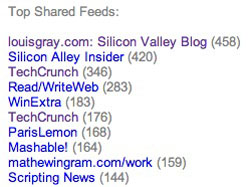
As with ReadBurner and RSSmeme, the top shared sources include popular sites like comics from XKCD, Lifehacker, TechCrunch and Gizmodo.

The new Feedheads.org is spartan in terms of its look and feel, but you can view the top shared items over the last 7 days, the last 24 hours, see newly shared items, popular tags, and feeds.

Feedheads also does more than just count the feeds. It can also show who shared the item, by clicking on the number of shares, and it shows shared Google notes, something RSSmeme has held to itself thus far.

You can even log in with your Facebook credentials and see your own sharing history, at http://www.feedheads.org/me, which effectively automatically gives you your own "leaderboard" of shared items, much like I rolled out late last month, only instead of the last 30 days, it shows your cumulative history from the first time you installed Feedheads.

I've often written about the interesting space of tabulating shared items in Google Reader, and the intrigue of Feedheads, having read about it on other blogs, was a big reason I eventually joined Facebook in the first place. After starting out by showing itself in Facebook as simply "Google Reader", the service rebranded as Feedheads in October, and rapidly grew to a user base of more than 10,000 by December of last year. Unfortunately, more recent statistics are unavailable, but breaking out of Facebook is a big step in the right direction for Mario.

The success of both ReadBurner and RSSmeme has shown there's room enough for more than one player in this space, especially as each site has differentiated itself through a series of innovations. Feedheads.org was the original player in this space, and Mario led the way in trying to make order where there was none before. Now, out of the walled garden, it should be interesting to see what innovations he has planned next.

July 28, 2008

July 28, 2008 · 4 MIN READ · BY LOUIS GRAY

Me-Too Software and Web Apps Often Find Their Own Niche

Me-Too Software and Web Apps Often Find Their Own Niche

As the price to develop Web applications and communities has decreased, and investment in people is less-demanding, it's no surprise that we've seen a boom in sites with significant similarities - be they social networking, lifestreaming, status updaters, online file storage or virtual worlds. While the rule holds true in software as it does in Silicon Valley, that the vast majority of products may meet a less than optimal fate, the potential payout continues to draw development, with new brand names hitting our RSS feeds on a daily basis.

The seeming onslaught of new services had the omnipresent Chris Brogan asking frustratedly yesterday, "Who's writing all these me too software apps? Do they feel accomplished?" Brogan later gave the services Kwippy and Yokway as examples of two services that had recently come across his view, adding, "(I) just dont' see why we need yet another of something we have in spades. Where's the innovation?"

Sometimes, in this age of instant analysis, determining the differentiation and purpose of a new site can be hard, especially as the bloggers and technology reporters try and grasp the new site and place it in the context of existing applications that are more well-known. (See: Inquisitr: Yokway: Sort of FriendFeed Meets Del.icio.us for one example)

Whether it's in the name of differentiation or competition, it's rare that a developer or startup team will be aiming to make a carbon copy of an existing site. RSSmeme debuted, after ReadBurner, to show the most shared items in Google Reader, and progressed differently, offering a custom FeedFlare and featuring deeper index with more linkblogs than ReadBurner, while ReadBurner partnered with multiple RSS engines, including NewsGator and Netvibes. Facebook was like MySpace and Friendster before it, but initially just for the college set and later high school, before opening up, and later adding a development platform.

There is a long history of services and software that have striking similarities to one another. That a product exists doesn't mean that any potential competing product should walk away and cede the market, delivering a monopoly. As Disqus' CEO Daniel Ha told me back in June, the existence of competitors like SezWho, Intense Debate and JS-Kit help let him know he's in a worthwhile market to pursue, even if it's a rare blogger who has plans to implement multiple commenting engines. The existence of Digg didn't stop Mixx from debuting, and the existence of HotBot, Lycos and Excite didn't look like too much of a hurdle for Google to get going.

Rob Diana of Regular Geek, in the FriendFeed comment thread spawned by Brogan's question, said, "Until someone dominates the space you will see a lot of similar applications," while Clint Ecker wrote, "The market will bear out the niche products and the unsatisfactory ones will fade away and disappear until the community has selected the 'best' service."

But even the selection of a "best service" doesn't mean there won't be more developers trying to crack the market. Plurk and Identi.ca are two recent approaches to microblogging, taking on Twitter. And Cuil's entry into the search market came at a time when Google's enjoyed its largest market share ever. The likelihood of these challenger sites to replace the market behemoths is very small, both short term and longer term, but just about every site and service can develop a dedicated community who swears by it - arguably making the developers' efforts worthwhile. You recently saw this happen when the niche community sites of Ballhype and Showhype, arguably Digg clones, were acquired for $3 million.

From the outside looking in, developers don't see themselves as copycats. Instead, they likely see opportunity, finding weaknesses in a competitor's offering, or finding a new way to seemingly offer the best of both worlds. And just because they aren't enjoying a majority market share in a given metric by a certain time period doesn't mean their efforts were in vain. There's no hard and fast law saying you need to sign up for every lifestreaming service, every social network, every microblogging client and every RSS reader, but as more options and alternatives are out there, there will be a small group of people who prefers the new entrant, whether it be for its GUI, its compatibility with plug-ins, widgets or extensions, or implied productivity.

As an early adopter, I'll usually be checking out most of these services, and I welcome more. It's not about finding how much they're all the same, but determining the differences, and seeing what I can do that's new. I might, sometimes, never use a service again, if I don't find it to do what I had hoped. But often, when I check back in a few months later, I'll find a small community that's calling it home, or see the development didn't stop at day one, making it a richer experience. So, development community, keep it coming. Let's see those new apps, the new innovation, and the new services. It will never be enough.

July 22, 2008

July 22, 2008 · 5 MIN READ · BY LOUIS GRAY

Techmeme and TechCrunch's Detractors Prove It's Hard to be On Top

Techmeme and TechCrunch's Detractors Prove It's Hard to be On Top

One downside of being in a visible leadership position is that you often have a bulls-eye on your back. Sometimes it's from your competition. Sometimes it's from people who feel what you offer isn't benefitting themselves personally, and other times, it can arguably be your biggest fans, who want to change what it is you do to serve their whim of the day. In the tech blogosphere, there is no single blog more influential and visible than TechCrunch, and there is no single aggregator or news site more influential and visible than Techmeme. That the two's fortunes are at times seen as being closely linked only helps to fuel the flames of frustration by those eager to see change, be it through finding alternative sources for news, or, instead, asking for either site to change its tone, its breadth of coverage, or its methodology.
From a third party point of view, it seems the day in and day out potshots against both Techmeme and TechCrunch have taken their toll on the most visible representatives of each site. Techmeme's Gabe Rivera is well-known for his sarcastic, evasive, answers when his site's reputation is questioned, and TechCrunch's Michael Arrington is often described as short-fused and sleep deprived. Recently rumors have circulated saying Arrington wants out of the blogging business, and is looking to sell, no doubt in part due to stress of the "always on" atmosphere and ruthless competition. Of course, rumors are simply rumors... but given most PR firms have gotten to the point where reaching out to TechCrunch is part of their standard shtick, it's likely not as fun fielding all the inquiries and sticking to others' schedules as openly writing once was. And TechCrunch has burned through its share of strong writers, with talents like Marshall Kirkpatrick and Duncan Riley leaving, one on good terms, and the other, not as well, as it turned out. (See: On Arrington, My Final Word)

The two sites' major detractors tend to rail on common topics. TechCrunch can be seen as egocentric, and Arrington is perceived to have a bee-line on exclusives. Techmeme similarly has been described as elitist by those who don't get included, navel-gazing by those who think it's too insular, biased by those who feel they have been overlooked, or a single person's playground, by those who feel Gabe's claims to automation are overblown. And some industry blog veterans who regularly appear on Techmeme have even taken to saying it's not as relevant and influential as it once was, replaced by other sources of news.

The complaints around either service became so commonplace that a new word, bitchmeme, was made, loosely defined as "bitching about Techmeme", usually on the weekend, when some tech bloggers had no news to write about. The phrase since took on a life of its own, meaning any silly conflict between blogs that took place on the weekend.

TechCrunch and Techmeme get as much grumpiness tossed their direction as they do because they each own a valuable niche in the blogosphere, and are expanding their lead, rather than relinquishing it. While you could say that TechCrunch competes with ReadWriteWeb, Mashable, GigaOM or others, they have cemented themselves as the go-to site for new services entering the market, and even their opinion pieces are widely read, with almost a million unique RSS subscribers taking note. Techmeme's best competition at this point is BlogRunner, with Hacker News, Dave Winer's TechJunk, Duncan Riley's QMeme and more organic sites like RSSmeme or ReadBurner coming up in conversation. But Techmeme's original perceived competition, like TailRank and Megite, are mere shadows of what they initially promised. Meanwhile, TechCrunch is bringing on new writers, and posting more stories than ever (See: The Statbot: TechCrunch Statistics A-W), and Techmeme is going more mainstream, with news sources like the Wall Street Journal and New York Times featuring more prominently than most individual bloggers.

And with this leadership position, the sites don't have the luxury of acting without criticism any longer. Gabe almost has a part-time position made for himself just to go from blog to blog and explaining that in fact, Techmeme is not evil, and that it is relevant, explaining that TechCrunch has built a reputation as a reputable source for tech news, and therefore, is adequately represented on his site and in the leaderboard. Seemingly every day, Gabe is having to answer questions on Twitter or FriendFeed from people like Robert Scoble (or me in one example, when I wondered why a hot topic wasn't getting airtime). Meanwhile, Arrington gets called nasty names, mocked by Valleywag, and yelled at on Twitter.

But if you take a step back, TechCrunch's goal is to be a technology blog focused on Web 2.0, and it's doing that. Techmeme's stated goal is to be like the front page of the memes that are happening in the tech blogosphere at any given time, and for the large part, it does do that. While there is some uncertainty as to all the criteria that makes up being part of Techmeme, or rising up and down the page, or when something makes the site, it typically takes discussion, not only on the original site, but through links from other blogs, on Twitter, and other sharing sites.

The argument could be made that you could possibly find your technology news faster in another way. Maybe you could find it on FriendFeed, and get a broader scope of sources. Maybe you prefer the democratic approach of ReadBurner and RSSmeme. Maybe you want to go through Google Reader yourself, or rely on others' shared link blogs. But there is no question in my mind that Techmeme is relevant, as is TechCrunch, and being mentioned on either site continues to drive traffic today.

I also believe that Techmeme does a very good job at being available to those bloggers who aren't elite household names. Just tonight, we saw a blog that was born only three days ago make the site, and Yuvi Panda's work on The Statbot shows one third of all Techmeme headlines come from the "Long Tail". Techmeme is accessible to bloggers who write quality content and spur discussion. While I'm absolutely active in places like FriendFeed and Twitter, I don't believe that discussions from FriendFeed belong on Techmeme any more than do popular Twitter posts or popular YouTube videos. Techmeme has specialized in bringing us top tech blogging news, and it's doing it.

The bottom line? If you don't like Techmeme and you don't like TechCrunch, stop reading, or go out and make your own. The best way to show they're no longer relevant is to take them down yourself through competition. But today, they are both standing strong whether you like it or not. I just hope Mike Arrington and Gabe Rivera are enjoying what they do as much as when they first started, and that the daily body blows haven't gotten them so jaded that they want out, for that would be a big loss.