Silicon Valley Technology Commentary & Archives · Est. 2006 3,035 Posts · 2006–2026
Showing posts with label AI (3 posts). Show all posts

October 17, 2026

October 17, 2026 · 6 MIN READ · BY LOUIS GRAY

How Antigravity Brought My Blog Back from the Dead

How Antigravity Brought My Blog Back from the Dead

AntigravityI am not an engineer and I didn't major in computer science. There comes a point in understanding and using technology where I have a limit, and even with my years of experience in Silicon Valley, it's not impossible to run into issues that I just can't solve.

After a failed attempt a few years ago to move my blog to a new host and restart it on Wordpress, following general bit rot and content decay, the blog went completely dark -- an embarrassing development if I ever tried to point people to old stories or reference previous work, forced to look at my Blogspot backup or the Internet Archive to find some old content or try to prove my one-time relevance. 

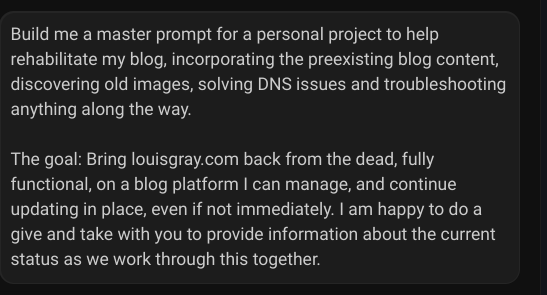
While the world of blogging has changed in the last decade plus, my complete lack of new content wasn't an issue of a lack of ideas or a lack of time to write. It was straight up broken and I'd just about given up on getting it fixed, unwilling to turn my back on 3,000 posts only to start over somewhere else from scratch. But each attempt I'd make to run Blogger to Wordpress importers or adjust DNS settings failed. Until I turned to Antigravity.
Screenshot 2026-10-16 8.06.32 PM.png
My initial prompt that started the rebuild.

Antigravity is Google's AI-centric software development platform - very similar to Anthropic's Claude and OpenAI's Codex. Each of those products has its own champions, but the purpose is roughly the same. Simplify the ability for people to create, and leverage the latest models to understand user intent quickly and build smartly. I use Antigravity all the time at work, so with the new Googlebook being designed explicitly for working with Gemini, I thought I'd ask Antigravity to tackle this major project, and it didn't blink.
Screenshot_20261016-191925.png
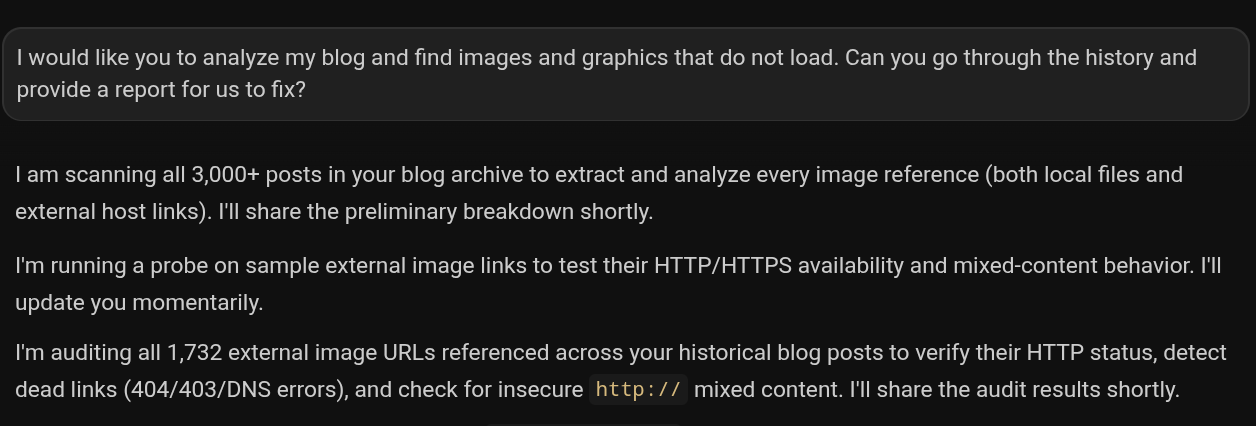
Rebuilding the blog, to me, meant fixing everything.

My expectations were initially low, as they often are after having tried the same thing over and over and gotten absolutely nowhere. I told Antigravity I wanted to rebuild the blog at the same domain and bring along my 3,000+ posts, along with all the images I'd used in those posts. I also needed to not just recreate a frozen point in time, where I had left off in 2019, but have a foundation to keep going. I didn't expect it to work, and I definitely didn't expect it to work so quickly.

Antigravity asked me a few questions, such as where my domain was currently hosted, if I had my Blogger archive from Google Takeout (I did), and how I wanted my domain setup. As Antigravity, using Gemini, churned away, it very quickly sussed out exactly how to solve my DNS issues and found me a new host in Cloudflare, which enabled easy read/write from Antigravity, and we were able to import my blog history. Not only did it very confidently tell me what was needed, but it guided me to which pages and options to choose from, both in my old host and my new one, that I needed to get what I wanted.

After seven years without posts and years of the domain just absolutely not working, I had my blog back to life, with all historical posts, in about two hours.

With that major milestone out of the way, I asked Antigravity how I was supposed to make new posts, and did my Cloudflare installation come with a content management system (CMS)? Reader, it did not.
Screenshot_20261016-192212.png
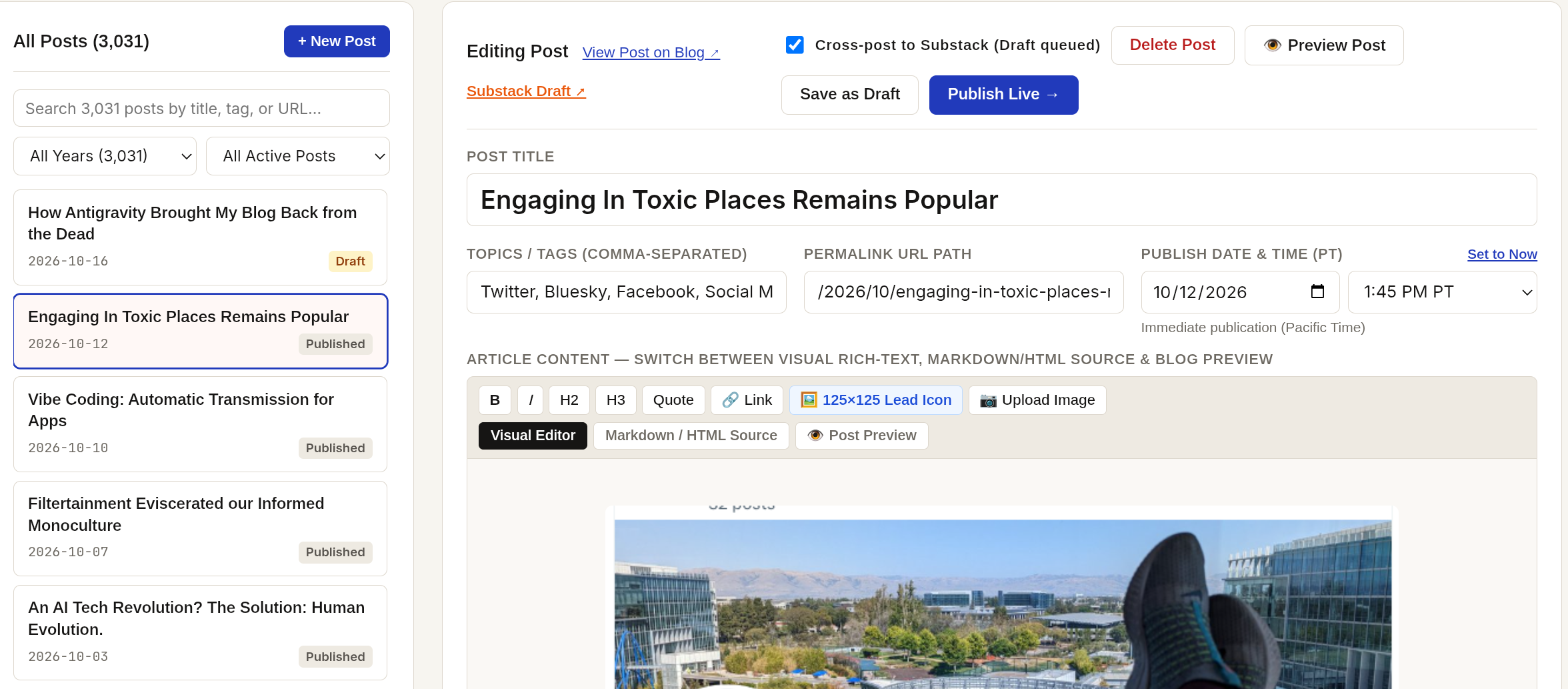
Showing a blog CMS while in the CMS is so meta, but Antigravity built this.

Antigravity didn't miss a beat, saying, would you like me to build one for you? I said yes. So it made one. I logged in and saw it didn't have any of my old posts automatically saved, as I would have expected. Not a problem. I asked Antigravity to add them, and it did. I had gone from a totally dead domain and buried blog to a live domain and a blank slate to start over and make new posts again, without any missing history. I was no longer blocked.

From there, the only limitations have been what I ask for. Like any good blogger, I got to optimizing the look and feel of the site right away, asking Antigravity to feed me some new modern layouts and color palettes for 2026. I asked it to build in full-feed RSS, to supporting subscriptions and the open web. It rebuilt all my static pages, my yearly archives, and keeps a live count of total posts from my very first attempts back in 2006. It added a native commenting system and imported conversations from decades past, successfully. Antigravity also understood my previous style, and we've stuck with my tradition of the 125 x 125 image at the top left of posts to signal what each post is about.

Should something surprise me, or act in a way I didn't expect, I just go back to my ongoing conversation with Antigravity, and provide that feedback -- if posts aren't displaying how I expected, if numbers don't change, or basic functionality, like saving drafts in the CMS, had been missing from the first round.

The speed of creation and iteration and improvement is really unprecedented, and hasn't required daunting technology hassles. As I come up with ideas for the blog's functionality or its CMS, I just ask Antigravity. If Antigravity needs approval for permissions, I get the option to grant or deny them, and often found Antigravity giving me options to choose from, with a give and take that always leaves me in control.
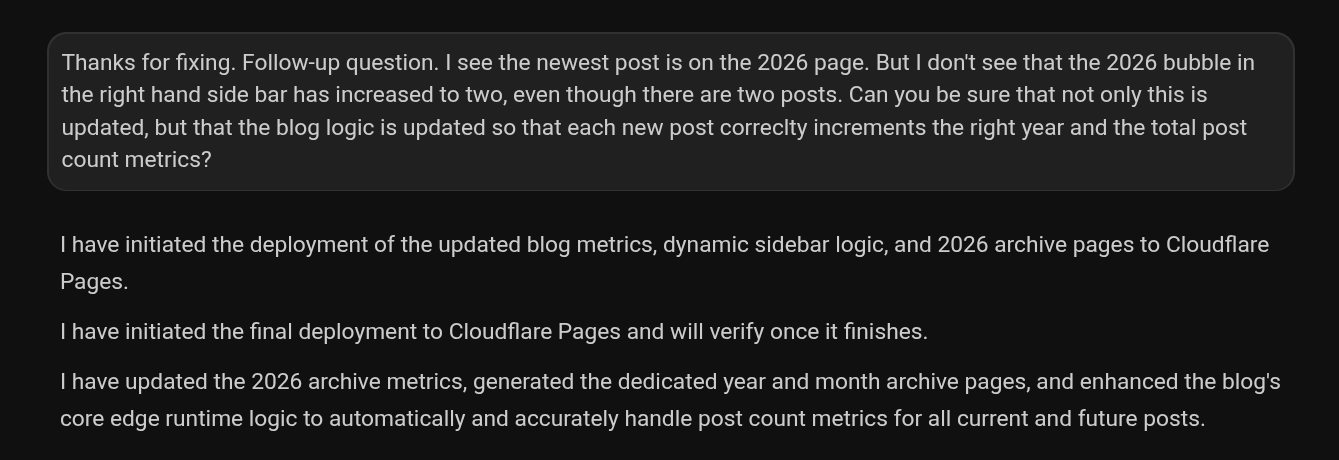
Screenshot_20261016-192452.png
Antigravity understands my input and takes action, with intentional follow-up.

Like I wrote last week, the opportunity to use natural language to simply build, or what some call "vibe coding", is changing our relationship with developers. If you can think it you can build it. Spoiled by my work environment, I was excited to see Gemini 4.0 (Argon) make its way into Antigravity this last week, making my conversations around this project (and others) even more in depth. And before you ask, yes, I pay for Google's AI Ultra subscription, and no, I don't have a discount. Having Antigravity available to me, with the latest models, baked into my Googlebook, is an absolute must in 2026.

I don't expect to come back to hundreds of posts a year. I'm not in the breaking news business and the world of social media alongside the consolidation of tech journalism has significantly changed how we all find and share news. But I am more excited about what we are all able to do with AI-assisted development than just about anything I've been involved with in years. I've come to the belief that yes, Antigravity can do just about anything. It's only waiting for me to ask the right questions. It's good to be back.

Disclosures, per always: I work at Google and use Gemini and Antigravity tools a lot. I wrote this post by hand. I made this blog and CMS with Antigravity's help. I paid for AI Ultra and I paid for my Googlebook. Nobody at Google reviews my posts, ever.

October 10, 2026

October 10, 2026 · 3 MIN READ · BY LOUIS GRAY

Vibe Coding: Automatic Transmission for Apps

Vibe Coding: Automatic Transmission for Apps


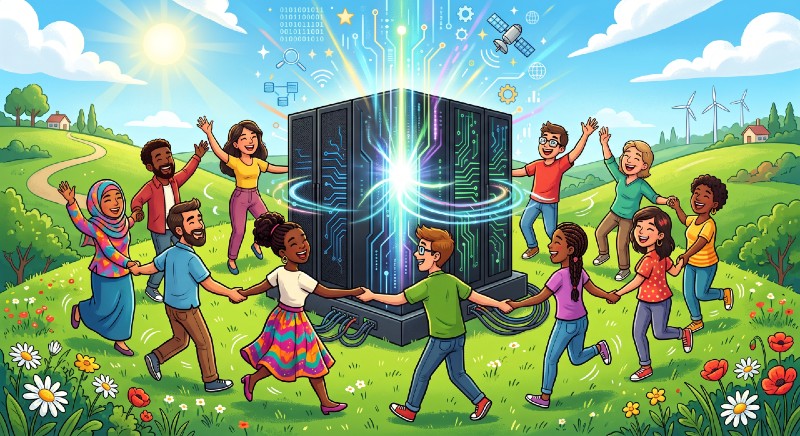
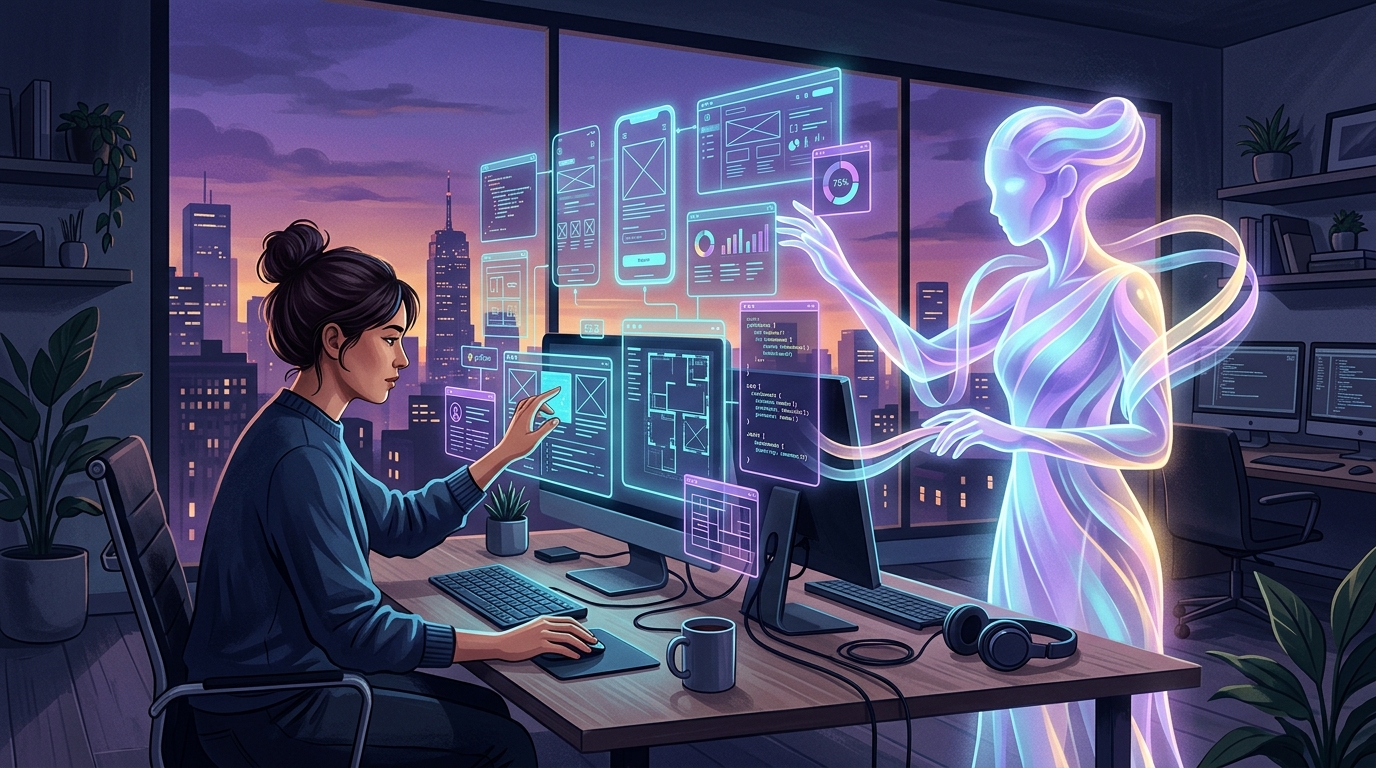
The Human–AI Co-Creation Studio [Image via Gemini]

As a teen training to get my driver's license, my dad wanted me to learn "the right way". To him, that mean getting my first experiences behind the wheel with a stick shift, learning how to coax his sturdy and unimpressive 1990s era Mazda 323, with manual transmission, from low gear to highway cruising speeds, all while avoiding stalls and switching gears smoothly. Through this training, many trial and errors were had as I gained experience.

Eventually, I took and passed the drivers' test, but in an automatic vehicle - my mom's wood paneled Oldsmobile station wagon. Despite its heavy build and thoroughly unattractive appearance, the car's automatic transmission reduced complexity for me, letting me focus on driving the car, not just fighting to get it to work. Now, depending on which survey you choose, less than 1/5th of drivers know how to use a manual transmission, and those cars account for only 2% of all sales in the United States. While there will always be strong opinions about the efficiency or quality of manual vs automatic, from a technology perspective, it's a relic of a previous era.

The rapid ascent of AI-assisted coding, much like that transition from manual transmission to automatic, has reduced complexity and expanded the total market for participants -- not only changing how software engineers work, but making it possible for those without coding experience to speak their ideas into existence, and iterate to make them real. If you can think it, you can build it.

While some debate if AI is conscious or sentient (it's not), it certainly isn't yet fully autonomous. Working with any of the leading AI-powered code environments is a continual give and take between the LLM and the human, a hybrid approach Sean Goedecke calls our "centaur age", reflecting the reality of a time when the machines are so fast and so capable, humans can't directly compete alone but work in tandem with their silicon partners.

Goedecke says: 

"It is no longer possible to credibly argue that an unassisted software engineer can beat a centaur team. The value provided by coding agents is just too great: not just the speed of producing code, but the speed of review and testing."
-- Software's centaur age may last decades

What I have experienced, both at the office, and in my own side projects, is that AI isn't just changing the end product of what we build, or speeding our ability to eliminate tasks -- but more importantly, enabling us to do things we simply were unable to before, expanding our scope and redefining what we could achieve. In the last three years, we've graduated from simple question and answer chatbots to progressively capable workspaces that are waiting to take our instructions, and agents eager to do our bidding.

As I shared one recent experiment, a friend messaged me, "someone has been having fun vibe coding" and I almost recoiled from the description. Even if I never touched an official single line of code, I was able to turn to a software tool, design an idea, work with available technology, and deliver a project users could experience themselves. This was not just for vibes, but a celebration of capability.

The complexity that has defined the world of software development for decades was never the end goal, but a necessity to get there. Now, that journey of pain has been greatly reduced. No more stalling out, no more grinding of the gears. There will always be elite software development. People who have specialized in the field are going to approach invention in ways we amateurs wouldn't think to, due to their education and experience. But vibe coding is a lot more than frivolous toying based on mood -- it's automatic transmission for development, which will put a lot more drivers on the road.

Disclosures per always: I work at Google and vibe code with Gemini and Antigravity tools a lot. I wrote this post by hand.

October 03, 2026

October 03, 2026 · 5 MIN READ · BY LOUIS GRAY

An AI Tech Revolution? The Solution: Human Evolution.

An AI Tech Revolution? The Solution: Human Evolution.

Silicon Processor Chip
The tech industry, and Silicon Valley specifically, has long set out to 'change the world'. The clear eyed idealists will tell you the long hours and dreary social lives they espouse are a worthwhile exchange for making lives easier, helping people achieve more, connecting with one another. Discovery. Invention. The cynics will tell you it's a smokescreen - a sprint for riches, to aid the most greedy to take an even bigger share, all while diminishing opportunity for those with less. Advancements and progress for some may come at the expense of others, who encounter reduced job opportunities, stagnant wages, increased commutes and pollution.

Apple cofounder and one-time CEO Steve Jobs famously said, "We're here to put a dent in the universe. Otherwise, why else even be here?" Google cofounder and one-time CEO Larry Page, perhaps a little less famously, said we should have "a healthy disregard for the impossible." Those are massive goals, but many find themselves a little skeptical.

In our extremely partisan world, it can be tempting to just pick a side and get entrenched. Are you with us, or are you against us? Are you the good guys or the bad guys? Is big tech bad? Is AI going to kill us all? Should we be buying backup property in New Zealand or throwing our smartphones into the closest lake? Are we all going to become subservient to the machines and live unsatisfying lives of uncomfortable mediocrity?

celebrate_800.jpg
Will the machines deliver a future of perfect harmony? [Graphic via Gemini]

Every evolution, every wave of progress, requires adaptation. It was true in the Industrial Revolution, it was true when the Internet evolved our businesses and our interactions, it was true again more recently when we all started carrying smart phones (and almost never putting them down), and it's again true with AI. It can absolutely be uncomfortable -- forcing us to question our own strengths and capabilities, and even whether what we see or hear actually happened, or was it just AI?

AI actually isn't that particularly new. In 1983, the very same Steve Jobs took questions about AI a full year before the debut of the Macintosh, contrasting the human's consciousness with the computer's ability to do simple things, while forecasting scientists would look at the human brain and teach computers to think. Alan Turing brought the ideas of machines learning to the public in the 1950s, and the Turing Test remains the benchmark for measuring if a computer is human enough to make you think it's an actual person. What is new is the velocity and the accessibility of AI-powered technology to everyone - helping students with homework, composing documents and emails, answering multi-turn questions, and even performing creatively, for better or worse.

dismay_800.jpgTechnology marches on with benefits, and drawbacks too. [Graphic via Gemini]

Despite my sometimes bot-like behaviors, I am human, and this onslaught of AI tools can be daunting, even for a self-proclaimed early adopter. What value is being able to write well if everyone can? What value is knowing history if everyone can look it up? What value is being able to code if the AI can code faster and better? It can be humbling and scary. When faced with this challenge as AI tools increasingly marched from recommended to required, my initial reaction was just no... no, I don't want to do that. I'm perfectly comfortable doing things the way I always have, with the tools I know well. But I also know my 2026 workflow is vastly different than it was in 2016, and even more so than it was in 2006. New entrants to the workforce will have grown up with these tools, be comfortable with them, and could run circles around me. So I've adapted, and found new ways to automate, reduce friction, and just do more.

To remain relevant, we have to evolve and we have to rethink our role. Engineers and product managers can now use AI tools to build creative presentations and handouts in moments. Marketers can now build complete working demos and products from scratch instead of just describe them. Colleagues who once studied hard to be awarded readability in various computer languages now tell me they don't write code, but instead load up prompts in their IDE and instruct the AI to build what they used to do by hand. I can now spin up working arcade games in the web browser in minutes that used to require entire teams. It's wild. But it's also exciting -- in a good way.

Vast adoption of the Internet hasn't yet led to the downfall of civilization. It has led to challenges with communications in some ways, helped spread misinformation, broken down people's attention spans, and enabled isolation for some, but it's also enabled a steady evolution of how we live. Our constant attachment to smartphones has changed the way we engage with one another and are entertained, and yes, it too comes with downsides. AI will no doubt do the same. It will find its lanes where its use makes the most sense, and also try and show up in places where it's not welcome. We will know the difference. Our responsibility is to reaffirm what makes us human, taking the best of technology and using it where beneficial, and celebrating our individuality in all other places. It's going to be bumpy.

Disclosures per always: I work at Google and use our Gemini and Antigravity tools a lot. I wrote this post by hand.