Silicon Valley Technology Commentary & Archives · Est. 2006 3,045 Posts · 2006–2026

February 10, 2011

February 10, 2011 · 2 MIN READ · BY LOUIS GRAY

Twitter Issues New Revamped Android Client

Twitter Issues New Revamped Android Client

Twitter was relatively late to the Android client game, purchasing Atebits (and Tweetie) for iPhone and rolling out a high quality experience there while competitors like TweetDeck and Seesmic made inroads on the Google side. But they are working hard on catching up fast, introducing their first native app in April of 2010, and expanding on it with a new version rolled out today. I've been using it for the last 24 hours, and yes, it's better. Some of the advancements are very simple, but the first big step is that the stream of tweets is at the center of the app, instead of a clunky navigation menu that was the hallmark of the previous version.

Opening the new Twitter for Android, once you have signed in with your account, you are immediately presented with the timeline view of tweets from those you follow. Above this timeline are simple icons that bring you to frequently visited parts of the service, including mentions, direct messages and lists. Smartly, the app signifies new content in those mentions, tweets and lists with a small blue dot, inviting you to click over and catch up.
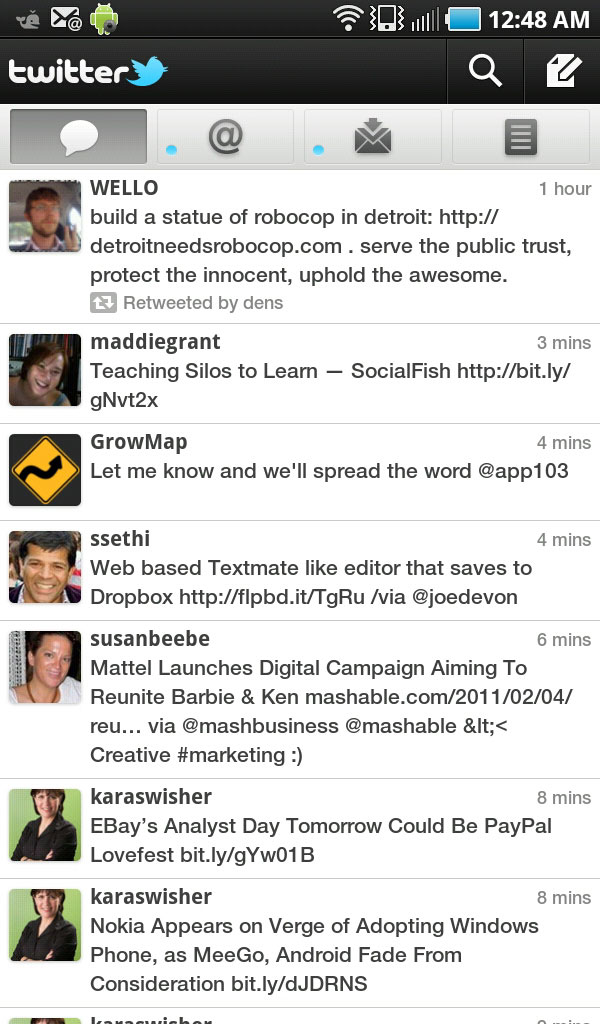

        
The New Twitter Timeline and Creating a Tweet on Android


One of the first things you'll notice with the new Android app is a push to get deep into your contacts - much like Facebook and Google have done with parallel apps. Twitter scours your contacts to find those with associated Twitter accounts, and goes so far as giving you the option to "Follow All" with a single click - not that I recommend it. It's no doubt a great solution for new people looking to expand their network on Twitter, and helps with onboarding, but may be less useful for experienced users.


Contact Syncing and Preferences on Twitter for Android


Twitter also integrates tightly with Android to offer notifications for new tweets, mentions and messages, which can pop to the front of the phone, cause it to vibrate, or simply show a notification light on the device.

Unsurprisingly, other aspects of the Twitter service are also integrated into the app, from suggested users by topic, displaying retweets, and the ever-popular trends that surface daily. You can also browse your previous favorites, or scan lists that you've created and followed.


Favorites and Replies on Twitter for Android


Oh yes, and don't forget to tweet. The new app simplifies tweeting by giving a full-screen view for making new messages. Uploaded photos display as thumbnails and show the size of the photo, which can impact time to post. You can also geotag updates and scroll through those you follow to mention them.

Twitter's goal is to keep their apps simple, so don't expect magical multi-column support, multi-account support and other advanced features for power users. But if you liked the last version, you'll like this one even more.

February 9, 2011

February 9, 2011 · 4 MIN READ · BY LOUIS GRAY

Why We Brought my6sense to Twitter.com via Chrome

Why We Brought my6sense to Twitter.com via Chrome

This morning, as you might have seen from one of the many places that covered the launch, my6sense took its first step beyond the world of mobile, bringing tweets ordered by personal relevance to Twitter.com, in the form of a Chrome Web browser extension. The idea, of course, is to take on the challenge of finding excellent content in your real-time streams and bringing it to the top. More signal and less noise. Working with a team that is small and has limited resources, we have to be smart about our choices, so it's my pleasure to talk about why this is such a big deal, and why we went this way.

Tens of millions of tweets pour through Twitter every single day, according to the company's cofounders, and even through the most valiant efforts, you're bound to miss something, even after carefully hand-selecting those you follow, skimming fast and having great news sources. The idea is no longer a situation where "the news will find me", but instead that you are sipping from the firehose, and your limited time at the fountain means you are seeing select portions of the stream from the time of day you are looking. Meanwhile, in between the best stuff from all your friends and brands, there are a lot of updates that just might personally not be relevant. So something is needed.

Even Twitter says "Our Challenge Is Relevance". We agree and we're hoping to help.
I joined my6sense to help accelerate the third wave of the Web - personalization of streams from all sources, not just to bring apps to consumers. So it's no secret we've been talking since day one of the right way to come to the Web and bring my6sense to where people already participate. We don't want to build a dedicated Web site to compete with our partners and popular Web services, but instead, to bring the magic of our app to where consumers already are.
my6sense in my Twitter stream

There are two ways to bring the intelligence of my6sense to existing streams - one being through their adoption of the Attention API, which some are pursuing, or through other methods that we can initiate, like a dedicated extension that works by service or domain. Twitter, an incredible company changing the way people communicate, has to be selective in how it works with third party APIs, not choosing favorites, so we knew bringing this intelligence via extension was the right move.

Browser extensions now exist for practically every platform - but are most well known for Firefox and Chrome. With the growth of Chrome's browser share, and the browser's overlap with our technology-savvy user base, launching on Chrome was the right idea. Also, starting with Chrome gives us a clear address on the Chrome Web store. No doubt, Firefox will be coming soon, resources depending.

My settings page on the my6sense Chrome extension

But what about the deployment? We knew we needed to make integration into Twitter.com seamless. From the first day we talked about this project, we wanted it to look and feel like Twitter. So our app simply adds a tab to the Twitter.com experience, and tweets are reranked based on user preferences. No fancy UI, just simple integration. Adding on support for URL expansion to preview articles and shared rich media, and we think we've brought real value to existing users without complicating their experience.

If you understand our focus - to implicitly determine your interests based on those items you read and skip, or act on in the Twitter.com interface (such as favorites, retweets, replies, etc.), you know we are trying to reduce the amount of time you spend culling through updates that aren't of interest to you. When people see the difference between the chronologically ordered timeline and the personally ordered timeline from my6sense, the difference is clear. Sometimes the stream may toss up surprises or items that aren't a clear fit, but no software is perfect. The good news is that we're listening to all the feedback, positive and negative, and hoping to make a real impact on the way we all consume and share content.

I hope you'll try our new extension and see how we can improve your Twitter.com experience by bringing the best updates from your friends and brands to the top. You can find the Chrome extension at http://m6s.com/chromeweb.


Disclosure: I am Vice President of Marketing at my6sense.
February 9, 2011 · 3 MIN READ · BY LOUIS GRAY

Convore Brings Bulletin Boards Into World of Real-Time

Convore Brings Bulletin Boards Into World of Real-Time

The new Web never runs out of great ideas for small groups of people to discuss topics with friends, share catchy images and videos and collaborate. From the earliest BBSes to public chatrooms, lifestreaming applications and today's social networking powerhouses, people are constantly searching for new communities and looking for new tools that make it easier to share - either to the general public or in private groups. Even as 2007 to 2009 saw an explosion of mass broadcasting tools letting you reach thousands of people with the same identical message, 2010 and 2011 are seeing a retrenching into more private groups, centered on similar interests, shared experiences or location - hence mobile apps like Beluga, Yobongo, GroupMe and TextPlus. On the Web, you've also seen groups play a role on Facebook, FriendFeed previously and many other sites.

For the last few months, I've been spending way too much of my time in the late evenings on a fun site so secret I never told you - not because of its dark subject matter or inappropriate content, but simply because it hadn't yet been ready to launch. Today, Convore goes live. Started by Eric Florenzano, Eric Maguire and Leah Culver, formerly of Pownce via Six Apart, the team has been building what Florenzano called "a targeted subset of FriendFeed", the once popular social networking site that rose quickly and fell in the eyes of Silicon Valley nearly as fast, being overweighted with features that may have confused the message.

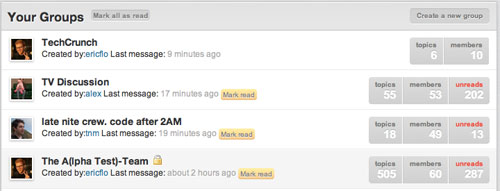
Popular Topics on Convore With Messages to Read

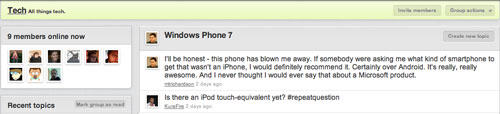
Discussion of Windows Phone 7 on Convore

Eric told me, in a 1-1 phone interview at the beginning of the year that what Convore is interested in is groups and group-based apps, including the communication aspects of this medium. The site is designed with each topic having its own chat room, in a smaller group, for those folks who are interested in specific topics.

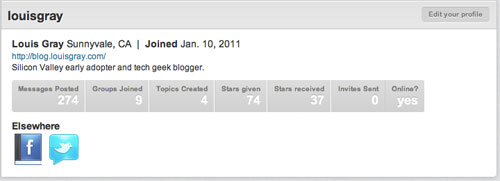
A User Profile on Convore With Stars, Messages Statistics

"We want each group to have its own identity," Eric said. "As Twitter has grown, it is less easy to say things we once did. With a smaller group of your friends, you can feel a lot more comfortable saying whatever the heck you want."

Like any good geek-initiated site, much of Convore's initial discussions have centered around tech, the benefits of Star Trek: The Next Generation and Internet memes. Where the product is especially fun is in sharing of rich media, as the service auto-supports image URLs and hosts them locally. With some momentum, a silly image share can lead to a real-time barrage of sharing from friends that is hard to duplicate anywhere else. You can also star items to reward posters or save the updates for later.

Lest the overlap with FriendFeed be too clear, Convore is funded by Y! Combinator, which includes Paul Buchheit, cofounder of FriendFeed, and a former Facebooker. It's also worth noting the site does not aggregate any external content, but only hosts new discussions. If you start engaging with other users of the site, a helpful "bell" that signals new updates in threads where you are active can keep you as addicted as Pavlov's dog. I've made hundreds of updates there and no doubt will be putting more time into one of my favorite sites. Check it out at http://www.convore.com.
February 9, 2011 · 3 MIN READ · BY LOUIS GRAY

Echo Prepares World for Migration to a Web of Streams

Echo Prepares World for Migration to a Web of Streams

The foundation of the Web is moving from one of unchanging static pages to continually updated streams fed by external services. Gone is the time when publishing an article or a site was the final step in creating content. Instead, this can often signify the beginning of the content's life, as it is shared, retweeted, liked, commented on, and further distributed. Echo, a company that first made its name in the comments space, explained to a full hall of industry onlookers Tuesday morning that dynamic social experiences are going to rule the future of the Internet, further arguing they have placed themselves at the center of this trend, having built a flexible environment for people to tap into the activity streams and benefit from the Web's continued evolution, instead of seeing visitors capitulate to household name social networks.

Companies like Facebook, Twitter and LinkedIn have unlocked billions of dollars in revenue around user streams of content, while traditional publishers have often held to traditional business models, unable to keep pace, said Echo's CEO, Khris Loux. "Today's publishers are ill-served to serve even their own audiences," he said. "The conversations, traffic flow and revenues have moved on."

What Echo recommended was to give publishers, ecommerce sites and startups the capability to craft user-centric, stream-centric experiences themselves, tapping into activity stream data as the unit of currency to power interactive next generation sites. To accomplish this work, the Echo team has created a stream server to deliver real-time experiences that support the existing brand and content without traditional costs of real-time. It was explained the company's new stream server supports thousands of queries per second, with live updates, based on open standards, with each item passing through the stream having the opportunity to be touched with the appropriate action (such as likes, replies, flags, votes, promotes, etc.)

But rather than building out a complex product portfolio to white label or charge premium fees to customers, Echo told attendees yesterday that they work "up to the API" and partner with other startups to connect their services to end users.

"We have coded up to the API and no further," said Loux. "It's scary as we can't solve anyone's problem ourselves. But that also means our partners have as much power as we do."

Echo, since its product shift in 2009, has signed up many top name brands to its platform, some of whom presented Tuesday, including Sports Illustrated. Displayed on SI.com and other partners' sites were real-time comments, user reactions, badges and achievements, and a visually appealing image gallery for hosted graphics. Partners supplying many of these things included Realtidbits, Janrain, Klout, Badgeville, Branchnext, Clicky and Arktan, who claim to have connected to Echo through open standards, enabling customers to switch providers in the future if desired.

"It's the beginning of a new way to look at software," Loux said. The company hopes to also offer a custom application store that enables partners to connect hours of effort to dollars through showcasing their apps on the market. Executing on a planned feature that is stream-centric looks right. Echo's demos from Tuesday and well before are showing real promise about the future of the Web. Rather than shying away from competing with the Web giants, Echo and its partners are set to offer a serious alternative - keeping ownership of the entire social experience on the corporate site.

Disclosure: Chris Saad, an Echo employee, and I occasionally collaborate on the Edge Theory conversations series, and I consider him a good friend.