Silicon Valley Technology Commentary & Archives · Est. 2006 3,045 Posts · 2006–2026

June 21, 2011

June 21, 2011 · 2 MIN READ · BY LOUIS GRAY

Matthew and Sarah Turn Three Years Old

Matthew and Sarah Turn Three Years Old


Excuse the temporary non-tech focus of this post - but yesterday marked the third birthday for Matthew and Sarah, Silicon Valley's favorite set of twins, who were pre-announced on this blog, arrived on June 20th, 2008, wore their unfair share of tech onesies from companies that have succeeded and failed, and celebrated two other birthdays in the interim. Last year, they even welcomed baby number three to the midst and have continued with their mostly upbeat spirits, inviting Braden as part of the family.

Living where we do, in Sunnyvale, just by 85 and 280, the twins live right between the headquarters of two of the world's most successful companies, Apple and Google. Some nights, we drive by Cupertino headquarters and point out all the Apple signs in their various colors... "Look daddy! Pink apple!" or we'll head the other way and have the kids play among the Android robots by Building 44 on the Google campus. The twins have mastered Netflix and YouTube on the iPad, and live in a world when they expect any show they want to be on demand immediately to any device. They refer to my 7-inch Samsung Galaxy Tab as "baby iPad", and the 10 inch Galaxy Tab as "robot iPad".

How deep is their tech immersion? I swear to you the only word Sarah can read is "Google", regardless of colors or font. She can read Google on a page, on a shirt, on a sign and on the Web. "Daddy! Google!"

So yes, two geeks destined for a life of electronics and gadgetry. Could be much worse. As for us, despite the occasional challenges presented by a houseful of little ones, I don't have (m)any complaints. They're delightful and funny, helpful and curious. At times, it seems we've had them in our lives forever, and other times, it seems there's no way they're already three. But they are. Next thing I know, they'll be in kindergarten, and we'll be on our way.

Happy Birthday (+1) to Matthew and Sarah.

June 17, 2011

June 17, 2011 · 3 MIN READ · BY LOUIS GRAY

Regator Introduces Streaming Breaking News App

Regator Introduces Streaming Breaking News App

Regator has had its eyes on the social media and blogging trends space for the last three years, following the introduction of their blog search engine in 2008, expansion to mobile the following year, and expanding to display global trends just last year. A week ago, the company introduced a new application, reminiscent of TweetDeck and LazyScope, which they are targeting at newsrooms and bloggers who don't want to miss stories in their field as they break. The company believes that its ability to closely follow social media channels gives them the ability to deliver alerts to top stories long before they arrive on traditional sites, helping writers get their stories out ahead of competition.

Meanwhile, if you're not shackled by the AOL Way or at a post mill like some of the major blogs, as a consumer, the new app can simply be a fun way to stay on top of the top news on topics you care about, cascading down your stream in a multi-column Adobe AIR app, with Growl alerts bringing new additions to your attention immediately.

Regator's Breaking News Service on My Desktop

With TweetDeck nearly three years old, the environment of a chronologically-ordered multi-column AIR app is very familiar to most. Regator mines its content repository, surfacing alerts from many different fields, including Entertainment, Sports, Politics, Fashion, Travel, Food, Tech and more, and more specifically, trending topics for all of the above, including subcategories like Social Media, Gadgets and Hardware for Tech, or Astronomy, Chemistry and Physics for Academia. You can also add columns for search terms of your choosing, and with the pro application, a Notes tab, intended for journalists sculpting stories discovered in the program.

To get the best handle on the app, I'd recommend starting with top trends in a major area of your interest. For example, my "Trends: Technology" column shows news of the day, from Research In Motion and LulzSec to more consistent updates from the world of iPhone, Android, Yahoo!, and yes, Angry Birds. Clicking any of these specific topics opens it up in a new column, so if you've got a beat that is interested in three or four major topics, you can just leave this app open and let the stories flow.

Top Stories on Samsung Galaxy Tab and Apple in Regator

In years past, I got excited about products like Lazyfeed, which did more than just follow individual blogs you had subscribed to or friends you followed, but topics you selected, and its partner, LazyScope, which combined quasi-RSS subscriptions to the Twitter experience. Regator has delivered an app that uses social as its content repository, but presents it in a way that is much more like a news wire than a social service. So you won't see which social media personality made a story popular, or any traditional social actions, like retweeting or favoriting. Just raw content with links to the source. It's a great way to get caught up on the news you like without having to suffer through all the topics you don't.

A limited Web version of the service can be seen at http://breakingnews.regator.com/recent/, showing breaking news in the topics you select or more global content.You can also get the app on the site by going to https://breakingnews.regator.com/manage/ and clicking "Download Desktop App".
June 17, 2011 · 2 MIN READ · BY LOUIS GRAY

OneTrueFan Introduces Friend Ranks, Improves Badging

OneTrueFan Introduces Friend Ranks, Improves Badging

If you've been running the OneTrueFan bar to follow your activity around the Web, as I've long extolled and done myself, you've gotten used to the ease of sharing great content downstream and racking up achievements, as you work your way to the top of sites' leaderboard. Today, the service introduced an array of visual enhancements which makes advancement more apparent, but more importantly, connects with your external social networks to find how you rank, not just globally, but against your friends as you travel through the Internet.

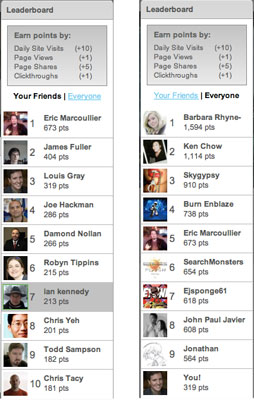
Now, instead of simply seeing the global OneTrueFan leaderboard for any site, you can now toggle between this ranking and a "Friends" ranking, which taps the connections you have made on Twitter or Facebook, surfacing the avatars of your buddies, giving you an even better idea of just what your friends are doing online, and what sites they find valuable. This way, even if you're a house hermit, you're never truly browsing alone. You can also now, for the first time, invite friends from Twitter and Facebook to join you on that site via the leaderboard, with a few clicks.

OneTrueFan Now Divides Friends From the World's Rankings

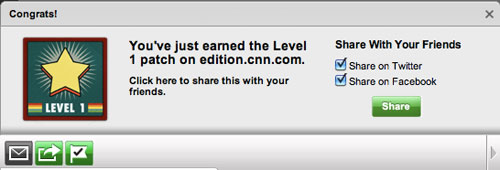
In addition to the friend segmentation, OneTrueFan also made a number of visual tweaks, most apparent to frequent users. Instead of a one-time bar flash that updates you on achievements, the message icon now glows red. When clicked, your most recent accomplishment, from the "Thanks for Sharing!" badge to achieving multiple levels from engagement, to achieving the much-desired OneTrueFan status, will be displayed in a larger, rectangular window, attached to the OTF bar.

The New Badging System on OneTrueFan

The enhancements are pretty slick and welcome for all existing users. It's always fun for me to find which sites my friends visit, and I'm often surprised when I find unexpected people in unanticipated places. The OTF team, on the heels of their excellent analytics package I discussed last Friday, continues to roll out useful updates.

June 15, 2011

June 15, 2011 · 4 MIN READ · BY LOUIS GRAY

Tech Leaders Don't Win By Saying They'll Crush Somebody

Tech Leaders Don't Win By Saying They'll Crush Somebody

The best technology companies in the world, be they in hardware, software or Web services, didn't get there by brashly saying they were going to take out #1, kill them or stomp on their grave. If you think about it, or do your share of reading up on Web history, you'll find that for the most part, the companies who we associate with leadership, be it through quality, market share or traffic stats, reached their position with a near purity of thought on their ability to deliver something new and differentiated. So when you read about company X targeting company Y or setting up to take them down, you can almost guarantee they either won't make it, or company Y is going to change the game again.

In the last few weeks, I've been doing a lot of reading on Silicon Valley history - away from the day to day news releases and rumor mongering, but a few years to a decade back in the past. I enjoyed reading "In the Plex" by Steven Levy, which walks through the rise of Google, and am nearing the end of "The Facebook Effect" by David Kirkpatrick, which goes beyond The Social Network's fight with the Winklevii and walks along Mark Zuckerberg and team as they try to change the world. In years past I've enjoyed plenty of books on Apple, Oracle, Microsoft, AOL and other tech titans, with similar paths.

In the recent cases of Google and Facebook, what you don't see is a lot of crowing about how they plan to "take down" Alta Vista, Yahoo! and Excite for the first, or to crush Friendster and MySpace for the second. In fact, as Levy points out, Google tried to sell itself to Excite in the early days, only to be turned down due to the engine's accuracy being so high it would reduce pages for ads to be displayed. Facebook quickly morphed from a single university system to a march on openness and increased social connections.

In Facebook's case, the failure of Friendster helped the company focus on system reliability to avoid issues that badly damaged the social pioneer, and contrasts with MySpace were common during the network's growth. But you don't see Zuckerberg targeting number one. Instead, he wanted to build a new platform with a higher mission.

Extend this to the world of mobile phones. If you remember the initial launch of the iPhone, Apple didn't talk about being the majority leader in market share. Instead, Steve Jobs set a target of one percent market share by 2008. Sure enough, in 2008, they reached 1.1 percent. (See: Ars Technica) They clearly beat that 1 percent goal, and kept going.

So when I read about challengers taking on big targets and swearing they will surpass them, I can't help but be skeptical. For example:
There are many many examples like this where the hubris outweighs the reality (all deference to the hardworking folks trying to make this happen). In 2008, I wrote that those talking about taking down leaders like TechCrunch and Techmeme only further proved how hard it is to be on top. In January of this year, I said there were no iPad killers, only alternatives. Don't get me wrong. Our iPads seemingly exist just so my kids can watch videos, while I'm much more open to using the Galaxy Tab, but I don't expect iPad sales to go anywhere but up for a while.

Look at who is on top today in whatever category makes sense for you. Social networking. Search. Mobile OS. Tablets. Storage systems. Operating systems. Printers. You name it. You would be hard-pressed to see those companies having talked big about taking down number one when they were on their pathway to success. They probably didn't do it at all.

I never saw Google commercials mocking Yahoo!. I never saw Facebook taking potshots at MySpace. Those throwing stones now should do what the big guys did to get here - focus on their business and do a fantastic job executing on something users really want. If they do, and they get a chance to get noticed, then they will get a chance to be number one. While bravado is fun for internal sales rallies and personal goals, it's probably not the best for a public press position. And those companies who are going to be the next Google, Facebook, Linkedin, Apple or who knows what... they're probably going to creep up on us and not tell the world they're going to do it. Just watch.