
Silicon Valley Technology Commentary & Archives · Est. 2006 3,034 Posts · 2006–2026

February 2, 2007

February 2, 2007 · 1 MIN READ · BY LOUIS GRAY

Playing the Super Bowl Like a Betting Fool

Playing the Super Bowl Like a Betting Fool

It's often said that watching the Big Game is much better if you have a few bucks on the line. Putting money down on the Super Bowl is big business, not just in Las Vegas and Atlantic City, but across the country, as many people make side bets at work or with friends, whether it be simple wagers over who will win the game, or on specific statistics.

For the last three years, my father-in-law and I have had a friendly tradition to bet one against another on a series of more than 100 questions, alternating picks. While in theory, the loser could be out more than $500, the law of averages tends to bring the final total to the mean, making the eventual margin of victory or loss in the much more manageable range of $5 to $50. As I always tend to come close to winning, but never do, the first question he always tends to ask me, before we get started, is "When can I expect the check?" Today, we laughingly decided I can pay him in monthly installments, with a low-low interest rate of about 17%, if I can't come up with the needed cash.

It's a fun tradition, so long as I don't get too wrapped up in who wins the game's opening coin toss, who makes the first first down, whether there will be an onside kick, or if the winning team's kicker will score more than 9 1/2 points. But it definitely puts some new wrinkles in the game. If I go over my answers, I think I should be rooting for Chicago more than Indianapolis, but it's fairly convoluted. Nobody's getting rich off this.

I mentioned our Super Bowl tradition a year ago, last February 4th, in "Miss a Week, Miss a Lot". Regardless of what the final outcome is, we're looking forward to the game.

February 2, 2007 · 1 MIN READ · BY LOUIS GRAY

Google Apparently Isn't Perfect, Sees Downtime

Google Apparently Isn't Perfect, Sees Downtime

At times, with the level of reverence doted on Apple and Google, we can forget that behind these tremendous brands, we have real people and technology that, at times, can fail. Maybe Google and Apple fail less often than others, but when they do, it makes news. Today, multiple reports cited Google Analytics, a free Web site traffic tracking service, had stopped tabulating data, while the company's Google Finance sites also were down.

Last fall, I had installed Google Analytics code on the Web site at work, as well as for my blog. Sure enough, our Google Analytics accounts had stalled, showing no visits. Google didn't come forward right away to confront the outage, and in the blogosphere, the company's delayed response was deafening.

Eventually, Google came forward and cited "system maintenance." Really? Maintenance? In the middle of the business day? I doubt it. Something must have gone down.

GigaOM and TechCrunch have more on the outages.

February 1, 2007

February 1, 2007 · 1 MIN READ · BY LOUIS GRAY

WTF? Technorati Unveils Heat Index

WTF? Technorati Unveils Heat Index

On the Web, there are three types of downtime - one being that you are overloaded with traffic and can't respond to requests, the second being for scheduled maintenance, and the third, when new products are being introduced. If The Apple Store is down, herds of Macophiles jump into a tissy, and last night, Technorati followed YouTube's footsteps by taking the entire site down to launch the anticipated WTF feature, standing for "Where's The Fire"?
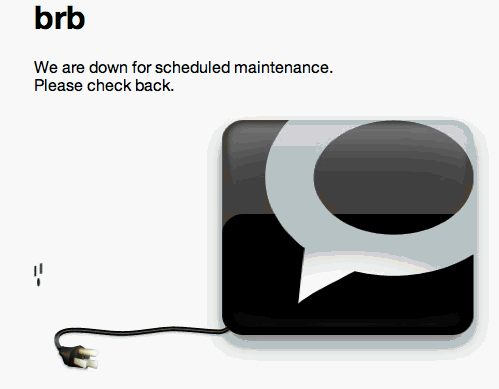
Though the site's frequent instability still causes me concern, the WTF feature shows Technorati is trying to capitalize on the details they have on the blogosphere's tendencies to link and talk about specific topics in near real-time. Just as Google Reader announced Trends, based on the data they had on its customers, Technorati is similarly expanding their feature set, due to their database's detail.

The company's CEO, David Sifry, explains the introduction, saying, "WTF is a big experiment; we're entrusting the most valuable real estate to you - our community - and we think it's going to be a powerful way to make Technorati more useful to you."

This explanation further pushes the blog search site into the user-generated content realm that is so hot in the social networking space these days. I guess one of the first things that will debut in WTF is WTF itself.

Good luck, Technorati. We'll be watching to see if WTF stands for "What Technical Foundation?" or "Wow, They Fixed it!"

January 31, 2007

January 31, 2007 · 2 MIN READ · BY LOUIS GRAY

Scoble's Right: Technorati Isn't Scaling to Beat Google

Scoble's Right: Technorati Isn't Scaling to Beat Google


I want to root for companies like Technorati, who have introduced new features and functionality for today's interactive, social Web. Technorati, when the site is up, is one of the best for tracking the popularity of topics and conversations, or to see which bloggers are among the most frequently linked to. But for months, the site has been riddled with slowness, server timeouts during searches or peak load, and most recently, has seen outage after outage. (The above image was posted on their site tonight, during some updates.)

In the past, Technorati CEO David Sifry has been open about the scalability problems. Just this last July, he commented on a previous note I made about the slowness, saying:
    You make a great point, we've been working very hard on building out the scalability and reliability of the Technorati service... Making sure that regular users like you are getting what you need, every time, quickly, is intensly important, and I want to know if you or anyone you know is having problems, so we can address the issues immediately...

His openness and speaking directly to the blogging community is commendable. I love the personal touch. But the truth is that Technorati still isn't scaling, and as Robert Scoble has pointed out time and again, Google's Blog Search tool is getting increasingly better, closing the gap between it and the blog search pioneers, including Technorati.

Meanwhile, Steve Rubel of Micropersuasion found one likely reason Technorati isn't that focused on keeping their core search tool on top of its game. He discovered on Tuesday that Technorati is planning a Digg-like competitor called Technorati WTF, short for "Where's the Fire"? Yet, that site still isn't live, though it could be coming shortly, causing some of the recent downtime.

Just like I mentioned with YouTube recently, downtime is not an acceptable part of today's Web-driven world. If you can't deliver your core services, then why are you adding new features? Fix what is broken, and learn how to make updates without impacting the users. I haven't seen Google go down for maintenance, maybe ever. If they're up and you're down, where are the users going to go?

Previous Stories:
Silly YouTube - Where's The Redundancy?
Web 2.0 Companies Play With Error Messages