
Silicon Valley Technology Commentary & Archives · Est. 2006 3,034 Posts · 2006–2026

June 10, 2007

June 10, 2007 · 1 MIN READ · BY LOUIS GRAY

Apple Entering Video Rental Download Market?

Apple Entering Video Rental Download Market?

The Financial Times confirmed today what many of us have already suspected, that Apple is working with movie studios to finally offer video rentals from iTunes for the low, low price of $2.99 for 30 days worth of access, including the ability to watch the film via iPod or iPhone.
If this comes to bear this fall, it will be the ultimate video on demand solution, and will help the Apple TV reach its full potential. If Apple has enough relationships with leading studios to deliver an impressive on demand video library, we will be canceling our Netflix account, and will start spending our money in $2.99 increments. Forget going to the theater for $10 or more per person. We'll wait for iTunes.

More of my previous comments on Apple and the dramatic effect the company could have on the video rental market can be found in the below links.

The Apple Blog: How Will Apple Compete With “On Demand”?
louisgray.com: How Apple Could Crush Netflix Now
louisgray.com: The Apple TV Debate is Upside Down
louisgray.com: What is the True Value of an Entertainment Download?

More discussion of the Financial Times news can be found on Ars Technica, Paidcontent.org, Business 2.0, Mashable! and the Wall Street Journal.

June 9, 2007

June 9, 2007 · 2 MIN READ · BY LOUIS GRAY

SportsBlogs Nation Revamps Home Page

SportsBlogs Nation Revamps Home Page

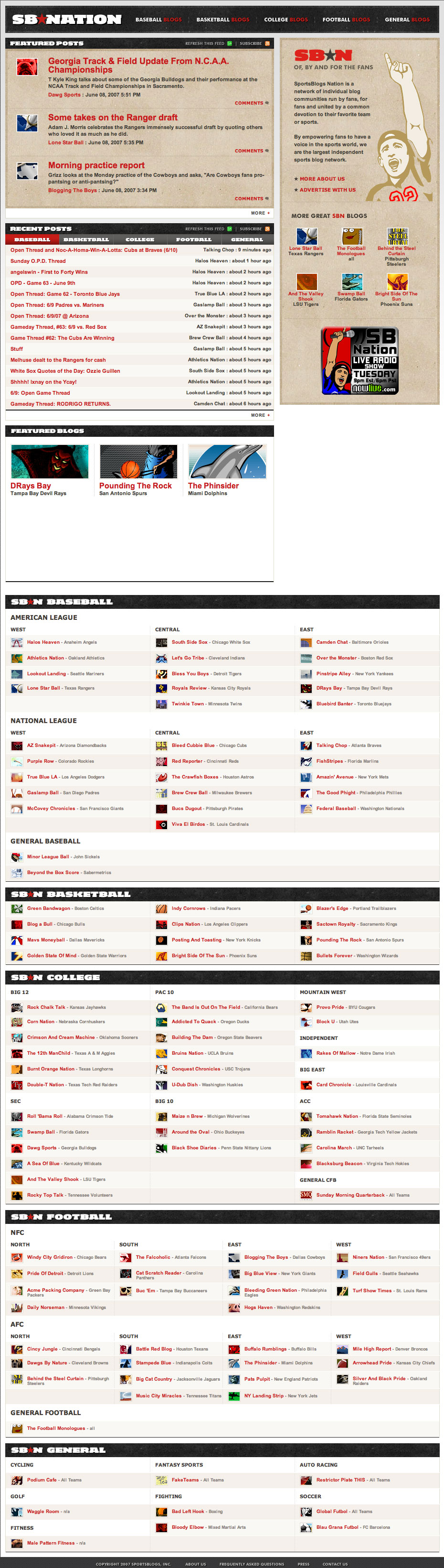
SportsBlogs Nation, which bills itself as "a network of individual blog communities run by fans, for fans and united by a common devotion to their favorite team or sports", as well as the mother ship for both Athletics Nation and Sactown Royalty, two sites where I contribute, revamped their Web site today at www.sbnation.com, in an attempt to best highlight the massive amount of new content being generated daily from the site network's legion of bloggers, who have signed up to cover everything from the major national sports to collegiate, fantasy games, soccer, golf and boxing.

Previously serving as something of an RSS feed aggregator for the network's sites, the new SBNation.com highlights featured posts, recent posts by sport, and showcases each of the network's 112 different sports blogs. That's right, 112, and growing. That's an amazing number, first of all, and if you take the time to visit a few of the sites, you'll be sure to find the quality of fanaticism of the sites' writers and their coverage to be as good as any you'll find in more traditional media.

Markos Moulitsas of Daily Kos, the site's co-founder, has often said that the world of blogs was best suited for the types of topics where people can take diametrically opposing positions, such as politics, sports and religion. Anybody who has ever tried to see if a Yankees fan and a Red Sox fan could reach consensus, or asked a mixed political crowd on the benefits of gay marriage can see that. The massive growth and acceleration of new sites and users for SportsBlogs Nation has proven Markos true time and again, and today's site revamp just may make SBNation.com a destination site in the way ESPN.com and Yahoo! Sports are for more casual fans.

As for me, it's been a long time since I relied on ESPN for my sports news. Truth is, I can usually find all I need to know about sports from the SportsBlogs Nation network and Ballhype. The move from mass media to fan-driven media is in full swing.

A screenshot of the new site from tonight is on the left. Click it to gain a full image, or simply visit www.sbnation.com.
June 9, 2007 · 2 MIN READ · BY LOUIS GRAY

Expanding the Conversation, One Link at a Time

Expanding the Conversation, One Link at a Time

Trying to gain the attention of the biggest, so-called "A-List" bloggers, is like raising your hand in a coliseum full of loud-mouthed spectators. Those on the field you're trying to impress either don't see you, don't want to see you, are distracted, or are well-trained to tune you out, even if you think you have something that could help.

The good news is in the blogosphere, some of the best conversations are best held down here on Planet Earth, not in the stratosphere. And once in a blue moon, if one of us comes up with an idea, it takes hold. So I thought I would note a few reactions to some of my words over the last month or so.

On Friday I said some of the biggest blogs have transcended the blogosphere, and should now be considered "new media". WinExtra agreed, asking, When Does a Blog Stop Being a Blog?. WinExtra says, "I have to agree with Louis that there is a point when successful commercialization of a brand raises you above the roots from whence you began." Kent Newsome, at Newsome.org, agrees, during one of his Evening Reading notes, where he says about big blogs, "The good ones are the new old media. The bad ones are pro sports: all about the money and the bling."

My earlier comments this week about feeling like I needed to read all my RSS feeds by midnight was noted by Piers Jones on Feed Need, who said, in a post on Getting Rid of RSS Guilt, "I can get the same thing when those unread items stack up and you feel a compelling need to try and clear them all and get to the important stuff..."

Speaking of guilt in the blog space, my notes in May about leading bloggers getting blog fatigue continues to have people thinking. On June 5th, a site called TrueGrit, in a post called Suffering Blog Fatigue also said they find times where the task of blogging just isn't fun any more. One commenter asks, why not just post less frequently when it's more important? Other previous comments on Fatigue included BizTips and Robert Scoble. Since Robert's note, his frequency has picked up quite a bit.

To join in the conversation, feel free to leave comments here, or add links to what you find interesting. Links connect us all.

June 8, 2007

June 8, 2007 · 2 MIN READ · BY LOUIS GRAY

The Biggest Blogs Aren't Really Blogs Any More

The Biggest Blogs Aren't Really Blogs Any More

Though my stance is likely a controversial one, I don't believe that the most successful blogs out there are really blogs in the true sense of the word as they were originally intended. Instead, the uber-blogs, like TechCrunch, GigaOM, Engadget, Mashable, Read/WriteWeb and others, have morphed into a new phase of their lives, mimicking old world media.

While millions of people continue to create popular and less popular Web logs chronicling their thoughts, lives and activities, TechCrunch and the rest have instead turned into product announcement and release launching pads, typically lacking a personal touch or insight. They have evolved from their own mouthpieces to instead, mouthpieces for others.

Gone is the personal touch and feeling that is so embedded in the blogosphere, replaced by an air of elitism and selective news aggregation mixed with startups gleeful over a successful data point of public relations.

It's been proven that popular blogs can retain the very personal one-to-one conversational style. Great examples of this include Robert Scoble's Scobleizer, Dave Winer's Scripting.com, Steve Rubel's Micro Persuasion and Jason Calacanis. But especially over the last 12 months, you can see a divergence, as the blog powerhouses are much less about the comments and conversation, and more about them acting like media. Meanwhile, old media, primarily those covering technology, are adding interactive tools made famous through blogging, like comments, and the ubiquitous "Digg This" icons on every story. The convergence of old media and new media is happening before our eyes.

This change isn't necessarily all bad, but I strongly believe the time to refer to these new media sites as "blogs" is gone. TechCrunch, in my opinion, is no more of a blog than is Computerworld, InfoWorld or eWeek, these days. Even InfoWorld has gone solely online, ditching their print magazine equivalent. The site's historical roots are truely embedded in the blog world, but you could say the site has grown up - now with a full network of sites, and even a trade show for startups looking to use the platform as their springboard to fame.

Will all blogs that find success move away from their humble origins? Likely not. But even as we enjoy the scoops, product introductions, reviews and obituaries from TechCrunch, GigaOM and others, we should make a conscious attempt to recognize in this new world of media and the "24 second news cycle", that the landscape is rapidly changing and definitions need constant tweaking.