
Silicon Valley Technology Commentary & Archives · Est. 2006 3,034 Posts · 2006–2026

July 21, 2007

July 21, 2007 · 2 MIN READ · BY LOUIS GRAY

Must-See Documentary: Who Killed the Electric Car?

Must-See Documentary: Who Killed the Electric Car?

While we may be patting ourselves on the back for the small percentage of consumers who have gone out of their way to adopt hybrid vehicles like the Toyota Prius or the Honda Civic Hybrid, the stark truth is that we could be much further along in the process to reduce air pollution and reliance on fossil fuels, were it not for reluctance on the part of the automakers, government and big oil to promote alternatives, like the electric vehicle.

This week, Kristine and I saw a documentary, "Who Killed the Electric Car?", which highlighted the creation, introduction and eventual erasure of GM's EV-1 from the marketplace. Almost single-handedly, the viewing of this film made me realize how much of a step backwards we have taken, just in the last decade. While I had once been vaguely aware of California's mandate to require a certain percentage of cars be electric, I didn't know how that mandate was voided, and how while more and more Americans were being guided toward massive SUVs through tax credits (See: The Hummer), a well-oiled political and PR machine was under way to stop the electric car in its tracks.

Now, having seen the massive potential for electric cars, I am almost unwilling to "settle" for a partial solution like a hybrid, which would only lessen my draw at the pump, not eliminate it. Watching the film, I was furious at how the potential was squandered, and how some early adopters of the EV-1, ecstatic about their cars in the same way Apple fans or Linux loyalists are, were told to go pound sand, and saw their beloved vehicles impounded and crushed in a forgotten desert well away from California's roads.

It's been a long time since a good documentary came around without Michael Moore's name on it that reshaped the way I think about everyday activities like driving. If you are looking to buy a new car, or looking to see what you can do to better the environment, if you are curious about the cold realities of business, or just want to know why we're not surrounded by electric or solar vehicles, be sure to put the video on your Netflix queue. I'm glad we did.

July 21, 2007 · 2 MIN READ · BY LOUIS GRAY

Amber Alert: The 2007 A's Offense Is Missing

Amber Alert: The 2007 A's Offense Is Missing

Tonight should have been a fun night at the ballpark. The A's were in the 4th game of a six-game homestand, coming off a 6-0 shutout win, followed by a day off, and the weather couldn't have been much better. But instead of the glee felt following a victory, we were once again let down by the team's completely inept offense, which had some in the stands murmuring over the possibility of a no-hitter. While history was not made, another nail in the coffin for the 2007 season was solidly hammered in place.

Seemingly by the time Kristine and I had made it to our seats, the A's were already down 1-0 in the first inning, courtesy of the aggressive Orioles hitters. While Baltimore went on to score in four of the first five innings, the A's hitters continued their cold spell, with the first 16 outs being recorded without an A's player reaching base by way of a hit. And when Mark Ellis clubbed a home run over the left field wall to close the gap somewhat, we were almost dismayed, knowing the A's didn't really stand much chance of competing, any more than they had in the just-concluded nine game losing streak.

As has been well documented, this is not an A's offense capable of taking advantage of opportunities. That the first place Angels had already lost their game had no impact on the moribund squad, missing many regulars due to injuries, and seeing Nick Swisher injure his shoulder midway through the contest, thanks to a fielding mishap.

When the painful three hours were over, the A's were again on the losing end, this time by a 6-1 margin. Though the score may change from day to day, the themes are all too familiar. Strikeouts. Popups. Double plays. And an apparent lack of urgency from the team's regulars, who look like they've already said goodbye to the 2007 pennant race.

I've already started booing some of the A's regulars when they come to the plate. I fear that with time, my "to boo" list will increase, unless massive changes start very soon. I won't be holding my breath.

July 18, 2007

July 18, 2007 · 2 MIN READ · BY LOUIS GRAY

Did Trackbacks Die, and Who Killed Them?

Did Trackbacks Die, and Who Killed Them?

In early 2006, I was fairly keen on this shiny new toy called the trackback. Rather than simply add a comment to a story I found interesting, I could send a trackback via my blog to the original source, and in most cases, the trackback, with my story's data, would be placed on top of the comment thread. On other occasions, the trackback would be treated on equal with comments, and made part of the thread itself. Regardless, it was a sneaky way to push my links onto more popular sites. But now, I can't remember the last time I sent out a trackback, and I haven't seen them used all that much. Maybe it's time to roll out the gravestone and write up their epitaph.
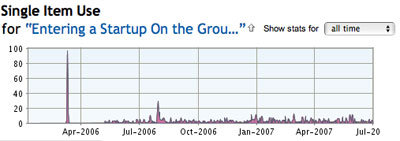
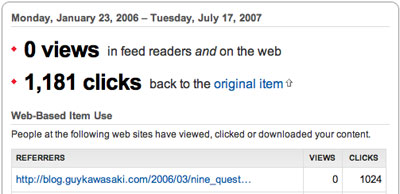
On March 25, 2006, Guy Kawasaki wrote a great, insightful story on "nine questions to ask a startup" if you were a prospective employee. That day, I posted a trackback to the story, referenced in a post I had, called "Entering a Startup on the Ground Floor", which recalled my first experience entering the Silicon Valley as a potential employee in late 1998, and how unprepared I was.

Surprisingly, my trackback not only got me traffic, but sustained traffic. My Feedburner stats tell me that since I left that link behind, I've had almost 1,200 visits to my Web site as a result.


Visits from Guy Kawaski's Site via the Trackback


While not large, considering it's been 16 months, that number trumps any other RSS feed link I've had to date. In fact, March of 2006 was basically when my trackback usage hit its peak. I'd commonly posted trackbacks to sites like Silicon Valley Sleuth and Internet Outsider, to name a few.

And then... I stopped. Maybe it's because I felt like using trackbacks was a cheap form of link spam, and that I wasn't adding value to the original source's story. But while that was part of it, it seems that integrated tools on most blogging platforms, like Blogger, TypePad or WordPress, automatically track who is saying what about you. Instead of relying on trackbacks to show somebody referenced your material, Meanwhile, sites like Technorati show the number of blog reactions, or "Links to this Item", per se.

Essentially, the shininess of the trackback wore off for me, and I expect it has for many others. Rather than take the effort to determine a post's trackback URL, and send a ping to that URL, I just let Technorati and Google Blog search do the work for me. As with many technologies on the Web, something usually comes along better than the last toy, and we move forward. I just hope the 1,000+ visitors Guy Kawasaki sent my way found what they were looking for.
July 18, 2007 · 3 MIN READ · BY LOUIS GRAY

Not All Links Are Created Equal

Not All Links Are Created Equal

There's all sorts of hubbub on the blogosphere in the last few days, over how one ranks authority of bloggers' influence. It is in the aggregate number of links, or the aggregate number of individual sites linking? Should all that be discarded due to the advent of microblogging? Given the current thinking is to throw out total page views in favor of total minutes on a site, as well, it seems the whole concept of how we measure authority is in flux. But while most argue tit for tat on whether a blurb on Twitter counts as much as a link from another blog, there should be no secret that not all links are created equal.

In fact, while one blog could dedicate its story to you, it may not result in 1% of the traffic you can expect from another highly trafficked source, whether it be Digg, or StumbleUpon, TechCrunch, TechMeme, Scoble, etc. Compounding this issue, there is a significant population of Web sites that don't even enter into the radar of statistics aggregators like Technorati, due to the fact they aren't classified as blogs or "the live Web".

A few self-focused examples:

1) Today, my site traffic spiked in the middle of the day to about 8-10x normal traffic. Instead of 100+ visitors per day, my norm, I saw 100+ just between 1 and 2 this afternoon, only to see the one-time spike go away, and traffic return to normal. Was there new content? No. Was there any reason the content got less relevant in the space of an hour? No. So what happened?

A StumbleUpon user found my story from last week on Facebook where I suggested the site would go the way of Friendster and GeoCities before it. Submitted to the popular service, I was seeing 25-40 concurrent visitors on the site, with new ones every minute. Then, as quickly as the spurt arrived, they vanished. Yet, the one link had given me a boost of 100 visitors, not exactly chump change.

2) On July 5th, we saw a similar spike in traffic, to about twice normal, thanks to 100+ visitors coming to the site to see my simple comments that I had gone a full week without filling my need for an iPhone. Again, without any promotion on my part, the visitors came. So what happened?

MacSurfer happened. MacSurfer posted a link to the story, sending all sorts of Apple afficionados my way. Like Digg and StumbleUpon users, those one-time visitors are a cheap date. They show up, don't comment, and move on. But there's no better place to drop a Mac link than MacSurfer, the granddaddy of all Mac link aggregation sites. Of course, MacSurfer doesn't even hit Technorati's radar, so they had no idea the link had occurred.

3) Just two days prior, on July 3rd, we had another spike, thanks to Robert Scoble's mentioning my post on addicting games that can reduce productivity in a story he had written on the Web-based game phenomenon. Interestingly enough, though the Scoble crowd dropped in to the site in strong numbers, not even his A-list credibility could send me as many unique visitors as MacSurfer and StumbleUpon in this round. His crowd was more in the 80-100 range.

It's hard to determine what posts will get traffic, and which ones won't, or which ones will draw comments, and which will be ignored. There's also always going to be interest from people to determine what the most successful, influential, or highly trafficked sites are. It's clear that a link from me to Scoble would drive maybe 1-3% the traffic his way as he could drive mine, so anybody in the business of counting links and assuming they are all equal is absolutely off their rocker. Not all links are equal, and someday, somebody will come up with a great algorithm to show just how much "more equal" one can be versus another.