Silicon Valley Technology Commentary & Archives · Est. 2006 3,034 Posts · 2006–2026

September 15, 2007

September 15, 2007 · 1 MIN READ · BY LOUIS GRAY

A's 11-9 Win Kicks Off Big Sports Weekend

A's 11-9 Win Kicks Off Big Sports Weekend

Come Monday morning, there is little doubt I'll start off the workweek a little hoarse, my voice worse for the wear after what's sure to be a great weekend of sports - as I have two A's games and a Cal Bears football game on the docket.

Tonight, I joined up with a colleague and took in an exciting back and forth game between the A's and the visiting Texas Rangers. While neither team is a threat to make the playoffs at this point, both clubs played with pride. Though the A's started off in a quick hole, down 6-0, they battled back, and on the power of a 7-run 5th inning, actually led at one point by the score of 9-6. But not even that would last, as Sammy Sosa slammed a three-run homer to tie it up, at 9-9.

Astutely, I turned to my friend and said, "I bet you it'll take one team's reaching double figures to win this game..."

Not surprisingly, I was right. The A's Nick Swisher untied things with a moonshot to left field, making it 10-9, and the A's padded on an 11th run for the final tally, more than three hours after the game had started.

All told, the game featured twenty runs, forty base runners, and 210 minutes of action. Not only did my colleague and I enjoy the game, but we had the rare opportunity to sit in a section occupied by the visiting team's sales staff, who made for great company, and really knew their baseball.

I'm looking forward to going back the Oakland Coliseum for tomorrow's rematch at 12:55. From there, Kristine and I will zip up to Berkeley to see our Cal Golden Bears take on Louisiana Tech at 3:30. With any luck, I'll be back here tomorrow telling you just how our teams won both those games...


September 13, 2007

September 13, 2007 · 3 MIN READ · BY LOUIS GRAY

Backlink Backlash Could Bring Forth Change

Backlink Backlash Could Bring Forth Change

My post-midnight ramblings on the questionable practice of overly relying on internal links certainly hit a nerve in the blogosphere, drawing attention from all corners, as we saw comments from Ryan Block at Engadget and Robert Scoble of Scobleizer, while representatives of TechCrunch and Gawker Media also weighed in on whether or not they found issues with the rapidly-growing model of preferring links to their own blog as opposed to the outside world.

Some reactions:

Surflizard: Sneaky Links
"The key to reading Engadget is to know that only the last link in a post is usually relevant to the post’s subject, and every other link is usually self-referencing spam."

Kent Newsome: Evening Reading: 9/12/07
"The problem, of course, comes down to the prospect of money. Rather than double linking, I'd call it double ad-serving. I'd love to know the average duration of those internal link page views."

The Last Podcast: Internal/Double Linking is a Bad Practice
"I am glad others are picking up on this, as it is annoying the heck out of me and keeps me from enjoying some of the best blogs out there."

Ryan Block of Engadget did a great job illustrating why Engadget favors self-referential links over external links. He notes that stories that reference other sources do contain an external link at the conclusion of the story, but he disagreed with my belief that tags should lead to referenced companies instead of prior coverage. In a post he titled On backlinking (or “internal linking”), he said:
"At Engadget, our MO is to offer a compressed, editorialized edition of technology news. Sometimes we can go as long (or longer) as any big-name newspaper on an important story, but because we do (and must!) have greater respect for our readers’ intelligence and attention, generally speaking we expect them to understand the jist of what we’re talking about when we start to geek out."

Essentially, he said Engadget readers already know the URLs for companies like Apple, Google, or Microsoft's XBox, so to link their way wouldn't add much value. Fair enough. But he did say the site will reevaluate their frequency for backlinking, adding, "I’m sure we could use additional fine tuning in what and how often we backlink, which I’ll be evaluating closer starting today."

His comments mirrored those from Mark Hendrickson of TechCrunch, who wrote in a comment on this blog, "We often link to CrunchBase pages rather than company websites because we think that our company profiles often give readers better corporate overviews than they would get by going straight to company websites," adding, "We do realize that many readers find this linking behavior undesirable, so we are actively looking into ways we can refer to both corporate websites and CrunchBase pages from the main blog."

Elsewhere, Nick Denton of Gawker Media wrote that the network has recently changed how they handle internal links versus external links, writing, "We have changed the style of internal tag links. They are no longer underlined. So the emphasis is on the external links, but regular readers know they can get background on a name or a product by clicking the text."

In 24 hours, we got an excellent cross-section of some of the tech blogosphere's most influential and most respected blogs. With the exception of Mashable, all sites I referenced, or commenters referenced, provided reason and updates as to why they operate the way they do.
(UPDATE: Mashable checked in this morning, saying "We have a verbal policy that the first link should go to the site in question, so that one is human error," and "I can guarantee that we'll try to avoid the LinkedIn type screnarios. As for linking to reference material...possibly we'll find a way to offer the user a choice.")

That's why, even when I see things that raise my eyebrows, I have faith in the direction blogs are going, and how we can continue to enable conversations. It should be interesting to watch and see how after the post ran through the Scoble/TechMeme gauntlet, if we see changes.

September 12, 2007

September 12, 2007 · 2 MIN READ · BY LOUIS GRAY

Internal Linking On Some Tech Blogs Is Out of Control

Internal Linking On Some Tech Blogs Is Out of Control

It seems the more major bloggers tend to ask for the same rights, privileges and respect given traditional journalists, the more frequently I'm seeing some of them violate best practices for information sharing and news gathering. One major issue I see is that some of the most popular blogs, including Engadget and Mashable, prefer to lead readers deep into their archives rather than linking out to the true sources of the story.

What do I mean by this exactly?

In real-world journalism, a reporter impartially offers up the news, as well as balanced commentary from individuals involved, whether they be the subject of a story, witness, or interested party. All efforts are taken to introduce the reader to the source of the information. On the Web, a story on Apple's iPod would link to the Apple Web site or directly to the iPod page. But if you look at Engadget, a hyperlink you would expect to take you to Apple would instead either take you to a previous story about Apple, or to search results within Engadget on the term Apple.

And now it seems Mashable, one leading Web log which follows the hot tech news of the day, is taking the same approach, much to the detriment of readers - many of whom likely find themselves clicking first, and asking questions later.

For example, from tonight's story: "Obama On LinkedIn"

The reporter writes:

"Sen. Barack Obama now has a LinkedIn account. We all knew that Obama is making the most of Internet culture, launching his own social network, gaining a larger-than-life presence on MySpace, YouTube, and even Twitter. He’s at the top of his game, according to a recent Nielsen study. The only surprise about Obama’s LinkedIn account is how seemingly late it is."

Being a typical reader, I would expect the three links in this paragraph, to LinkedIn, Twitter and Nielsen, to take me to those services' respective sites, as my links do. But they don't. Instead, the links go to related prior stories from Mashable, in an effort to keep the reader locked into the site as long as possible, either to increase ad revenue, or to possibly make the reader think the site more valuable due its deep archives and previous history.

In June of this year, Yuvi Panda analyzed Engadget and found that more than 40% of all links from Engadget were back to itself, "about 25 times the number of links of it’s closest competitor (which incidentally happens to be EngadgetMobile, an offshoot of Engadget)." Engadget, an unquestioned leader in gadget and tech news, should feel confident enough to send readers off site and expect them to come back.

When I link internally, I introduce the link as a previous post, and when I link to Engadget, you'll know the link goes to Engadget, not a previous story I wrote on Engadget. I believe the practice of hotlinking keywords instead to internal stories is sneaky and doesn't serve readers who are looking for the true sources of information. I hope we see the practice's growth stop cold.

Update: Robert Scoble calls the practice "double linking", while Joe of SurfLizard proposes a new term for this practice: "masterblinking".
September 12, 2007 · 1 MIN READ · BY LOUIS GRAY

Microsoft PowerPoint Chews Through My Hard Drive

Microsoft PowerPoint Chews Through My Hard Drive

Anybody who has used Microsoft Office products for a significant period has likely perfected the keyboard shortcut to auto-save repeatedly through the creation of critical documents - whether in Word, PowerPoint or Excel. It's quite possible every single one of us knows the pain of seeing the application crash, taking our critical data with it. To avoid complete data loss, over the years, Microsoft has instilled "AutoSave" and "AutoRecovery" features, so if your Office app inevitably does crash, you don't lose all that much.

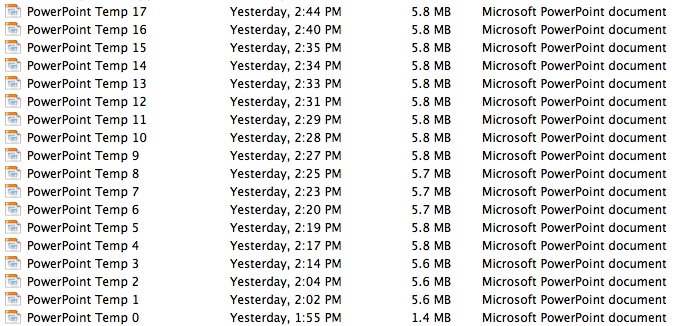
While I appreciate that "feature", I was amused late tonight when I looked in the folder of a PowerPoint document I was updating earlier today, only to find Microsoft went out of its way to save my hide, archiving no fewer than 17 different temp files, with snapshots taken anywhere from 2 to 10 minutes apart. All told, these 17 backups absorbed 99.2 MB of my precious hard disk space, while the original document is a comparatively slim 5.9 MB. (See below)


Thanks Microsoft for going the extra mile to keep my data safe!