Silicon Valley Technology Commentary & Archives · Est. 2006 3,034 Posts · 2006–2026

February 16, 2008

February 16, 2008 · 1 MIN READ · BY LOUIS GRAY

Yes, Macs Can Crash Too

Yes, Macs Can Crash Too

The first sign I had a problem was when my iTunes started to sound like a broken record. It just played the same note over and over. Then the e-mail I had half-written stopped letting me type into it. I tried to force quit, and nothing happened. The Mac was toast. My cursor had disappeared, and not even the famous three-finger restart would flip it back on. I had to hold down the power key until the MacBook Pro shut down all the way. After bringing it back up, not only was that e-mail gone, but the new blog template I had been working on reverted to the state I had it, around 1:30 this afternoon. I wasn't working on it for the full five hours or anything, but I definitely lost some work.

So... yeah. I'm not feeling too tech friendly right now. More tomorrow.
February 16, 2008 · 1 MIN READ · BY LOUIS GRAY

Mashable Divides Early Adopters and Harsh Reviewers

Mashable Divides Early Adopters and Harsh Reviewers

A Web service's adoption cycle certainly has multiple stages - from its initial development, to seeding with bleeding-edge adopters and test accounts, gaining word of mouth and referrals, leading to more early adopters and tech aficionados, before being poked at by more mainstream folks, and eventually, technology laggards.

A key element of graduating a service to the mainstream is a positive review from an objective, trusted, third party. Once the trusted third party gives the service their blessing, it's a sign the masses can sign up and expect it to work flawlessly.

In a great post this morning, where I happen to be mentioned a few times, Mark Hopkins of Mashable admits to both wanting to be in the early adopter role, and find services first, but also, needing to play the more cautious role of harsh reviewer, a role shared by blogging compatriot Steven Hodson. Where I may express excitement about potential, they can express caution or annoyance if a bug gets in the way.

In marked contrast, when I find a bug in one of these new services, I typically have made a screenshot and e-mailed it to the developers... and I'm currently in the QA phase for a few services we'll be talking about in the next coming weeks, playing that role before it's time for their unveiling.

So... depending on where you live in the adoption cycle, you might love a new service's potential, or you may hate that it doesn't do everything you want immediately. But we know our role, and when Mark thinks these services have passed the threshold for a Mashable endorsement, that will be an exciting day for entrepreneurs who keep tweaking their code.

See: The Early Adopter vs. The Harsh Reviewer

February 15, 2008

February 15, 2008 · 2 MIN READ · BY LOUIS GRAY

FriendFeed Admits They Know Me Pretty Well

FriendFeed Admits They Know Me Pretty Well

Of all the different sites I've talked about over the last year which look to bring people together with similar interests and shared viewing habits, none has driven more consistent activity and real sense of community than FriendFeed. The site offers friends a meeting place to aggregate, follow, and interact with a diversified set of Web services. Starting first as a centralized in box for all my activity across the Web, it's added social functions with comments and "Likes", the ability to post directly to the site, and now, as of yesterday, FriendFeed has unveiled a sweet set of statistics worth obsessing over.
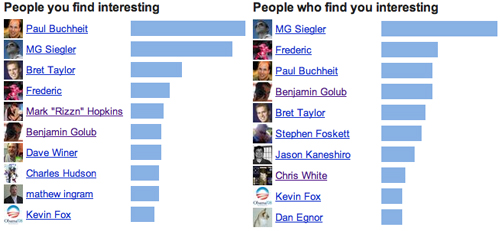
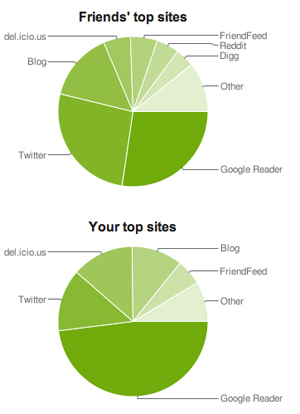
FriendFeed co-founder Bret Taylor, in a blog post titled "Personalized FriendFeed stats", shows how the team rolled out a set of simple graphs, showing the top ten people I find most interesting, the top ten people who find me interesting, what types of services my friends like, and what are the top sites which I like. People I find interesting are tabulated by entries I've commented on or liked, and top sites are determined by the last 30 days of my activity.

Looking at these statistics at first glance, I'd have to say there aren't any major surprises.


I have a pretty good idea whose updates I most look forward to, including those of FriendFeeders Paul Buchheit, Bret Taylor and Kevin Fox, B-Listers MG Siegler and Frederic Lardinois, Mashable's Mark Hopkins, RSSMeme's Benjamin Golub, and Mathew Ingram.

I also knew that the highest percentage of activity I deliver to my own FriendFeed is through my Google Reader shared items. Nothing can compare to it in sheer volume. Lagging behind Google Reader for me are Twitter, Del.icio.us, louisgray.com and FriendFeed itself. Of more interest was seeing how my friends' top sites show Twitter almost equal to that of Google Reader, and del.icio.us playing a smaller role, with Digg and Reddit breaking out of the "Other" category.

Also extremely interesting (and humbling) was seeing the stats from Bret Taylor and Paul Buchheit.

Paul Buchheit's statistics (shared on Flickr) show me as the FriendFeeder he finds most interesting, narrowly beating out his own wife, Jess Lee of the Google Maps team, Bret Taylor and MG Siegler.

Meanwhile, Bret Taylor had me in the #3 overall position, behind Paul and Jess. Not too shabby.

Now, the question is, with these stats available, will I try to over-compensate by using less-favored services to give them a piece of the pie? Will I start making more comments to other friends and mentally reduce those for others, to affect the rankings? I hope not. In order for FriendFeed's latest innovation to work, the data needs to be true and not manipulated, despite human nature. Regardless, it's yet another sign that FriendFeed is innovative, fun and listening to its users. Now, I've got to go back to FriendFeed and add some more comments...

Also See: Paris Lemon: FriendFeed Can Now Tell You Who You Find Interesting
February 15, 2008 · 2 MIN READ · BY LOUIS GRAY

Expanding and Explaining the Early Adopter Role

Expanding and Explaining the Early Adopter Role

Over the last few days, I've been delighted to see some very positive comments tossed my way, discussing my recent focus on social feed aggregators, and shared link engines. I've been excited to see some of these new services be discovered and launched through louisgray.com, and it now seems the blog's turned the corner, if I were to rely on my e-mail box as an indicator.

A significant percentage of traffic to my personal e-mail now consists of would-be PR reps hoping I'll cover their story, small bloggers hoping I'll link their way and share their story with readers here, or notifications that I've gained new subscribers to my Twitter or FriendFeed accounts.

As the author of one stealth service wrote me the other day, "One thing I know for sure - if we get beat to market by a competitor, you will likely be the one to post that scoop! :)"

Another developer in quasi-stealth, writing on Thursday, seeing the early discussion we've had around AssetBar, ReadBurner and others, sent an e-mail, "It seems like you're fast becoming the blog expert on various types of content aggregation services."

That's quite a little niche. Don't you think?

I've talked a bit before about what I want to do with louisgray.com - share new and exciting services as they come to market, talk about how I'm contributing to or benefiting from technology, and continuing to offer a human face to the fast pace of Silicon Valley. That this is happening more and more is exciting and daunting. Now, it's no longer enough to tell you I upgraded the software in my Apple TV (which I did) or give you an update on my bowling scores from tonight (crappy and a little less crappy), or whether I think the Oakland A's Rich Harden has any merit in his case against their medical staff (he does). Now, I expect to share ideas with entrepreneurial spirits in the RSS and link aggregation space. Now, I am playing a more journalism-like role, seeking out interesting services that have been neglected. And it's a lot of fun - not that I'm without detractors.

On Wednesday, My B-List partner in crime, Steven Hodson, complained of "Aggregator Overload", saying "There comes a point when too much is really just too much." He said, like social networks, there are many players in the space, and he won't need to join every one, that it's already "a flooded field". While there's certainly some overlap between each of the services, in my opinion, they've all been noble in their goals, and each has something unique to share. I count myself as an avid user for just about all of them.

Part of being an early adopter and a champion for the entrepreneur means giving early versions of the software a little slack and seeing where developers want to take their service. If it's too much, then pick the ones you find useful and keep using those, while the more bleeding-edge folks will play the early adopter role and wait for you. The best services will still be there when you're ready. Hopefully, more of them will choose to start their lives here.