Silicon Valley Technology Commentary & Archives · Est. 2006 3,034 Posts · 2006–2026

February 18, 2008

February 18, 2008 · 2 MIN READ · BY LOUIS GRAY

FriendFeed Discussions Break Through the Walled Garden

FriendFeed Discussions Break Through the Walled Garden

Part of FriendFeed's allure is the concept of openly sharing comments and items from various Web services with friends and other like-minded individuals. The service, started by a group of former Googlers, so far has maintained its lofty technophile intellectual bent, largely as former Googlers have linked to friends who are current Googlers, and other technology-loving people have been drawn to the service, like moths to a flame, myself included.

But as the service has grown more popular, and as comments or shared items are typically made visible to the entire world, it's no surprise that the idyllic concept of these conversations forever remaining private is starting to show cracks. Today, we saw the first fissures in that foundation, as a pair of Google-focused or tech-watching blogs keyed in on comments made via FriendFeed, and pulled them outward to the unfiltered blogosphere.

See: Criticism of Unreserved Google Praise and Valleywag: Quotable

As recent FriendFeed hire, Kevin Fox, wrote in response to seeing one of the articles, "ripping the blanket of implicit FriendFeed privacy through obscurity seriously wigged me out, though I of all people should have known better." Another, Jim, simply added... "Uh oh, the party's over."

Only yesterday, a virtual war of words broke out between TechCrunch's Michael Arrington and Fred Wilson of A VC over the responsibility that bloggers attempting journalism should take - including original research. But those in the public eye, including those of us publicly making comments on FriendFeed, should expect those conversations to be at risk of repeating as primary source data, just like you take a risk any time you send an e-mail, make a comment on another blog, or post a note on Facebook. Anything that can be copied and pasted is fair game for a lot of people trying to make news and break news.

While it's with some regret we see FriendFeed moving beyond the initial stage of "a small beta site filled with a small group of friends", as Kevin Fox put it, it's also a wonderful milestone. I hope FriendFeed continues to grow rapidly, and that those using the service, notable quotables or otherwise, don't suddenly clam up due to the increased risk of potential exposure.

February 18, 2008 · 2 MIN READ · BY LOUIS GRAY

FeedBurner Quietly Kills All-Time RSS Feed Stats

FeedBurner Quietly Kills All-Time RSS Feed Stats

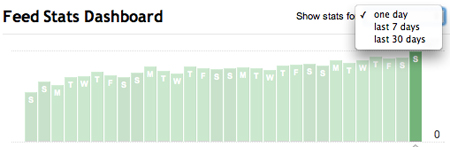
FeedBurner, the RSS syndication engine behind the vast majority of leading blogs, now part of Google, quietly turned off the ability to view all-time statistics for individual feeds at the end of last week, erasing years of accumulated data, without any explanation. Now, instead of seeing options for "One Day", "Last 7 Days", "Last 30 Days" and "All-Time", feed owners can only see statistics over the last 30 days at maximum, and it doesn't look like there is an "Pro" version that lets us get them back.

When FeedBurner was acquired by Google last year, the company made a lot of noise about how what had previously been premium services would now be free, with Google footing the bill. (See: FeedBurner: From Fee to Free: Should We Flee?) I was then worried that the company, not seeing inherent revenue-associated value, might slow the innovation. But to remove features outright, possibly in an effort to reduce data storage or bandwidth demands? I never expected that.


Google is great! So... where are my all-time stats?

So, what's the big deal? The big deal is bloggers that have relied on FeedBurner for any good length of time just lost all access to historical data. We can no longer see how our RSS subscriber growth rates are changing over time. We can no longer see accumulative statistics for click-throughs to popular articles, and and we can no longer show when our feeds reached specific milestones.

For a great example, just look at my December 28th post, "Feedburner Milestone Reached: 200 Subscribers". In that post, I noted when we hit 50 subscribers, 100, and then, 200. Well, the big news would be that last night, for the first time ever, we reached more than 500 total subscribers to louisgray.com, but now, I can't show you that all-time graph. It's gone.

And FeedBurner remains silent. Their official blog hasn't been updated since November of 2007, and as customers beg for an explanation in the site's support forums, there hasn't been any response.

We already know the blogosphere loves their RSS. We know they love their stats too. So, I'm a little surprised more folks haven't caught on to the fact this data's been erased. What's the deal, FeedBurner?

February 17, 2008

February 17, 2008 · 2 MIN READ · BY LOUIS GRAY

Companies That Listen to Their Users Will Win In the End

Companies That Listen to Their Users Will Win In the End

Continuing in our discussion of acting in the role of early adopters, I've really enjoyed having the opportunity to communicate with developers of new services as they've come to market - sometimes getting the first public account, and helping shape how these new products are interpreted and discussed. And more often than not, while I've certainly been exposed to a lot of new applications, it's those that keep innovating and keep listening that have me bookmarking and engaged.

In August, I wrote a post entitled "Use Your Blog To Talk To Companies", illustrating a few good examples of how companies like Google, MyBlogLog, Technorati and LinkedIn took suggestions I had made on my blog, and made changes to their product, sometimes coming back to tell me they'd upgraded.

In the ensuing months, I've seen this on an amazing scale. Whether it's been ReadBurner, RSSMeme, AssetBar or FriendFeed, my favorite new applications are working together with their users, as partners, to make their products even better.

FriendFeed co-founder Paul Buchheit spells out this process in his blog today, saying, the most important thing to understand about new products and startups is that it's important to release a product early, gain users and listen to them. If you don't, you might keep tweaking and tweaking a product, never finding it complete. (See also: Mathew Ingram: Being smart isn’t always enough)

AssetBar is another perfect example of this. After opening up the service in beta to some early accounts, they've gotten some strong feedback from different corners of the blogosphere, begging for updates to their user interface. Some have said it's too slow or too complicated, or they've erred in favor of features over simplicity. And AssetBar has answered. In a post on Valentine's Day, called "Lots to Learn", Israel LHeureux wrote "the bottom line is that we are really excited to improve Assetbar UI so it’s simpler and easier...Thanks for the critiques, folks–we have our marching orders. And I still have lots to learn."

The key word? Humility. The AssetBar guys have it in spades, and I know they'll get there with time, if they continue to listen to their users, who continue to offer feedback, from th@talldude to Two Point and Unique Frequency.

As famous NHL star Wayne Gretzky once said, "I skate to where the puck is going to be, not to where it has been."

I think I know where the puck is going. It's going to the companies that continue to listen. When it comes to developing new Web services, it makes sense not to copy those companies that have come before, as to offer a me-too solution that completely lacks differentiation wouldn't attract users the way a new service that continues development would. And there's no question some of the new ones won't have everything nailed in the first round. Development takes time, and it's hard, or else somebody else would already have it nailed.

FriendFeed listens and participates with you. AssetBar listens. Benjamin Golub of RSSMeme and Alexander Marktl of ReadBurner listen. Adam Stiles of LinkRiver listens. I love it. Keep up the good work, everybody, and keep listening.
February 17, 2008 · 1 MIN READ · BY LOUIS GRAY

Updated Blog Design and New Features

Updated Blog Design and New Features

While the changes aren't too dramatic, I am pleased to introduce a cleaner, more informative look to LouisGray.com, including the introduction of a new site logo and slogan, as well as newly introduced pages - one to serve as an "About" page, and the other, an ever-growing repository of "Coverage", highlighting select links from around the blogosphere and media discussing content here.

As the new slogan suggests, LouisGray.com is "Home for early adopters, technology geeks, RSS addicts and Mac freaks." With the site's gaining newfound attention from a greater number of sources, ranging from Mashable and Read/Write Web, to ReadBurner, Twitter, AssetBar and FriendFeed, I thought it made sense to have the site speak to new visitors as well as repeat visitors.

The new pages can be found here:

LouisGray.com: About: http://louisgray.com/live/about.html
LouisGray.com: Coverage: http://louisgray.com/live/coverage.html

If you find bugs, please do let me know. If you think I missed something major, or you hate the new updates, also please let me know.