Silicon Valley Technology Commentary & Archives · Est. 2006 3,034 Posts · 2006–2026

April 26, 2008

April 26, 2008 · 4 MIN READ · BY LOUIS GRAY

You Can Only Pitch Me In Reverse Polish Notation or Pig Latin

You Can Only Pitch Me In Reverse Polish Notation or Pig Latin

As the world of journalism/old media gets increasingly blurred with bloggers/new media, some of the larger news-breaking bloggers are finding themselves inundated with pitches from companies looking for additional exposure. In an effort for some top bloggers to reduce the total noise sent their way, some are spelling out the right way and the wrong way to pitch them. But for any company looking to make a name for themselves, how can they possibly remember who wants to be communicated how?

Take a look at some of the more high-profile bloggers who have, at one point or another, said there is one approved way to get their attention:


Stowe Boyd of /Message writes Via Twitter, "The Only Approved Way To Pitch Me" is via TwitPitch.
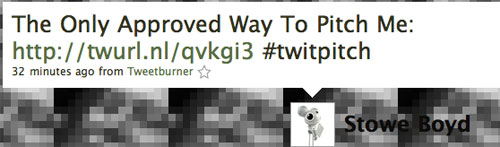

On his blog, he writes, in Twitpitch Is The Future, "Companies will be directed to this page to get the idea, and those that try to stick with the bulging email approach will suffer a three-strikes-and-you're-out rule: After three times of being warned, they go into the spam category."

Upside to him: Less e-mail, more clarity on whether something is being sent his way to write about.

Downside to the company: Their pitch is visible to everyone, making it clear they are shilling, and exclusivity is eliminated.


Marshall Kirkpatrick of ReadWriteWeb says the site gets "piles and piles of pitches for coverage from companies all day long and they almost always come in by email." His recommendation for would-be article subjects would be not to send an e-mail, not to call, not to use Twitter (even Direct Messages), not to use Facebook or Instant Messenger. Instead, he wants you to use RSS!
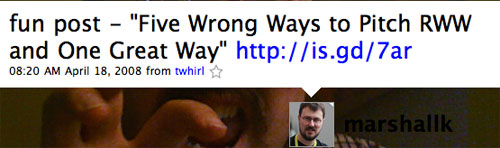

His idea there is that PR folks should send RSS feeds for client blogs and news releases, so when updates are made to their blogs, he'll see it, at his leisure.

Upside to him: Less e-mail, and the ability to enjoy/actually use Facebook, IM and Twitter without getting pitched.

Downside to the company: No understanding as to whether ReadWriteWeb actually "saw" your pitch, absolutely zero pre-pitching, and zero exclusivity. This way, RWW wouldn't get the news until it was out. In fact, Marshall says this is only for things that are public with no embargo, even pushing people back to e-mail for those.


And last year, Robert Scoble famously said Facebook would be "a new kind of press release". In the face of a growing e-mail tsunami, he said Facebook wall messages would be passed to his Nokia phone. He says, "now we have a new way for PR people to let me know about their apps. Write it on the wall please. Facebook: the new press release."

Of course, this only works until every PR person figures it out, and Robert would end up with the same information glut, just moved somewhere else.

Upside to him: Lower e-mail flow and fewer phone calls.

Downside to the company: Not every company uses Facebook or considers it professional. Facebook pitches would get lost amidst others wishing Robert a happy birthday or any other notes, and again, they would lose any chance at exclusivity or an embargo, after pitching in public.


So what do we have here, just in these three examples? We have three prominent bloggers with three very highly differentiated, inefficient ways of soliciting engagement with public relations and companies. While it's extremely popular these days to dish on old media journalists and claim print is going the way of the dodo, even the biggest reporters at the high-profile media outlets can still be reached by phone or by e-mail. They're not making you jump through hoops to get their attention.

To me, while its likely bloggers are looking to make their own lives easier, and looking to utilize available technology tools to bring clarity to the process, it looks like a sign of weakness. Can't handle the data glut or the outreach coming your way? Somebody else will. Somebody else with the ability to write as quickly as you can, with the right tone and a big enough audience, who can be reached by e-mail or by cell phone, or by Twitter or Facebook or FriendFeed or anything, will write that article and get that news coverage you miss.

Do you really think companies are going to remember to pitch Marshall at ReadWriteWeb via RSS and Stowe Boyd by TwitPitch and Scoble by Facebook? Knowing PR companies, I know they won't. Most of them still believe in the spray and pray method of e-mailing all contacts under the sun. There needs to be change, but making everybody jump through hoops while losing the personal engagement, exclusivity and timing won't work.

UPDATE: Elliott Ng, in the comments, gives us some good links, including Brian Solis' article on PR 2.0: In Blogger and Media Relations, You Earn the Relationships You Deserve and Rafe Needleman of WebWare complaining on Twitter about being pitched via Plaxo.

April 25, 2008

April 25, 2008 · 3 MIN READ · BY LOUIS GRAY

What's Your Twitter Noise Ratio?

What's Your Twitter Noise Ratio?

The many thousands of people who use Twitter do so in wildly different ways. Some use it to deliver minute by minute updates of their daily activity. Others use it to hold conversations with friends and peers using the service. And still, a good percentage of people use Twitter as a broadcast medium to announce items, but not necessarily to engage. Meanwhile, as Twitter has grown, its not uncommon to see people either following, or being followed, by thousands of other users. Some do so reciprocally, while others are more discerning.
I feel there are different categories of Twitter users, from those who have a listening audience, measured by a high "followers" to "updates" ratio, those who are engaging, seen with near equal "followers" and "updates", and those who are more noisy, with a lot more "updates" than actual "followers".

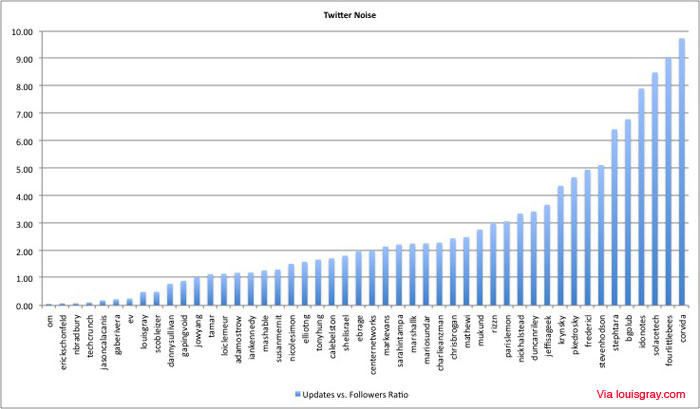
Taking a look at 48 Twitter users I either follow or engage with, I found the average number of "tweets" per "follower" was almost exactly 1, measuring at 1.02. But the ratio of updates to followers varied widely, from the sleepy 0.06 (@om) to the firehose-like 9.75 (@corvida). And surprisingly, those Twitterers best known for creating a lot of noise, like Robert Scoble and Jason Calacanis, were quite in line with their number of followers, measuring in with ratios of 0.50 and 0.18 respectively, making their perceived noise to be in fact, a consequence of their engagement.

Download the Microsoft Excel data file

One of the informal guidelines I've used since opening my Twitter account a little over three months ago was to maintain an updates/followers ratio of less than one. I feel if I "tweet" too often, those following will opt out or gain in annoyance. As of today, my ratio is at 0.49, with 318 updates for 644 followers, putting me on the quiet side in comparison to the others I looked at.


A Twitter "Noise" Chart for 48 Users

(Click for Larger Image)

Of note, this was done by hand, via Excel, without fancy algorithms, so it can be assumed to recognize a point in time from Friday, April 25th.

Twitter's Listeners (Ratio of Updates to Followers of Less than 1)

Twitter's Middle Ground (Ratio of Updates to Followers of 1 to 2.0)

Twitter's Conversationalists (Ratio of Updates to Followers of 2.0 to 5.0)

Twitter's Megaphones (Ratio of Updates to Followers of more than 5.0)

This is, of course, a simplistic analysis of a select number of Twitter users. An argument could be made that those with thousands of updates are flat-out noisy, regardless of how many followers they have, but I also believe that being selective in one's tweeting habits can lead to an increasing audience for further conversations. If there's an imbalance between how often somebody is tweeting and how many people are choosing to follow them, it could be the noise has grown too loud.

Have any better examples of odd ratios between total number of Twitter updates and total Twitter followers? With thousands and thousands of users, there's no way this 48-person list gets everybody. What's your Twitter noise ratio?

April 24, 2008

April 24, 2008 · 5 MIN READ · BY LOUIS GRAY

Profy Rolls Out Combined RSS Reader, Blogging Platform

Profy Rolls Out Combined RSS Reader, Blogging Platform

Profy wasn't satisfied by simply rolling out a brand-new online RSS feed reader to challenge the established leaders, including Google Reader, NewsGator and Bloglines. With one massive update, the new service, launched in beta yesterday, not only gives Web users a new option for RSS feed consumption, but also, a new blogging platform, with interesting features that integrate the two, as well as linking in to other Web services, including Blogger.

While the world isn't lacking for RSS readers, Profy's combined offering is very interesting. With some fine-tuning as the company moves out of the beta process, the service could be very compelling to both established bloggers and new ones looking for a simplified platform to get started.
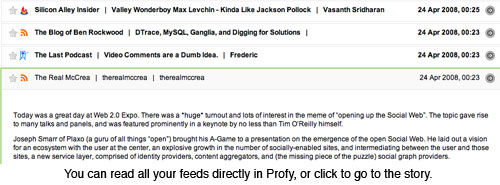
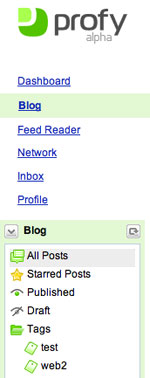
There are a few facets to Profy to focus on, including the "Feed Reader", the "Blog", the "Dashboard" and their messaging system or "Inbox".

The Feed Reader operates much like others out there. I imported my 260 or so feeds from Google Reader, and Profy recognized the folder structure. The Feed Reader is laid out cleanly with multiple tabs, enabling me to select from "Posts", reading the available items, "Feeds", showing me the name of the feed, its URL, and giving me the option to make edits, and "Folders", matching those I had in my OPML file.

I can read posts in list view, showing the source, feed name and author, or I can select expanded view, showing the entire post in the reader. Those are the basics. And aside from adding keyboard shortcuts, like Google Reader and AssetBar, there's not too much to demand before the company hits 1.0.


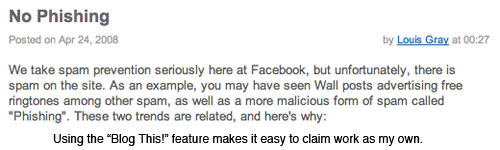
In the Feed Reader, I can "Add Star" to highlight a post, E-mail it to a friend, add tags, or most interestingly, I can hit "Blog It!", which pre-populates a post in my complementing Profy blog, including the full text and links of the post. Profy essentially copies the full text and headline of the post in my own blog, with me as the author, leaving the deleting to me. It's a cool tool, but one I could see abused by spam bloggers, should they ever get into the system. In my testing, it was easy to use, and I could simply post a Facebook story as my own (See the below screenshot). Profy does give credit to the source in the bottom right corner of your own post, but I expect it'd be a bit better to tweak "Blog It!" to instead focus on the headline and URL.


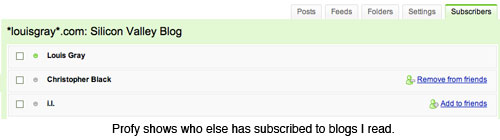
The Feed Reader also offers some strong flexibility. I can search my feeds for keywords, and I can look at the "Subscribers" link on any feed to see if other Profy readers are subscribed to that same blog. From those results, I can even "Add to friends" to get connected to similar Profy users who like reading what I do.


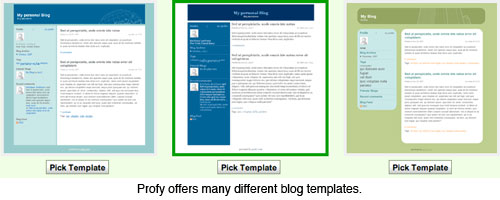
The Blog operates like those in TypePad and Blogger. There are a wide array of blogging templates provided by Profy, and you're given a Profy URL, like TypePad, with your own username: (For example: louisgray.profy.com)


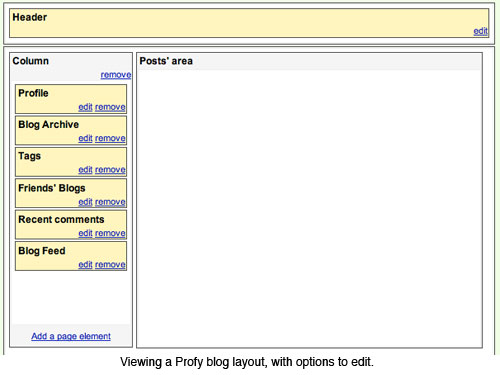
Once you've selected a blog template, you can edit the layout of your blog, make new posts, or further down the road, read or moderate comments on the site.


Posting to Profy is simple for any TypePad or Blogger user. There's the option to post in either WYSIWYG or HTML, and you can use helpful buttons for styling or for adding images and YouTube video.

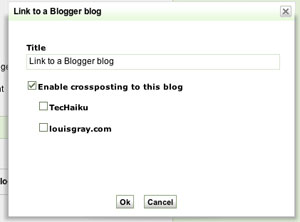
But most interesting to me is the ability to cross-post to Blogger or other platforms from Profy. If I were to move to Profy as my RSS reader or blogging platform, I wouldn't have to change a thing on louisgray.com. I wouldn't have to move files from the FTP site, or tweak Blogger in any way, as Profy could cross-populate both the Profy.com hosted blog and my own, just by linking the two. In testing, it was transparent to me that both posts from my Profy blog hit the louisgray.com site. To be honest, I was hoping to make it less transparent, so I could "push" individual posts to louisgray.com or Techaiku, instead of it happening automatically, but I expect either I was missing a step, or they'll make that option in the future by the 1.0 release.
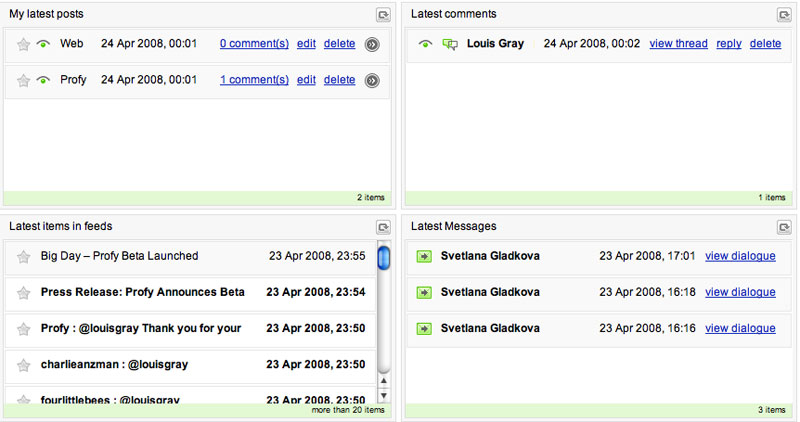
Once the Feed Reader and Blog are up and running, you can manage all activity via Profy's Dashboard. From the Dashboard, I can view blog posts, read feeds, see comments made on my blog, or exchange messages with other Profy users. And any friends I've found through Profy automatically populate my Network, which assuming service growth, would expand over time.


Click for larger Dashboard image

For a beta product, Profy has done a solid job in introducing a lot of good functionality not usually found even in some of the more established feed readers, or blogging platforms. The idea of linking the feed reader and blog, while not abandoning existing services, is a good one. Obstacles in their way, aside from the usual efforts of growing awareness, and keeping up with user expectations, would be to follow the lead of Fav.or.it or others to enable commenting from RSS feed readers to the original blog, integration of Disqus in either area, and the ultra-important area of keyboard feed navigation.

The question is, can Profy rise up, in 2008, to challenge the established leadership of TypePad, WordPress and Blogger? The big three hold a commanding mindshare and user base, which is formidable. But so long as Profy makes it transparent and easy to move data into their service from others, and continues on the path of innovating and linking their disparate services, they have as good a chance as any.

If you're interested in getting your hands on Profy, it is in limited invite-only beta. I believe I have five available, but with any luck, I can get more. Let me know if you're interested!

April 23, 2008

April 23, 2008 · 3 MIN READ · BY LOUIS GRAY

Plaxo Pulse Making Strides, But to What End?

Plaxo Pulse Making Strides, But to What End?

In the spirit of unifying comments from disparate services across the Web, Plaxo and Disqus made a strong announcement Tuesday, giving users the ability to have comments made within their lifestreaming service, Plaxo Pulse, to flow back to the original blog. The company's VP of Marketing, John McCrea, eagerly said the addition was a natural response to the discussion a few weeks ago around fractured comments and how many bloggers wanted to maintain a central repository for activity. And it is indeed a good addition, but I still need a big push before I'm on the Plaxo bandwagon.
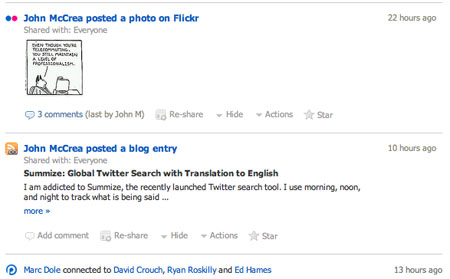
There's no question Plaxo Pulse has been an interesting development within the service over the last year. But the company's origins, as a business contacts database, similar to LinkedIn, have led to it being seen as a business tool. For me, the contacts I have in Plaxo, thanks to many invites over the years, are largely colleagues, business contacts, or partners - in contrast to more social databases, including Facebook, Twitter or FriendFeed, which are comprised of Web peers, casual acquaintances and friends.


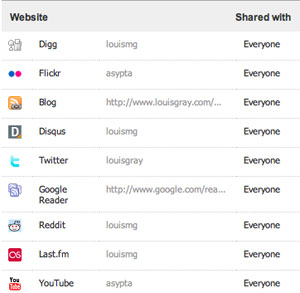
Some shared items in the Plaxo Pulse feed


Due to this basic difference, while I have the willingness to share my Digg, Del.icio.us, Last.fm, Google Reader Shared items and other activity on some services, I'm much less likely to do so in Plaxo, and by extension, I would also be uncomfortable offering comments on Plaxo contacts' blog posts, etc.
What Plaxo is asking me to do, by asking me to start streaming my content in Pulse and interact with contacts, is to proverbially mix business with pleasure, in a way that will certainly muddy up how I'm interpreted, as contacts start to see me on a casual, personal level, and not through the usual, more professional routes of communication. While I'm certain the company is under intense pressure to leverage the contact databases they have on their site and become a full-fledged social network, like Facebook, I feel that making a shift of this kind runs contrary to their original intentions, making it extremely difficult to succeed.


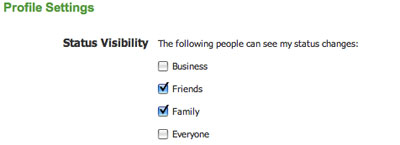
Plaxo lets you distinguish between family, friends and work.

This isn't to say Plaxo hasn't considered the problem of making such a dramatic shift in the public eye without losing its existing customer base. No doubt with the issues I brought up in mind, Plaxo has enabled categories of contacts, from "Business" to "Friends" and "Family", making it possible that I could show my personal streaming data only to Friends and not Business contacts, for instance. That's a smart move, one I expect other lifestreaming services to borrow. But not even this granularity solves the basic problem of what the site is known for and what they're now trying to be. Putting wings on a car doesn't make it an airplane.

Just because a business network starts to add social functionality doesn't make it a social network who would be a willing audience for my other activity on the Web. And that goes for LinkedIn as well. LinkedIn is a fantastic tool for showing connections to others, for doing research on companies, and keeping tabs on contacts who change companies. But I wouldn't want to take what is essentially an online resume being viewed by colleagues, recruiters and potential employers, and start to crowd that data with the songs I like, the posts I write, and the stories I Digg. Even if all my comments were kept in a single place, why would I want to start that conversation there anyway?

So the core question exists: Can Plaxo make a successful transition away from acting as a business contacts repository and into a social network with lifestreaming capabilities? It takes more than simple aggregation to become a destination site, and while I respect the efforts that have been made so far, and their optimistic direction, I'm quite tentative to take the plunge. Are we instead moving to one massive database with friends, family and business across all services, or is the delineation I still have in my head as to which site does what still valid?