Silicon Valley Technology Commentary & Archives · Est. 2006 3,033 Posts · 2006–2026

July 31, 2008

July 31, 2008 · 2 MIN READ · BY LOUIS GRAY

SocialMedian Opens Up and Launches Beta

SocialMedian Opens Up and Launches Beta

More than three months ago, this was the first blog to discuss SocialMedian, the social news service created by former Jobster CEO Jason Goldberg. In the last 100 days, the site has grown to encompass more than 4,000 users, who have themselves created more than 1,000 individual news networks, each tailored to sharing specific topics, driven by keywords, collaborative filters, and bookmarked items.

All this progress took place while the site was under invite-only alpha. As of tonight, the site opens up to all comers, in beta, which should set the service toward what will either be significant growth, or simply short-term curiosity.

SocialMedian is best described as an amalgamation of pieces from FriendFeed, Digg and Del.icio.us. Like in each service, you can bookmark external items, and share them with friends. Like with Digg, each item gets a total count for how many times it is "Clipped". You can see my own page to get an idea of what I've clipped over the last 100 days, who is following my updates, and who I'm following (like FriendFeed does).

SocialMedian's adherence to news topics so far separates it from FriendFeed. You can follow Web 2.0 or Politics or Venture Capital or one of the many news networks that have sprung up, and when you clip items, SocialMedian automatically assigns the item to one or multiple news networks.

But turning on the switch from alpha to beta wasn't just a matter of passing a date. In the last month, as SocialMedian readied for opening in beta, the service added mini-profiles, so you can learn about a person before following them, you can assign someone as a "newsmaker", the equivalent of a faux celebrity, and invite friends using your existing accounts on GMail, Hotmail, Yahoo! and other services. (Being frequently named as a "newsmaker" is what was behind my recent iPhone win)

When joining SocialMedian, if you choose to do so, it helps to register a nickname that matches your Twitter ID, if you have one. This triggers the service to autopopulate other sites, using the Google Social Graph API, and helps to automatically suggest to users who they should follow, based on those people they follow on Twitter and FriendFeed, and the popular friends of those users.

The site officially started development in February, and launched in alpha this April (when I first wrote about it). They've come a long way in just five months, and now that they've opened their doors, it will be interesting to see if they can get something resembling larger momentum. I've come across a lot of social news, aggregation and lifestreaming sites over the last few years, and SocialMedian is on my short list that frequently has me checking in. I'm eager to see how the site changes now that they are starting to get the attention of folks like TechCrunch and CNET.

See Previous Coverage:

July 30, 2008

July 30, 2008 · 5 MIN READ · BY LOUIS GRAY

Matthew's Story: From CenterNetworks' Future to Fired In A Month

Matthew's Story: From CenterNetworks' Future to Fired In A Month

Finding a writing position at a brand-name blog is hard to do, especially without having a significant resume, not to mention any references. So when Allen Stern of CenterNetworks offered my newborn son, Matthew, a position on his excellent blog, we of course struck at the deal. But in just a month, what at first seemed like a dream come true turned out to be a sordid tale of broken promises, unsafe working conditions and tears. A week after Stern publicly announced Matthew's firing, as a family, we've decided to tell our side of the story.

The fierce competition between East Coast and West Coast blogs these days is rivaling the old time feuds between East Coast and West Coast rappers. Based in New York, Stern has long been seeking the opportunity to open a Silicon Valley bureau, so this spring, when he learned we were expecting twins, he struck early, asking to sign up "whichever of the two kids was bigger". I naively accepted, not knowing that his request was due to the incredible stress that blogging and filing stories can be for a newborn.
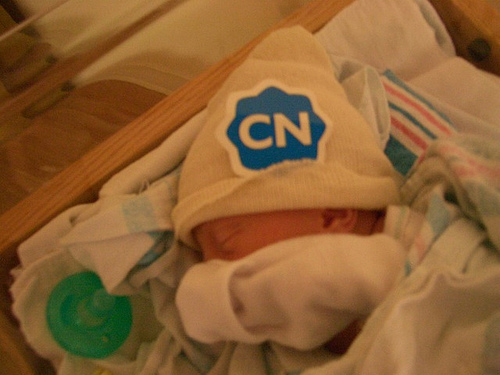

Matthew Signed On to CenterNetworks In Days

Matthew and Sarah arrived on June 20th, he weighing a robust 5 pounds, and she, trailing at 4 pounds, 3 ounces. That made Matthew the candidate of record. The next four days were a whirlwind of deal-making, contracts being faxed from coast to coast, with little being given up on either side. Finally, the agreement completed, Matthew announced his signing, and was photographed with the world-famous CN sticker. The next day, Stern announced it to the world, and while he said "Of all the people I've hired over the years, this negotiation was the toughest," his listed demands were later proven to be a slap in the face.
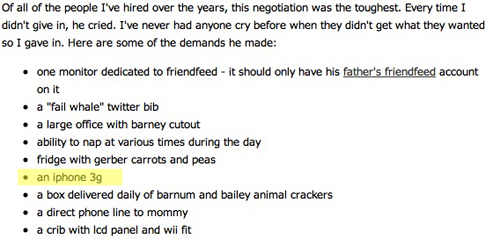

Stern's Initial Set of Promises Included a New iPhone


But Stern Later Went Back On His Word


Over the next two weeks, Matthew made significant headway with CN, reaching out to Bay Area startups, reviewing alpha versions of Mac software and Web services, and even, somehow, transcribing quarterly conference calls. But while Stern publicly lauded his efforts in an update, the long hours, fatigue and strain were already becoming quite clear. As you can see from the follow-on post, Stern had openly reneged on the promised iPhone 3G, saying Matthew would get it "under no circumstances", despite it being promised in the initial agreement. Similarly, the promised crib with LCD panel and Wii Fit never materialized, which Stern attributed to "inventory shortages". Making matters worse, Stern would frequently call Matthew's home number at the start of East Coast business hours to talk strategy, despite it being only 5 a.m. Pacific.

The long hours and stress saw Matthew often falling asleep in front of his keyboard after filing a news story. He soon began to complain that he was unable to relax and casually visit his favorite sites, fearing an irate Stern would notice the gap in submissions and send yet another series of e-mails with even more assignments. And with every "like" or comment he placed on FriendFeed, Stern would just lose it - saying he was slacking off, or even worse, claiming he was manipulating activity on the site through creating hundreds of fake accounts. But it wasn't true, and try as Matthew would to explain he was just trying to catch up on the world outside of CenterNetworks, Stern wouldn't listen, ranting about how Mashable had scooped him on some new Facebook widget, or how ReadWriteWeb had gotten an exclusive look into a new AIR application that sent updates to Flickr and Twitter simultaneously, on Matthew's watch. The once promising job with significant career potential had spiraled into despair of inter-office politics and accusations that left Matthew depressed and unwilling to spend time with his sister or peers.
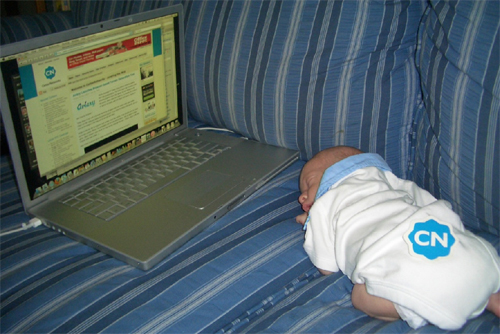

Matthew's Long Hours At CN Took Their Toll

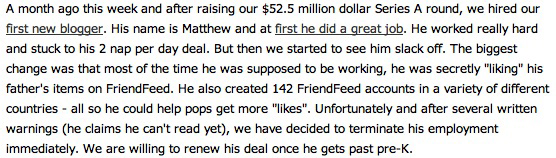
It all came crashing down early last week, on July 21st. The first sign was when Matthew's CenterNetworks e-mail stopped working, and the daily shipment of Barnum and Bailey animal crackers didn't arrive. Then, two of the stories Matthew had filed were printed under Stern's byline, without his being mentioned as a contributing reporter. But Stern wouldn't take phone calls and Matthew was left to fend for himself. The next day, we realized what had happened. Stern, in a public missive, fired Matthew, without contacting him or myself, and continuing his rant about how Matthew was slacking off and creating FriendFeed accounts, accusations later proven untrue by FriendFeed interns Dan Hsaio and Ross Miller, who looked into the the service's logs following the allegations.

Stern's Hallucinations Fueled the Firing

Over the last eight days, as a family we've had to do a lot of soul-searching. Matthew, for one, swears he's had it with the blogging business, though it's not clear what line of profession he intends to take next. And if that weren't enough, on Monday, the long-promised Barney poster finally arrived, a stark reminder of one of the many unfulfilled promises by Stern and his crew. What should have been a case of spotting talent early, and helping to guide a young prodigy through the ranks instead was one that smacked of servitude, double-speaking and unhappiness. While we know we have a legal case against Stern and CenterNetworks proper over the unfulfilled iPhone, lack of proper advance notice of contract termination, and unfair child labor practices, we're going to swallow our pride and move on as a family. It's been hard, but we felt the right thing was to leave with our heads held high, without dragging this out through the morass that is the American judicial system.

So Pete "Peanut" Carreira, Stern may be whispering sweet nothings to you now and calling you a serious Seesmic star, but watch your back and protect yourself before what happened to Matthew happens to you as well.

July 30, 2008 · 3 MIN READ · BY LOUIS GRAY

New Facebook Design Confuses Many, Obscures Features

New Facebook Design Confuses Many, Obscures Features

By Jesse Stay of Stay N' Alive (Identi.ca/FriendFeed)
(UPDATE: I wrote this post originally with the intent to show several missing features, which appeared to be missing to me over the last week or so. As you can read in the comments, I was very quickly corrected - either Facebook has recently re-added those features in place, or they are, as I mentioned in this post, just hard to find! I realized we had something bigger on our hands - If Facebook can confuse me, how many others will also be confused? I've modified this post to reflect that.)
With every new site redesign comes angry users ready to criticize the change. People just don't like change. I saw this first when I redesigned the site, SteepAndCheap.com (where I went by the nick, "SAC Hacker" in the forums). We saw every possible reaction to the new design on SteepAndCheap a few years ago, but in the end, people settled down, got used to it, and realized it was actually better for them in the long run. We're seeing this currently with Facebook's new design, even when only 5% of their users have actually switched to the new design! However, some of that outrage may be warranted, as you know (look in the comments), I originally wrote this thinking several features were missing, only to realize even I was confused at where to find them!
Facebook seems to have moved the Pages and Groups on users' profile pages. Now, to access Pages or Groups, one has to click one page deep from the main profile Page into the "Info" tab, and if you scroll down your Pages and Groups will be in the main section below. What's even more odd is that there is no way to drag those Groups or Pages around like there was before in order to put them higher up for users to see. Facebook evidently does not want users to see Pages and Groups as the first things users see when they visit your profile, as the company seems to be saving the business portions of Facebook for later. They seem have put low priority on them lately.

It's obvious that Applications have now moved to the "boxes" tab, and Facebook has made this clear in several announcements and blog posts recently. They did cut developers short however in the time frame they offered, and developers aren't happy either. For this reason you'll see most of your applications in that Boxes tab, rather than on your main Profile page, and applications like the FriendFeed app on Facebook no longer display detailed information in your news feed, but rather, "so and so has new activity in FriendFeed".

Lastly, up until just recently it appears (because there is an entire thread of people here that seemed to be missing it), a much needed and appreciated feature, the "ignore all" feature for applications was gone entirely. Facebook seems to be trying to remove spammy activity by applications, but somehow this was overlooked when they launched the new design it appears. It's a welcome sight to see that "ignore all" button back in your requests again.

As you can tell from the original revision of this post that I mentioned above, even I was confused by the new design (and I wrote two books about Facebook)! While I like how clean the new design is, getting to know where features are and aren't will take some time. This is going to confuse many of you, and there will be some backlash. My hope is, that with time, all this will work out for a better, cleaner, less spammy Facebook that we can all appreciate.

There are probably many more things that have moved or changed - please share them and your frustrations in the comments!

July 29, 2008

July 29, 2008 · 3 MIN READ · BY LOUIS GRAY

Facebook Still Banning Aliases to Avoid Becoming Fakebook

Facebook Still Banning Aliases to Avoid Becoming Fakebook

That Facebook has an itchy trigger finger when banning users or applications for assumed wrongs is not new or a mystery. People have been kicked off the site for adding friends too quickly, for using fake names, or trying to export data from the walled garden social network. And Facebook's adherence to this policy, especially when it comes to pseudonyms, puts them at odds with just about every other popular Web service out there. Just last night, a former colleague of mine, and now a Web friend, found himself on the outside looking in.

Vicky Chaudry (or Chau), whom I worked with at my current company from 2002 to 2005, is now the founder and CEO of StartupNewz, a Digg-like service focused on startup and technology news. To better highlight his immersion into Web 2.0 and social networking, Vicky took to calling himself Vic Podcaster, a name which has served him well, on LinkedIn, where he has more than 500 connections, on Twitter, where he is followed by more than 1,150, and on FriendFeed, where he follows almost 1,300. His pseudonym also didn't seem to stop his ability to get into the recent TechCrunch August Capital party (see pictures on Flickr) or the F8 afterparty for Facebook developers last week.


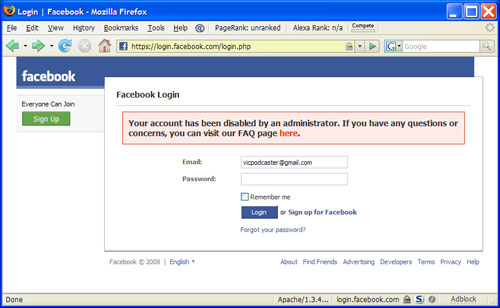
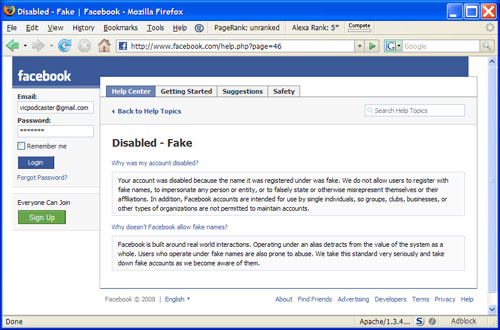
But eight months after opening a Facebook account under his name, Vic Podcaster, Vicky tried to log in to the service last night, to find his account had been disabled, "because the name it was registered under was a fake". Amusingly, this screen is surrounded by a note that "Everyone can join", and doesn't offer any kind of helpful link to challenge the ruling.


In the FriendFeed discussion that ensued after Vicky told everyone he had been banned, the once-banned Robert Scoble said, "Facebook sucks for just this reason.", while Jesse Stay suggested "One thing Facebook does still need to do, but I argue this is a minor thing, is make sure a human is reviewing disabled accounts before they get disabled."

Vicky's clearly not the only person using an alias on Facebook today. My high school acquaintance Bill Parnell is going by the name of Biznill Parnorell. There's even a user who friended me by the name of Daily Contempt. Surely that's not their given name?

I've been giving a lot of thought of late to the migration away from nicknames and more toward real names, especially as people are taking ownership of their blog posts, microupdates and comments across the Web. In most cases, users of apps like Facebook and FriendFeed are using their own given names, first and last, unless the user name is already taken. Facebook clearly didn't like Vic's changing his name to "Vic Podcaster", although LinkedIn, Twitter, FriendFeed and GMail had no problems with it. But what constitutes fake? If Robert Scoble changed his login to Robert Scobleizer, would he be banned again? And while Michael Arrington uses his real name on Facebook, its the TechCrunch brand he's aligned with on Twitter. What if he went by Michael TechCrunch on Facebook? Grounds for banning?


Vic Podcaster Still Lives On LinkedIn

Aliases aren't the only reason you can get banned from Facebook, of course. Scoble was banned for using an early version of Plaxo software, and many have been banned for spam-like behavior. Alex Hammer, who I've written about before, e-mailed me three weeks ago, saying, "I'm working to get reinstated back into Facebook because I added too many friends too quickly." In their defense, he adds, he was warned.

So who's right here? Is Facebook wrong to stop people from using aliases, or are the other sites that have more permissive rules the ones who are making the mistake? Should Facebook have waited eight full months before banning Vicky? Couldn't they tell by his activity on the site that he's a real person with real connections? It seems to me at the very least, a human should have reached out to him and offered a way to change his last name to get it within guidelines.