
The one thing that change always promises to bring is more change. And bringing twins into our household has definitely had an impact - changing how we manage our time, our sleep, our travels, and our activities. Now that Matthew and Sarah are seven weeks old, and with my being back at work for three full weeks, we have something resembling a routine. While I had always kidded that adding to newborns to the family would be "mildly disruptive", there has certainly been an impact to what I've been able to do with tech, both online and offline, since they arrived.
1. Whatever I'm Doing Has to Be Able to Stop At Any TimeSo far, I haven't been able to teach Matthew or Sarah how to use an alarm clock, or how to make requests using a pad or paper, let alone e-mail. This means that their best way of requesting attention is crying, and I, or my wife, have to be on alert at all times. This means, for example, that I can't participate in any online gaming, even if it's as simple as hearts or cribbage, because I'd never know when I'd have to bail, and therefore, concede. Whatever I'm doing has to have the ability to be paused, or closed, without impacting somebody else.
2. I'm Not Getting Nearly As Much Online Activity Done In the MorningPrior to having kids, I could spend a good hour answering e-mail, reading feeds, and getting caught up on the social networks before getting ready to head into the office. Now, that option is clearly gone, as I'm more likely to be awakened by someone who is hungry or needs attention than by my alarm clock. That activity now usually has to take place once they're taken care of and I've driven to the office, leaving my poor wife behind to fend for herself with a pair of ungrateful infants.
3. Scheduling Time for Evening Conference Calls Is A Lot HarderAs I don't typically wait around for press releases to hit my in box to write a story, most of my posts about new technology comes from engaging with developers early, trading e-mail, chatting on
Google Talk, or taking a phone call. Now, while my intentions may be to take a call and get updated, it's absolutely likely that call will land in the middle of my feeding somebody, or our phone call could be interrupted by crying. So far, Sarah and Matthew have made their voices heard to Travis Parsons of
Browzmi, Eric Marcoullier of
Gnip and
ReadBurner's Drew Olanoff, to name a few.
4. My iPod Touch Usage Has Gone Way UpWith the addition of the
iPod Touch's 2.0 software, the product became much more useful - due to the push e-mail capability, Exchange integration, and of course, all the new applications. But the iPod Touch also has another advantage - stealth use, and one-handed browsing. It's not uncommon these days to be flat on my back with a kid resting on my chest, or sitting up and holding a bottle. This effectively eliminates my use of the laptop, but a WiFi-connected iPod Touch is a great backup plan to read e-mail, browse
FriendFeed, access Safari bookmarks, and update
Twitter. An added bonus? I can turn off the sound, so using the keyboard is completely silent - again, totally unachievable on the laptop.
5. Backing Up My Data Is Now More Important Than EverDespite having much of my life online, I've never been all that great at backing it up. I used to back up my mail and personal docs, or have an archive of company data, on a previous-generation iPod, and also used Apple's Backup program that came with .Mac. But my false sense of security went away a few years ago, when I stupidly left my iPod in the seat pocket on a plane between Chicago and Baltimore, never getting it back. So that wasn't good. Also, as my primary storage space (my laptop) has gone through its share of bumps and bruises, including getting crushed in a rented convertible this last Spring Training, I know that's not 100% reliable. Over time, as I've moved from machine to machine, I've lost very little, but it's been known to happen.
That said, I've moved our family photos to
SmugMug, relying on the cloud as a backup to my own local storage, I've posted some early videos to YouTube, and I'm looking seriously at
Apple's Time Capsule for home storage backup, because if I lose photos and videos of Matthew and Sarah at this stage, I'll never again get the chance to retake them.
6. My Online Activity Is More Purpose-Based Than Time WastingJeremy Toeman once commented on
FriendFeed that my activity on the service after having kids would never again approach the level it was prior to having kids. And while in the first few weeks after Matthew and Sarah came, I kept the same pace, if not increasing it, returning to the office and having that time eat into my schedule has probably made his prophecy true. While I'm still reading the same number of RSS feeds in
Google Reader, still keep the blog updated, and still scan FriendFeed,
Social Median and
Twitter, I'm likely engaging in less idle chit chat and arbitrary "liking", which makes my statistics lower than before.
7. I've Dusted Off the Camera In a Big WayI don't pepper the blog with photos of myself or my wife all that often, as I've never been much of a photographer, and quite honestly, I want the blog to be more about what I'm observing and thinking than my daily doings. I've also kept my wife's visibility low for her privacy. As a high school teacher, she doesn't exactly want her nosy students knowing her every move. That said, the twins are a lot more photogenic than either of us, and so far, friends online have really eaten up the pictures, so I'm rarely too far from our camera. And after seven weeks, I finally got Matthew and Sarah on video, and
posted to YouTube. Videos of them should get more prominent going forward.
8. The Online Social Circle Is Seeing ChangeWhereas previously, I would consider single guys or newlyweds my peers, I'm having a lot more opportunity to share stories and jokes with Web-savvy moms and dads who are similarly managing their time. I'm now talking a lot more with parent pals like
Cyndy Aleo-Carreira and
Carla Thompson or
Jesse Stay and
Jeremy Neal. Even uber-blogger
Robert Scoble and I are probably talking as much about kids' weights and behaviors as we are debating social network behavior.
9. Blog Posts Often Get InterruptedWhile I can still, on occasion, sit down and power through a post in 20 minutes or so, it's now just as likely that it will take two or three stops at the laptop to get some of the longer ones done, especially if screenshots or reviews are needed. This means a lot of saving, re-reading what I had started, and posting when I can, not exactly when I wanted to. I've even told people who want stories embargoed, when I do go that route, to get me the data well ahead of time so I can plan better.
10. No More Leaving the Cell Phone In the Other RoomIf you have young kids, you know that the last thing you want to do is wake them up after some serious effort to get them to bed. That means better management of potential noise is required. Now, I can no longer casually put my cell phone down, with my keys and wallet, and walk away. Instead, I need to cart it, and the handset for our landline, with me whenever I've got the kids, or if they are sleeping, to avoid prolonged ringing and unnecessary wake-ups.
I knew having kids would be more than "mildly disruptive", and any disruptions so far have been far outweighed by the many benefits of being a father, for sure. But I know that having crossed that chasm means that how I used to operate online is never going to be exactly the same. It should be fun to keep watching as Matthew and Sarah get to 6 months, a year, 2 years and beyond, to find out what activities stay, and which go. Change always begets more change, and I know more change is coming.
 Fav.or.it, which is attempting to bring RSS to the masses, has recently been under fire from people like Duncan Riley of the Inquisitr and Mark Hopkins of Mashable for essentially republishing full feeds of blogs, with integrated comments, alongside advertising.
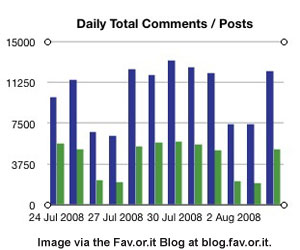 An initial post by Nick Halstead, titled "Blogosphere Commenting Statistics", shows an average of 13,000 comments per day coming into the system, and unsurprisingly, that number dives down to just over half on the weekends. And while he only offers three examples: TechCrunch, Mashable and ChrisBrogan.com, it looks like the more intimate feel and participation of Chris leads to a higher level of repeat commenters than do the blog networks.
 Before
 But while ReadBurner and RSSmeme were gaining traction outside the walled garden of Facebook, and gathering a good deal of visibility from bloggers who liked their democratized view of finding "hot" stories, Feedheads remained less visible, available only on Facebook. That all changed tonight, as Romero has brought Feedheads to
  You can even log in with your Facebook credentials and see your own sharing history, at
  The
The